Screen-Free Gift Ideas for Toddlers That Get Played With
The best screen-free gift for a toddler is one that starts a game with you. Blocks, books, dressing-up clothes, paper and paint, a simple puzzle: they all work because a grown-up sits down and plays alongside the child. We built Mooshie around that idea. Each day it gives you one short game, chosen for your child’s age and stage, using things already in your house, so a gift (or its box) turns into play the same afternoon.
Below you will find gift ideas grouped by what they help your toddler practise, the safety checks that matter in the UK, and simple ways to make sure the present is still being played with in February.
TL;DR
- Choose open-ended gifts (blocks, art supplies, dressing-up, books) that a toddler can use in many ways as they grow.
- Check the age label, the safety mark and any “not suitable under 36 months” warning before you buy anything for a child under 3.
- A toddler learns more from you than from any toy, so pick things you can play with together.
- The box, the wrapping and the contents of your recycling bin make good presents too.
- Our app gives you one screen-free game a day, with the words to say, so the gift becomes shared play.
Table of Contents
- What makes a gift screen-free and right for a toddler
- Screen-free gift ideas by what they build
- Safety checks before you buy for a child under 3
- Gifts that cost almost nothing
- Making the gift a game, not a lesson
- Gift ideas by age
- Our view: the gift is the start of the game
- Turn every present into a game with Mooshie
- FAQ
- Sources
What makes a gift screen-free and right for a toddler
Screen-free means the toy works without a display: no tablet, no light-up screen, no app the child taps. That is a useful rule for a busy house, because the NHS advises limiting a toddler’s daily screen time, knowing what they watch and watching together so you can talk about it.
Local NHS-linked guidance is more specific. Liverpool’s Start for Life advice says to avoid screen time under 2 apart from shared family activities, and to keep 2 to 5-year-olds to about an hour a day, less if possible. It adds that playing and listening to stories help children learn to talk more than TV does.
A screen-free gift also needs to suit the stage your child is at. Toddlers still explore with their hands and mouths, so a good gift has big pieces, simple cause and effect (push it, it moves; stack it, it falls) and survives being dropped, chewed and thrown.
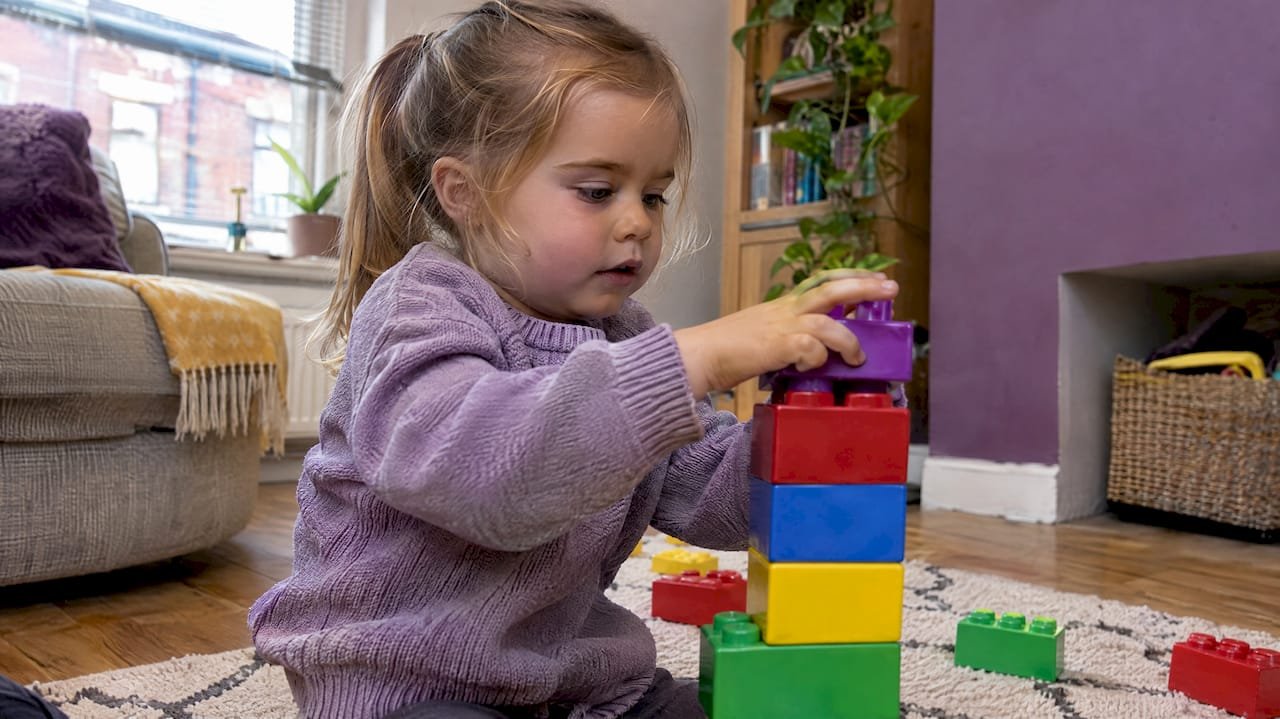
The research on toys backs the “play together” approach. A 2019 paper from the American Academy of Pediatrics says the best toys match a child’s current skills and encourage new ones. It also says the most educational toy is one that fosters supportive interaction between caregiver and child rather than solitary play. Its example is blocks: an 18-month-old stacks them, while a 2-year-old uses them symbolically or builds a bridge. One gift, two stages.
Screen-free gift ideas by what they build
Here are gift types that suit toddlers, grouped by the skill they give your child a chance to practise. Prices for named products change often, so check the retailer before you buy.
| Gift | What it helps with | Good to know |
|---|---|---|
| Large blocks and bricks | Spatial skills, hand control, imagination | Grows with your child from stacking to building |
| Chunky crayons, paint, paper | Creativity, early drawing | Works from around 18 months |
| Dressing-up clothes, doctor or vet set, tea set | Pretend play, new words | Best with a grown-up joining in |
| Sturdy board books | Language, listening, calm time | Survives drops and chewing |
| Simple puzzles | Fine motor skills, problem-solving | Choose big pieces |
| Screen-free audio player | Stories and songs, independence | Child plays audio with a card or figure |
| Playdough, water and sand play | Hand strength, communication | Needs supervision and a tidy-up plan |
Blocks and bricks
If you buy one thing, buy blocks. The Guardian’s May 2026 two-year-old gift guide quotes child psychotherapist Becky Goddard saying large blocks and bricks in different colours are versatile, and that playing alongside your child while talking about colours and asking what they are making is good for spatial and motor skills and imagination.
The same idea appears in the Guardian’s 2025 guide for one-year-olds, where The Childcare Guide’s Hazell points to open-ended toys that can be used in many ways for a long time, and toys that spark conversation between parent and child.
Art supplies
From 18 months, the NHS suggests drawing and painting with crayons, felt tips or powder paint. It also suggests making hand puppets from socks and envelopes, then drawing on them and getting them to talk. A bundle of chunky crayons, a pad of paper and an old apron is a gift that costs very little and gets used straight away.

Pretend play kits
Speech and Language UK recommends dressing-up clothes, doctor or vet sets and tea sets for imaginative play, because talking through the game helps children pick up new words and grow their creativity. These gifts are also lovely for kind, helpful behaviour: a toddler who looks after a poorly teddy is practising care for someone else. For ideas to go with the gift, see our pretend play ideas for toddlers using things at home.
Books
Books and nursery rhymes are the NHS’s own suggestion for building language. A good toddler gift is a sturdy board book with a clear story you will not mind reading forty times. If your child is starting to notice letters and sounds, our guide to early literacy and phonics activities for toddlers shows how to play with them without flashcards.
Screen-free audio players
An audio player lets a child start a story or song by placing a card or figure on it, with no screen involved. The Yoto Player’s UK page describes cards you insert or a Green Button to play audio, parental controls in an app, and suitability for ages 3+, with younger children using it alongside a caregiver. The Guardian’s 2025 guide notes the Toniebox 2 is suitable from one year, and lists My First Tonies sets at £29.99 in 2025. These are a bigger purchase, so they suit a gift the whole family chips in for.
Messy and sensory play
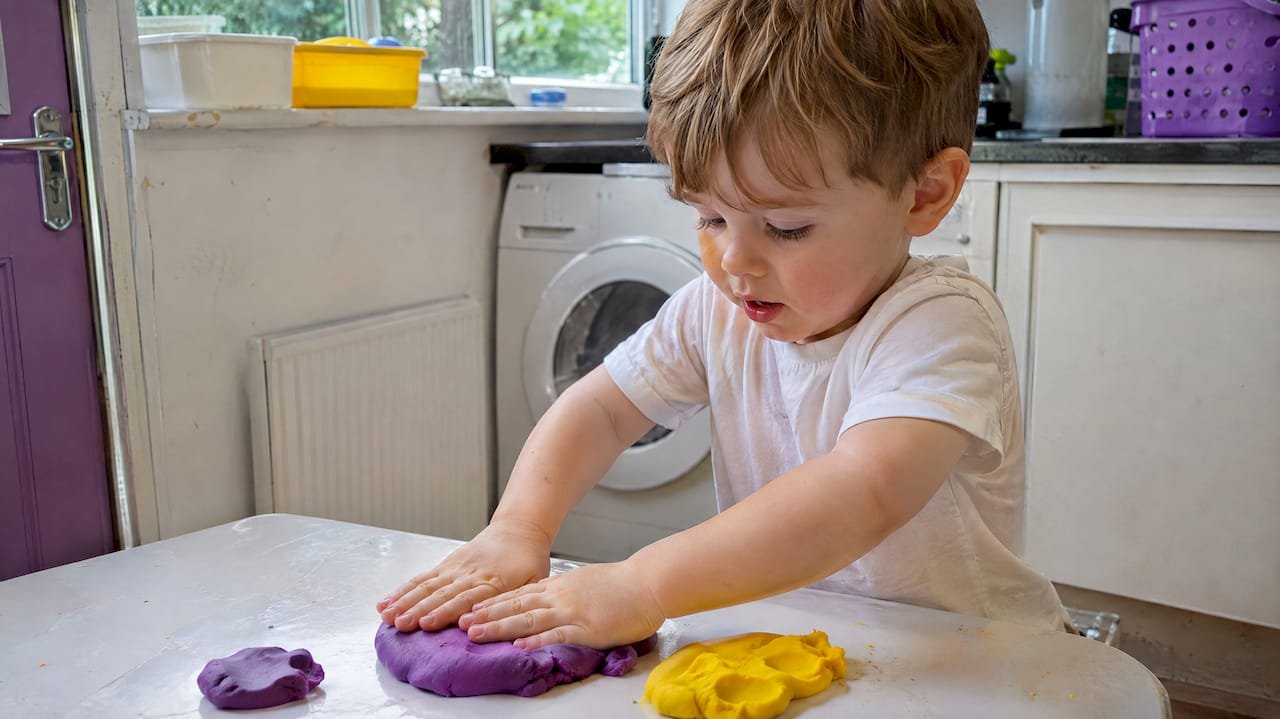
Water, sand, chalkboards, finger paint and playdough all support communication, because they give you words to use: pour, squish, rough, smooth. Speech and Language UK says messy play helps teach action, colour and texture words. For more on hands-on activities and why they matter for development, read this guide to sensory play and child development.
Safety checks before you buy for a child under 3
A gift is only a good gift if it is safe. Work through this list in the shop or before you click “buy”.
- Read the age label. The NHS says never to give a toy marked “Not suitable for children under 36 months” to a child under 3. Under UK law, toys that are not safe for under-3s must say so in words or pictures, according to Nottinghamshire Trading Standards.
- Look for a safety mark. The NHS points to the British Standard kitemark, Lion Mark or CE mark. The Child Accident Prevention Trust explains that the UKCA mark is the manufacturer’s claim of compliance with UK law and the Lion Mark shows the maker belongs to the British Toy and Hobby Association. All marks can be faked, so also use your judgement on very cheap prices.
- Watch for small parts, batteries and magnets. Under-3s are at the biggest risk from button batteries, strong magnets, water beads, long cords and small parts, according to the same charity. Healthier Together adds that accidents most often involve toys made for older children, broken toys and swallowed small items such as beads, batteries or magnets.
- Choose your seller carefully. The charity recommends well-known brands and retailers for under-3s, and notes that sellers on online marketplaces are not required to check third-party toys are safe. Before buying, you can check the gov.uk product recall list, as Nottinghamshire Trading Standards suggests.
- Take care with second-hand toys. Check them physically for wear, modification and missing safety features. Healthier Together also notes that toy libraries are a good option because they lend safe, good-condition toys.
The law behind this is the Toys (Safety) Regulations 2011. It requires the CE marking to be visible, legible and permanent on the toy, a label or the packaging, and it requires toys to be safe when used as intended, bearing in mind how children behave, especially those under 36 months. Warnings must be in English.
A quick example: a game rated 4+ and a puzzle designed for 8+ are both screen-free, but neither is a toddler gift. Hasbro’s Crocodile Dentist is labelled for ages 4 and over, so it is a gift for next year or the year after, not for a two-year-old.
Gifts that cost almost nothing
You do not need a shopping list to give a toddler a good time. The NHS says play does not need to be difficult or expensive, and that you can use things already lying around the house. It also says a child will learn more from a parent than from any toy.
Just One Norfolk NHS lists boxes, interesting-shaped stones, fabrics, pots and cardboard tubes as things that can fire up imaginative play. For 1 to 2-year-olds it suggests easy puzzles, building blocks, big boxes to hide in and sofa cushions to climb on. If you make a basket of household objects, supervise it and include only things too big to swallow.
From 30 months, the NHS recommends junk modelling: cardboard boxes, cartons, yoghurt pots and bottle tops, glued together into whatever your child likes. We have a full guide to junk modelling for toddlers, and our toilet roll crafts for toddlers page is handy once the wrapping paper tubes pile up.
So here is a gift plan that works for many families: one open-ended present, one book, and the biggest box in the house.
Making the gift a game, not a lesson
Most gifts lose their shine within a week, usually because nobody showed the child how to play with them. A few habits help.
Sit down for ten minutes. The AAP paper notes that the data supporting a developmental role for toys come mostly from studies of children playing with caregivers, not alone. Toys that facilitate imaginative play and problem-solving are most likely to bring a caregiver into the game, while electronic toys are less likely to.
Say what you see. Describe what your child is doing: “You put the red block on top. It’s tall!” That running commentary builds vocabulary without feeling like a lesson. We explain how in our guide to narrating play for your toddler’s language growth, and if you want more on helping your child talk, try our speech and language activities.
Follow their lead. Pedal’s Goodacre, quoted in the Guardian’s 2025 guide, says to let a child play with a toy they have latched onto for as long as they are getting something out of it. If it is the box, it is the box.
Keep it to a few toys at a time. Put some gifts away and bring them out later. A toddler who sees a block set again after a month often plays with it in a new way.
Have a go-to game for the moments in between. Mornings are where many parents run out of ideas, and our morning activities for toddlers are quick enough for the school-run rush. At Christmas, our Christmas activities for toddlers turn the festive mess into play.
Gift ideas by age
12 to 18 months: chunky stacking blocks, board books, a basket of safe household objects (supervised), simple shape sorters. Look at the age grading on everything with pieces.
18 to 30 months: chunky crayons and paper, big blocks, soft toys for caring games, a tea set, hand puppets. This is when pretend play begins to take off.
30 months to 4 years: junk modelling supplies, dressing-up, simple puzzles, playdough, longer picture books. Games with a 4+ label start to become suitable towards the end of this range.
If your child has additional needs, the best gift is still the one that fits how they play. We have guides on activities for toddlers with Down syndrome, autism activities for toddlers and wheelchair-friendly and seated activities.
Our view: the gift is the start of the game
We talk to parents who feel pulled in two directions. They want to cut back on screens, and they also worry about whether their child is getting enough from play. A shelf of toys does not settle that worry. A few minutes of play together does.
That is why Mooshie gives you one short game a day, chosen for your child’s age and stage. It tells you how to play, the exact words to say and what the game is building in your child’s brain. The parent holds the phone and the child never touches it, and the games use things already in the house, so there is nothing to buy.
We want children to grow up thinking well, creating freely, feeling secure, pitching in and being kind. Blocks, crayons and cardboard boxes are all good raw material for that. When you know the game to play and the words to use, a present from Grandma becomes a week of playing together instead of a pile on the floor.
If a relative asks what to buy, tell them something open-ended, safe and age-labelled. Then give them a game to play with it when they visit.
samit
Turn every present into a game with Mooshie
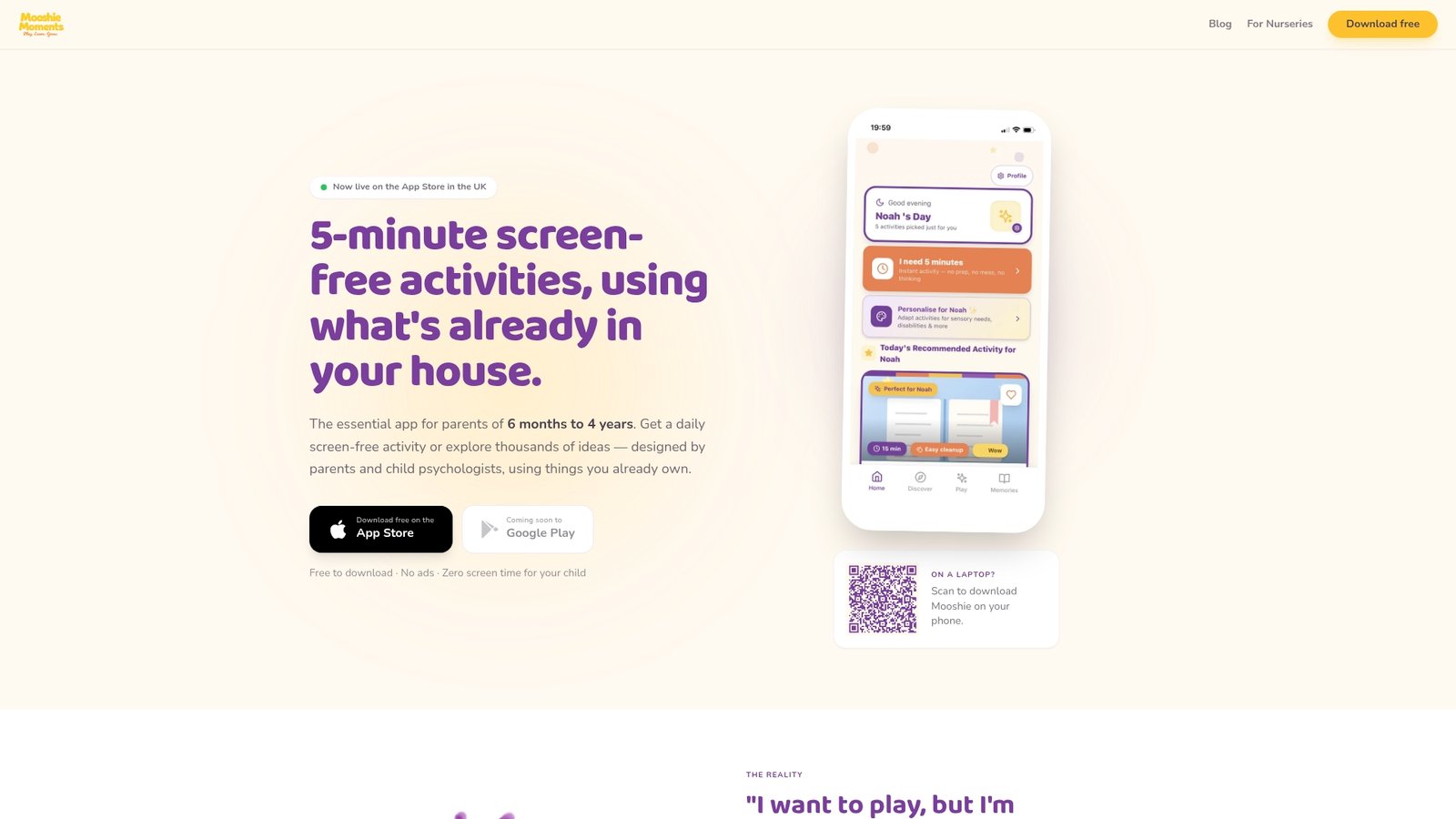
Mooshie is a free-to-download app for parents of children aged 6 months to 4 years. It gives you one short game a day that suits your child’s age and stage, with the words to say and a plain explanation of what it builds. The games use things you already have at home, and your child never touches the phone. If you want to see how it works, take a look at Mooshie.
Running a nursery or early years setting? We also offer a Partnership Pack and home-learning resource for your families.
FAQ
What is the best screen-free gift for a 2-year-old?
Large blocks are a strong choice, because a two-year-old can stack, knock down and begin to build with them, and they stay useful for years. Chunky crayons, a dressing-up item or a sturdy picture book are also good picks. Check the age label and safety mark on anything with pieces.
Are screen-free audio players suitable for toddlers?
They can be a nice gift, since the child starts a story or song with a card or figure rather than a screen. Yoto’s UK site lists its player as suitable for ages 3 and over, with younger children using it alongside a caregiver, and the Guardian’s 2025 guide notes the Toniebox 2 is suitable from one year. Always check the age guidance of the model you are buying.
How do I know a toy is safe for a child under 3?
Look for a UKCA, CE, Lion Mark or kitemark, and for any warning that it is not suitable under 36 months. Be wary of small parts, button batteries and strong magnets. Buy from well-known retailers, because marks can be faked and marketplace sellers are not required to check third-party toys.
What can I give that costs almost nothing?
Cardboard boxes, tubes, fabric scraps and yoghurt pots are all recommended by NHS guidance for imaginative play. Add some child-safe glue and crayons for junk modelling from around 30 months, and you have a present that is also an activity.
How can a gift help my toddler learn without feeling like a lesson?
Play with them and describe what they are doing. Research from the American Academy of Pediatrics suggests the most educational toy is one that encourages interaction between you and your child. Follow their interests, keep the game short and stop when they lose interest.
Sources
- Baby and toddler play ideas, NHS
- Start for Life guidance, Liverpool Family Information & SEND Directory
- Selecting Appropriate Toys for Young Children in the Digital Era, American Academy of Pediatrics
- Best toys and gifts for two-year-olds, The Guardian
- Best toys and gifts for one-year-olds, The Guardian
- Top ten toys, Speech and Language UK
- Yoto Player, UK site
- Safer Shopping: Buying toys, Nottinghamshire Trading Standards
- Toy Safety, Child Accident Prevention Trust
- Toy Safety, Healthier Together (NHS)
- The Toys (Safety) Regulations 2011, legislation.gov.uk
- Crocodile Dentist Game, Hasbro
- Play Ideas, Just One Norfolk NHS
Recommended
- Best Indoor Games for Toddlers: 14 Easy Ideas for Home
- No New Toys Needed: Sensory Play Ideas Parents Can Use With Toddlers
- Toddler Activities With No Supplies: 25 Ideas to Try Now
- Best Boredom Busters for Toddlers: Easy, Screen-Free Ideas
Want play ideas matched to your child's age?
Mooshie Moments gives you simple, guided play ideas for ages 6 months to 4 years. Try 3 free activities a week.
Download free on the App StorePart of our guide: Screen-free activities · Compare toddler activity apps
More like this
Best Indoor Games for Toddlers: 14 Easy Ideas for Home
The best indoor games for toddlers, using things you already own: active, pretend and quiet ideas, age tweaks, safety checks and how…
Small Space Toddler Activities: 15 Ideas for Any Room
Small space toddler activities that need no shopping and little setup: 15 ideas for flats and tiny living rooms, with safety tips…
10 Minute Toddler Activities Using Things You Already Own
Ten quick, screen-free toddler activities for UK parents. Each takes about 10 minutes, uses household items, and comes with age tweaks and…