
Small Space Toddler Activities: 15 Ideas for Any Room
You don’t need a playroom to give a toddler a good play session. A doorway, a patch of floor, a kitchen table and a few things from your cupboards are enough for balancing, sorting, pretend play, music and sensory fun. Below are 15 small space toddler activities we like, grouped by how much effort they take from you, plus the safety checks that matter more when walls and furniture are close.
TL;DR
- Most of the best small-space play needs two minutes of setup or none: a doorway, a muffin tin, a roll of tape, a cardboard box.
- Pick by your energy first and the toddler’s age second. Five minutes of fully engaged play is plenty.
- In a small room, check corners, furniture and hard floors before any movement game, and keep small objects out of reach.
- Every idea here can be shrunk for a baby or stretched for a four-year-old.
- Quality beats quantity: short, screen-free sessions where you watch, comment and join in count.
Table of Contents
- What makes an activity work in a small space
- Zero-setup activities (no prep at all)
- Two-minute setups
- Quiet and low-mess ideas
- Quick comparison: space, setup and mess
- Adapting for a baby, a one-year-old and a four-year-old
- Safety in a small room
- Getting enough movement without a big room
- When you’re tired or short on time
- Why small-space play still counts
- Our perspective
- Mooshie: quick ideas for the room you have
- FAQ
- Sources
What makes an activity work in a small space
A small space changes three things: how far a toddler can move, how much can be left out, and how quickly a mess takes over the room. So the activities that work best share a few traits.
- Small footprint. They happen on a lap, a table, a fridge door, a tray or a few feet of floor.
- Tiny setup. If it takes more than a few minutes to prepare, it rarely happens on a tired day.
- Easy reset. One box or tray holds everything, so tidying takes a minute.
- Everyday items. Official UK health advice for toddlers leans on household things such as pots and pans, cushions, books and blocks for stacking, and sheets for dens. Action for Children also says you don’t need lots of toys or equipment for fun activities at home.
It also helps to know that you don’t have to fill the time. A realistic target is a short burst of happy play, and toddlers are not meant to concentrate for long. If you want a wider bank of ideas by time, our page of quick toddler activities for 5 to 30 minutes is a good next stop.
Zero-setup activities (no prep at all)
These are for the moments when you are standing in the kitchen and need something now.
1. Doorway freeze dance
Play a song, dance in the doorway or on one clear spot, and stop the music so everyone freezes. It needs no setup and almost no room. Toddler Preschool lists it as suitable from about 12 months. For a baby, hold them and sway, then pause and whisper.
2. Fridge or cookie-sheet magnet play
Let your toddler stick magnets on the fridge door or on a baking tray on the table. They can sort by color, make a line or hand you the ones you name. It works for roughly 18 months and up. Choose magnets too big to fit in a mouth (see the safety section below).
3. Kitchen drummer
Give your toddler safe, shatter-proof bowls and wooden spoons. UNICEF suggests this for toddlers aged 1 to 2 and says it helps develop fine-motor skills. Try loud and quiet, fast and slow, and copy each other’s beats.
4. Describe-the-room explore
Let your toddler pick up safe objects around the room while you name them: soft, hard, round, heavy. The BBC’s Tiny Happy People team lists this among low-energy ideas for tired parents. It builds vocabulary and costs you almost nothing.
Two-minute setups
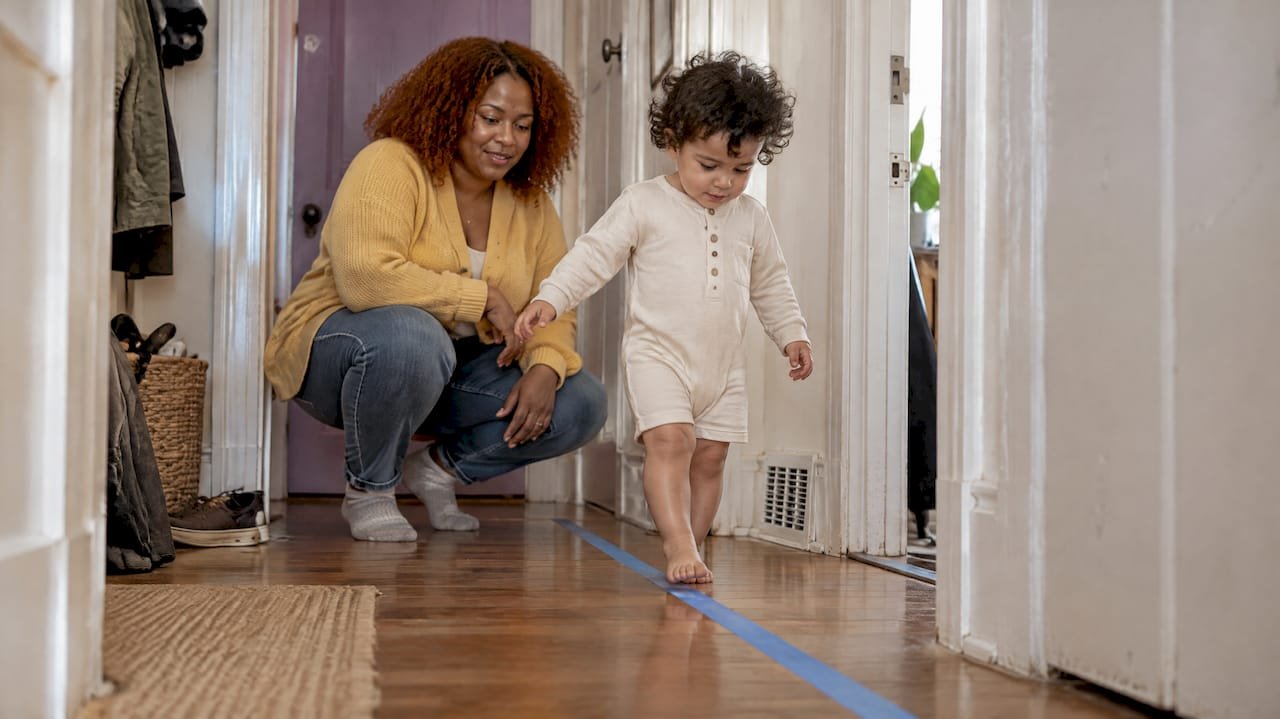
5. Painter’s tape balance line
Stick a strip of painter’s tape on the floor and let your toddler walk along it. A few feet of open floor is enough, and Toddler Preschool puts it at about 18 months to 3.5 years. Younger walkers can walk beside you holding a finger. Older ones can tiptoe, walk backward or carry a soft toy on their head.
6. Muffin tin sort
Put a few safe items in a muffin tin and let your toddler sort them by color or size. Mother.ly describes this for ages 1 to 4 with a two-minute setup, and notes that it builds fine motor skills and early math ideas. Use pasta shapes only for a child who no longer mouths everything, and stay close. Pom-pom style items or large wooden blocks are safer for younger toddlers.
7. Cushion tower and crash
Build a tower from cushions, books or blocks. The same NHS service lists building and stacking among its ideas for 1 to 3 year olds. Knocking it over is half the fun, and it takes up a square meter of floor.
8. Sheet den
Drape a sheet over two chairs or the sofa and add a blanket and a book. A den turns a corner into a separate place, which is handy when you have only one room. The NHS service above also suggests dens made from sheets, cushions and blankets.
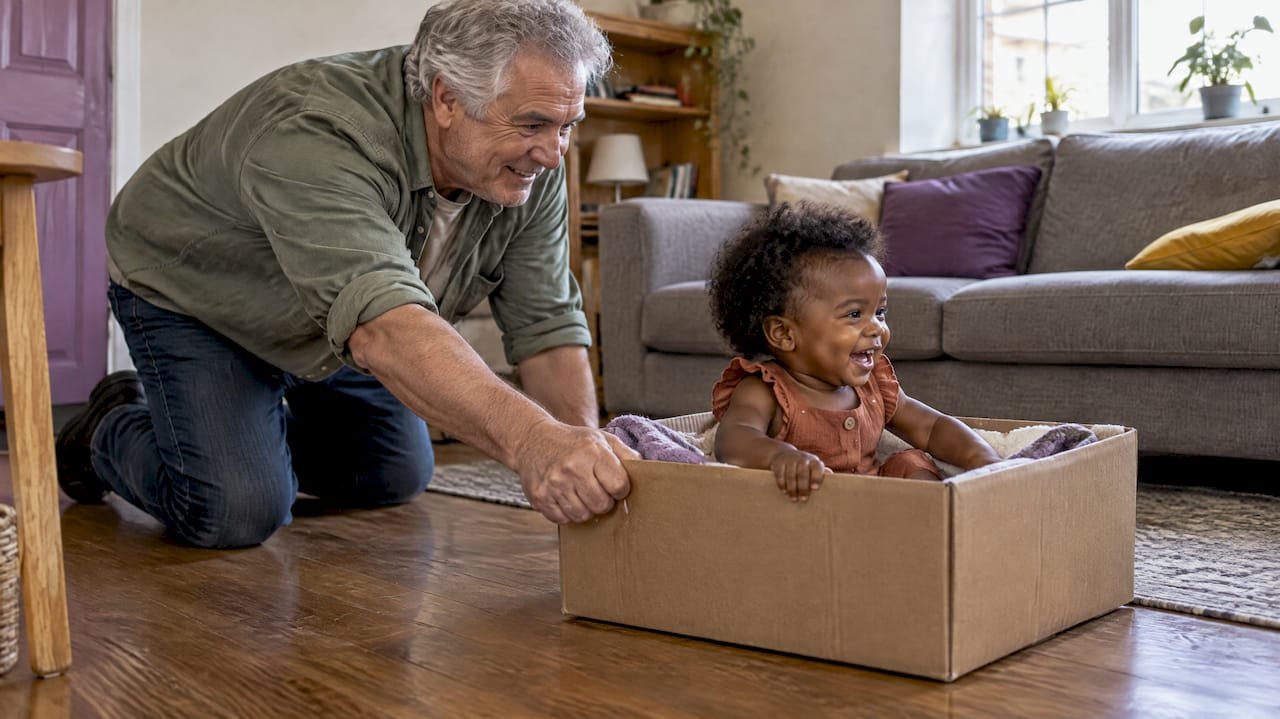
9. Box car
Put a toddler aged 1 to 2 in an empty box with soft blankets and pull it gently from side to side. UNICEF says this works even in limited space because you move the box side to side. Keep the movements slow and keep your hand on the box.
Quiet and low-mess ideas
10. Busy page on your lap
A book with flaps, a cloth book or a sheet of stickers needs no setup and no table. It suits a lap or small table and creates no mess.
11. Posting and threading
Post large lids through a slot in a box, or thread big pasta tubes onto a shoelace once your toddler is ready for it. These are good for the quieter moments when a toddler is calm but bored. For more hand-skill ideas, see our guide to fine motor activities for toddlers and preschoolers.
12. Bubbles on the balcony or by the window
Bubbles are easy to scale. Action for Children notes that babies may enjoy feeling bubbles pop on their skin, while toddlers chase and pop them. The BBC also lists bubbles as a low-energy option for tired parents.
13. Washing-up bowl water play
Put a bowl on a towel on the kitchen floor, add a cup and a few toys to wash. The NHS service suggests a washing-up bowl for cleaning toys, though it describes it outdoors. Indoors, a towel underneath keeps cleanup to a minute. Never leave a child alone with water, even a shallow bowl.
14. Potato stamps
Cut a potato in half (an adult job, since sharp tools are for adults only) and let your toddler stamp with a little washable paint. For a small kitchen, Islington Council suggests a mess-proof area from taped-down bin bags, newspaper or a wipeable tablecloth.
15. Pretend bedtime for Teddy
Put a soft toy to bed with a blanket, a lullaby and a cuddle. It is on the BBC’s list of low-energy ideas, and it grows into storytelling and role play as your child gets older. If you’re curious about why this kind of make-believe matters, there is a good read on pretend play in toddlers.
Quick comparison: space, setup and mess
| Activity | Space needed | Setup | Mess |
|---|---|---|---|
| Doorway freeze dance | One doorway or clear spot | None | None |
| Magnet play | Fridge or small table | None | None |
| Kitchen drummer | Floor or lap | 1 minute | None |
| Tape balance line | A few feet of floor | 2 minutes | None |
| Muffin tin sort | Lap or small table | 2 minutes | Low |
| Cushion tower | One square meter | 1 minute | None |
| Sheet den | Corner of a room | 3 minutes | None |
| Water bowl play | Kitchen floor with towel | 3 minutes | Medium |
| Potato stamps | Kitchen table | 5 minutes | Medium |
Space and setup for the first, second, fifth and tape-line activities come from Toddler Preschool’s list. The others are our own estimates from the way these games usually run.
Adapting for a baby, a one-year-old and a four-year-old
The same item can serve several ages if you change what you ask of your child.
- Around 6 to 12 months: Keep play close and sensory. Let them touch, mouth (safe items only) and watch. Sing, sway and describe. Put a few safe objects within reach on a blanket.
- 1 to 2 years: Add simple actions such as pulling, posting, stacking, banging and cruising along furniture. Short sessions work best.
- 2 to 3 years: Add sorting, patterns, pretend play and simple rules, such as freeze and go.
- 3 to 4 years: Add choices and small challenges. Ask them to make a path with the tape, or to sort by two things at once.
A good guide for hand skills comes from the NHS Wirral occupational therapy team: start with things your child can do with ease to build confidence, then grade the difficulty as their skill grows. The same advice warns that pushing a skill your child isn’t ready for can lead to frustration and reduced self-esteem. If you’d like to see how hand and wrist control develops in more detail, this piece on hand and wrist control is worth a look.
For older toddlers who like a challenge, our ideas for problem solving activities using things at home stretch the same household items further.
Safety in a small room
Small rooms put hazards closer. A few checks before you start:
- Look at corners and furniture. Toddler Preschool points out that furniture, doorframes and hard floors are often closer in a small room, so check for sharp corners or unstable furniture before active games.
- Check for choking hazards. The NHS says babies and toddlers are most at risk because they explore with their mouths, and advises keeping small balls under 4.45 cm across, deflated balloons and button batteries out of reach. Another NHS trust says that anything smaller than a 2p coin can choke a baby or young child.
- Cut small foods. ROSPA advises cutting grapes, cherry tomatoes and other small soft fruit into quarters, and keeping marbles, peanuts and small toys away from children under three.
- Stay close. Islington Council says under-5s should be supervised throughout all activities. Action for Children also asks you to watch for small parts, sharp items and anything that could go in the mouth.
If you want a full room check before an active game, our indoor obstacle course page has a section on getting the room ready and keeping play safe.
Getting enough movement without a big room
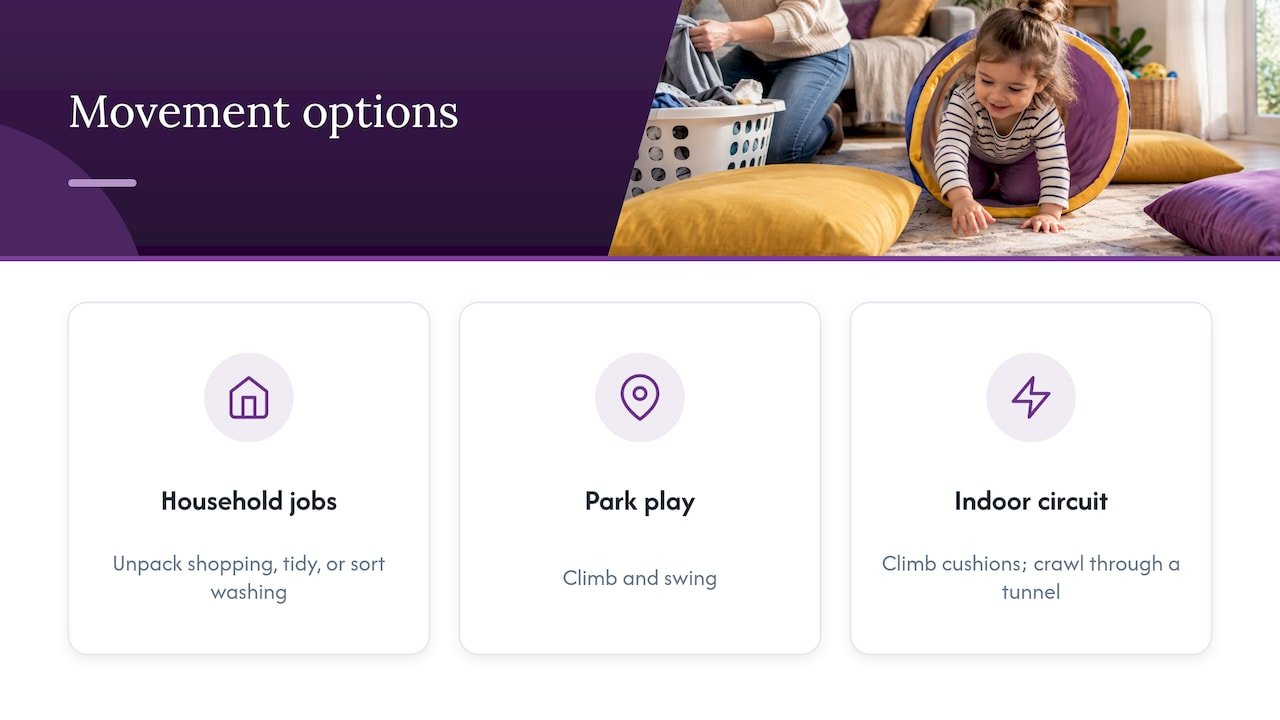
A small flat doesn’t mean your toddler can’t move. The NHS advises that once a child is walking, they should be active for at least 180 minutes a day, spread across the day. It also suggests involving them in household jobs such as unpacking shopping, tidying or sorting washing, and getting out to the park to climb and swing.
So a freeze dance, a tape line and a trip to the park all add up. When the weather is bad, a short indoor circuit of cushions to climb over and a tunnel to crawl through uses a single corridor. We cover this in our 10 minute indoor obstacle course, which uses things you already own.
When you’re tired or short on time
This is the part nobody puts in the activity list. Some days you have nothing left.
- Aim for five minutes. Action for Children says five minutes of fully engaged play can be more meaningful than forcing a long session, and that watching and commenting on your child’s play counts too.
- Use a timer. The same charity suggests telling your child that when the timer goes off, you will play, which helps them learn to wait.
- Read the signals. A speech and language therapist quoted by the BBC says that grouchiness is often tiredness, and that a cuddle and a book can be better than a new game.
- Give a starting point, not a full show. Set up one idea, sit nearby and let your toddler lead. Independent play matters too, and you can encourage it by setting up an activity and staying nearby.
For more ways to connect in a few minutes, see our bonding activities for toddlers.
Why small-space play still counts
Simple play at home isn’t a lesser version of a proper outing. Islington Council says sensory play helps under-5s learn through exploration and develop speech, language, motor and problem-solving skills. Shropshire Council notes that play stimulates language and cognitive development. And you are the main ingredient. Sitting on the floor beside your toddler, even in a tiny room, is the bonding.
Our perspective
Most parents we talk to don’t lack love or ideas in theory. They lack energy, time and a spare brain cell at 4pm. And when the flat is small, it feels like the options shrink too.
That’s why we built Mooshie around what you already have. You tell us your child’s age, how much time you have and how much energy is left, and we suggest an activity that uses things from your own cupboards. Every activity explains the developmental reason in plain language, so you know what a muffin tin or a roll of tape is doing for your child.
We think play works best when it is quick, screen-free and shared. A small room is not a barrier to that. It just means we choose the right idea, and we make it easy to pick one fast.
samit
Mooshie: quick ideas for the room you have
If you’d like these ideas to come to you instead of searching each time, Mooshie is our app for parents and caregivers of children aged 6 months to 4 years. It suggests quick, screen-free activities that use common household items, personalized by your child’s age, your available time and your energy level. Each one has an expert-reviewed explanation and coaching tips. Take a look at Mooshie.
Working in a nursery, daycare or childminding setting? We also offer activities and resources for nurseries and early years settings.
FAQ
What are the best toddler activities for a small flat?
The best ones need little setup and little floor: doorway freeze dance, magnet play on the fridge, a tape balance line, a muffin tin sort and a sheet den. All of them use things you already own and reset in a minute or two.
How long should a toddler activity last?
Short is normal. Action for Children says there is no single rule for how often or how long you should play and that quality matters more than set amounts. Five focused minutes can be enough, and many toddlers move on after a few more.
How do I keep a toddler busy while I cook?
Give a starting point that suits the kitchen: the kitchen drummer set, a bowl of water on a towel or a muffin tin to sort. Stay within sight and arm’s reach, and keep sharp tools and hot items well away. Involving your child in small jobs like sorting washing or unpacking shopping is also recommended by the NHS.
Can I use the same activities for a baby and a toddler?
Often yes, with changes. A baby can feel, watch and listen while a toddler pulls, stacks, sorts or pretends. Action for Children gives bubbles as an example: babies enjoy feeling them pop on their skin, while toddlers chase them. Always supervise and remove small items from reach of a baby.
Sources
- Play ideas for your toddler (Derbyshire Family Health Service, NHS)
- Activity ideas for toddlers (Action for Children)
- 20 Indoor Toddler Activities for Small Spaces (Toddler Preschool)
- Indoor play ideas to stimulate young children at home (UNICEF)
- Tired parents (BBC Tiny Happy People)
- Easy screen-free activities for toddlers (Mother.ly)
- Sensory activities to try at home with under 5s (Islington Council)
- What is sensory play and why is it important? (Action for Children)
- Fine motor activities advice (Wirral University Teaching Hospital, NHS)
- Safety: preventing choking (Better Lives Healthy Futures, NHS)
- Toy safety (Cambridgeshire and Peterborough children’s health, NHS)
- Home safety chart (ROSPA)
- How to keep your baby or toddler active (NHS)
- Playing with your child (Action for Children)
- Working with under 2s know-how guide (Shropshire Council)
- The role of pretend play development in toddlers
- The role of abacus in developing fine motor skills
Recommended
- Low Prep Toddler Activities by Skill Area in 2–15 Minutes
- Quick Toddler Activities for UK Parents
- Low Energy Toddler Activities for Sofa Days
- Cardboard Box Toddler Activities: 12 Ideas by Age
Want play ideas matched to your child's age?
Mooshie Moments gives you simple, guided play ideas for ages 6 months to 4 years. Try 3 free activities a week.
Download free on the App StoreMore like this

Best Indoor Games for Toddlers: 14 Easy Ideas for Home
The best indoor games for toddlers, using things you already own: active, pretend and quiet ideas, age tweaks, safety checks and how…
Toddler Activity Schedule: A Realistic Day That Works
A simple toddler activity schedule for ages 1 to 4: sample days, short play blocks, nap timing, winter tweaks and screen-free ideas…

10 Minute Toddler Activities Using Things You Already Own
Ten quick, screen-free toddler activities for UK parents. Each takes about 10 minutes, uses household items, and comes with age tweaks and…