Problem Solving Activities for Toddlers Using Things at Home
You don’t need a shop-bought kit to help your toddler think things through. A colander, a few socks, a cardboard box and a bit of patience are enough. The best problem solving activities for toddlers are small puzzles that appear in ordinary play: how do I get this lid off, how do I fit through this tunnel, which sock goes with this one? Below we share ideas for each room of the house, how to adjust them for different ages, and how to help without taking over.
TL;DR
- Toddler problem solving grows through hands-on play: pouring, building, sorting, climbing, fitting and matching.
- Everyday items such as plastic bottles, spoons, cushions, socks and cardboard boxes make good puzzles at no cost.
- Let your child lead, ask a question instead of giving the answer, and be happy with messy attempts.
- Always supervise water, craft and small-part play, and check for cords, strings and choking hazards first.
- Adjust each activity to your child’s age: babies explore, 1-year-olds experiment, 2 to 4-year-olds plan and pretend.
Table of Contents
- What problem solving looks like for a toddler
- Kitchen activities that get little brains working
- Living room activities: building, crawling and fitting
- Table-top play: playdough and small hands
- Turning daily routines into problem solving
- Activities by age
- Outdoor and seasonal ideas
- How to help without taking over
- Our perspective on problem solving play
- Staying safe during household play
- Find your next idea with Mooshie
- FAQ
- Sources
What problem solving looks like for a toddler
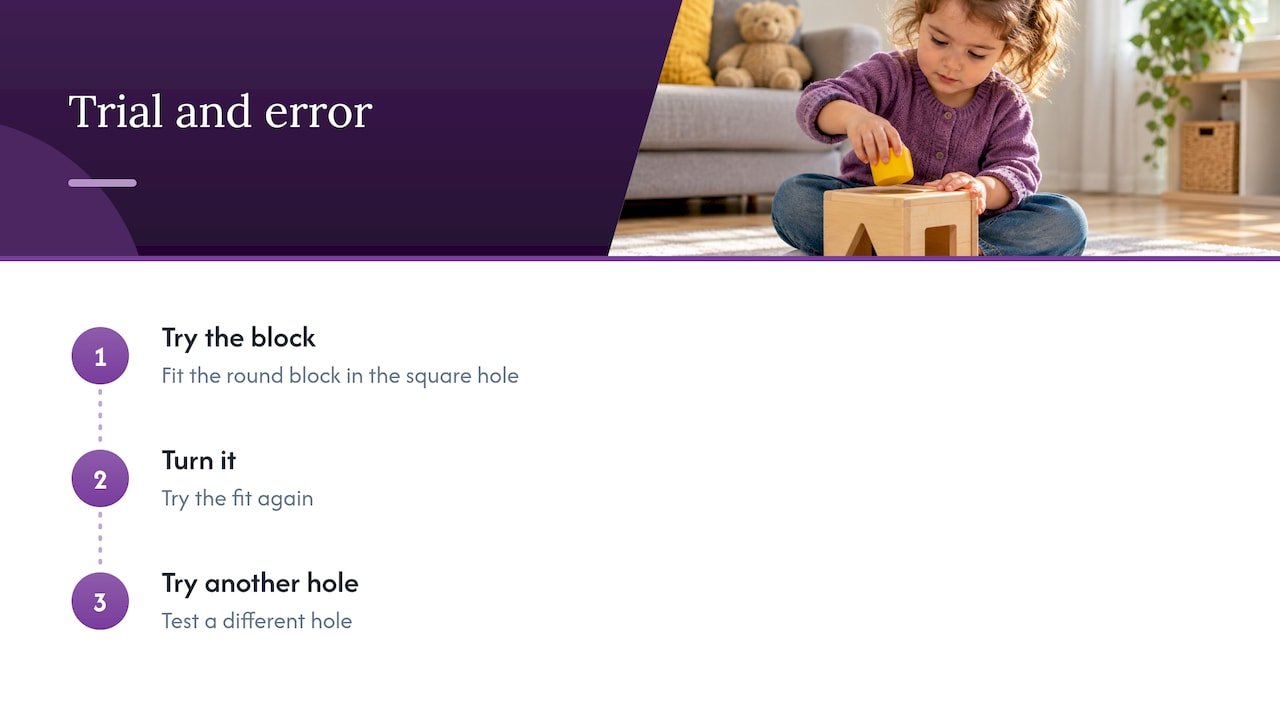
When we say problem solving, we don’t mean worksheets or logic games. For a toddler it looks like trying the round block in the square hole again, then turning it, then trying a different hole. It looks like pushing a chair to reach a shelf (which, yes, needs watching). It looks like figuring out that the big spoon won’t fit in the small cup.
This kind of trial and error is the point. Your child is testing ideas, noticing what happens and trying again. That’s real thinking, and it happens most easily when play is relaxed and your child is in charge of the direction.
The good news for tired parents is that you can set up most of these moments in under five minutes, and often in under one. If you want more ideas sorted by skill and time, our low prep toddler activities by skill area page is a handy place to browse.
Kitchen activities that get little brains working
The kitchen is full of safe, interesting objects, and toddlers love anything grown-ups use.
Pouring, scooping and squirting
Water play is a classic problem solving setup. The NHS suggests plastic bottles for pouring and squirting, plastic tubing, a sponge, a colander, straws, a funnel and spoons. Each one poses a question. Why does the water stream out of the colander but stay in the cup? What happens when the funnel is held higher? How many scoops fill the bottle?
You don’t need to answer any of those questions. Just put the items out, sit nearby and watch. For more setups, see our water play ideas for babies and toddlers.
Pasta, lids and containers
Give your toddler a drawer or basket of plastic tubs and matching lids. Finding which lid fits which tub is a proper puzzle, and it’s quiet enough to do while you make a cup of tea. Dry pasta shapes and a bowl with a spoon add scooping, filling and transferring. Our pasta play ideas and safety rules cover how to set this up with younger children who still put things in their mouths.
Setting the table
The Everyday STEM Talk guide from a US university early childhood center suggests using daily routines to explore sequences and patterns, and posing problems such as working out what is needed to set the table or what order to follow in a recipe. With a toddler, that can be as simple as: “We have three people. How many spoons do we need?” Let them walk the spoons over one at a time. If they get it wrong, nothing is lost.
Living room activities: building, crawling and fitting
Forts, tunnels and obstacle courses
Blankets, cushions, chairs and cardboard boxes turn a lounge into a thinking space. A US early learning organization lists blanket forts, cardboard-box tunnels and obstacle courses made with cushions, chairs and sheets as good ways to use household objects as toys.
Here is why they work. To build a fort, your child has to work out how to make a roof stay up. To get through a tunnel, they have to judge whether their body fits. On an obstacle course they plan their route: over, under or around?
Try this:
- Lay two or three cushions in a line on the floor.
- Drape a sheet over two chairs to make a low tunnel.
- Put a favorite soft toy at the end.
- Say, “Teddy is stuck. How can we get to him?” Then wait.
If the sheet keeps falling, resist fixing it straight away. Ask, “What could hold it down?” A book on the corner is a discovery your child made, which feels very different from one you handed over.
Puzzles and shape fitting
Simple puzzles are one of the most reliable options. Action for Children notes that simple puzzles help build problem-solving skills and concentration. You can also make your own: cut a cardboard box flat, draw a big circle, square and triangle and let your child match household lids or blocks to the shapes.
Dressing up and puppets
Pretend play is full of problems to solve: what does the shopkeeper need, how do we carry all this shopping, who is the puppet talking to? The NHS suggests using socks and envelopes to make hand puppets and collecting old hats, bags and curtains for dressing up. Check that nothing has loose cords, strings or ribbons that could wrap around your child’s neck or trip them.
Table-top play: playdough and small hands
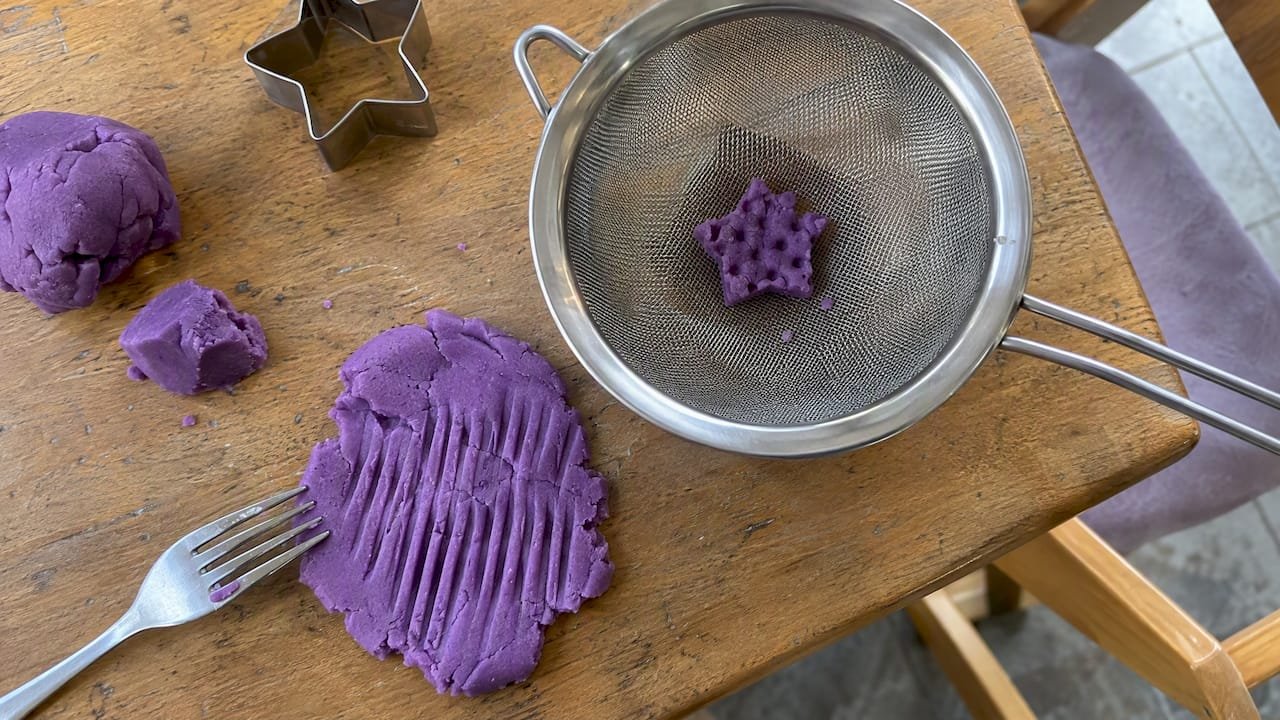
Playdough is cheap, forgiving and endlessly open ended. Action for Children’s fine motor activity guide suggests children can explore dough with cookie cutters, rolling pins, strainers, forks, animals, blocks and art materials such as buttons, pipe cleaners and straws. The same guide says exploring playdough helps build the muscles in children’s hands and wrists, supporting control for everyday tasks such as using zippers, pens, pencils and scissors.
The problem solving comes from questions your child asks with their hands. Can I push this fork all the way through? How do I get the dough out of the strainer? What shape will I make with this cutter if I press harder?
For children aged 24 months and up, the same guide says using scissors to cut playdough is an introduction to cutting something thicker than paper. Stay close, use child-safe scissors and keep small items like buttons away from any child who still mouths things.
If your toddler is still in the mouthing stage, our taste safe sensory play ideas give you ways to offer exploration without worry. Our guide to sensory play with things you already own is also useful for this stage.
Turning daily routines into problem solving
You don’t need extra time. Routines you already do each day are full of small puzzles.
Tidying and laundry
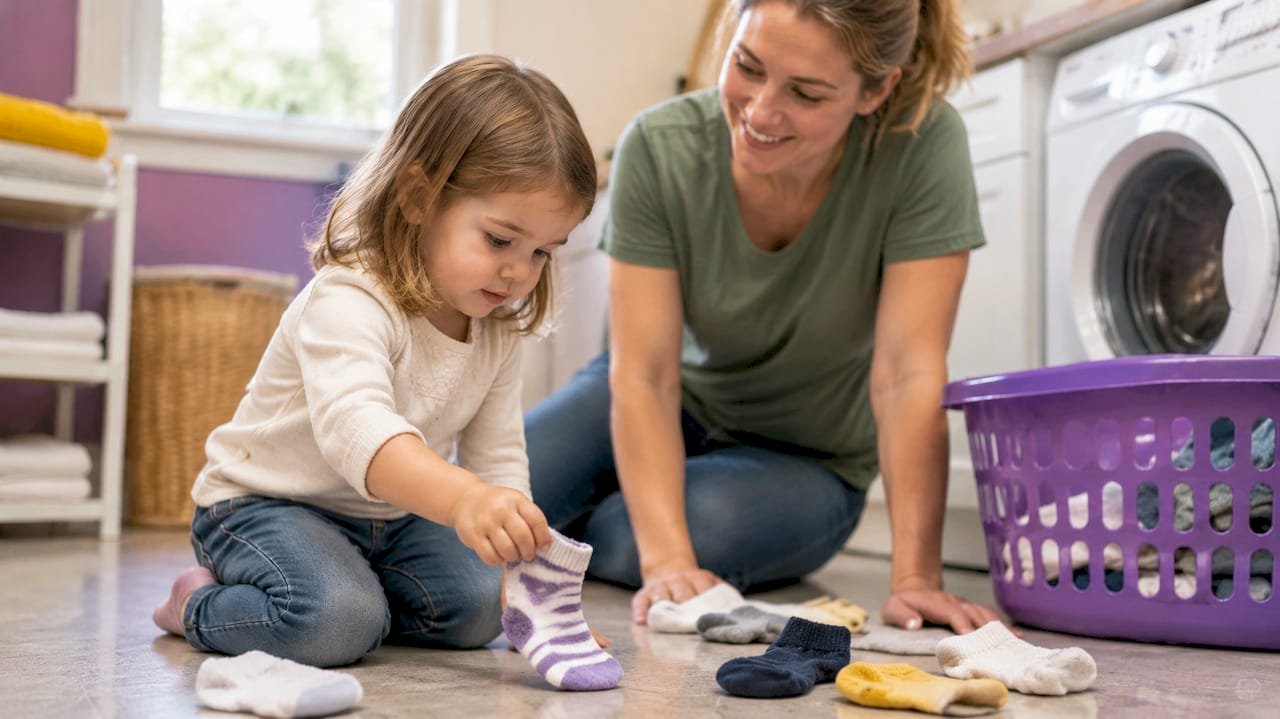
A parent manual from the Reach Up early childhood program says many play and language activities can be part of everyday routines such as eating, bathing and household chores. Sorting laundry is a good example. Ask your toddler to find all the socks, then match pairs, then put the big towels in one pile and the small ones in another. Sorting by size, color or owner is early classification, and it feels like helping.
Making chores a game
A children’s museum in the US suggests chores can become play through imaginative role-play, such as pretending to be a shop owner while sweeping or making a game of putting laundry away. Penn State Extension adds that parents are role models, and that making chores fun, for example by pretending to be dump trucks while putting away blocks, can help children join in.
The problem to solve might be “how many blocks can the dump truck carry in one trip?” or “where does the red block go?” The tidy-up gets done and your toddler practices planning.
Getting dressed
Give two choices: “Do you want the blue top or the green top?” Then let your toddler work out how to get an arm into a sleeve. It takes longer, so save this for mornings when you’re not rushing. Even trying to pull socks on is a problem solving workout.
A predictable rhythm helps
The same Reach Up manual notes that consistent daily routines, such as regular mealtimes or bedtimes, help toddlers feel safe. A child who feels secure is more willing to try something tricky and fail at it.
Activities by age
Toddlers change fast, so one activity can look very different at 10 months and at 3 years. Here is a quick guide, based on how we usually adapt play.
| Age | What problem solving looks like | Simple activity |
|---|---|---|
| 6 to 12 months | Exploring cause and effect | Dropping safe objects into a basket, banging a wooden spoon on a pan |
| 12 to 24 months | Trying things out, early fitting and stacking | Matching lids to tubs, stacking cups, simple puzzles |
| 2 to 3 years | Planning a few steps, early pretend play | Blanket forts, sorting laundry, pouring water between cups |
| 3 to 4 years | Predicting and explaining | Setting the table, obstacle courses they design, playdough building challenges |
For the youngest babies, keep everything big enough not to be a choking risk and stay within arm’s reach. For older toddlers, add a “what if” question: “What if we use a bigger cup?”
If your child has additional needs, you may find our pages on activities for toddlers with Down syndrome and calm, predictable autism activities helpful for adapting play. And if you are following the early years framework, our EYFS activities at home page links play to all seven areas of learning.
Outdoor and seasonal ideas
The garden, the park and even the walk to the shops are problem solving spaces. Puddles invite questions about depth and splashing. Sticks and stones can be sorted by size. A walk to the postbox is a chance to ask, “Which way do we go?”
Autumn is a great time for this. Leaves, conkers (with careful supervision, as they are not for eating), acorns and mud give you collecting and sorting tasks for free. Our autumn activities for toddlers and EYFS page has more. Cold weather also opens up play with frozen items, and our ice play activities show how to try this safely.
If you’d rather avoid buying anything, our eco-friendly toddler activities use items already in your recycling bin.
Out shopping and need something quick? Our no prep shopping activities turn the trolley into a game.
How to help without taking over
The hardest part for most grown-ups is not setting up the activity. It’s keeping quiet while your toddler struggles.
A home learning booklet from EENET explains that learning through play means children choose what to do and are free to explore and discover, with adults joining in. It suggests adults can support discovery by letting children lead, observing, imitating, asking questions and offering deeper thoughts rather than instructing.
In practice, that looks like this:
- Watch first. Count to ten before you step in.
- Copy. If your child is banging two lids together, bang two lids too.
- Ask, don’t tell. “What do you think will happen?” is better than “Put it there.”
- Add a little. If they’ve mastered one thing, offer a slightly different challenge, like a smaller container.
- Narrate. Describing what they do helps language grow too. Our guide to narrating play for language growth shows how, and our speech and language activities build on it.
HealthyChildren.org, from the American Academy of Pediatrics, points out that caregivers should show their own problem-solving process, including how they handle frustration, so toddlers can learn from it. Saying out loud, “Hmm, this lid doesn’t fit. Let me try another one,” is a small way to model that. The same page advises against micromanaging play, which can encourage perfectionist tendencies, and suggests welcoming “happy accidents.”
Pretend play is one of the richest places for this kind of shared thinking. This piece on pretend play development in toddlers explores how adults can join in without directing the story.
Our perspective on problem solving play
We built Mooshie Moments for the moment when you’re tired, your toddler is bored and your mind goes blank. Most parents we hear from don’t lack love or effort. They lack a spare brain cell at 4pm.
That’s why we think the best problem solving play is the kind that asks nothing of you but a few minutes and things you already own. When a child works out how to get the blanket to stay on the chairs, they’re learning. You don’t need to turn it into a lesson.
What we try to do in the app is take away the guesswork. You pick your child’s age and how much time and energy you have, and you get an idea that uses household items. Each activity explains the developmental reason behind it in plain language, so you know why dropping spoons into a bowl matters, and you can enjoy it more.
We also believe in play that gets grown-ups off their phones. Our activities are screen-free for your child, and we hope they help you put your own phone down for a few minutes of real attention together.
samit
Staying safe during household play
Household items are wonderful for play, but they weren’t made as toys, so a little checking goes a long way.
- Water: The NHS says never to leave a young child alone in the bath or playing with water, as a baby or young child can drown in less than 5 centimetres of water. Stay within arm’s reach for every water activity, even a shallow washing-up bowl.
- Crafts and small parts: Action for Children says to always supervise babies and young children during craft activities and to watch out for small parts that could be choking hazards and sharp items. Buttons, pipe cleaners and beads stay out of reach of any child who still mouths objects.
- Cords and ribbons: For dressing up and puppets, remove loose cords, strings or ribbons that could wrap around the neck or cause a trip.
- Bought toys: If you do buy toys, the NHS advises looking for the British Standard kitemark, lion mark or CE mark, which show the toy meets safety standards.
A quick scan of the play space before you start takes about thirty seconds.
Find your next idea with Mooshie
If you’d like a fresh problem solving idea without having to search for one, Mooshie is a free-to-download app for parents and caregivers of children aged 6 months to 4 years. It suggests quick, screen-free activities that use items you already have, matched to your child’s age and the time and energy you have right now. Each idea comes with a plain-language explanation of what your child is learning and a tip for joining in.
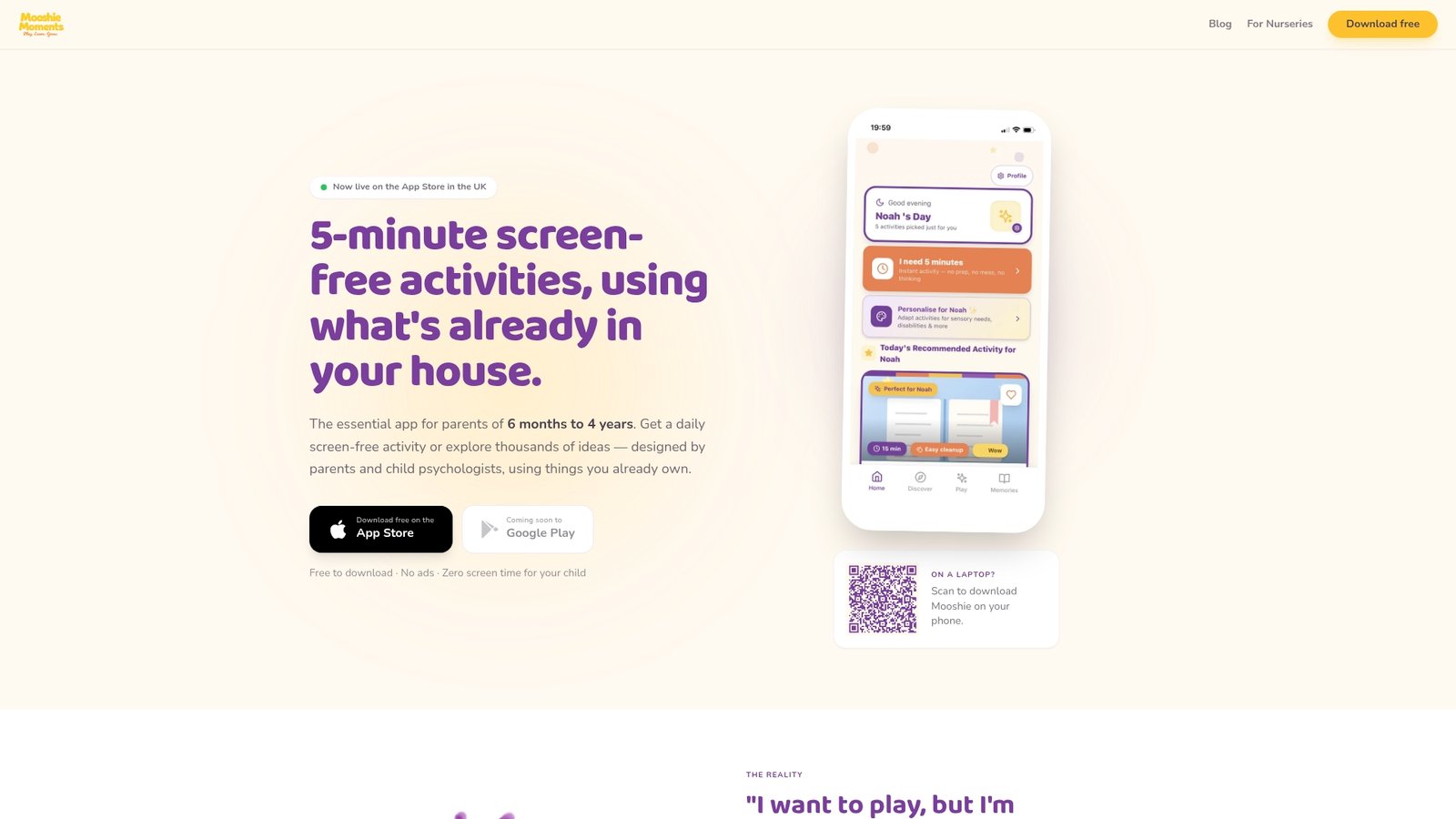
You can see how Mooshie works and try it at home. Grandparents, aunties and uncles can use it too, which makes it easy for anyone who looks after your toddler to have something good to play. If you run a nursery or work in early years, take a look at our Partnership Pack for nurseries. And if you like to try science-style play, our STEM activities for toddlers are a good next step. For something gentle and connecting, try our bonding activities for busy parents.
FAQ
At what age can toddlers start solving problems?
Babies begin much earlier than most people expect. Even at 6 months, dropping a toy to see what happens is an experiment. From around 12 months, toddlers start trying different ways to reach a goal, such as fitting a lid on a tub. Keep activities simple and stay close.
What if my toddler gets frustrated and gives up?
Frustration is a normal part of learning something tricky. Stay calm, name the feeling (“This is hard, isn’t it?”) and offer a small hint or a slightly easier version rather than doing it for them. HealthyChildren.org suggests showing your own way of handling frustration so your child can copy it.
Do I need to buy special toys or puzzles?
No. Containers, lids, spoons, cushions, socks and cardboard boxes all work well. Simple puzzles are a nice extra, but most of the best problem solving moments come from ordinary things around the house.
How long should a problem solving activity last?
As long as your toddler stays interested, which is often only a few minutes. Follow their lead. If they walk away, that’s fine. You can leave the setup out and they may come back to it later.
Sources
- Baby and toddler play ideas, NHS
- Infant Toddler Fine Motor Activities, Action for Children
- Activity ideas for toddlers for fun and learning, Action for Children
- Use household objects as toys for young kids, First Things First
- A Guide to Everyday STEM Talk
- Parent Manual, Reach Up and Learn
- Playful Mindset Turns Chore Time into Play Time, Minnesota Children’s Museum
- Helping hands, Penn State Extension
- Supporting learning at home in the early years, EENET
- Raise a Problem Solver: 3 Ways Play Can Help, HealthyChildren.org
Recommended
- Montessori Toddler Activities for UK Homes: 16 Ideas, No Shopping
- Eco-Friendly Toddler Activities Using Things You Already Have
- STEM and Science Activities for Toddlers
Want play ideas matched to your child's age?
Mooshie Moments gives you simple, guided play ideas for ages 6 months to 4 years. Try 3 free activities a week.
Download free on the App StoreMore like this

Best Indoor Games for Toddlers: 14 Easy Ideas for Home
The best indoor games for toddlers, using things you already own: active, pretend and quiet ideas, age tweaks, safety checks and how…
Small Space Toddler Activities: 15 Ideas for Any Room
Small space toddler activities that need no shopping and little setup: 15 ideas for flats and tiny living rooms, with safety tips…
Toddler Activity Schedule: A Realistic Day That Works
A simple toddler activity schedule for ages 1 to 4: sample days, short play blocks, nap timing, winter tweaks and screen-free ideas…