
Pasta Play for Toddlers: 9 Easy Ideas and Safety Rules
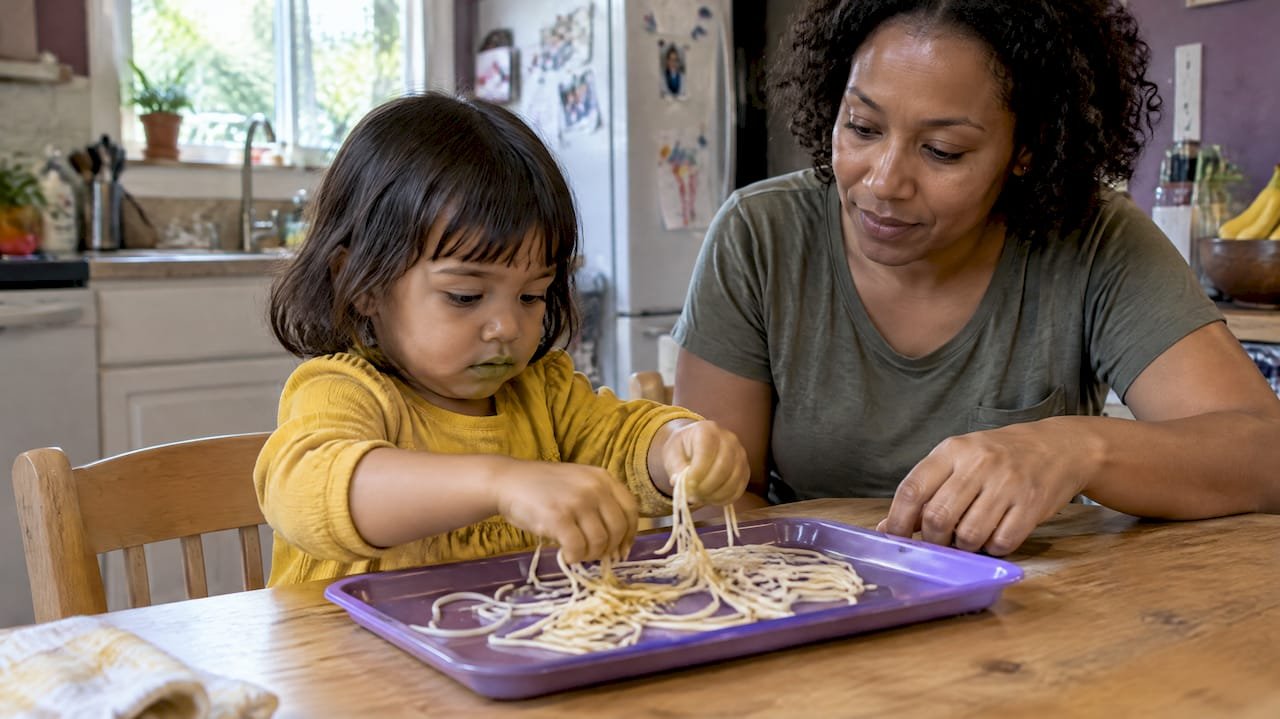
21 October 2026 · 9 min read
Pasta play is one of the easiest ways to turn a rainy afternoon into real play. You probably have a packet in the cupboard already. Cooked spaghetti gives soft, slippery, squishy sensory play. Dry shapes give scooping, sorting and threading. Add a few clothes pegs and you have a fine motor game too. The one thing to get right is safety: toddlers under 4 are still learning to chew and swallow, so how you prepare the pasta and how closely you watch matters more than any idea below.
We built Mooshie Moments around moments like this: quick, screen-free play with things you already own. Here is how we would do pasta play at home.
TL;DR
- Cooked, cooled and cut-up pasta is the easiest place to start for under-3s. Keep dry pasta for older toddlers, and only with an adult sitting right beside them.
- Keep your child seated and watched at all times. Choking risk is higher under 4 because chewing and swallowing skills are still developing.
- Pasta play can be a gentle, no-pressure way to explore food textures, which can help fussy eaters.
- Pegs, tongs and spoons turn a bowl of pasta into fine motor practice.
- Five to ten minutes is plenty. Follow your toddler’s lead and skip the “right” result.
Table of Contents
- Why pasta works so well for toddlers
- Safety first: choking rules for pasta play
- What you need
- Nine pasta play ideas, from easiest to most hands-on
- A quick guide to ages
- Pasta play and fussy eaters
- Our perspective: why we keep it simple
- Mess, cleanup and making it easy
- Make it part of your day
- Looking for more ideas like this?
- FAQ
- Sources
Why pasta works so well for toddlers
Pasta is cheap, safe to touch and different in every form. Spaghetti is long and bendy. Penne has holes. Shells scoop. Cooked pasta is slippery and cool, while dry pasta is hard, rattly and smooth.
That range matters. A 2025 systematic review of 34 publications found that sensory play with everyday items supports neural development, fine motor control and cognitive flexibility in children under 6. You do not need to remember the research. The takeaway is simple: handling real materials is real learning.
Pasta also suits tired grown-ups. There is no shopping trip and no set-up beyond a tray or a baking dish. If you want more ideas in this spirit, our guide to sensory play ideas that need no new toys has plenty.
Safety first: choking rules for pasta play
Read this section before you open the cupboard.
UK government early years guidance on choking hazards explains that babies and young children are at higher risk when they do not chew well or try to swallow food whole. NHS parent guidance says it takes time to learn to breathe, chew and swallow in harmony, so until then children need you to cut up or avoid anything that could block their airway.
What that means for pasta play:
- Stay with them. Sit beside your toddler for the whole activity. Do not leave the room to answer the door or put the kettle on.
- Keep them seated. A child who is walking, running or climbing with food or small objects in their mouth is at greater risk. A high chair or low table works well.
- Cut cooked pasta small. For children who still put things in their mouths, snip long spaghetti and larger shapes into short, manageable pieces.
- Treat dry pasta with care. Early years settings that run food play, such as this Bristol childcare policy, stress that dry pasta should only be used under active adult supervision, because it can be swallowed or block the airway. For a child who mouths everything, we suggest sticking to cooked pasta for now.
- Check for allergies. Pasta contains wheat, and many types contain egg. If your child has a known allergy or you are unsure, ask your GP, health visitor or dietitian before you start, and use another material.
- Know what to do. If your child is choking, follow the first aid steps you learned on a paediatric first aid course, and call 999 if they cannot breathe, cough or cry. If you have not done a course, booking one is worth the time.
Nurseries work through these same checks every day. The sensory play guide from Sunflower Nursery maps age bands and safety checks to the EYFS, which is a handy comparison if you want to see how a setting thinks about suitable materials for under-4s.
If your child is a keen mouther, our list of taste-safe sensory play ideas is a better starting point than dry pasta.
What you need
Nothing special. Pick from this list:
- A packet of spaghetti, penne or macaroni
- A baking tray, large bowl or washing-up bowl
- A tea towel or old sheet for the floor
- Spoons, a sieve, a colander, a muffin tin
- Clothes pegs and a cardboard box or plastic tub
- Optional: food coloring, a little cooking oil, playdough
That is the whole kit. Everything on it is already in most kitchens, which fits how we think about play: no purchases, no prep stress.
Nine pasta play ideas, from easiest to most hands-on
1. Cold spaghetti sensory tray (age 6 months and up, with close supervision)
Cook a handful of spaghetti, rinse it under cold water, and toss it with a tiny splash of oil so it does not stick. Cut it into short lengths for younger children. Tip it on a tray and let your toddler squish, pull and drop it.
Sit beside them and name what you see: “slippery”, “cold”, “long”, “wiggly”. Do not try to steer the play. Researchers writing about sensory play and toddler cognition suggest adults act as a sensory partner who narrates and joins in, not a director. Letting your child lead is what keeps them focused.
2. Rainbow pasta (age 18 months and up)
Put cooked, cooled pasta into zip bags with a few drops of food coloring each, squeeze, then rinse. Your toddler can squeeze the bags too, which is half the fun. Colors are a natural talking point. Ask “Where is the red one?” and wait for the point or the grab.
Keep it to cooked pasta for under-3s, and supervise closely, since food coloring makes it tempting to taste.
3. Scoop, pour and transfer (age 12 months and up)
Give your toddler a bowl of cooked shapes, an empty bowl and a spoon. Moving pasta from one bowl to another is serious work for small hands. It builds the wrist and finger control they need later for holding a pencil. We cover more of this in our guide to fine motor activities for toddlers and preschoolers.
Try a muffin tin for sorting by color or shape once they are two or older.
4. Pasta in the playdough (age 2 and up)
Press shapes into a lump of playdough to make prints, or poke penne into it like candles on a cake. Dry pasta is the usual choice here, so this is for older toddlers who no longer mouth objects, and you stay beside them throughout. If your child tends to put things in their mouth, use cooked pasta instead, or leave this one for a few months.
5. Peg and pasta box (age 2 and up)
Peg activities are a favorite for toddlers because they work the exact small muscles that later help with writing and dressing. Here is a simple way to combine pegs and pasta:
- Take a cardboard box or plastic tub with a firm rim.
- Show your toddler how to squeeze a peg open and clip it on the edge.
- Once pegs are on, drop a few cooked pasta shapes into the tub and use the pegs as pincers to pick them out.
Pegs are tricky at first. Start with wide, easy-grip pegs, and clip a couple on yourself so they can copy. If they get frustrated, put the pegs away for a week and return to scooping. Nothing needs to be finished.
6. Spaghetti and colander (age 2 and up)
Push lengths of dry spaghetti through the holes of a colander, or stand them in a lump of playdough. This is a classic “poke and pop” game. Because dry spaghetti snaps into sharp, small sticks, stay close and take it away if it becomes a chewing toy. Cooked spaghetti poked through the holes is a softer option.
7. Pasta threading (age 2.5 and up)
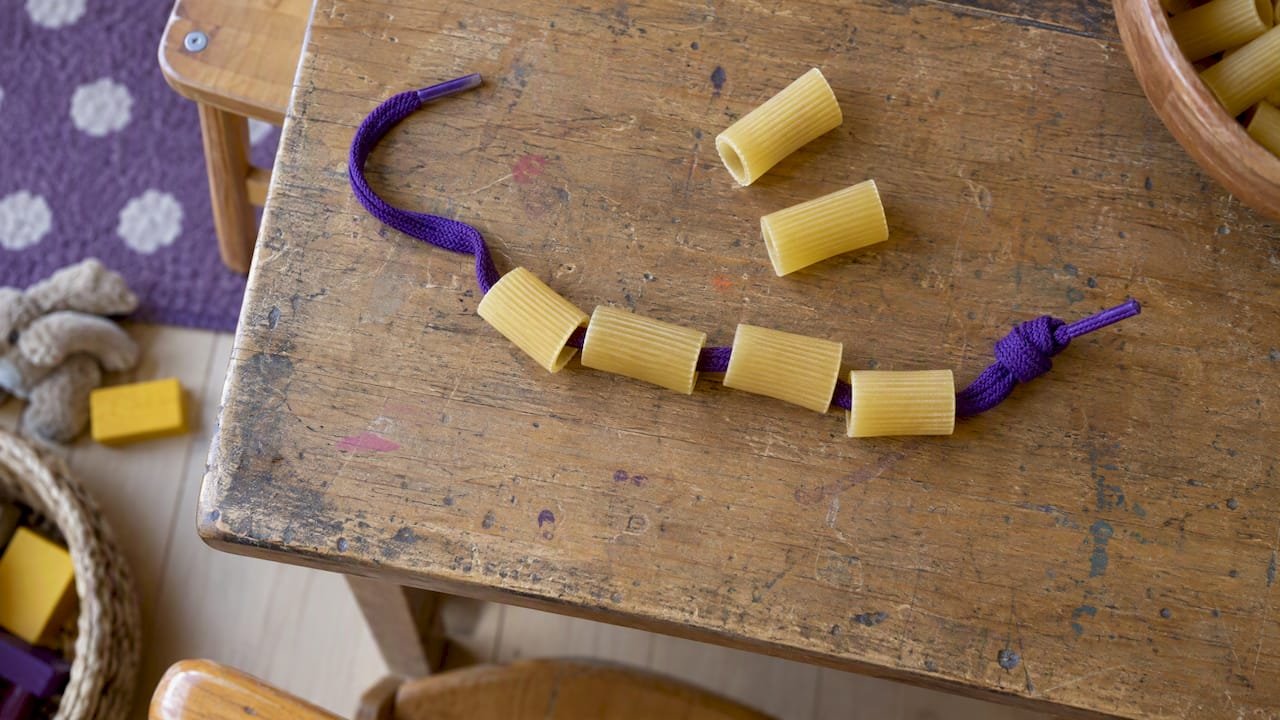
Thread large tube pasta, such as penne or rigatoni, onto a shoelace with a knot at the end, or onto a pipe cleaner. Older toddlers love it and it needs steady hand-eye coordination. Keep it short, five minutes is usually enough, and do not worry if the pasta ends up in a pile rather than a necklace.
8. Pasta rescue (age 2 and up)
Freeze a few cooked shapes in a shallow tub of water, or hide them in a bowl of cold spaghetti. Give your toddler a spoon or toy tongs to “rescue” them. It is a lovely mix of sensory input and problem solving, and you can narrate the whole thing: “Cold! You found a shell!”
9. Pasta garage and road (age 3 and up)
Lay out long spaghetti as roads on the tray and drive toy cars across them. Add shells for houses and penne for tunnels. At this age, your toddler may start to tell a story, which is great for language. Our guide on narrating play to grow your toddler’s language shows how to join in without taking over.
A quick guide to ages
| Age | Best pasta setup | Adult role |
|---|---|---|
| 6 to 12 months | Cooked, cooled and cut small, in a tray | Sit beside them, hands free to react |
| 12 to 24 months | Cooked pasta, spoons and bowls | Narrate textures and actions |
| 2 to 3 years | Cooked shapes, pegs, tongs, rainbow bags | Offer a model, then step back |
| 3 to 4 years | Threading, sorting, simple stories | Follow their ideas, keep watch |
These are our practical suggestions, not medical rules. Every child develops at their own pace, so adjust to yours. If you have worries about your child’s development or feeding, speak to your health visitor or GP.
Pasta play and fussy eaters
Many parents come to pasta play because mealtimes are hard. That is a good reason to try it.
A children’s occupational therapy service in Bedfordshire and Luton explains that playing with food lets a child explore textures safely, without needing to eat anything. A randomized controlled trial of 32 toddlers with food refusal compared sensory-based feeding treatment with nutrition education alone. That was a structured therapy program, not a pasta tray at home, so treat it as encouraging background rather than a promise.
What we would take from it for everyday life:
- Do not ask your child to eat the pasta. Let them touch, smell and lick if they want to.
- Do not praise or push. A calm “you’re exploring it” is enough.
- Keep sessions short and repeat them over weeks.
- If your child is very distressed by textures, or you worry about their weight or diet, ask your GP or health visitor about a referral.
For more on this, see our guide to food play for fussy eaters.
Our perspective: why we keep it simple
We talk to a lot of tired parents, grandparents, aunties and uncles. The same worry comes up: “I don’t have the energy to set up something fancy.” So when we think about pasta play, we ask one question: can a grown-up start in under two minutes?
A bowl of cold spaghetti passes that test. A themed, color-coded, Pinterest-ready tray does not need to. Toddlers do not mind either way. What they notice is you, sitting nearby, curious about what they are doing.
That is why every activity in Mooshie explains the “why” in plain language. If you know that scooping builds hand strength, or that naming textures grows vocabulary, you can relax and let the play be messy and short. You also do not need a screen to keep up, which means your phone can stay in your pocket and your attention can stay on your child.
We also think safety belongs inside the idea, not at the bottom of the page. Cooked pasta for the youngest, supervision always, and an honest “not today” when your toddler is tired, hungry or mouthing everything in sight.
— samit
Mess, cleanup and making it easy
Pasta play is wet and slippery, so plan the cleanup before you start:
- Lay a tea towel or old sheet under the high chair or low table.
- Use a tray with sides so most of the pasta stays put.
- Put a bowl of warm water and a flannel nearby for hands.
- Throw cooked pasta in the food waste or bin afterwards. Do not keep it to reuse after a toddler has played with it. Cooked food left out is not a good idea to store for another day.
- Sweep up any dropped dry pasta right away so a crawler does not find it later.
If mess feels like too much, try a smaller version: a few pieces of cooked penne in a baking dish, five minutes, done.
Make it part of your day
Pasta play fits well into moments you already have:
- While dinner is cooking. Set aside a handful of cooled pasta for your toddler to play with at the table, while you stir the pot.
- After a nursery pick-up. A short, calm sensory tray can help a tired child settle.
- On a wet autumn afternoon. If you are stuck inside, pair pasta with our autumn activities for toddlers.
If you have only a few minutes, our low prep toddler activities are sorted by skill and by how long you have.
Looking for more ideas like this?
Mooshie is a free-to-download app for parents and carers of children aged 6 months to 4 years. You tell it your child’s age, how much time you have and how much energy you have left, and it suggests a screen-free activity using things already in your home. Each idea comes with a plain-language explanation of what it builds and a coaching tip. Take a look at Mooshie the next time you are staring into the cupboard with no ideas.
Run a nursery, preschool or childminding setting? We also offer a Partnership Pack for nurseries with a home-learning resource you can share with your families.
FAQ
What is pasta play?
Pasta play is open-ended play where children touch, scoop, sort, thread or move pasta, cooked or dry. It is a type of sensory play. The aim is exploration, not making something, so there is no right or wrong result.
What age can toddlers start playing with pasta?
Many families start sensory play with cooked, cooled pasta from around six months, once a baby is sitting well and is used to solid foods. Keep the pieces small and stay with them. Dry pasta is better left until your child no longer mouths objects, and always with an adult beside them. If you are unsure, ask your health visitor.
Is dry pasta safe for toddlers to play with?
It carries a choking risk, because hard pieces can be swallowed or block the airway. Childcare settings that use it do so only with active, constant adult supervision. For a toddler who still puts things in their mouth, choose cooked pasta or another taste-safe material.
Can pasta play help a fussy eater?
It can be a low-pressure way to get used to food textures, because your child does not have to eat anything. It is not a guaranteed fix. If your child eats a very narrow range of foods or mealtimes cause real distress, talk to your GP or health visitor.
How long should a pasta play session last?
Five to ten minutes is a good target for most toddlers. Stop when they lose interest, and bring it out again another day.
Sources
- Early years choking hazards food safety advice (GOV.UK)
- Safety. Sorted! Parents Pack (NHS)
- Activities, Experience and Learning Policy, Appendix 2 (Bristol childcare)
- Sensory play and toddler cognitive development (Parent Science)
- Strategies to help sensitive children eat (Bedfordshire and Luton children’s occupational therapy)
- Sensory Based Feeding Intervention for Toddlers With Food Refusal: A Randomized Controlled Trial (PMC)
- Systematic review on sensory play in children under 6
Recommended
- Taste Safe Sensory Play: Top 10 Ideas for Mouthing Toddlers
- No New Toys Needed: Sensory Play Ideas Parents Can Use With Toddlers
- Fussy Eater Toddler? Food Play Takes the Pressure Off
Want a new idea every day, matched to your child's age?
Mooshie Moments gives you simple, guided play ideas for ages 6 months to 4 years.
Download free on the App StoreMore like this
Toddler Scavenger Hunt: Easy Ideas for Home and Garden
Easy toddler scavenger hunt ideas using things you already have: indoor, garden and nature walk hunts, by age, with safety tips and…

Camping With Toddlers: Activities That Work at the Campsite
Easy camping activities for toddlers using what you already have: nature play, campfire-free games, rainy-day ideas and safe-play tips for UK campsites.
Eco-Friendly Toddler Activities Using Things You Already Have
Simple eco-friendly toddler activities using things you already have: water play, nature hunts, junk modelling and garden play, with safety tips for…