Toddler Scavenger Hunt: Easy Ideas for Home and Garden
A toddler scavenger hunt is one of the easiest play ideas you can set up. Pick a handful of things your child can find, say them out loud, and go looking together. You need no printer, no shopping trip and no screen. Most hunts take two minutes to set up and give you ten or fifteen minutes of real, chatty play.
Below we cover how to run a hunt for a baby, a one-year-old and a three-year-old, what to look for indoors, in the garden and on a walk, and how to keep it safe.
TL;DR
- A toddler hunt needs only a theme (a color, a shape, a sound) and a few things to find. Aim for a short list and let your child set the pace.
- Indoors, a hide-and-find game with “warmer” and “colder” clues works well with a favorite toy, and it builds listening, positional words and following simple instructions.
- Outdoors, leaves, stones, twigs, feathers and flowers make a free “find list” for any garden or park.
- Match the hunt to your child’s age. Babies explore safe objects, one-year-olds hide and find, and two- to four-year-olds can handle themes and picture clues.
- Stay close, clear away small choking hazards, and treat detours as part of the game.
Table of Contents
- What a toddler scavenger hunt really is
- Set up a hunt in two minutes
- Indoor toddler scavenger hunt ideas
- Garden and nature walk hunts
- Adapting the hunt by age
- Making the hunt work for your child
- Keeping it safe
- Our view on toddler scavenger hunts
- Bring more ideas into your week
- FAQ
- Sources
What a toddler scavenger hunt really is
A scavenger hunt means searching a place for objects using a list or clues. With toddlers we strip that down to the bit they love: finding something and shouting about it. Parents.com notes that a hunt can be tailored to a child’s age and interests and supports observation and problem-solving. It can also use items already in place, so there is no setup.
There is no winning here, and that is the point. Your toddler is not racing anyone. They are looking, pointing, naming and checking with you. The grown-up job is to be curious alongside them.
Why it works so well at this age
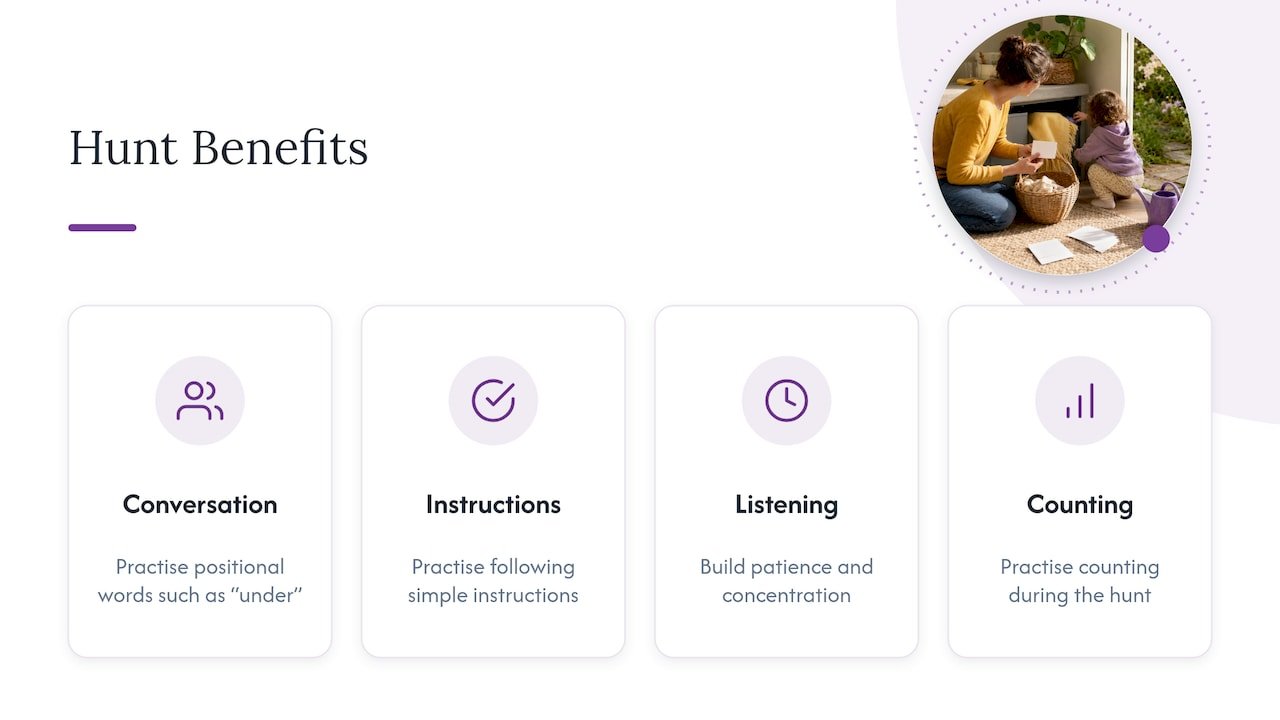
Toddlers are natural collectors and fillers and emptiers. A hunt gives that urge a purpose. BBC Tiny Happy People says a treasure hunt encourages conversation and helps children practise following simple instructions and positional words such as “under” and “behind”. It also lists listening, patience, counting, imagination, thinking and concentration. That is a lot from a game that costs nothing.
The Woodland Trust describes scavenger hunts as an exciting way to explore the natural world that helps young children build observation skills and adds fun to family walks.
If you like the language side, hunts pair nicely with narrating play for your toddler’s language growth. Every find is a chance to say the word, describe it and let your child repeat it.
Set up a hunt in two minutes
Here is the quick method we suggest when you are tired and need something now.
- Pick one theme. Colors, shapes, soft things, round things, things that make a noise. One theme keeps the game clear for a small mind.
- Choose a few targets. For a young toddler, three or four is plenty. For an older child, you can stretch to a longer list. Start small and add more if they are still keen.
- Say the first clue out loud. “Can you find something red?” Point or give a hint if they stall.
- Find it together. Hold it up, name it, describe it. “A red sock. Soft sock.”
- Celebrate every find. A cheer, a high five, a hug. Praise the looking, not the speed.
- Stop when they stop. Finishing the list does not matter. If your child wanders off to stack cushions, the hunt is over and the play carries on.
This is the kind of low-prep idea we build Mooshie around: quick, no shopping, and tied to how your child is developing. If you want more like it, our guide to low prep toddler activities by skill area is a good next stop.
Indoor toddler scavenger hunt ideas
Rainy day, short on time, or just cold outside? Your living room already has everything you need.
The warmer and colder game
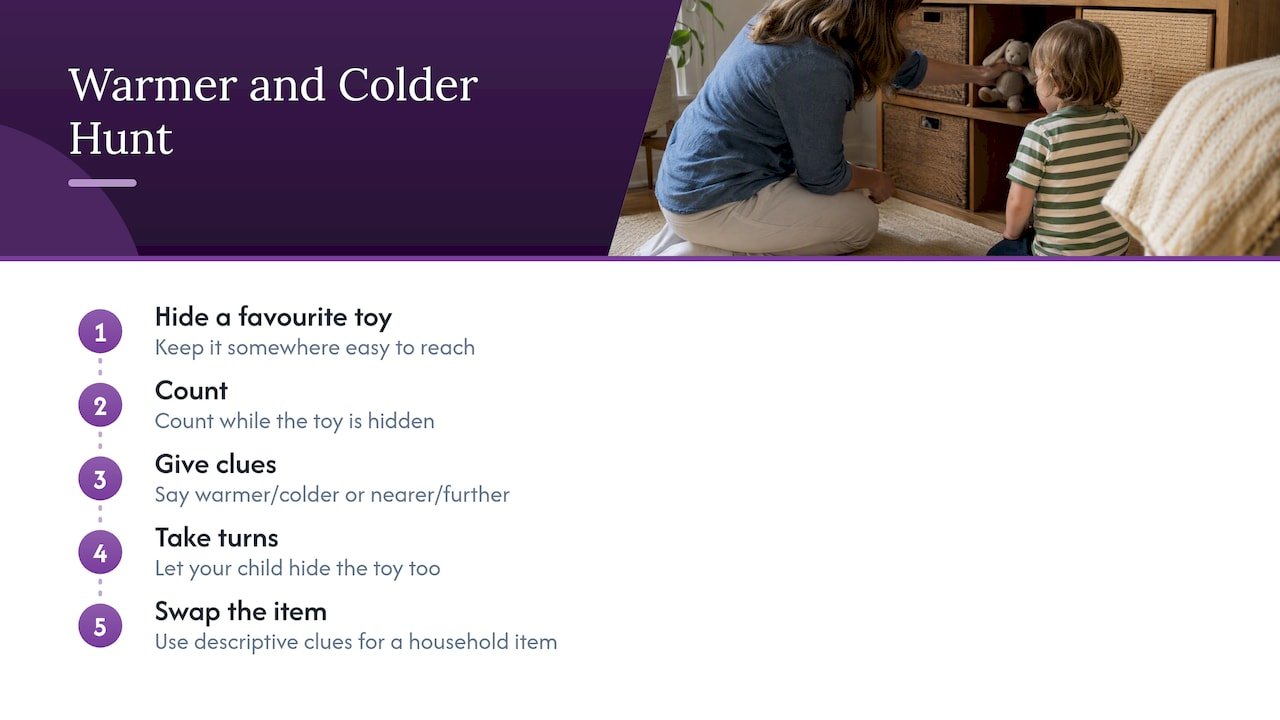
This is the simplest hunt and the one we would try first. Take a favorite toy. Your child counts (or you count for them) while you hide it somewhere easy to reach. Then give clues: “warmer” as they get close, “colder” when they move away, or “nearer” and “further”. Ask where they think it might be. BBC Tiny Happy People describes this version, including taking turns so your child gets to hide it for you too.
When the toy gets boring, swap it for a familiar household item or piece of clothing and give descriptive clues, such as “it’s soft and it goes on your foot”. That moves you from simple searching to listening and thinking.
Color hunts
Call out a color and let your child bring you something that matches. A red cup, a red sock, a red book. Keep one color per round. If your child loves this, we have a whole set of color sorting activities for toddlers that build on it, such as sorting what they find into piles afterward.
Shape and texture hunts
Look for something round (a plate, a ball, a lid) or something flat. Or go by feel: something fluffy, something bumpy, something smooth. Feel-based hunts suit children who are not yet saying many words, because they can show you rather than tell you. For more of this, try our shape activities for two-year-olds.
Sound hunts
Sit still and listen. Can you hear the fridge hum, the tap drip, a car outside? Then go and find the thing making the noise. It slows everyone down in a good way.
Pretend play twists
Turn the hunt into a story. You are looking for a lost teddy’s hat, or you are animals hunting for food. Pretend play stretches the game and fits how toddlers naturally think. There is more on pretend play development in toddlers if you want to see why it matters.
Garden and nature walk hunts
Going outside gives you endless free props. A local council education sheet for outdoor hunts, from Hackney, lists the sort of things children can look for: leaves, stones, twigs, feathers and flowers. That list works in almost any UK garden, park or pavement-side verge.
Easy nature targets
- A big leaf and a tiny leaf
- A smooth stone
- A stick as long as your arm
- Something yellow (a dandelion, a fallen leaf)
- A feather
- Something that feels rough, like bark
- Something that moves, such as a snail or a bird
The BBC also suggests taking the hunt outside to find natural objects like the biggest leaf or the smoothest stone, which makes a nice open-ended challenge because there is no single right answer.
In autumn, the hunt practically writes itself, with conkers, acorns, crunchy leaves and puddles. Our autumn activities for toddlers and EYFS page has more seasonal ideas.
Collect or spot?
Decide before you start. Some children love filling a bag or an egg box with treasures. Others find it hard to leave things behind, so a “spotting” hunt, where you point and say “I see it!”, works better. For spotting, a quick “tick” in the air or a high five does the job. For collecting, a small bag or an empty egg box with one find per hollow keeps things tidy.
Use the seasons and senses
The Woodland Trust suggests adapting prompts by season, color and the senses, such as signs of spring or autumn, colors, textures, scents or sounds. That keeps the same walk fresh through the year. One week you look for green things, the next you listen for birds, the next you smell herbs or pine needles (with a grown-up checking first).
Our nature play ideas for toddlers page adds a dozen more things to try once the hunt is done.
Minibeasts in the garden
In one Ofsted inspection of a nursery, toddlers were enjoying a garden scavenger hunt looking for dragonflies, worms and other insects. You can copy that at home. Lift a plant pot or turn over a leaf, look gently, and put things back where you found them.
Shopping trips and waiting rooms
A hunt travels well. In the supermarket, “find something yellow” turns a tedious aisle into a game. We have a full set of ideas in our guide to no prep shopping activities for toddlers.
Adapting the hunt by age
Not every child is ready for the same game. HENRY, a UK charity focused on early childhood health, suggests different approaches by stage, and we find the same pattern in homes every day.
| Age | What works | Example |
|---|---|---|
| Babies up to 12 months | Supervised exploration of safe objects with different shapes, sizes, colors and textures | A basket of safe household items to look at and touch |
| 12 months to 2 years | Simple hide-and-seek or matching | Hide a teddy under a blanket; match a sock to its pair |
| 2 to 5 years | Themed collections, scent searches or simple picture clues | Find three red things; sniff herbs; follow a drawn picture |
For babies
A baby cannot search, but they can discover. Put a few safe objects in a basket and let them mouth, shake and drop them. You do the narrating. “Smooth. Cold. Bumpy.” Stay within arm’s reach the whole time.
For one-year-olds
Think peekaboo with objects. Hide a toy under a cloth while your child watches, then ask “where did it go?” The success is in uncovering it. Make the hiding spots very obvious.
For two- and three-year-olds
Now themes work. Keep the list short and spoken. If your child likes pictures, quickly draw simple pictures on scrap paper, such as a sun, a flower and a cup, and tick them off. Pictures beat words for children who cannot read yet.
For four-year-olds
Try two-step clues: “Find something soft that is also blue.” Let them hide things for you, and let them be the clue-giver. Add counting: “Can you find five spoons?” Our EYFS activities at home guide shows how hunts like this connect to the areas of learning nurseries and reception classes use.
Making the hunt work for your child
Attention spans are short, and that is fine
A two-year-old might manage five minutes. A rested four-year-old might go for twenty. Watch for signs they are done: wandering, whining, or dumping the bag. Stop on a high note and say “we can do it again tomorrow”.
Let detours happen
If your toddler stops to watch a beetle or stack stones, let them. That is not a failed hunt; it is toddler-style exploration, and it is often where the best learning happens. Follow their lead, name what they are looking at, and pick the hunt up again later or never.
Talk more than you test
Resist the urge to quiz. Instead of “what color is it?”, try “look, it’s a bright red leaf, and it’s crunchy!” Naming things builds vocabulary without pressure. If your child is slower to talk, our speech and language activities page has gentle ways to support them.
Calm, predictable versions
Some children, including many autistic children, do better with a clear start, a clear end and the same pattern each time. A hunt with a visual list of three things and a “finished” moment can work well. See our calm, predictable play ideas for autistic toddlers for more. For children with Down syndrome, shorter, repeated hunts with plenty of praise often suit, and you will find more in our activities for toddlers with Down syndrome.
Keeping it safe
Safety is simple but not optional with this age group.
- Stay close. Toddlers should always be supervised during a hunt, indoors or out.
- Clear small objects. Remove coins, buttons, small batteries and anything else a child could choke on. The NHS advises keeping small objects out of reach and checking toy boxes for small-parts warning symbols. If you are hiding things, choose items bigger than your child’s fist.
- Watch cords and sharp edges. Keep them out of reach and off your target list.
- Plants and berries. Do not let your child eat anything they find outdoors. Even in settings with experienced staff, children are taught to forage safely and to identify potentially poisonous plants, as noted in an Ofsted inspection of a nursery with forest school sessions. At home, the simplest rule is that finds are for looking and carrying, not tasting. Wash hands afterward.
- Mind the surroundings. Check the garden for litter, animal mess and sharp bits before you start. Steer clear of roads and water.
If you are worried your child has swallowed or choked on something, call 999 straight away.
Our view on toddler scavenger hunts
We built Mooshie for the moment when you are tired, the afternoon feels long and you cannot think of one more thing to do. A scavenger hunt is a perfect example of what we mean by good play: no shopping, no prep, and a real reason behind it.
When you hold up a red sock and say its name, your child is practising looking, listening, remembering and talking. We think grown-ups deserve to know that “why”, in plain words, so every activity in the app explains what your child is practising and gives a coaching tip to try.
The other thing we care about is you. Hunts pull you off your phone and into the same room, the same game and the same laugh as your child. We designed Mooshie so you can pick your child’s age, how much time you have and how much energy is left, and get an idea that fits right now. No screen for your toddler, no supplies list for you.
samit
Bring more ideas into your week
Hunts are a great starting point, but we know you will not want to plan something new every day. Mooshie is our free-to-download app for parents and caregivers of children aged 6 months to 4 years. It gives you quick, screen-free activity ideas that use everyday household items, matched to your child’s age, your available time and your energy level. Each idea comes with an expert-reviewed explanation of what your child is learning and a coaching tip.

You can find out more and get the app at Mooshie. If you run a nursery, childminding setting or playgroup, our Partnership Pack offers ready-made home-learning resources for the families you work with. And if you want more ways to connect in a few minutes, try our toddler bonding activities.
FAQ
What age can a toddler start a scavenger hunt?
You can start from around 12 months with very simple hide-and-find games, such as a toy under a cloth. Before that, babies can explore a basket of safe objects with you. Two- to four-year-olds are ready for themes and picture clues. Go at your child’s pace.
How many things should be on a toddler scavenger hunt?
Fewer than you think. Three or four is a good start for younger toddlers, and you can stretch the list for older children if they are still keen. Stop whenever your child loses interest, because finishing the list is not the goal.
Do I need a printable scavenger hunt list?
No. Spoken clues work perfectly well, and so does a toy, a sock or a leaf. If you want a visual list, quickly draw a few simple pictures on scrap paper. Pictures are easier than words for children who cannot read yet.
How do I make a scavenger hunt safe for a toddler?
Stay close, and remove small items such as coins, buttons and small batteries. Keep cords and sharp edges out of reach, and do not let your child eat anything found outdoors. Check the garden or park for hazards before you start.
What if my toddler ignores the list and does their own thing?
That is normal and it is still good play. Follow their interest, name what they are looking at, and bring the hunt back in if they want it. Success here means engagement and exploration, not ticking things off.
Sources
- Indoor treasure hunt for kids, BBC Tiny Happy People
- Fun Outdoor Scavenger Hunts for Kids, Parents.com
- Nature Activities for Kids and Families, Woodland Trust
- Outdoor Scavenger Hunt, Hackney Education
- Let’s go on a treasure hunt, HENRY
- Safety: preventing choking, NHS
- Inspection of Treetops Hopscotch, Ofsted
- Inspection of The Children’s Garden, Ofsted
- The Role of Pretend Play Development in Toddlers
Recommended
- 15 Low Prep Garden Activities for UK Toddlers, Rain or Shine
- Nature Play Ideas for Toddlers: 12 Simple Activities to Try
- Montessori Toddler Activities for UK Homes: 16 Ideas, No Shopping
Want a new idea every day, matched to your child's age?
Mooshie Moments gives you simple, guided play ideas for ages 6 months to 4 years.
Download free on the App StoreMore like this
Camping With Toddlers: Activities That Work at the Campsite
Easy camping activities for toddlers using what you already have: nature play, campfire-free games, rainy-day ideas and safe-play tips for UK campsites.
Eco-Friendly Toddler Activities Using Things You Already Have
Simple eco-friendly toddler activities using things you already have: water play, nature hunts, junk modelling and garden play, with safety tips for…
Paper Plate Crafts for Toddlers: 9 Easy Ideas With Household Items
Nine quick paper plate crafts for toddlers using things you already have, with age adaptations, prep times and safety tips for parents…