How to Narrate Play for Your Toddler’s Language Growth
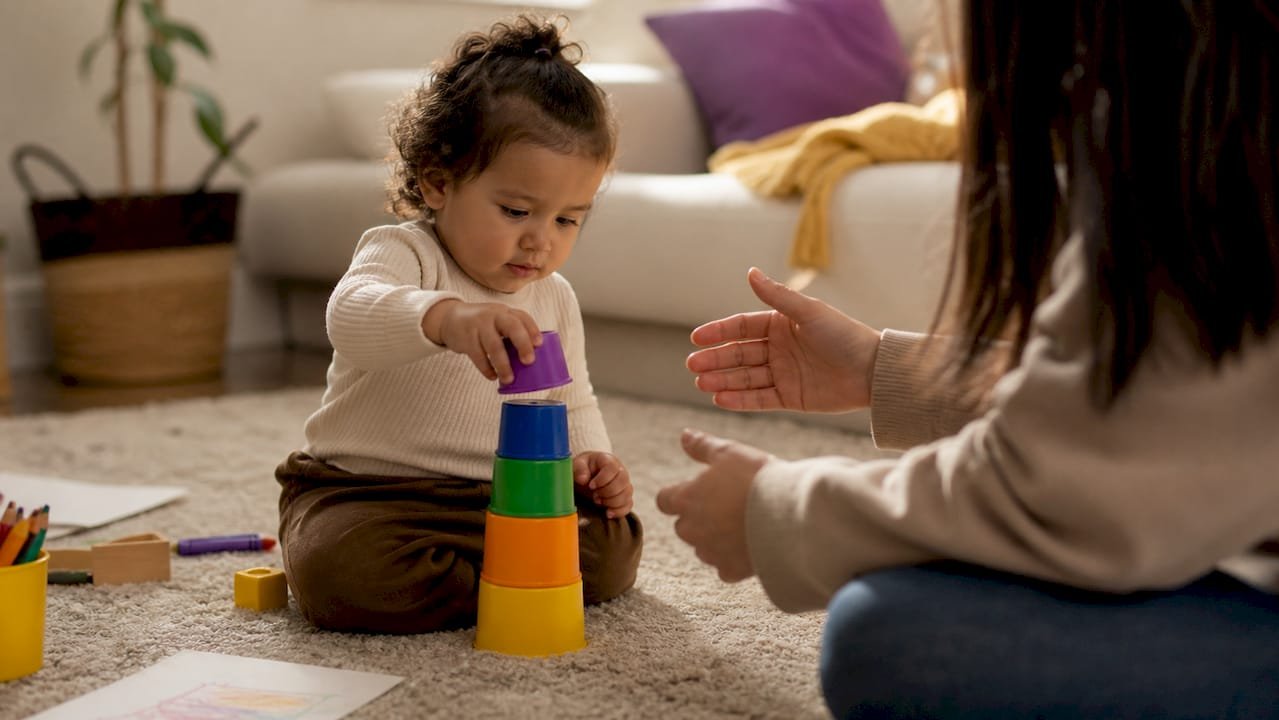
Narrating play for toddlers means describing what you and your child are doing, out loud, in simple language, as it happens. Speech-language pathologists call this technique parallel talk and self-talk, and it works because words tied to real actions stick. Your child hears “the red block goes on top” at the exact moment they see it happen, and that connection builds vocabulary faster than flashcards ever could.
Here is a 3-step micro-script you can try in the next 60 seconds:
- Observe. Watch what your child is doing without jumping in.
- Describe. Say one simple sentence about it: “You’re stacking the blocks. Up, up, up!”
- Pause. Wait five full seconds. Let the words land.
That’s the whole foundation. Everything else in this article builds on those three steps.
Key Takeaways
Narrating play is one of the most effective things you can do for your toddler’s language development, and it takes less than 10 minutes a day to make a real difference.
| Point | Details |
|---|---|
| Observe, describe, pause | Follow this 3-step sequence every session to keep narration low-pressure and effective. |
| Aim for 3 comments to 1 question | This ratio keeps interactions language-rich without putting your child on the spot. |
| Match language to their stage | Use two-word phrases for early talkers; expand to full sentences as they grow. |
| Watch the red flags | No words by 16 months or no two-word combos by 24 months warrants a pediatrician call. |
| Mooshiemoments supports daily practice | The app provides age-matched, SLP-reviewed narration scripts and 5-minute activity ideas. |
Table of Contents
- What is narrating play, and how is it different from asking questions?
- Why narrating play helps your toddler develop language
- When and where should you narrate during the day?
- Step-by-step strategies for narrating play effectively
- How to adapt narration for your child’s age and language stage
- Ready-to-use narration scripts for common play scenarios
- How narration works alongside AAC and other communication supports
- When should you talk to a pediatrician or SLP?
- Five 5-minute narrating activities you can do today
- The part nobody tells you about narrating play
- Mooshiemoments makes narrating play easier every day
- Sources
What is narrating play, and how is it different from asking questions?
Narrating play sits inside a family of techniques that speech-language pathologists use every day. Two terms come up most often.
Parallel talk means describing what your child is doing: “You’re pouring the water.” Self-talk means narrating what you are doing: “I’m putting the lid on the pot.” Both expose your child to meaningful language tied to real actions without asking anything in return.
The difference between narration, questioning, and instruction matters more than most parents realize:
| Approach | Example | Effect on child |
|---|---|---|
| Narration | “You’re pushing the car fast.” | Low pressure; models vocabulary in context |
| Question | “What color is the car?” | Creates a test; can feel stressful |
| Instruction | “Put the car in the box.” | Directs behavior; limits child’s language turn |
Narration wins for language learning because it removes the performance pressure. Your child doesn’t have to produce anything on the spot. They simply absorb. The learning mechanism is joint attention: when you and your child focus on the same object at the same moment, the word you say gets mapped to that object in their memory. Language connected to meaningful actions builds word-meaning links far more reliably than drills or repetition alone.
Why narrating play helps your toddler develop language
The benefits show up across several areas of development, and they compound over time.
- Vocabulary growth. Hearing words in context, repeatedly, is how toddlers build their word bank. Narration delivers dozens of new words per play session without any pressure to repeat them.
- Sentence structure exposure. When you say “The dog is sleeping in his bed,” your child hears subject-verb-object structure naturally. That pattern gets absorbed long before they can produce it.
- Pragmatic language. Narration models how people talk about what they see and feel, which is the social glue of conversation.
- Attention and play persistence. Children whose caregivers narrate tend to stay engaged with an activity longer because the running commentary keeps them anchored to what they’re doing.
- Independent play. Over time, children internalize the narration and begin talking themselves through play, which supports self-directed learning and problem-solving.
The CDC’s developmental milestone guidance links early language exposure directly to communication milestones, and pediatricians consistently point to caregiver talk as one of the strongest levers parents have. Therapists working with late talkers also note that indirect language stimulation, the kind narration provides, can increase vocabulary and intelligibility over time, even for children with limited verbal output.
Stat to know: The CDC recommends tracking milestones and acting early if a child isn’t meeting them, because early intervention produces the best outcomes for language delays.
When and where should you narrate during the day?
You don’t need a dedicated “narration session.” The best moments are the ones already in your day.
- Playtime (blocks, cars, dolls, sensory bins)
- Bath time (“I’m washing your toes. Scrub, scrub, scrub!”)
- Snack and mealtimes (“You’re picking up the cracker. Crunch!”)
- Getting dressed (“The shirt goes over your head. Pop!”)
- Errands (“We’re putting the apples in the bag. One, two, three.”)
- Storytime (narrate the pictures before reading the words)
- Outdoor play (“You found a big stick. It’s rough and bumpy.”)
Self-talk and parallel talk work across all of these routines, not just structured play. That’s what makes them so practical. You’re not adding a task; you’re layering language onto what you’re already doing.
For time commitment, start with 5–10 minutes of intentional narration during one daily play session. Then sprinkle shorter bursts throughout routines. Consistency matters more than duration.
Pro Tip: Use a calm, clear voice at a slightly slower pace than normal conversation. Pause after each sentence. Toddlers need a few extra seconds to process what they’ve heard, and that silence is where the learning happens.
Step-by-step strategies for narrating play effectively
Follow this sequence and narration will start to feel natural within a week.
- Get down to their level. Sit on the floor, face-to-face. Eye contact and shared gaze are the foundation of joint attention.
- Observe silently for 10–15 seconds. Watch what your child is doing before you say anything. This tells you what to narrate and signals that you’re following their lead.
- Describe simply. Use short sentences: “You’re rolling the ball.” Match your vocabulary to just above what your child currently uses.
- Expand once. If your child says “ball,” you say “Yes, the big red ball.” Add one or two words, not a whole sentence.
- Pause and wait. Count to five silently. Give your child space to respond, babble, or act. This technique works without requiring a response, so don’t fill the silence.
- Recast when needed. If your child says “dat few,” you say “Yes, it fell down!” You’re modeling the correct form without correcting them directly, which keeps the interaction positive.
What to avoid:
- Rapid-fire questions (“What’s that? What color? Where does it go?”)
- Taking over the play (“Here, let me show you how.”)
- Correcting immediately (“No, it’s not a doggy, it’s a horse.”)
A practical rule of thumb: aim for three comments for every one question. That ratio keeps the interaction low-pressure and language-rich.
Pro Tip: Try “acoustic highlighting” — say the key word slightly louder or with a little extra emphasis: “You’re building a TOWER!” That gentle stress helps toddlers pick out new words from the stream of speech.
How to adapt narration for your child’s age and language stage
Narration looks different depending on where your child is developmentally. Meeting them at their level is what makes it effective.
- 6–12 months (early babble and sounds). Keep it single words and sound effects. “Ball. Ball. Bounce, bounce!” Pair words with gestures. Your goal is exposure, not production.
- 12–18 months (first words emerging). Use two-word phrases and simple sentences. “Big dog. Dog runs.” Label everything in the environment. Repeat the same words across multiple play sessions.
- 18–24 months (two-word combinations). Model three-word phrases. “Dog runs fast. You push it.” Start adding simple descriptors like color, size, and location.
- 2+ years (short sentences). Expand to four-to-five-word sentences and introduce connectors. “The dog is hiding under the blanket. He’s sleeping now.” You can begin narrating feelings and intentions: “She looks sad. Maybe she wants a hug.”
For late talkers, the guidance from therapists who specialize in early language is consistent: simplify your language, increase your use of parallel talk, and reduce questions even further. If you’re concerned about your child’s progress, track what you’re observing and bring it to your pediatrician. The earlier you flag a concern, the more options you have.
Ready-to-use narration scripts for common play scenarios
These lines are grouped by activity. Pick the level that matches your child’s current stage.
Block play
- Early stage: “Block. Up! More blocks. Tall!”
- Mid stage: “You’re stacking the blocks. One more. It’s so tall!”
- Later stage: “You built a really tall tower. I wonder if it will fall down. Uh oh, crash!”
Pause after “crash” and wait. Let your child react before you say anything else.
Pretend food and kitchen play
- Early: “Spoon. Stir, stir. Yum!”
- Mid: “You’re stirring the soup. Hot soup!”
- Later: “You’re making soup for the baby. She must be hungry. What should we add?”
The question at the end is your one question for the exchange. Keep the rest as comments.
Vehicle play
- Early: “Car. Go! Zoom!”
- Mid: “The car goes fast. Beep beep!”
- Later: “The red car is going really fast. It’s going up the ramp. Whoa, it jumped!”
Art and sensory play
- Early: “Paint. Red. Squish!”
- Mid: “You’re painting with red. It’s so squishy!”
- Later: “You mixed the red and yellow together. Now it’s orange! You made a new color.”
Outdoor play
- Early: “Dirt. Dig. Wet!”
- Mid: “You’re digging in the dirt. It’s cold and wet.”
- Later: “You found a worm! It’s wiggling. Worms live in the dirt to stay cool.”
Troubleshooting: If your child ignores your narration, that’s normal. Keep going. If you notice yourself talking nonstop, build in longer pauses. The NDNA activity guidance recommends observing first and commenting rather than directing, which naturally creates space for your child to lead.
How narration works alongside AAC and other communication supports
Augmentative and alternative communication (AAC) includes picture boards, communication apps, and simple sign language. If your child uses any of these tools, narration doesn’t compete with them. It complements them.
When you narrate alongside a picture board, you’re modeling both the spoken word and the symbol at the same time. For example, while your child points to a picture of a cup, you say “Cup. You want the cup. Here’s your cup.” That pairing helps your child connect the symbol to the word and to the real object.
Narration paired with visual supports or gestures builds comprehension alongside expressive support, which is especially valuable for children who are working on both understanding and using language.
A few practical notes:
- Use the same words on the board and in your narration.
- Point to the symbol as you say the word.
- Don’t wait for your child to use the device before you narrate. Keep the language flowing.
If your child is already working with an SLP on AAC, loop them in on your narration practice. They can help you align your language targets with the device vocabulary your child is building.
When should you talk to a pediatrician or SLP?
Narration is a powerful tool, but it’s not a substitute for professional evaluation when development seems off track. Here are the red flags to watch for:
- No babbling by 12 months
- No single words by 16 months
- No two-word combinations by 24 months
- Little or no eye contact during play or interaction
- Loss of language skills your child previously had
- Limited response to their name being called
If you notice any of these, here’s what to do:
- Document what you’re seeing. Short video clips of typical play sessions are more useful to a clinician than a verbal description.
- Use the CDC milestone tracker to compare your child’s development against typical ranges.
- Talk to your pediatrician at your next well-child visit, or call sooner if you’re concerned. Ask specifically about an SLP referral or early intervention services.
- Contact your state’s early intervention program directly if your child is under 3. You don’t need a referral in most states to request an evaluation.
Early action matters. Services accessed before age 3 tend to produce stronger outcomes than those started later.
Five 5-minute narrating activities you can do today
These activities use items you already have at home. Each one is built around a specific language goal so you know exactly what you’re practicing.
1. Tower crash
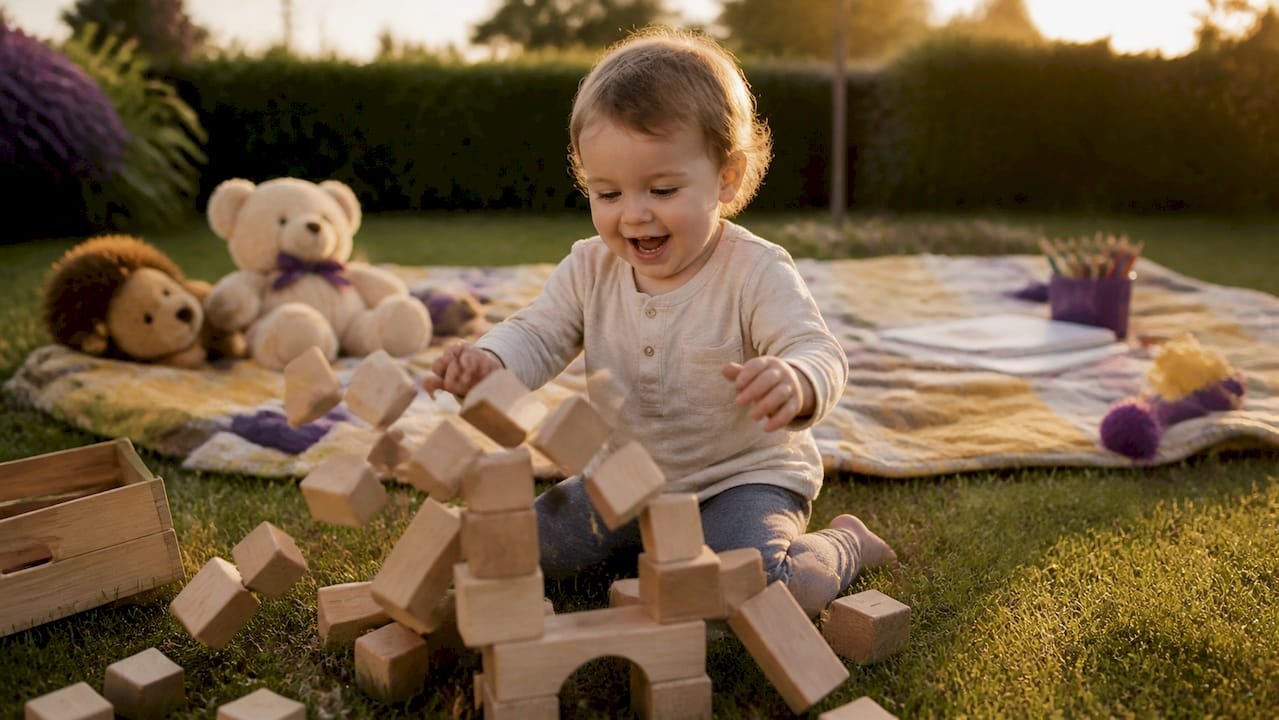
Goal: Action words and cause-and-effect language. Materials: Blocks or stacking cups. Steps: Stack blocks together while narrating each one (“Up, up, up!”), then let your child knock them down. Narrate the crash (“Boom! They all fell down!”) and rebuild. Repeat 3–4 times.
2. Spoon stir soup
Goal: Pretend play vocabulary and sequencing words. Materials: A pot, spoon, and any safe household items. Steps: Pretend to make soup together. Narrate each ingredient (“In goes the carrot. Stir, stir. It smells good!”). Let your child lead the additions.
3. Sock sort
Goal: Descriptive language (color, size, same/different). Materials: A pile of clean socks. Steps: Pull socks from the pile one at a time and narrate (“This one is blue. It’s a big sock. Let’s find the match.”). Pair them up together.
4. Water pour
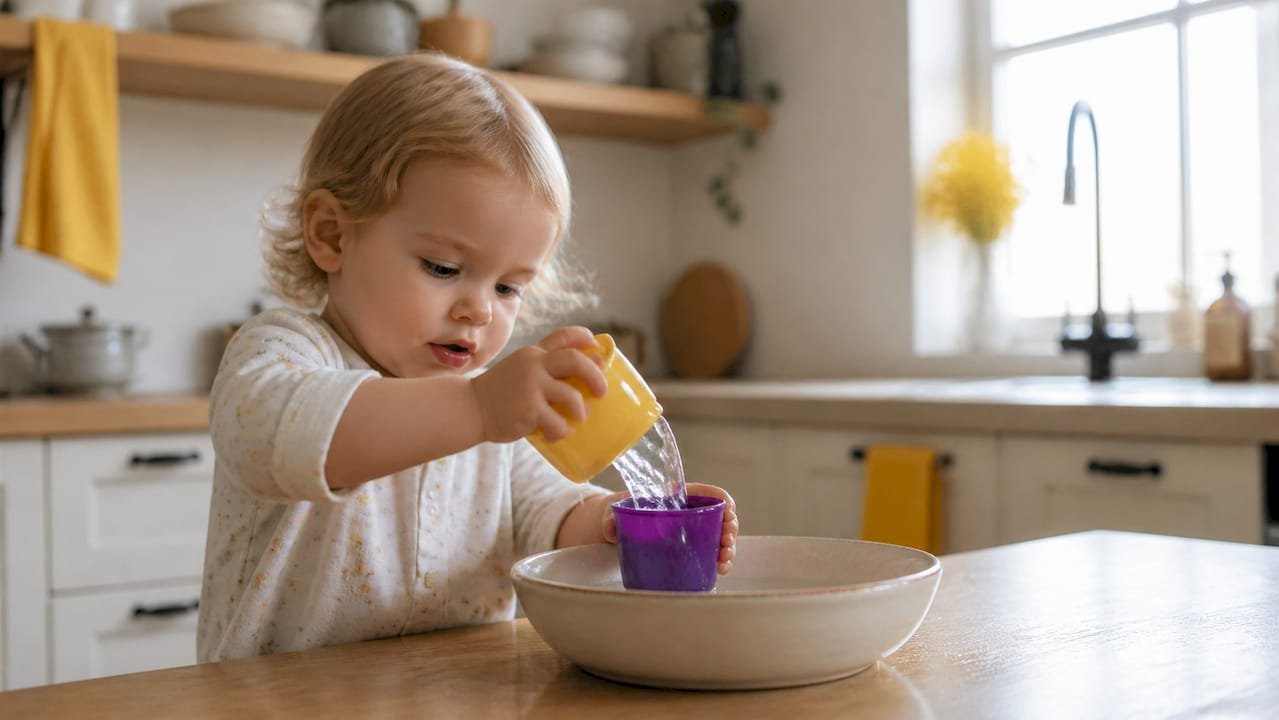
Goal: Spatial and sensory vocabulary. Materials: Two cups and a small amount of water (in the sink or a bin). Steps: Pour water back and forth while narrating (“The water goes in. It’s full. Now it’s empty. Cold water!”). Let your child pour and narrate what they do.
5. Animal parade
Goal: Describing words and action verbs. Materials: Any toy animals or animal picture cards. Steps: Line up the animals and narrate a “parade.” (“The elephant walks slowly. Stomp, stomp. The bunny hops fast. Hop, hop!”) Let your child choose the next animal and narrate its move.
Narration works across all of these play types and fits naturally into short, repeated sessions rather than long dedicated exercises.
The part nobody tells you about narrating play
Most articles on this topic make narration sound effortless. In practice, it feels awkward at first. You’re essentially talking to yourself while a small person ignores you and chews on a block.
What I’ve found, after reading the research and watching how this plays out in real families, is that the parents who stick with it aren’t the ones who do it perfectly. They’re the ones who do it consistently, even when it feels silly, even when their toddler doesn’t respond, even when they forget for three days and start again. The technique works precisely because it doesn’t require a response. You’re planting seeds, not harvesting them in real time.
The other thing worth saying: narration isn’t about filling every quiet moment with words. The pauses are part of the method. A caregiver who narrates three sentences and then waits is doing more for their child’s language than one who talks nonstop. Silence, in this context, is an invitation.
Mooshiemoments makes narrating play easier every day
Knowing the technique is one thing. Having a ready library of age-matched scripts and activities when you’re tired and your toddler wants to play right now is another.
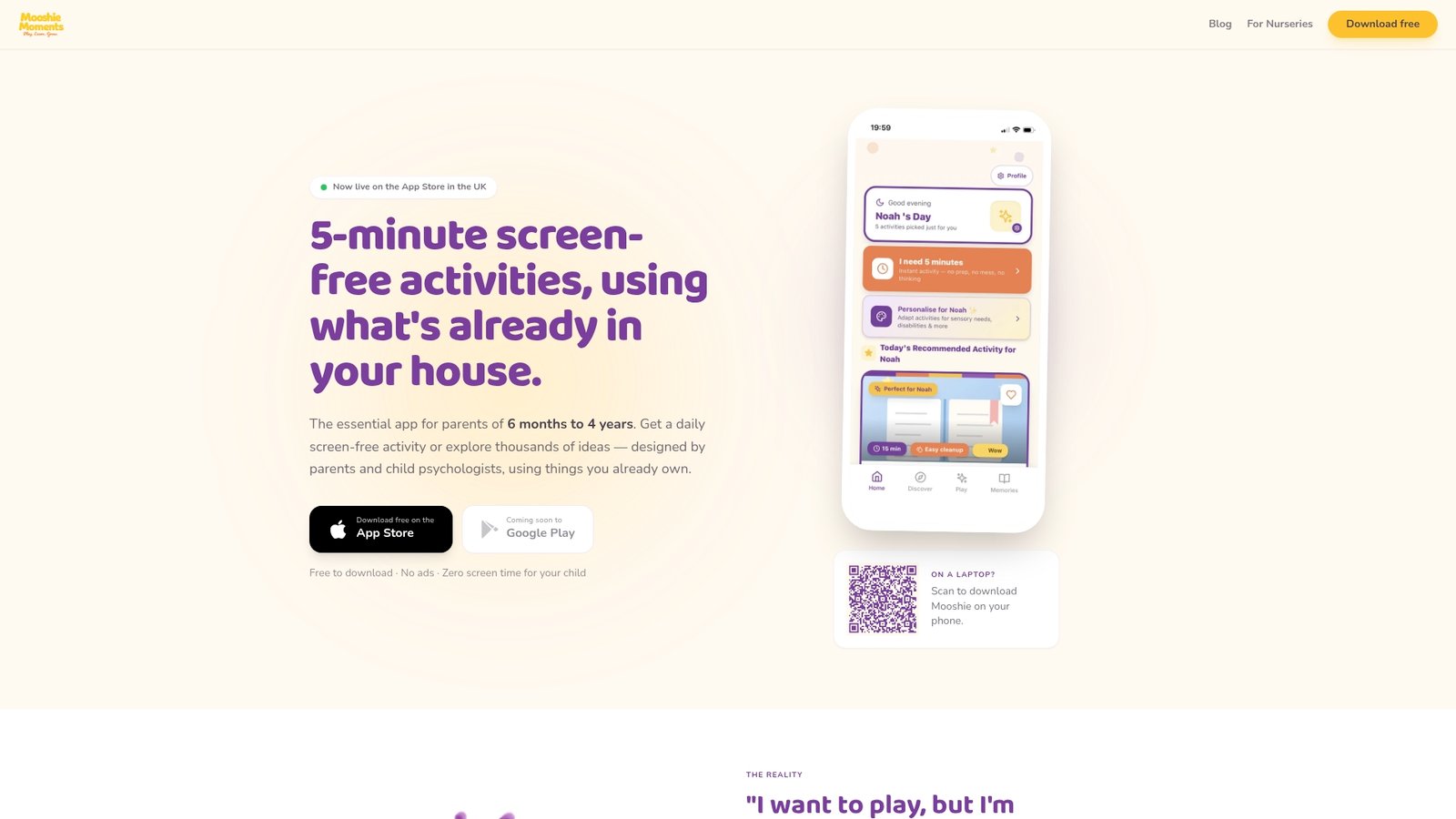
Mooshiemoments is built for exactly that moment. The app gives parents of children aged 6 months to 4 years a large library of screen-free, 5-minute activity ideas that use everyday household items, each with expert-reviewed developmental explanations and narration coaching tips built in. You tell the app your child’s age and how much time you have, and it surfaces activities matched to their language stage, so you’re always modeling at the right level without having to think about it.
Every activity includes the kind of scripted narration lines this article has been teaching, so you’re not starting from a blank page. For nurseries and early years settings, Mooshiemoments also offers partnership packs and printable resources that make it easy to share narration strategies with families at home. Download the app and explore the free activities to get started, or unlock the full premium library for daily, personalized guidance.
Sources
These resources are worth bookmarking for ongoing reference.
- Developmental Milestones | CDC
- Self Talk vs. Parallel Talk — Hear Center
- Activity: Narrating children’s play — NDNA
- Strategy Spotlight: Self Talk, Parallel Talk — Bridges Auditory Verbal Practice
- Self-Talk and Parallel-Talk — Sidekick Therapy Partners
- The Power of Narrating Play: Help Your Child Talk More Naturally — MD Searchlight
Recommended
- Blog – Mooshie
- Screen-Free Toddler Activities in 5 Minutes | Mooshie Moments
- Home Learning Partnership for Nurseries | EYFS Parent Partnership | Mooshie Moments
- Become a Mooshie Affiliate | Creator Partnerships
Want a new idea every day, matched to your child's age?
Mooshie Moments gives you simple, guided play ideas for ages 6 months to 4 years.
Download free on the App StoreMore like this
Ice Play Activities for Toddlers: 12 Easy, Safe Ideas
Simple ice play activities for toddlers using things you already have at home, with safety tips for choking and cold, plus ideas…
Cardboard Box Toddler Activities: 12 Ideas by Age
Twelve cardboard box activities for babies and toddlers, sorted by age, with safe prep tips and ideas for tubes too. No shopping,…
Best Boredom Busters for Toddlers: Easy, Screen-Free Ideas
Screen-free boredom busters for toddlers using things you already own: quick ideas by time and energy, set-up tips and honest advice for…