Cardboard Box Toddler Activities: 12 Ideas by Age
Updated 18 October 2026 · 10 min read
The best cardboard box activities for toddlers are the simplest ones: hand over an empty box, add one prompt like “in, out” or “your turn”, and follow your child’s lead. Below you’ll find twelve ideas sorted by age, from kicking and posting at six months to shops, robots and obstacle courses at four. We’ve also added a section on cardboard tubes, plus the safety checks worth doing before play starts.
No shopping needed. Most of us have a delivery box in the hallway right now.
TL;DR
- Boxes work for every age from babies to four-year-olds. The same box can be kicked, posted into, crawled through, pushed, drawn on and turned into a shop.
- Keep prep tiny. Offer the box first, then follow your child’s idea. One prompt is plenty.
- Your talking matters more than the box. NHS guidance says children learn more from an adult joining in than from a toy alone.
- Do the cutting yourself, before your child arrives. Check edges, tape flaps, remove staples and plastic, and keep small items away from under-threes.
- Repetition is a feature. Posting the same object fifty times is practice, not boredom.
Table of Contents
- Why a plain box is such good play
- Before you start: prep and safety
- Box activities for babies, 6 to 12 months
- Box activities for 1 to 2 year olds
- Box activities for 2 to 4 year olds
- Cardboard tube activities
- How to make box play last longer
- Our view: you are the best part of the box
- When you want more ideas in the moment
- FAQ
- Sources
Why a plain box is such good play
A toddler doesn’t need a toy that does something. A box does nothing, so your child decides what it is. That’s the point.
The NHS suggests boxes for junk modelling, sorting, pretend play, drawing and construction, and notes that toddlers don’t need lots of toys or devices. For ages 2, 3 and 4 it lists old cardboard boxes as a simple alternative.
The same box also grows with your child. ZERO TO THREE and HENRY both show how one box can be kicked by a baby, posted into by a one-year-old and decorated or pretended with by an older toddler. For a tired adult, that is the real win. You can reuse one box across several days instead of inventing a new activity each time.
Before you start: prep and safety
This part takes five minutes and it matters.
- Cut first, play second. Make doors, windows, slits and tube halves yourself, then put scissors and box cutters away straight away.
- Check every edge. Run a hand along cut edges, tape down loose flaps and bin any damaged cardboard.
- Remove extras. Take out staples, plastic wrapping and anything that could come loose.
- Choose objects that can’t be swallowed. For babies and younger toddlers, swap small balls and pom-poms for a large scrunched paper ball, a rolled-up sock or unbreakable household items that can’t fit in a child’s mouth.
- Stay close. Supervise the whole time. Never let a child walk about with a cardboard tube in their mouth.
- Know the battery rule. UK guidance says to keep sharp edges, small parts and button batteries away from little ones. If you think a child has swallowed a button battery, the NHS says to go to A&E immediately or call 999.
Where do you find boxes? HENRY suggests supermarkets, DIY stores and local shops, which will often give away used boxes for free.
Box activities for babies, 6 to 12 months
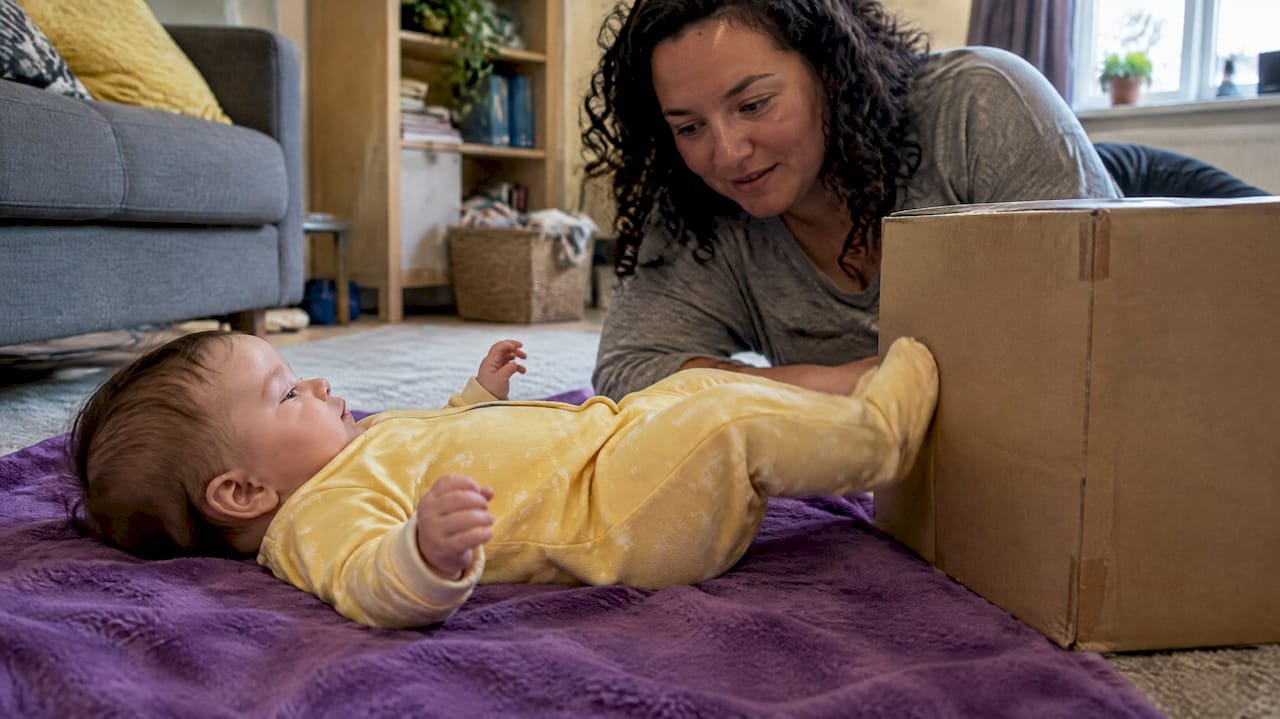
1. Kicking box
Place a sturdy box within kicking distance of your baby, on their back or sitting supported. Their feet will find it. HENRY recommends a kicking box and a posting box for this age.
Talk as they kick: “Bang! Kick! Again!” You are giving them words for what they just did.
2. Posting box for babies
Cut a hole in the top. Show your baby how to drop safe, unbreakable household objects through it, then help them get the objects back out. Offer a mix of soft and hard items, because the different noises are half the fun.
Try placing an object just out of reach. That nudges your baby to stretch, crawl or pull up to get it.
3. Texture box
This one needs a little more prep. BBC Tiny Happy People suggests an empty box, six different household materials, and glue or tape. Attach each material firmly to an outside face. Preparation takes around 15 minutes.
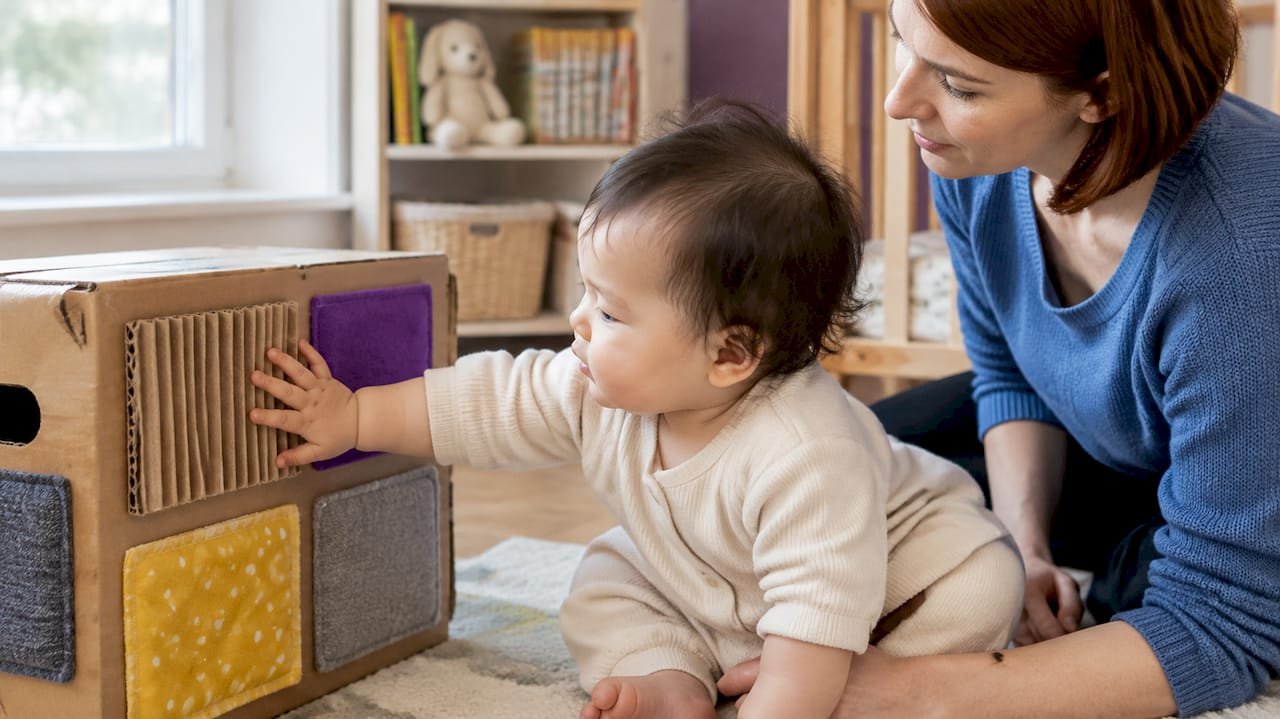
Sit with your baby, talk about each texture and follow where they go. Keep sharp or small bits out of reach, and stay with them throughout. If textures are your thing, our sensory play ideas need no new toys either.
Box activities for 1 to 2 year olds
4. Posting by category
Same box, new challenge. Sort what goes in: big things and small things, or things of one type. HENRY gives posting by color, size or object type as an idea for this age band. We have more in our guide to sorting activities for toddlers.
5. Box car
Open the top and let your toddler push, pull, park and load it. A teddy makes a good passenger. Short loops round the living room are plenty. Pushing a box is also good practice for balance and early walking, which links nicely with our ideas on hand-eye coordination.
6. Tunnel
ZERO TO THREE describes a tunnel made from two boxes opened at both ends and taped together. Crawl through first yourself. Peek-a-boo from the far end is an instant hit.
7. Stacking box blocks
Tape the tops of about ten boxes of different sizes closed and you have giant building blocks, according to ZERO TO THREE. Build a tower together, then let your toddler knock it down. Knocking it down is not a failure. It is the experiment.
Box activities for 2 to 4 year olds
Older toddlers bring ideas. This is where “follow their lead” pays off, because they will decide what the box is.
8. House, shop or oven
Cut a door and a window and your box becomes a house. Add a slot for a shop counter, or draw dials on the side for an oven. Raising Children Network suggests house play, a puppet theatre, a robot costume, a plane or a car for ages 2 to 6. Ask questions like “Who lives here?” or “What’s on the menu today?”
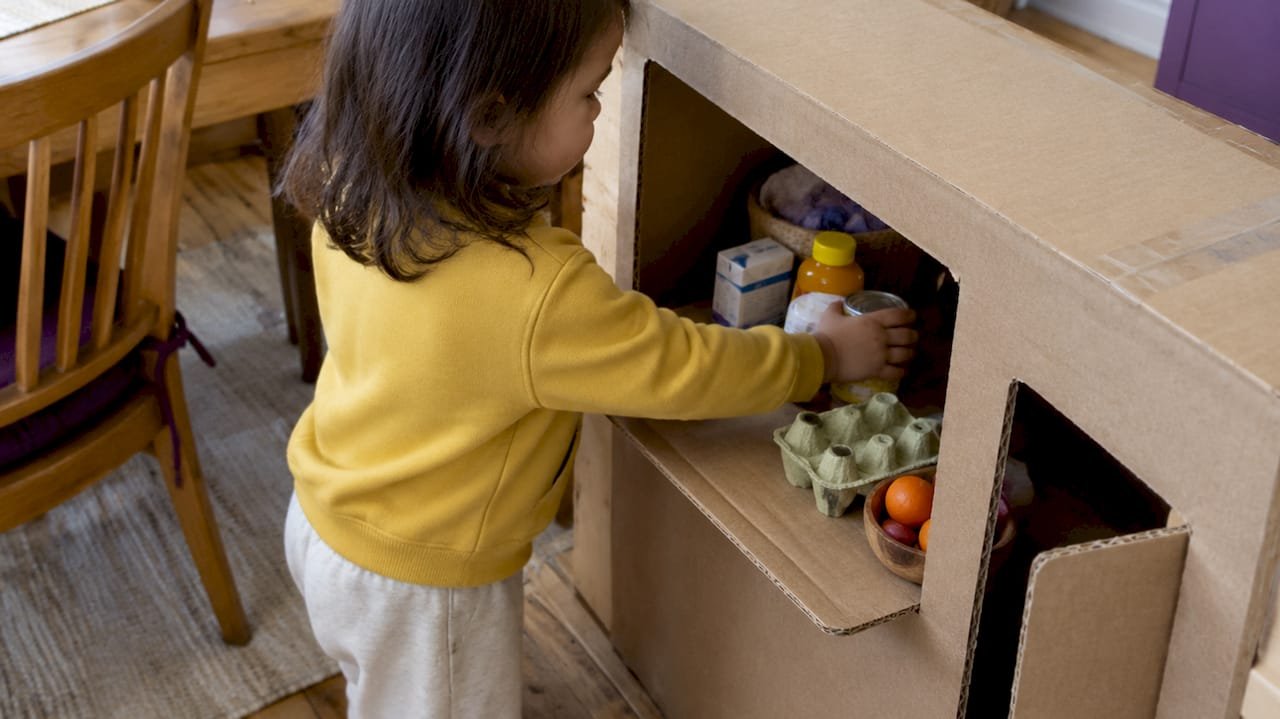
Pretend play is brilliant for language, and our guide to narrating play shows how to add words without taking over.
9. Sort, match and count
Use a few boxes as “homes” for different groups of objects: socks here, spoons there. For three-year-olds, the NHS-linked milestone guidance lists matching and sorting games and play with bricks and boxes among activities to try. Counting in the objects as they go in adds a number layer. More ideas in toddler counting games.
10. Obstacle course
Lay out a box to step over, a tunnel to crawl through and a box to climb into. For a two-year-old, the local NHS milestone list includes running and stopping, jumping with both feet and walking up or down steps, so a short course gives them somewhere to practice. Keep it low and soft underfoot.
11. Junk modelling
Give your child crayons, washable pens, tape and a few extra bits of cardboard and let them make something. A robot, a rocket, a monster. Don’t ask for a finished product. If you’d like more prompts, see our junk modelling ideas for toddlers.
12. Cozy reading corner
A big moving box with a soft blanket becomes a reading nook. ZERO TO THREE calls it a cozy corner. It’s a calm option for the end of a busy afternoon, and you can fit in with a book too.
Cardboard tube activities
Kitchen roll and wrapping paper tubes are the box’s best friend.
Posting down a tube. Hold a tube upright or at a slant and let your toddler drop an object in. Tākai explains that this game teaches anticipation through repetition and touches on problem-solving and early science ideas such as gravity and momentum. Name the actions: “in”, “out”, “again”, “fast”, “slow”. Then pause, and let your child take a turn.
A ball run. BBC Tiny Happy People’s homemade ball run can take up to 20 minutes to set up. Cut tubes lengthways, make a large ball from paper, foil or a sock, and tape the tubes in a downward line. Put a bowl at the bottom to catch the ball, test it, and take turns. The BBC warns that small balls can be a choking hazard, so make sure the ball is too big to fit in a toddler’s mouth.
Homemade skittles. If you have milk or juice cartons, BBC Tiny Happy People shows how to make skittles for a bowling game with counting and turn-taking built in.
How to make box play last longer
Some simple habits keep a box interesting for days.
- Offer the box before you decorate it. The quickest setup is usually the least decorated. Your child may have a better idea than you.
- Add one prompt only. “In, out.” “Fast, slow.” “Your turn.” That’s it.
- Let them repeat. Posting the same object again and again lets a toddler predict what will happen, test cause and effect, and hear useful words over and over, as Tākai describes.
- Rotate, don’t replace. Put the box away for a few days and bring it out again with a new hole, a new door or a blanket.
- Recycle with them. When the box is soggy and done, flatten it together. That counts as play too.
As your child grows, open-ended thinking games build on this kind of play. Parents of four- to nine-year-olds might like these critical thinking activities for ages 4 to 9 for what comes next.
Our view: you are the best part of the box
We built Mooshie Moments for parents who are tired and short on ideas, so we have strong feelings about cardboard boxes. We love them because they ask so little of you.
Here is what we believe. The box isn’t the activity. You are. When you name what your child is doing, wait for their turn and laugh at the tower falling over, you are doing the developmental work. NHS guidance and BBC Tiny Happy People both point to the same thing: adult talking, naming and joining in turn a household object into a rich learning moment.
That’s why our activities explain the “why” in plain language and use things you already have. You shouldn’t need to buy supplies, build a craft station or stare at a screen to get a good ten minutes with your toddler. If your child turns a box into something you didn’t expect, that is not going off script. Raising Children Network says the open-ended choice is part of the value.
So skip the Pinterest-perfect castle. Hand over the box, say “in, out” and see what happens.
— samit
When you want more ideas in the moment
Boxes are great, but we know there are days when even a box feels like too much thinking. Mooshie is our free-to-download app for parents and caregivers of children aged 6 months to 4 years. You choose your child’s age and how much time and energy you have, and it suggests a quick, screen-free activity using things already in your home, with a plain-language explanation of what it helps your child learn. Take a look at Mooshie.
If you work in a nursery, preschool or childminding setting, we also offer a Partnership Pack and home-learning resource for your families.
Want to browse first? Our guide to low prep toddler activities by skill area is a good place to start, and no-toy activities is full of other things to do with what you’ve got.
FAQ
What age can toddlers start playing with cardboard boxes?
Babies can play from around six months. Try a kicking box or a posting box with unbreakable objects too big to fit in their mouth, as HENRY suggests. Stay right beside them the whole time.
How do I keep my toddler safe with cardboard?
Do all cutting before play and check every edge. Tape down loose flaps and remove staples, plastic and damaged cardboard. Keep small items and button batteries away from young children, and supervise throughout, as the NHS advises.
Do I need to decorate the box?
No. The least decorated setup is often the best one. Offer the box first and see what your child does with it. If they want to draw on it, give them washable pens or crayons.
What can I do with cardboard tubes?
Post objects down them, build a ball run or turn cartons into skittles. Use a ball that is too big for your toddler’s mouth, as BBC Tiny Happy People recommends. Tubes should never be carried around in the mouth.
How long will my toddler play with a box?
It varies a lot, and short bursts are normal. Repeating one game is a good sign, not a sign of boredom. You can bring the same box back out over several days with a small change.
Sources
- Baby and toddler play ideas, NHS
- Let’s play with a cardboard box, HENRY
- 5 Ways to Play With a Cardboard Box, ZERO TO THREE
- Playing with cardboard boxes: 2-6 years, Raising Children Network
- Homemade ball run for toddlers, BBC Tiny Happy People
- How to make a little baby sensory box, BBC Tiny Happy People
- Homemade skittles, BBC Tiny Happy People
- Posting down a tube, Tākai
- 3 year developmental milestones, Bedfordshire and Luton children’s health
- 2 year developmental milestones, Bedfordshire and Luton children’s health
Recommended
- UK Parents: Low Prep Toddler Activities by Skill Area in 2–15 Minutes
- 12 Low Prep Toddler Activities for Grandparents With Seated Options
- Babysitting Toddlers: 12 Low Prep Ideas and Why They Help
- Busy Parents: 12 No Prep Shopping Activities for Toddlers
Want a new idea every day, matched to your child's age?
Mooshie Moments gives you simple, guided play ideas for ages 6 months to 4 years.
Download free on the App StoreMore like this

Ice Play Activities for Toddlers: 12 Easy, Safe Ideas
Simple ice play activities for toddlers using things you already have at home, with safety tips for choking and cold, plus ideas…
Best Boredom Busters for Toddlers: Easy, Screen-Free Ideas
Screen-free boredom busters for toddlers using things you already own: quick ideas by time and energy, set-up tips and honest advice for…
12 Low Prep Balloon Activities for UK Toddlers That Build Skills
Explore 12 low prep balloon activities for UK toddlers, with quick games, easy crafts, age adaptations, and safety advice to build movement…