Ice Play Activities for Toddlers: 12 Easy, Safe Ideas
Updated 19 October 2026 · 10 minute read
Ice is one of the cheapest, quickest ways to get a toddler curious. You need a freezer, a bowl and a few minutes of your attention. Below you’ll find 12 ice play activities for toddlers, how to adapt them for babies and older toddlers, and the safety points we’d want every parent to know before the first cube comes out.
The rule that matters most: ice play is something you do with your child, sitting beside them, not something that keeps them busy while you do the dishes.
TL;DR
- Ice play works best for ages 1 to 4 with an adult sitting right there, talking about cold, slippery, hard and melting.
- Most ideas need only things from your kitchen: ice cube trays, a bowl, a baking tray, food coloring or a few flowers from the garden.
- Watch the size of the ice. As it melts it can reach choking size, so keep it large or stay close. For babies, use a sealed freezer bag.
- Keep a small amount of water in the bowl and stay within arm’s reach. Teach early that ice play is for the kitchen floor or garden, never for ponds or lakes.
- Start with two or three of the ideas below. You do not need all twelve.
Table of Contents
- Why ice is such good play for toddlers
- Before you start: safety first
- 12 ice play activities for toddlers
- A quick guide by age
- Setting up in five minutes
- What to say while you play
- When ice play is a good reset
- Our view: it’s not about the ice
- Want a new idea every day?
- FAQ
- Sources
Why ice is such good play for toddlers
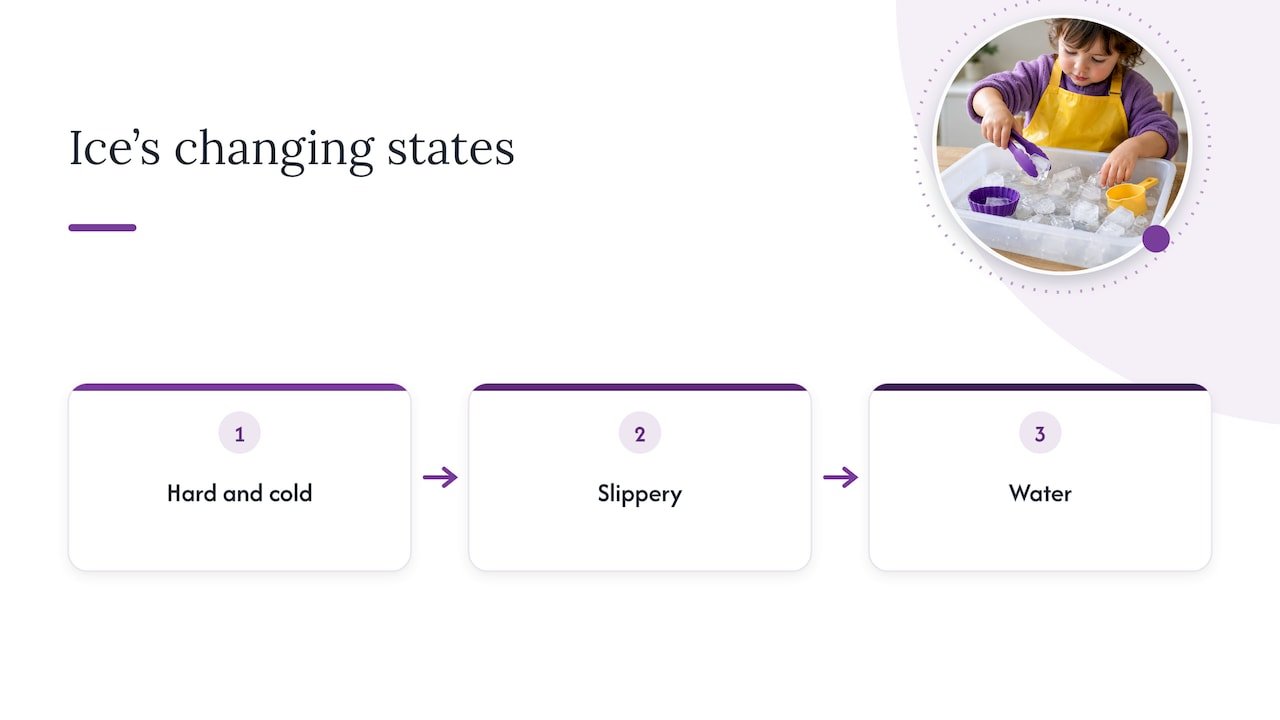
Ice changes while your child watches. It starts hard and cold, then turns slippery, then becomes water. That is a lot of learning packed into one ice cube.
Early years resources describe ice play as a way for children from birth to 5 to build sensory awareness, reasoning and early math ideas like prediction and states of matter, without any special toys. A big block of ice can hold interest for 45 minutes to an hour, though a toddler squeezing in ice play between lunch and a nap will often be done in 5 to 10.
The bigger win is language. According to early years educators at LEYF nurseries, the value is less in the activity and more in what you say as it happens: cold, smooth, shiny, melting, drip. Your toddler hears those words attached to something they can feel right now. That sticks far better than a flashcard.
There is a calming side too. Sensory activities like exploring cool, changing ice can help children settle and regulate big feelings, which is handy in the tricky late-afternoon stretch. If you want more ideas for that part of the day, our 5 minute calming activities for toddlers are screen free and low prep.
Before you start: safety first
Ice is simple, but three risks are worth thinking through. None of them need to put you off. They just shape how you set things up.
Choking: size changes as ice melts
UK safety guidance says anything smaller than a 50p coin is a choking risk for children under 5, and the Antrim and Newtownabbey council guide to preventing choking, suffocation and drowning lists small items to keep out of reach. Ice is easy to forget, because a large cube that is fine at the start becomes a small, slippery piece as it melts.
Practical rules we’d use:
- Start with big pieces: a large block, a loaf tin of ice, a muffin-tin disc. Skip crushed ice and tiny chips.
- Check the pieces as the session goes on. Take out any that have shrunk to about 50p size.
- Some parents’ guides go further and say that ice cubes are a choking hazard for under 3s. If your child still mouths everything, use the bag method below.
- If you want something your toddler can put in their mouth, choose a taste-safe idea instead. We cover those in taste safe sensory play for mouthing toddlers.
Water: keep it shallow and stay close
Ice play gets wet. The NHS safety in and around water guidance reminds parents that children can drown quickly and in small volumes of water, and that supervision needs to be constant. So keep the water in the tray shallow, empty it when you finish, and never leave the room mid-activity, even for a ringing phone.
Outdoor ice is not play ice
This one is worth saying out loud to your child, even a two-year-old, in very simple words: ice in a bowl is for playing, ice on a pond is not. The Met Office has winter water safety advice about the real danger of frozen water and cold water shock, and RoSPA notes that ice can look stronger than it really is. Say it the same way every time: “Ice is for the tray. Not for the pond.”
Check what you freeze inside it
Frozen small toys, gems and beads are popular in ice play ideas online. For toddlers, choose only big objects that cannot be swallowed. Water beads are a hard no: GOV.UK product safety advice says they should be kept away from children under 5.
12 ice play activities for toddlers
Each idea uses things you probably already have. Times are rough, as every toddler is different.
1. The big ice block (ages 1 to 4, 10 to 40 minutes)
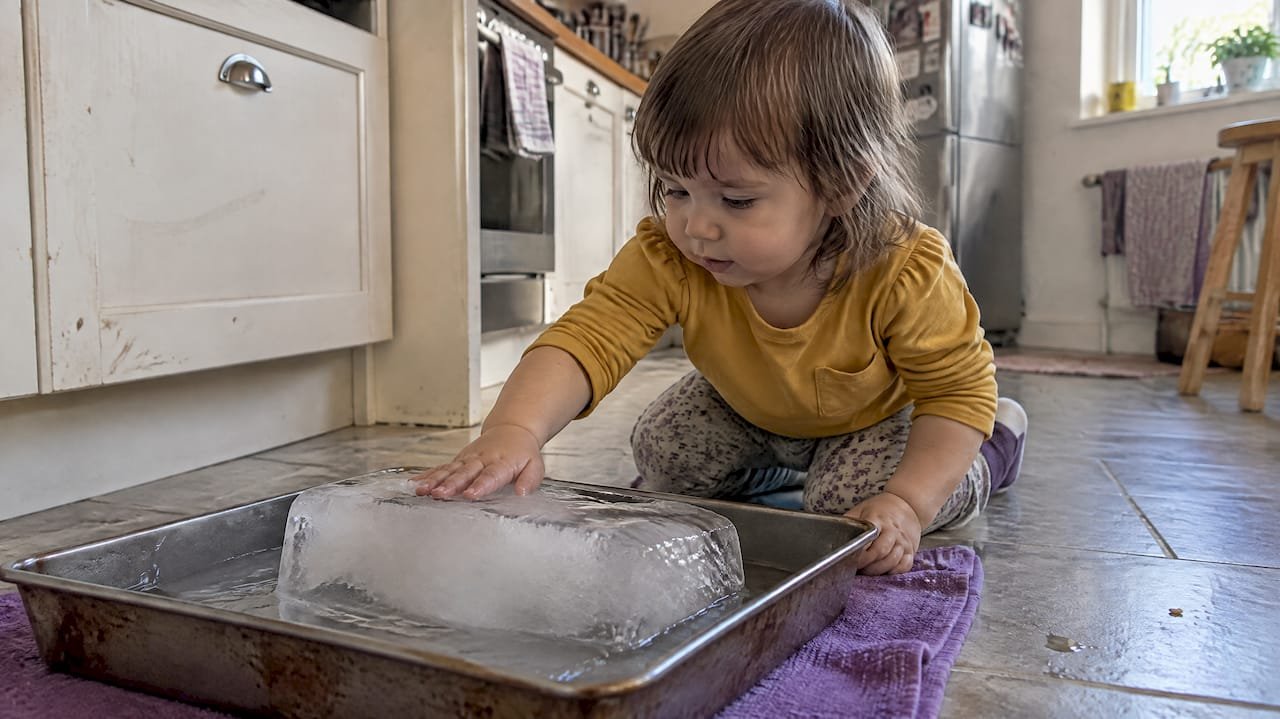
Freeze water in a washing-up bowl, a loaf tin or a large plastic tub. Tip it onto a baking tray or put it outside on the patio. Your child pats, pushes, licks their hands and watches it shine.
A large block is the safest way to play, because it stays big for a long time. Add a small cup of lukewarm water and let them pour it on to see what happens. The South Australian government early years play page suggests exactly this kind of exploring.
2. Ice in a freezer bag (ages 6 to 18 months, 5 to 10 minutes)
For babies, put a few pieces of coloured ice in a sealed, clear freezer bag, check the seal, and lay it on a tray or a towel. Your baby feels the cold, slick surface and watches the colors blur as it melts. There is no mouthing, no puddle and almost no prep, which makes it a good one for a tired parent. LEYF suggests this approach in its sensory ice play guide.
Sit with your baby the whole time and take the bag away if it starts to leak or tear.
3. Coloured ice painting (ages 2 to 4, 10 to 15 minutes)
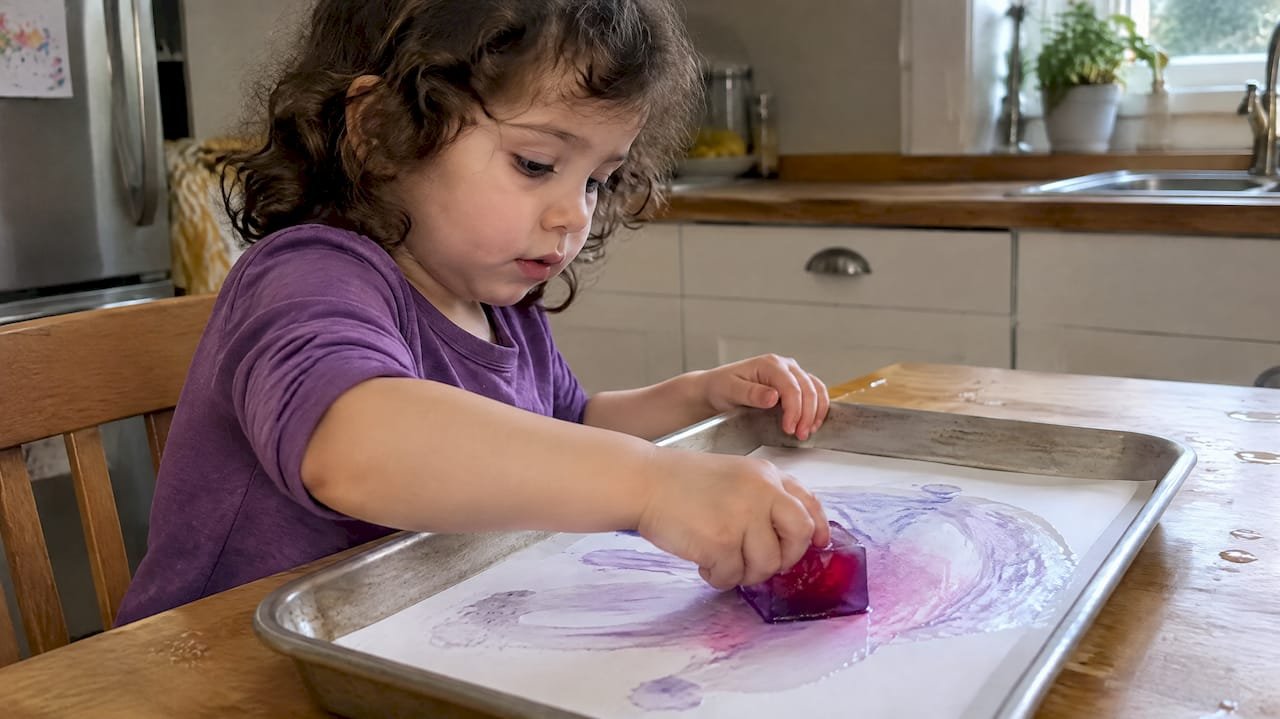
Add a drop of food coloring to water, freeze it in a tray, and let your child rub the cubes across paper. Use large cubes or a muffin tin so the pieces stay big. The color comes off as the ice melts, and the paper gets soft and swirly. Tape the paper to a tray so it does not slide around.
4. Melt the ice with warm water (ages 18 months to 4 years, 10 minutes)
Give your child a plastic squeezy bottle or a small jug of lukewarm water and a big piece of ice. They squirt, watch the ice shrink and talk about what is happening. Early years educators say patience is the biggest hurdle, because toddlers under 2 can get cross when the ice is too hard to break straight away. Warm water turns that frustration into a little experiment.
5. Frozen flowers and leaves (ages 2 to 4, 15 minutes)
Put a few big petals, leaves or garden flowers in a container, cover with water and freeze. In October, autumn leaves from the park work well. Your child can explore the ice as it melts and free the leaves. If you like this one, our autumn activities for toddlers have more seasonal ideas.
Pick flowers you know are safe to touch, and rinse them first.
6. Ice cube transfer (ages 18 months to 3 years, 10 minutes)
Put large ice cubes in a bowl with a spoon, a pair of kitchen tongs and an empty bowl next to it. Scooping, pouring and picking up cold, slippery objects is good hand practice. If you want to build on this, we have a whole hand-eye coordination routine for toddlers that fits into five minutes a day.
7. Ice sensory bin (ages 2 to 4, 15 to 20 minutes)
Fill a shallow tub with a thin layer of cold water and a few large ice pieces. Add a spoon, a cup and a sponge. A school activity sheet from a US university program suggests freezing larger items in containers and adding them to a water table, and the same idea works on your kitchen floor with a towel underneath.
Keep the water really shallow, as covered above, and stay beside your child. For more ideas that fit around water, see our water play ideas for babies and toddlers.
8. Frozen scoops of color (ages 2 to 4, 10 minutes)
Freeze water in a muffin tin with three different food colorings. Ask your toddler to put the red discs in one bowl and the blue ones in another. It doubles as a sorting game; for more of that, try our color sorting activities.
9. Ice and salt experiment (ages 3 to 4, 10 minutes)
Sprinkle a little table salt on a big ice piece and watch together. Your child may notice it start to melt faster. Do not make a big science lesson of it: say “look, the ice is getting wet” and let them guess why. Keep the salt away from their mouth and eyes, and wash hands after. More ideas like this live in our STEM and science activities for toddlers.
10. Which melts first? (ages 2 to 4, 15 minutes)
Put one ice piece in the sun by a window, one in a bowl on the table and one in a bowl in the shade. Ask your toddler to guess which will go first. Check back every few minutes. Predicting is an early math skill, and your child doesn’t need to get it right.
11. Seated ice play (all ages, 10 to 20 minutes)
Put a big block of ice in a shallow tray on a table or a lap tray, so your child can play from a chair, a high chair or a wheelchair. Nothing is on the floor and everything is in reach. Our wheelchair-friendly and seated activities for toddlers page has more ideas like this.
12. Ice with a story (ages 2 to 4, 5 to 10 minutes)
Freeze a large, hollow ice “cave” in a cup or a bowl, then let a toy animal “live” in it. Ask what happens when the sun comes out. Use big toys only, nothing small enough to swallow. It’s a great use of ice at bedtime-adjacent moments when you want something quiet.
A quick guide by age
| Age | Best ice idea | What to watch |
|---|---|---|
| 6 to 12 months | Sealed freezer bag (idea 2) | No loose ice, check seal, stay beside them |
| 12 to 24 months | Big ice block, warm water squirts (1, 4) | Pieces shrinking to 50p size, shallow water |
| 2 to 3 years | Ice painting, transfer, sensory bin (3, 6, 7) | Mouthing, wet floors, cold hands |
| 3 to 4 years | Salt, melt races, prediction games (9, 10) | Salt near mouth and eyes, outdoor ice talk |
We have kept these age bands loose on purpose. Some 2-year-olds are ready for the sensory bin, some 3-year-olds still put everything in their mouths. You know your child best.
Setting up in five minutes
The parents we hear from rarely have time for elaborate prep. Here is the quick version.
- The night before: fill a bowl, loaf tin or muffin tin with water, add color if you want, and put it in the freezer.
- Lay a towel on the floor or tray, or play in the garden or on a hard kitchen floor.
- Gather a spoon, a cup, a sponge and a small jug of lukewarm water.
- Sit down at your child’s level and put your phone out of reach.
- Talk about what you both see and feel: cold, slippery, shiny, drip, melt.
- Tidy up by tipping the water down the sink or onto the plants and putting the towel in the wash.
If your toddler has had enough after two minutes, that is a fine session. Put the ice away and try again tomorrow.
What to say while you play
You don’t need a script. Short, repeated words work best for toddlers.
- Feel: “Cold! Ooh, slippery.”
- See: “Look, it’s shiny. Now it’s getting smaller.”
- Do: “Push it. Pour it. Squeeze.”
- Wonder: “Where did the ice go? Is it water now?”
Pause after each phrase and wait. Your child may answer with a word, a sound or a point, and each one counts. The NHS baby and toddler play ideas page makes the same point: play does not need to be difficult or expensive.
When ice play is a good reset
Ice is a handy tool on grumpy days. The cool temperature and slow change give a child something quiet to focus on. If you want to read more about how sensory play supports self-regulation, this parent’s guide to sensory play and child development is a good companion read.
A few honest caveats. Some toddlers hate the feeling of cold or wet hands, and that is normal. Let them watch you first, offer a spoon so they do not have to touch, or try the sealed bag. If your child is sensitive to textures and you want predictable, calm routines, our autism activities for toddlers page has gentler, structured ideas. And if ice play is not working, our sensory play ideas that need no new toys offer other things to try.
Our view: it’s not about the ice
We built Mooshie Moments for tired parents who want to play with their toddler but can’t think of anything at 4pm on a Tuesday. Ice play is a good example of what we mean. There is nothing to buy and almost nothing to prepare, yet the activity holds a lot of learning: words, early science, hand control, patience.
What we have noticed is that the activity is rarely what makes it work. It’s the five minutes where you are actually there. You are not scrolling, not tidying, just sitting on the floor with a bowl of ice and a small person who is very, very interested in how it feels. That is the kind of play we want to make easy: real, unhurried and screen free.
So don’t worry about doing ice play “properly”. Pick one idea, keep the pieces big, stay close, and describe what is happening. That is already a great session.
— samit
Want a new idea every day?
If ice play has you wondering what else you can do with what is already in your kitchen, that is exactly what the Mooshie app is for. Tell it your child’s age and how much time and energy you have, and it suggests a quick, screen-free activity using household items, with a plain-language explanation of why it helps your child’s development. Browse our low prep toddler activities by skill area to see the kind of ideas inside.
Working in a nursery or as a childminder? Take a look at our activities for nurseries, daycare and childminders.
FAQ
Is ice safe for toddlers to play with?
Yes, with the right setup. Keep the pieces big, check them as they melt so none shrink to about the size of a 50p coin, keep water shallow, and stay within arm’s reach. For babies and children who still mouth everything, use a sealed freezer bag instead of loose ice.
What are some fun activities with ice for toddlers?
Good starters are a big ice block with a jug of lukewarm water, coloured ice painting on paper, frozen flowers or leaves to free as they melt, and an ice transfer game with a spoon and two bowls. Each takes five to fifteen minutes and uses things from your kitchen.
Can babies play with ice?
Babies from about 6 months can feel ice safely through a sealed, clear freezer bag, which keeps it out of their mouth and stops puddles. Check the seal and stay beside them. Loose ice is best avoided because it is slippery and can become a choking risk.
How long should ice play last?
Follow your child. A big block of ice can keep an older child busy for up to an hour, but a young toddler is often done in 5 to 10 minutes. Stop when interest fades or the pieces get small.
What can I do if my toddler dislikes the cold?
Offer a spoon, tongs or a cup so they do not have to touch the ice, or let them watch you play first. The sealed bag works well too. Never force it: try again another day, or pick a warmer sensory idea.
Sources
- A big block of ice, South Australian Department for Education
- Sensory ice play, LEYF Nurseries
- Sensory Play Activities at Home, NYSCI
- Preventing Choking, Suffocation and Drowning, Antrim and Newtownabbey Borough Council
- Cool Off with a Baby-Friendly Ice Sensory Activity, Hands On As We Grow
- Safety in and around water, NHS Better Lives Healthy Futures
- Winter water safety, Met Office
- Winter water safety tips, RoSPA
- Product Safety Alert: Water Beads, GOV.UK
- Activity Share: Ice Sensory Bin, Fullerton
- Baby and toddler play ideas, NHS
Recommended
- Babysitting Toddlers: 12 Low Prep Ideas and Why They Help
- No New Toys Needed: Sensory Play Ideas Parents Can Use With Toddlers
- Water Play Ideas for Babies and Toddlers
- UK Parents: Low Prep Toddler Activities by Skill Area in 2–15 Minutes
Want a new idea every day, matched to your child's age?
Mooshie Moments gives you simple, guided play ideas for ages 6 months to 4 years.
Download free on the App StoreMore like this
Cardboard Box Toddler Activities: 12 Ideas by Age
Twelve cardboard box activities for babies and toddlers, sorted by age, with safe prep tips and ideas for tubes too. No shopping,…
Best Boredom Busters for Toddlers: Easy, Screen-Free Ideas
Screen-free boredom busters for toddlers using things you already own: quick ideas by time and energy, set-up tips and honest advice for…
12 Low Prep Balloon Activities for UK Toddlers That Build Skills
Explore 12 low prep balloon activities for UK toddlers, with quick games, easy crafts, age adaptations, and safety advice to build movement…