Pretend Play Ideas for Toddlers Using Things at Home
The best pretend play ideas for toddlers need no shopping. A banana becomes a phone, a towel becomes a cape, a plate becomes a steering wheel, and your job is simply to follow your child’s lead and say what you see. Below you’ll find ideas sorted by age, what to do and say when you join in, and how to keep it quick on the days you have almost nothing left in the tank. If you’d like a fresh idea matched to your child’s age and the minutes you have, we built Mooshie for exactly that.
TL;DR
- Everyday objects work as well as toys: a banana phone, a teddy tea party and a plate steering wheel are all BBC Tiny Happy People suggestions.
- Follow and copy your child, take turns, and describe what is happening instead of quizzing them.
- Start small: dolls and teddies around 14 to 15 months, small-world play (little figures and animals) around 18 months, then characters and stories from two.
- Keep props few. Early years guidance says not to overload the box.
- Real play with you is the aim: UK guidance on screen time for under-fives points to play and conversation as what builds language and social skills.
Table of Contents
- What pretend play is, and why it matters at this age
- Pretend play ideas with things already in your kitchen
- Ideas by age: what to try and when
- How to join in without taking over
- Keep the props few
- Ideas for grandparents, aunties, uncles and other carers
- When you want less screen time
- A five-minute pretend play routine
- Our view: why a good idea at the right moment is what parents need
- Mooshie for the days you need an idea fast
- Where to go next
- FAQ
- Sources
What pretend play is, and why it matters at this age
Pretend play is when your child makes one thing stand for another, or acts out something they have seen. Feeding a teddy, talking into a banana or driving a cushion all count. It looks like silliness, and it is also hard work for a small brain.
According to BBC Tiny Happy People, pretend play lets toddlers experiment with language, take turns, solve problems creatively, pick up vocabulary and begin to understand another person’s point of view. A teddy that needs feeding gives your child a reason to use words they have heard you say, and to look after the doll the way adults look after them.
The Waltham Forest Early Years Guidance for two-year-olds says everyday role play supports imagination, creativity, social skills and problem-solving, especially when children recreate things they have seen or experienced. That is why the best themes are the boring ones: making tea, shopping, cooking, putting someone to bed. Your toddler already knows these routines, so they can act them out.
The UK government’s Best Start in Life screen time guidance adds that play, simple games and back-and-forth conversation help build language, problem-solving, self-control and social understanding. In other words, you do not need to be a brilliant entertainer. You need to be there, a few minutes at a time.
Pretend play ideas with things already in your kitchen
These take under a minute to set up. Pick one, and let your toddler change it however they like.
The banana phone call
Hand over a banana, or just your own hand, as a phone. Ring, say hello, and pass it over. BBC Tiny Happy People lists this as an easy first game. Take turns “talking”, then hold it out and wait. Waiting is half the activity: it gives your child space to babble, copy a word or make a sound back.

A teddy tea party
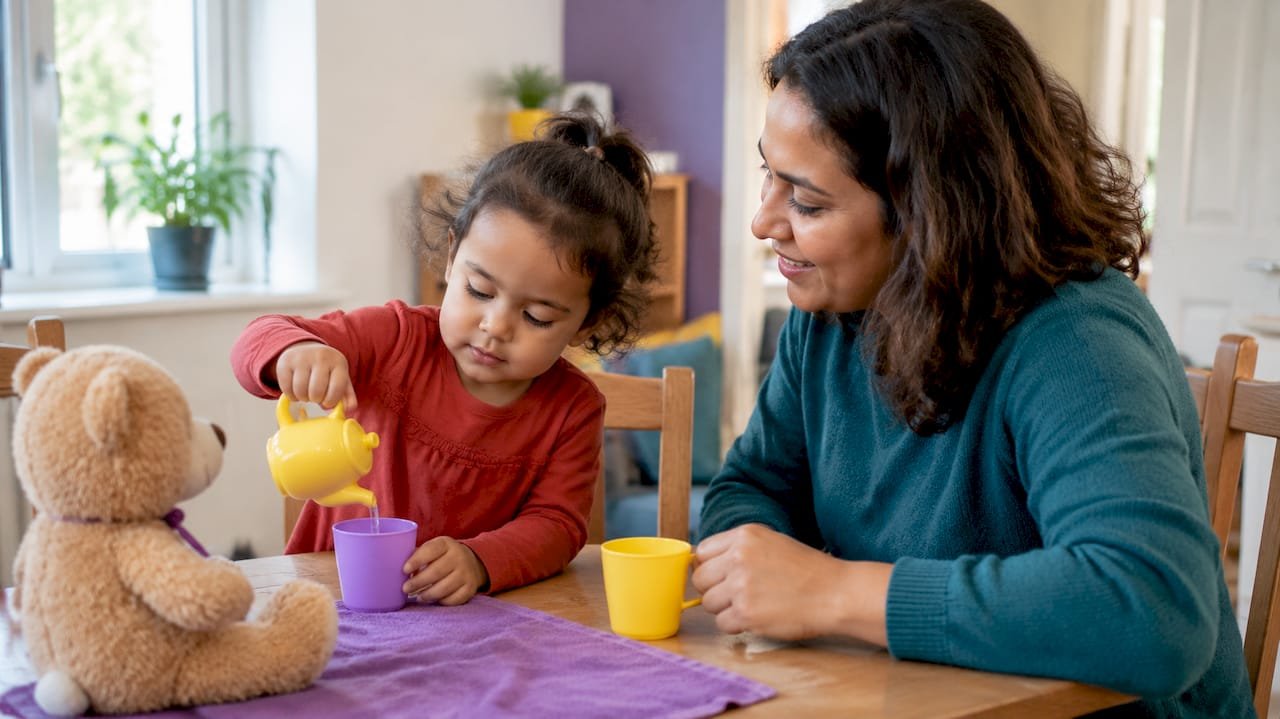
Gather a few favourite toys, a couple of plastic cups and a tea towel for a tablecloth. Tea parties are popular for toddlers because they use something your child already knows well: eating and drinking. Pour pretend tea, say “Ooh, hot!”, and let your toddler decide who gets a turn.
Race car with a plate
A plate becomes a steering wheel and a bowl becomes a helmet. Add engine noises and a destination: the shops, Grandma’s house, the park. This is another one from BBC Tiny Happy People, and it works well with a cushion or a low stool as the car seat.
Kitchen cupboard play
Save the Children UK’s parents’ guide to play names measuring cups, wooden spoons, plastic containers and safe pots as good materials for imaginative play, building and music-making. Give your toddler a wooden spoon and a pot and they will cook, stir, serve and drum. Stick to safe, unbreakable items and stay close while they play.
One towel, five games
Peeple’s everyday play guide points out that a towel can be a picnic blanket for teddies, a den, a cape or a peekaboo prop. Try them in that order. Picnic first, since it is calm. Peekaboo when the energy rises. Cape last, because it usually ends in running.
Boxes and laundry baskets
The same guide suggests that a laundry basket or large box can become a vehicle, a ball pit or a cosy reading nook with books and blankets. Save the Children UK calls boxes, fabric scraps, cushions and clean recycling materials open-ended loose parts: things a child can use in more than one way. A box is a boat today and a bed for the dolls tomorrow. We have a whole page of cardboard box toddler activities by age if you have a delivery sitting in the hall.
Ideas by age: what to try and when
Toddlers do not all hit pretend play at the same moment, and there is no test to pass. Treat the ages below as a rough guide to what tends to interest children at each stage, not a checklist.
| Age | What it often looks like | Easy idea to try |
|---|---|---|
| Around 12 to 14 months | Copying simple actions: “drinking” from a cup, brushing hair | Pretend to sip from a cup and offer it to your child |
| Around 14 to 15 months | Large doll play: cuddling, feeding, putting to bed | A teddy or doll, a blanket and a spoon |
| Around 18 months | Small-world play with little figures, animals or cars | A few toy animals and a tea towel as a field |
| 2 to 3 years | Objects become characters; short stories begin | Socks as puppets, a banana phone, a teddy tea party |
| 3 to 4 years | Longer role play: shops, doctors, cooking | A pretend shop with tins and a bag, or a cafe with a tray |
The 14 to 15 month and 18 month stages come from BBC Tiny Happy People’s pretend play guide. For two to three year olds, their imaginary play tips say socks, toys and ordinary household objects can become characters, and adults can use funny voices and then wait to see how the toddler responds. The other rows are general patterns, so take your child’s cues over the numbers.
For babies from six months
True pretend play comes later, but you can lay the ground. Peekaboo with a towel, “drinking” from a cup and handing it over, and making a teddy wave hello all show your baby that actions can stand for something else. They watch and soak it up long before they copy.
For one-year-olds
Keep it to real-life routines: feeding, sleeping, brushing hair, talking on the phone. Use one prop at a time and repeat the same game for days. Repetition is not boring to a toddler. It is how they get good at it.
For two- and three-year-olds
This is the stage for little stories. A sock puppet gets lost, and your child helps find it. The teddy is hungry, so someone needs to cook. Ask for their ideas by pausing and looking curious rather than firing questions. Our page on problem solving activities for toddlers builds on this, since pretend games are full of small puzzles.
How to join in without taking over
Many parents tell us the hard part is not finding an idea. It is knowing what to do once the banana is in their hand. The research here is reassuring: the simple moves work best.
- Follow and copy. BBC Tiny Happy People frames copying your child as a way to keep them engaged. If they stir, you stir. If they feed the teddy, you feed another teddy.
- Take turns. One go for them, one for you. Turn-taking is also a way of inviting communication, even if their turn is a squeal.
- Describe what is happening. “Teddy is drinking. Mmm, tea!” Naming and commenting let your toddler hear useful words without pressure, rather than turning play into a test with questions, as the Toddler Club guide puts it.
- Ask one simple question at most. “Who is it for?” is plenty.
- Extend a little, never direct. The Waltham Forest guidance says adults can join a child’s play, follow their interests, model language and extend the game without dictating it. If your toddler pours tea, you might hand over a spoon. You do not announce that the tea party is now a restaurant.
If you want more on this, the post on how to narrate play for your toddler’s language growth goes deeper. There is also a helpful read on adult strategies for pretend play that covers following a child’s lead and modelling play without quizzing.
What to say when you run out of words
Tired brains go blank. Keep three phrases in your pocket:
- “Teddy is hungry.” (Describe.)
- “Your turn!” (Take turns.)
- “Oh no, where did it go?” (A tiny problem to solve.)
That is a full pretend game. Add a funny voice if you have the energy, and skip it if you do not.
Keep the props few
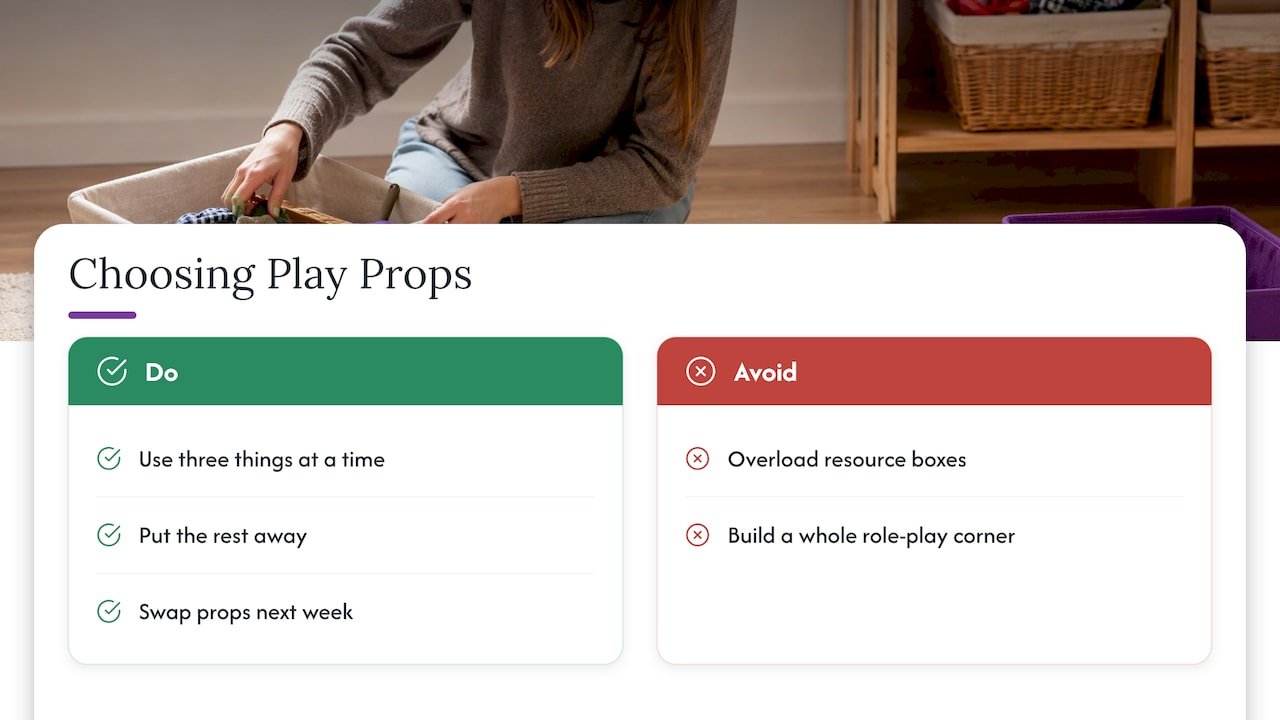
It is tempting to build a whole role-play corner. The Waltham Forest guidance suggests a simple, accessible area and cautions against overloading resource boxes with props. Too many items make it harder for a toddler to settle on one game.
A good rule is three things at a time. For a kitchen game: a pot, a spoon, a cup. For a shop: a bag, two tins, a banana. Put the rest away and swap them in next week. The freshness comes from the change, and you spend nothing.
Save the Children UK makes a point that suits tired grown-ups well: the value of everyday play lies less in the objects than in the adult engagement and the conversation that grows around them. A wooden spoon with you beside it beats a boxed toy on its own.
Ideas for grandparents, aunties, uncles and other carers
You do not need to know the toddler’s favourite character or have a cupboard full of toys. Pretend play works with anyone who is willing to be a bit silly.
- Grandparents: use the routines you already do together. A cup of tea, a phone call, a trip to the shops. Let your grandchild be in charge and you are the customer.
- Aunties and uncles: be the sound-effects person. Engines, animal noises and a dramatic “uh-oh” are very welcome.
- Childminders and nannies: keep one short, repeated game per visit so the child knows what to expect.
More ideas that need nothing at all are in our list of toddler activities with no supplies, and the bonding activities busy parents can do in 2 to 15 minutes are good for the days you only have a few minutes.
When you want less screen time
If you are trying to cut back on screens, pretend play is an easy swap because it asks for so little. The Best Start in Life guidance, last updated on 29 June 2026, advises avoiding screen time for under-twos apart from shared family activities that encourage bonding, interaction and conversation. For children aged two to five, it advises aiming for no more than one hour a day, and less if possible.
A five-minute banana phone call will not replace every screen moment, and it does not have to. It gives you something to reach for when your toddler is bored and you are out of ideas. For more, see our no toy activities for UK toddlers and sensory play ideas that need no new toys.
A five-minute pretend play routine
When you have no energy, a routine takes the thinking out of it.
- Pick the theme from your day. Whatever you just did: breakfast, a walk, a nappy change, a bus ride.
- Grab two or three props. Whatever is within arm’s reach.
- Start, then stop talking. Do one small action, such as pouring tea. Then wait.
- Copy what your child does. Even if it makes no sense to you.
- Describe it in short sentences. “You’re stirring. Stir, stir, stir.”
- Stop when they do. Ending on a good note makes them more likely to ask again tomorrow.
That’s all. No setup, no clean-up beyond putting the pot back in the cupboard.
Our view: why a good idea at the right moment is what parents need
We hear the same thing from tired parents again and again: it is not that you do not want to play, it is that your mind goes blank at 4pm.
That is why we built Mooshie around the moment you are standing in the kitchen with a toddler and five spare minutes. You tell the app your child’s age, how much time you have and how much energy you have left. It gives you a quick, screen-free idea that uses things you already own, so there is nothing to buy and no prep.
Every activity also explains the developmental “why” in plain language, and each idea comes with coaching tips, so you know what to say and what your child is practising. Our activities are expert-reviewed and draw on child-development research.
We think that is the better way to get real play and bonding into a busy day: a small idea, matched to your child, that you can start right now, with your phone put down.
samit
Mooshie for the days you need an idea fast
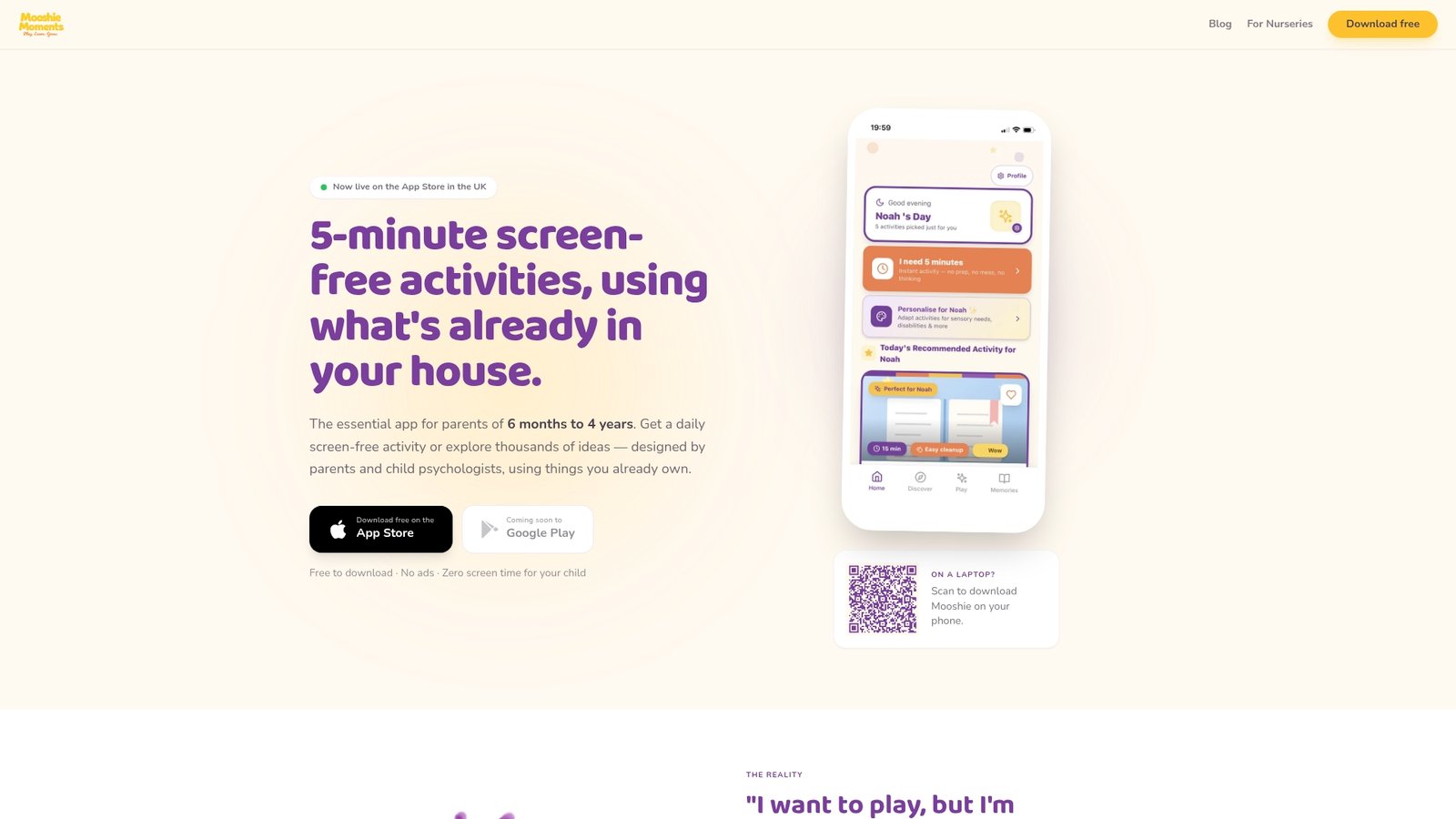
Mooshie is a free-to-download app for parents and carers of children aged 6 months to 4 years. It offers a large library of quick, screen-free activities that use common household items, personalised by your child’s age, your available time and your energy level. Each one comes with an expert-reviewed explanation and coaching tips, so you can see what your toddler is learning while you play.
It works for grandparents and other family members too, so anyone who looks after your child can pick up an idea in seconds. See Mooshie and try today’s idea.
If you run a nursery or early years setting, we also offer a Partnership Pack and home-learning resource for your families.
Where to go next
Pretend play is one piece of a bigger picture. If you like to see how play maps to the early years framework, our guide to EYFS activities at home covers all seven areas of learning. For short ideas sorted by skill, try low prep toddler activities by skill area. And if shopping trips are where your toddler gets restless, there are no prep shopping activities for toddlers.
FAQ
What age should pretend play start?
Simple pretend actions, like “drinking” from an empty cup, can start around the first birthday. According to BBC Tiny Happy People, large doll play appears at around 14 to 15 months and small-world play at around 18 months. Every child is different, so follow what interests yours.
What are some good pretend play items?
Start with what you have: a banana or hand for a phone, a plate for a steering wheel, a towel for a cape or picnic blanket, wooden spoons, safe pots and plastic containers. Boxes, cushions and fabric scraps work because a child can use them in many ways. Three props at a time is plenty.
How do I join in without taking over?
Follow what your child does and copy it, take turns, and describe what is happening. Ask at most one simple question. If your child changes the game, go with it. Your job is to add words and warmth, not to direct the story.
Does my toddler need toys for pretend play?
No. Early years guidance and children’s charities both point to ordinary household items and your attention as what matters. A pot, a spoon and a few minutes of your time can fuel a whole game.
Sources
- Early pretend play with toddlers, BBC Tiny Happy People
- The Toddler Club: Pretend Play Ideas, BBC Tiny Happy People
- Top tips for 2 to 3 years: Imaginary play, BBC Tiny Happy People
- Domestic role play guidance for two-year-olds, Waltham Forest Early Years
- Baby and toddler screen time guidance, Best Start in Life
- Everyday play with free, everyday things, Peeple
- Your Child’s Superpower: How Parents Make Play Matter, Save the Children UK
Recommended
- Problem Solving Activities for Toddlers Using Things at Home
- Eco-Friendly Toddler Activities Using Things You Already Have
- No New Toys Needed: Sensory Play Ideas Parents Can Use With Toddlers
- Best Indoor Games for Toddlers: 14 Easy Ideas for Home
Want play ideas matched to your child's age?
Mooshie Moments gives you simple, guided play ideas for ages 6 months to 4 years. Try 3 free activities a week.
Download free on the App StorePart of our guide: Toddler activities by age · Compare toddler activity apps
More like this
Brain Development in Babies and Toddlers: Birth to Age 4
How a baby's and toddler's brain develops from birth to age 4, what the NHS and researchers say helps, and how to…
Focus Activities for Toddlers: Short Games That Work at Home
Simple, screen-free focus activities for toddlers, with realistic attention spans by age, 5-minute games from household items and what to do when…

Praise vs Encouragement for Toddlers: What to Say
Praise vs encouragement for toddlers: the real difference, what to say in play and tantrums, and simple swaps you can use today,…