Praise vs Encouragement for Toddlers: What to Say

Praise tells your toddler you approve of the result. Encouragement notices what they are doing and trying, so they keep going even when it is hard. Both help. For toddlers, the most useful version of each is specific, warm and about something they can do again, like effort, a choice or a small step. That is why “Clever girl!” does less for your child than “You kept going with that tower.”
Below, we explain the difference in plain words, show what the research says, and give you phrases to use in play, at tidy-up time and in the middle of a meltdown.
TL;DR
- Praise is approval of a behavior or result. Encouragement is praise for effort and progress, aimed at helping your child keep trying.
- Specific beats general: “You put the bricks in the box” gives your toddler more to learn from than “Great job!”
- Praise what a child can control and repeat, such as effort, strategies and kindness, rather than being “clever” or “good”.
- Skip comparisons with other children, and match your delivery to your child: some like a cheer, others a quiet smile.
- In hard moments, calm first. Encouragement lands after the storm, not during it.
Table of Contents
- The difference, in plain words
- Why the words you choose matter
- Five swaps you can use today
- Encouragement in real moments
- How to avoid overpraising
- Our view on praise and encouragement
- Make it a daily habit with Mooshie
- FAQ
- Sources
The difference, in plain words
The two words get used as if they mean the same thing, and in daily life they overlap. But the parenting guidance draws a useful line.
Leicestershire County Council’s parenting guidance describes praise as telling a child you like their behavior, and encouragement as praise for effort, for example noticing that they are trying. The American Psychological Association’s review of the psychology of encouragement goes a step further. It describes praise as a positive evaluation of traits, performance or products, and encouragement as aiming to build confidence, perseverance, hope or positive motivation. Praise can simply comment on something that has already happened. Encouragement looks forward: it strengthens a child’s motivation for the next try.
Here is how that sounds with a two-year-old:
- Praise: “What a lovely tower!”
- Encouragement: “You tried the big block at the bottom this time. Look how steady it is.”
Neither is wrong. The second gives your child information they can use tomorrow.
Praise is not something to avoid. GOV.WALES parenting guidance says genuine praise helps children learn what positive behavior looks like and builds your relationship with them. It also says you can value a child simply for who they are, without tying it to anything they have done. Cuddles, delight and “I love watching you” all count.
Why the words you choose matter
Toddlers repeat what gets attention. The CDC says praise tells children which behaviors adults like, and children are more likely to repeat behaviors that are praised. It can also help them feel good about themselves. So the question is not whether to praise, but what you are teaching your child to repeat.
Person praise and process praise
Researchers call the two styles person praise (“You’re so smart”) and process praise (“You worked hard on that”). A 1999 study of children aged 5 to 6 found that after a setback, children who had received person-focused feedback showed more helpless responses than those given process-focused feedback.
A toddler follow-up study is closer to your child’s age. In an interview with psychologist Carol Dweck, Stanford Report described research in which mothers who gave more process praise during toddlerhood had children who, five years later, were more likely to have a growth mindset and want challenges. Those children also did better in maths and reading in fourth grade. Dweck describes process praise as highlighting effort, strategies, focus and persistence.
You do not need to remember the research. You need one habit: say what your child did, not what your child is.
Five swaps you can use today
The CDC explains that labeled praise names exactly what the child did, such as putting toys away, while “Great job!” does not give the same information. Leicestershire’s guidance suggests immediate, genuine feedback on small steps, such as “Well done for putting your shoes on.” Illinois Early Learning Project recommends describing observable actions rather than broad judgments about character.
Here are everyday swaps built on those ideas:
| Instead of | Try | What it teaches |
|---|---|---|
| “Good boy!” | “You put your book back on the shelf.” | Which action was helpful |
| “You’re so clever!” | “You turned the puzzle piece until it fitted.” | Trying different ways works |
| “Beautiful painting!” | “You used a lot of blue paint.” | You notice their choices |
| “Better than your brother!” | “You waited for your turn.” | Kindness, without competition |
| “Great job!” | “You carried that cup with two hands.” | Careful effort |
The blue paint and bookshelf lines come from the Illinois tip sheet. The rest follow the same pattern: a verb, a detail, no verdict.
Keep it short, warm and quick
Toddlers live in the moment, so give the comment straight away. BabyCentre’s medically reviewed toddler guidance recommends specific, honest praise soon after the behavior, and acknowledging small steps and attempts. Its example is: “You’ve been really helpful putting the toys away for me. Thank you.”
Leicestershire also advises moving down to your child’s level, giving your full attention and using a genuine tone. Thirty seconds of real attention does more than a distracted “well done” from across the room.
Encouragement in real moments
During play
The CDC says that describing or imitating a toddler’s positive play shows attention and interest. It can support self-esteem and help a child stay with an activity longer. In practice, that is a running commentary: “You’re pushing the red car up the ramp. Now it’s rolling back down.” If you want more ideas for this, our guide to how to narrate play for your toddler’s language growth has examples.

When something is hard
The Education Endowment Foundation’s STAIRS model for early years recommends giving children thinking time, encouraging them to try new or difficult things, and allowing enough time to try different solutions before you step in. Its example is an adult helping a frustrated three-year-old with a jigsaw. The adult reduces the overwhelm, points out strategies and gradually holds back so the child solves more alone.
At home, that might be:
- Pause. Count to five before helping.
- Name what you see: “You’ve tried that piece three ways.”
- Point to a strategy: “Look for the straight edge.”
- Step back and let them finish it.
- Mention the effort afterward: “You didn’t give up.”
When the tower keeps falling
ZERO TO THREE suggests that, with a toddler frustrated by a falling tower, you calm together first. Then make an observation about the wobbly bottom blocks and wonder aloud what might happen with larger blocks underneath. That is encouragement at its best: no verdict, just a nudge toward the next try.
During a tantrum
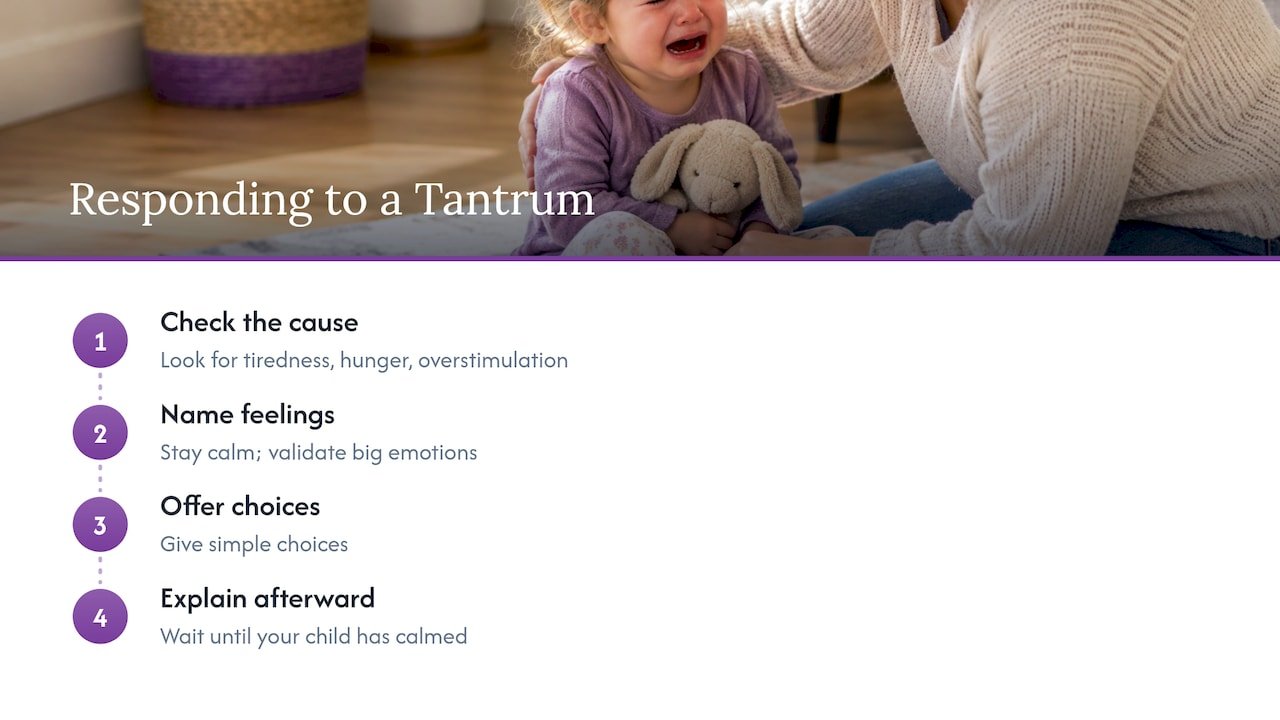
This is the one moment to hold back on words. Barnardo’s toddler guidance says toddlers are still learning to understand and express big emotions. It suggests checking for tiredness, hunger and overstimulation, staying calm, and naming and validating their feelings. It also suggests offering simple choices and explaining after your child has calmed down, not expecting reasoning mid-meltdown. Save the encouragement for when the storm has passed: “You were so cross, and you came back to cuddle. That was hard.”
If you are working out what your toddler can manage at their stage, this piece on the role of boundaries in toddler development explains why considering their emotions and abilities before you respond makes the response kinder and more effective.
How to avoid overpraising
Overpraising is rarely about too many kind words. It usually means vague, automatic or comparative words. A few guardrails:
- Be specific. The CDC’s praise-and-rewards guidance, updated 30 April 2026, says to use simple words, be specific and use an upbeat tone.
- Skip comparisons. GOV.WALES recommends avoiding comparisons with other children. Illinois Early Learning Project notes that calling one child a better helper than a sibling can invite competition or resentment.
- Match your child. GOV.WALES says some children prefer a quiet comment or look, others enjoy exuberant praise. The CDC adds that children differ on touch, so a smile, wink or thumbs-up can stand in for a hug.
- Mean it. Genuine enthusiasm is part of the advice from both GOV.WALES and Leicestershire.
- Praise the repeatable. GOV.WALES recommends noticing effort as well as outcomes, and praising things a child can control, change or do again.
Building independence at a manageable pace
Encouragement is also how toddlers become more independent. When you comment on a tiny step (“You pulled your sock all the way to your heel”), you are telling your child they can handle the next step too. For a wider look at that, see this guide on how to encourage independence in children.
Our view on praise and encouragement
Most parents we talk to are not short on love or good intentions. They are short on time and on the right words at the right moment. “Good job” comes out because it is quick, not because it is best.
We think the fix is not a lecture on parenting theory. It is a small, daily moment of play where you know exactly what to do and what to say. When you play a short game with your child, you are already close, already paying attention, and that is when specific words land best.
That is why each Mooshie game comes with the exact words to say and a plain explanation of what the game is building in your child’s brain. You hold the phone, your child never touches it, and the game uses things already in your house. Over time, those little moments of noticing add up to a child who thinks well, creates freely, feels secure, pitches in and treats others kindly.
samit
Make it a daily habit with Mooshie
Encouragement gets easier with practice, and it is easiest in a short game with nothing else competing for your attention. Mooshie gives you one game a day, chosen for your child’s age and stage, for children from 6 months to 4 years. It tells you how to play, the exact words to say and what the game builds. Everything uses things you already have at home.

You can try Mooshie and see what today’s game is. If you want ideas for tricky parts of the day, our 5 minute calming activities for toddlers and bonding activities for busy parents are good places to start. If you work in a nursery or as a childminder, there is also a Partnership Pack for early years settings.
FAQ
Is encouragement the same as praise?
Not quite. Praise tells a child you approve of what they did or who they are. Encouragement is praise for effort, such as noticing that they are trying, and it aims to build confidence and persistence. In daily life you will use both, and the aim is for most of your comments to be specific and about effort.
Why is praising children important?
GOV.WALES says genuine praise helps children learn what positive behavior looks like and strengthens the bond between parent and child. The CDC adds that praised behaviors are more likely to be repeated. Used often and sincerely, praise helps your toddler feel noticed and valued.
Can I still say “good job” to my toddler?
Yes. A warm “good job” is not harmful, and your tone and attention matter a lot. Adding a detail makes it work harder: “Good job putting the cars in the box” tells your child exactly what you liked. The CDC says labeled praise like this gives more information than general praise.
How do I encourage a toddler who gives up quickly?
Give them time before stepping in, then point to a strategy rather than doing it for them. Name what they have already tried, suggest one small change and step back again. Afterward, mention the effort, not just the result. This follows the approach in the EEF’s STAIRS model.
What should I say during a tantrum?
Stay calm and name the feeling in simple words, such as “You’re really cross.” Offer a simple choice if it helps. Wait to explain or encourage until your child has calmed down, as Barnardo’s advises.
Sources
- Effective praise, Leicestershire County Council
- The Psychology of Encouragement, American Psychological Association
- Make time for praise, GOV.WALES
- Tips for Praise, Imitation, and Description, CDC
- Tips for Using Praise and Rewards, CDC
- Person Versus Process Praise and Criticism, 1999
- Perseverance key to children’s intellectual growth, Stanford Report
- Encouraging Words, Illinois Early Learning Project
- Encouraging good behaviour and setting boundaries, BabyCentre
- The STAIRS model, Education Endowment Foundation
- Celebrate Your Child’s Strengths, ZERO TO THREE
- Encouraging positive behaviour from toddlers to teens, Barnardo’s
- The Role of Boundaries in Toddler Development
- The Best Ways to Encourage Independence in Children
Recommended
- How to Narrate Play for Your Toddler’s Language Growth
- Speech and Language Activities to Help Your Toddler Talk
- Busy Parents: 8 Easy, Research Based Storytelling Ideas for Toddlers
Want play ideas matched to your child's age?
Mooshie Moments gives you simple, guided play ideas for ages 6 months to 4 years. Try 3 free activities a week.
Download free on the App StorePart of our guide: Toddler activities by age · Compare toddler activity apps
More like this
Brain Development in Babies and Toddlers: Birth to Age 4
How a baby's and toddler's brain develops from birth to age 4, what the NHS and researchers say helps, and how to…
Focus Activities for Toddlers: Short Games That Work at Home
Simple, screen-free focus activities for toddlers, with realistic attention spans by age, 5-minute games from household items and what to do when…
Queue Games for Toddlers: 12 Screen-Free Ideas
Easy queue games for toddlers that need no kit and no screen: ideas by age, how to keep them short, and how…