
Queue Games for Toddlers: 12 Screen-Free Ideas

The best queue games for toddlers are tiny, need nothing but your voice and a few things in your bag, and finish while your child is still enjoying them. Think “Ready, steady, go”, turn-taking with a teddy, “find three blue things” and copy-me claps. Each one runs in two to five minutes, keeps your child close to you in a busy place, and quietly builds talking, waiting and noticing skills. Below you will find ideas for each age from 6 months to 4 years, how to keep a restless child with you, and the safety points that matter when you are standing in a crowd.
TL;DR
- Pick one game, say it in one sentence, and play it in short rounds. Stop while your child still wants more.
- Turn-taking games (ball rolls, “my turn, your turn”, “Ready, steady, go”) are the backbone of most good queue games, and NHS speech and language services recommend them for every age from babies up.
- Match the game to the age: peek-a-boo and handing back and forth for babies, spotting and pretend play for two and three year olds, simple rules for four year olds.
- In a public place, keep your toddler harnessed or beside you, and choose games that keep their feet still or their hand in yours.
- A different quick game every day is easier when someone else picks it for you and tells you what to say.
Table of Contents
- Why queues are a good place to play
- The simple rules behind every good queue game
- Queue games by age
- A quick table to choose from
- When your toddler is already restless
- Keeping queue games safe in public
- Ideas that work for a quick dose of focus
- Our view: tiny games add up
- A game a day, chosen for your child
- FAQ
- Sources
Why queues are a good place to play
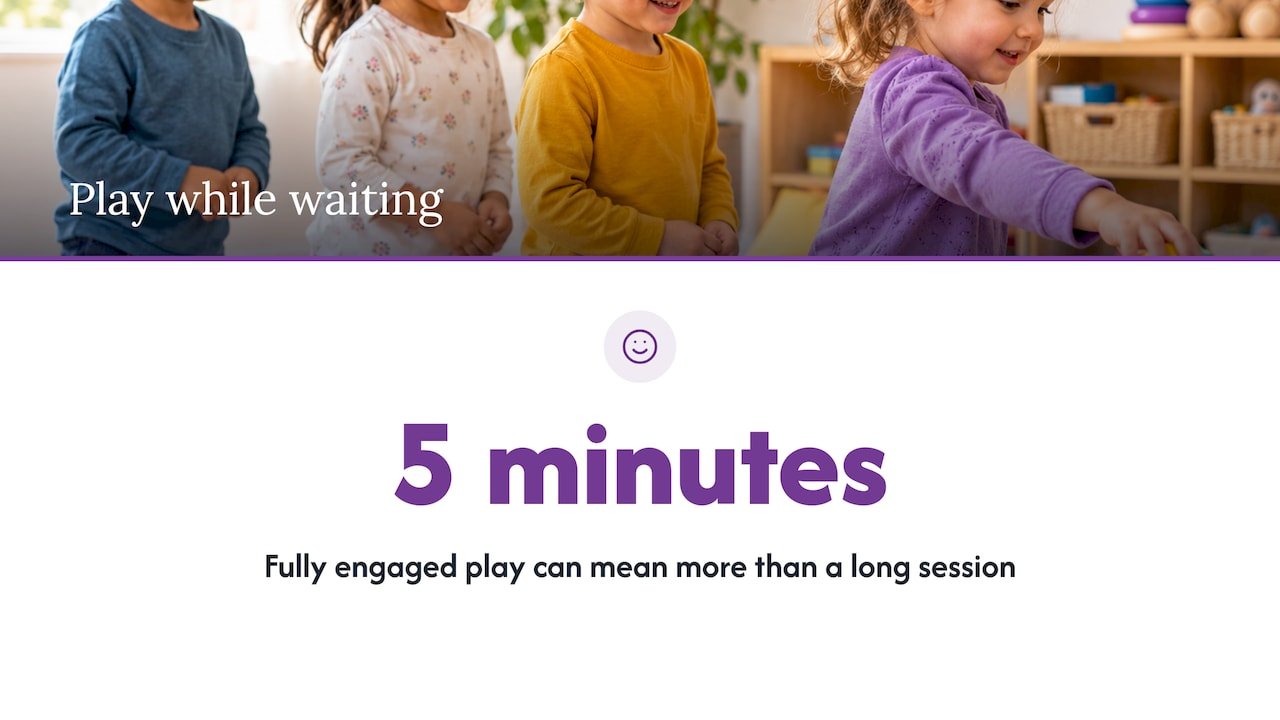
A queue is a short, predictable wait with your child right next to you. That is close to the ideal setting for the games speech and language therapists suggest. Waiting is itself a skill: Action for Children says a child can learn to wait, which builds resilience and patience, and that five minutes of fully engaged play can mean more than a long session when you are busy or stressed.
So you do not need a big plan. You need a handful of games you can start without thinking.
How long a toddler can really focus
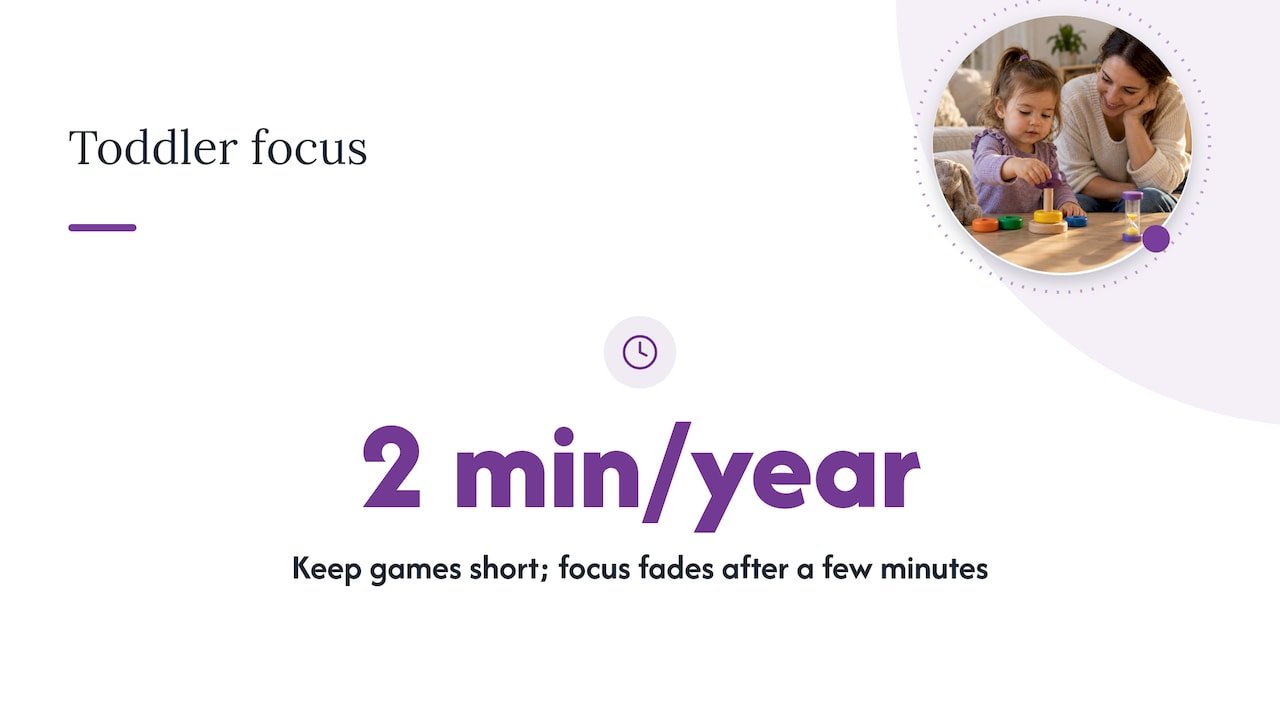
A useful rule of thumb is that young children focus for only a couple of minutes per year of age. A two year old who loses interest after a few minutes is completely normal. That is why the best queue games are built in short rounds. If the queue is long, run a few small games one after the other rather than stretching one game out.
The simple rules behind every good queue game
Before the ideas, here are four habits that make any game work, taken from NHS and early years guidance.
- Keep the wait short at first. Solihull’s guide to anticipation games says waiting and turn-taking are tricky skills, so keep the waiting to a minimum at the start so your child does not lose interest.
- Use a pause, not a prompt. The Department for Education’s early years guidance says leaving gaps gives children time to respond. Say “Ready, steady…” and wait. Do not keep saying “your turn”.
- Accept any answer. A reach, a sound or a glance counts. The same Solihull guide says to accept any communication effort and use simple key phrases like “more ball” or “ball finished”.
- Stop while it is still fun. NHS Borders advises stopping while the child still wants to play again, and making your voice as exciting as possible while you play.
It can also take a few goes. Nursery World notes that it may take the third, fourth or fifth time before a child joins in with a repeated sound or routine. If your toddler ignores your game the first time, that is not failure.
Queue games by age
Babies, 6 to 12 months
At this age your baby is probably in a pram, sling or on your hip, so games are about faces, voices and hands.
- Peek-a-boo. Essex NHS speech and language therapists suggest listening games with anticipation such as peek-a-boo and Round and Round the Garden for babies between 6 and 12 months. Use your hands, a scarf or the pram hood.
- Hand it back. BBC Tiny Happy People suggests handing a teddy back and forth while saying whose turn it is for 9 to 12 month olds, so they learn the pattern and anticipate what comes next.
- Babble back. Copy the sounds your baby makes, then pause. The same BBC page recommends copying a baby’s babble back to them.
- Wave, clap, point. A Royal United Hospitals NHS leaflet for 9 to 12 months lists waving, clapping and pointing as gestures to practise.
Toddlers, 1 to 2 years
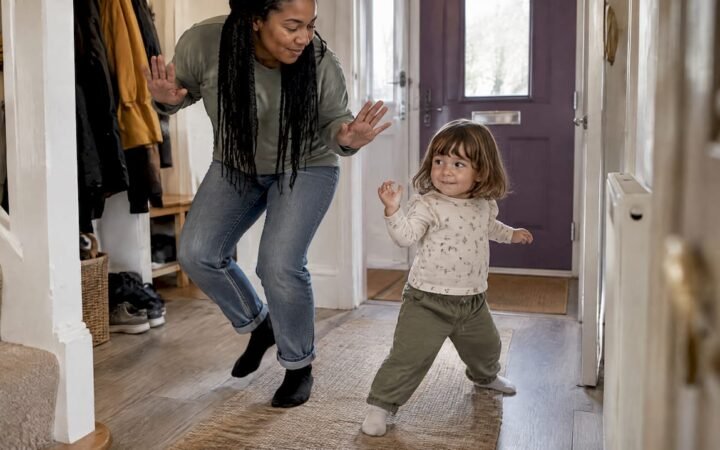
This is the “Ready, steady, go” age. Cambridgeshire and Peterborough NHS says that by two years toddlers start to take turns, such as rolling a ball back and forth. It suggests pausing before you say “go” and slowly making the wait a little longer to hold attention.
- Ready, steady, go. Hold a toy car, a pop-up toy or a bubble wand. Say “Ready, steady…” then wait. When your child looks, reaches or makes a sound, say “Go!” NHS Borders lists peek-a-boo, bubbles and a car down a ramp as versions of this.
- Post it. Take turns posting things into a box or bag. A purse and a few cards or large buttons held out of reach of mouths work well if you are supervising closely.
- Tickles and songs. Oxford Health NHS suggests saying the same phrase every time, such as “Let’s play tickles”, and using a sign or gesture for “finished” at the end. A clear ending helps when you have to move up the queue.
Two and three year olds
By three, children enjoy pretend games and can take turns in everyday jobs, according to Cambridgeshire and Peterborough NHS. Language is growing fast, so these games are about words and noticing.
- Find three blue things. Pick a colour, a shape or a type of thing (round, soft, shiny) and look for three together. It starts in one sentence and works in a quiet two minute queue.
- I spy with a pointing finger. Younger toddlers can point rather than guess. You name what they point at and add one word: “Yes, a big red bus.”
- Pretend on the go. BBC Tiny Happy People says pretend play on the move builds imagination and conversation. Use things you have with you as props, follow your child’s lead and say “my turn”. A bank card becomes a ticket, your hand becomes a phone, and you ask “Do you want to speak to Nana?”
- Queue counting. Count the people in front, then the trolleys. If you want more ideas like this, we have a page of toddler counting games that need no kit.
- The line game. Nrich, a UK maths education project, describes queueing as a play idea for 3 to 5 year olds, with adults asking positional questions such as front, back, behind and between and counting the queue. In a real queue you can ask “Who is in front of us? Who is behind?”
Four year olds
Humber NHS’s milestones chart says that by four years children can take turns in games without adult help. Cambridgeshire and Peterborough NHS suggests structured turn-taking with a visual cue, such as a silly hat or toy that shows whose turn it is. A scarf or a glove passed back and forth does the same job in a queue.
- Silly hat turns. Pass one item back and forth to decide who gets to choose the next thing to spot.
- Story chain. You say one sentence about the person in the queue, your child adds the next. Keep it kind and make-believe, never about a real person.
- Secret signal. Agree a squeeze or a wink. Whenever you do it, your child has to guess the animal you are thinking of. It keeps them close and listening.
A quick table to choose from
| Wait length | Age | Game | What it builds |
|---|---|---|---|
| 1 to 2 minutes | 6 to 12 months | Peek-a-boo, babble back | Anticipation, early turns |
| 2 minutes | 1 to 2 years | Ready, steady, go | Waiting, attention |
| 2 to 5 minutes | 2 to 3 years | Find three blue things | Noticing, vocabulary |
| 3 to 5 minutes | 2 to 4 years | Pretend on the go | Imagination, conversation |
| 5 minutes or more | 3 to 4 years | Silly hat turns, story chain | Turn-taking, listening |
When your toddler is already restless
Some queues come at the worst time: nap time, hunger, a noisy shop. A few things help.
- Start before the fuss. It is easier to begin a game when your toddler is still cheerful than to rescue a meltdown. Say “We are going to play Ready, steady, go” rather than asking “Do you want to play?”.
- Let them move. West and South Hampshire NHS occupational therapy guidance says that if a child finds queues hard, you can use interactive games, visual timers or stories, and allow safe, regular movement breaks before and after the wait. Before you join the queue, let your child stomp, jump or push the trolley. In the line, try slow “giant steps” on the spot or squeezing hands.
- Offer something they can do beside you. Action for Children suggests giving a child an activity they can do next to you while you keep watch. A half-built tower of cards or a small task such as holding the shopping list gives them a job.
- Check the noise. The same NHS guidance suggests ear defenders with breaks for noisy places, and finding quieter times or areas if you can.
- Keep a routine. Repeating the same few games each time makes them familiar, and familiar games start quickly. This article on consistency in toddler routines explains why toddlers settle better with predictable patterns.
If the wait is longer than you can fill, bring back one short idea at a time. Our guide to no-prep shopping activities for toddlers has more for when you are out and about.
Keeping queue games safe in public
A queue is a busy, distracting place, and a toddler who is concentrating on a game can still move fast. A few points to keep in mind:
- Use the harness. The NHS advises using a 5-point harness in a pushchair or highchair, and it says toddlers are unsteady and can trip and fall quickly. Pick games that work from a seat, such as peek-a-boo, spotting and pretend phone calls.
- Stay within arm’s reach. Standing games should keep your toddler beside you, with a hand in yours, rather than letting them wander along the line.
- Keep small items under your eye. Posting and stacking games are great, but use items too big to fit in a mouth and keep them in your hand between turns.
- Choose quiet games for tight spaces. Whispered games, finger games and spotting games do not disturb others or invite running.
- Never hand over a phone to fill the gap. Games where you do the talking and your child does the looking stop the wait turning into screen time.
If you are ever worried about a child’s development, such as not responding to their name or showing very little interest in turn-taking, speak to your health visitor or GP.
Ideas that work for a quick dose of focus
If you are after more short, low-effort ideas beyond the queue, there is a good list of focus activities for preschoolers that take only a few minutes. For no-toy ideas, try our page on no toy activities for toddlers, and for a bigger collection by age, our 40 activities for two year olds.
Our view: tiny games add up
We built Mooshie around one idea: the small moments in a day are where children learn the most from the people they love.
A queue is one of those moments. A parent does not need a toy box, a plan or an hour. They need one short game, the exact words to say, and a plain reason why it matters. When you know that “Ready, steady, go” is building waiting and attention, or that “find three blue things” is building noticing and vocabulary, a dull five minutes becomes a good one.
That is why Mooshie gives the parent one short game a day, chosen for their child’s age and stage, using things already in the house. The parent holds the phone and the child never touches it. We want children to grow up thinking well, feeling secure, creating freely, helping out and treating others kindly, and the games that get us there are often the shortest ones.
samit
A game a day, chosen for your child
If you would rather not hunt for ideas while a queue is moving, Mooshie gives you one short game each day for your child’s age and stage, for children from 6 months to 4 years. It tells you how to play, the exact words to say and what the game is building in your child’s brain, and it uses things already in the house. You hold the phone, and your child never touches it.
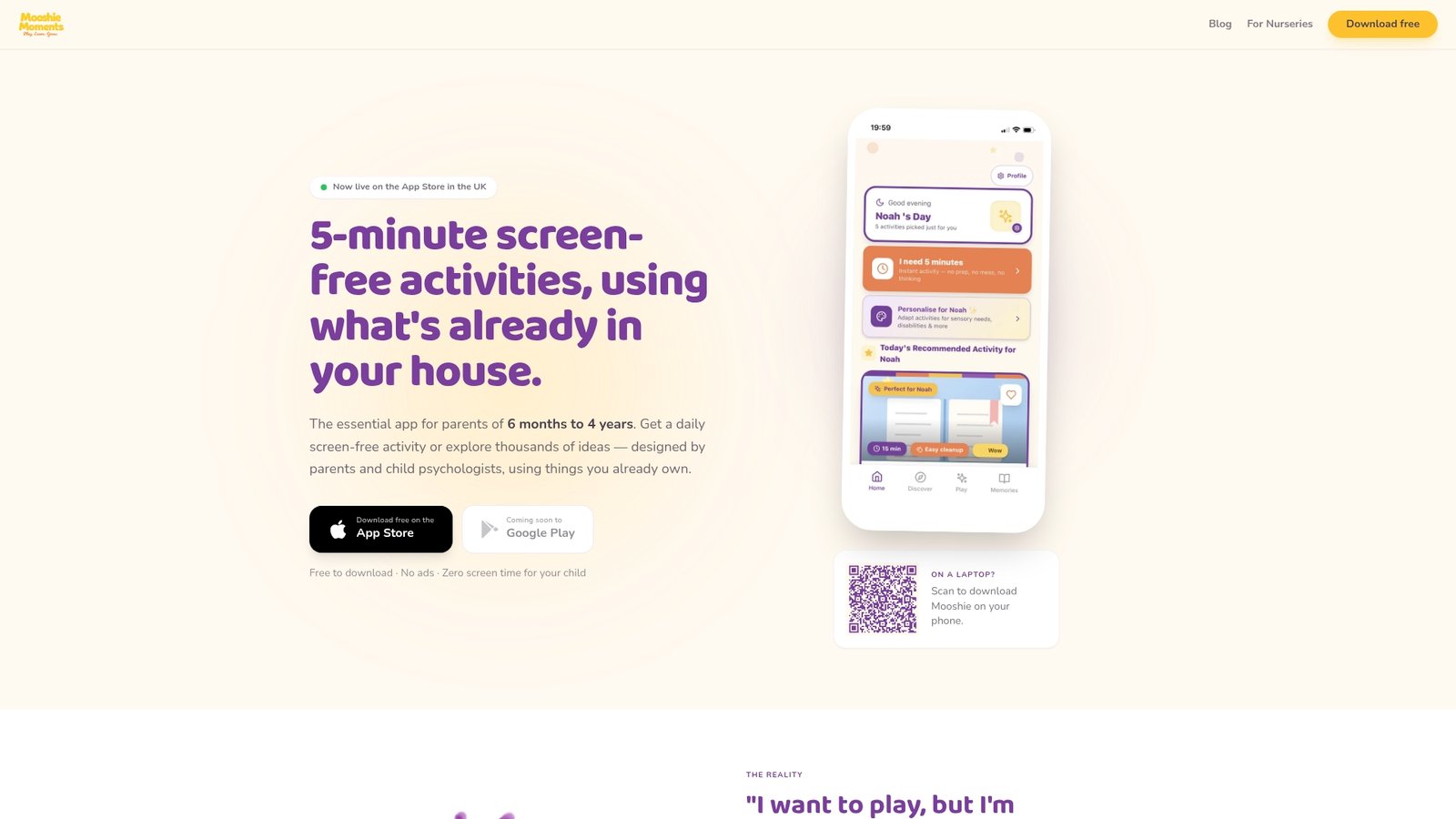
Try Mooshie and keep the day’s game in your pocket. If you work in a nursery or an early years setting, we also offer a Partnership Pack and a home-learning resource for your families.
FAQ
What are some fun games to play while waiting in line with a toddler?
Start with “Ready, steady, go”, “find three blue things”, peek-a-boo, copy-me claps and pretend phone calls. They need nothing but your voice and maybe a glove or a toy from your bag. Each one runs for a few minutes and can be repeated.
Which game is best for a 2 year old?
Turn-taking games suit two year olds best, because NHS speech and language services say this is when toddlers begin to take turns, for example by rolling a ball back and forth. In a queue, use “Ready, steady, go” with a small toy, or take turns pointing at things you can see. Pause, then wait for a look or a sound before you say “go”.
How do I keep a toddler from having a meltdown in a queue?
Begin a game before they get upset, and keep it very short. Let them move around before you join the line, and offer a small job they can do beside you. If it is loud, find a quieter spot if you can. The aim is to calm things down early, rather than to win a long game.
Do queue games need any equipment?
No. The best ones use only your voice, your hands and whatever you are carrying. A scarf, a glove, a soft toy or a pen can be a turn-taking cue. Anything small should stay in your hand between turns.
Sources
- Playing with your child, Action for Children
- Solihull MBC, Anticipation Games
- Help for early years providers: Interactions, Department for Education
- Listening and attention activities in the home, NHS Borders
- Small Changes, Better Communication, Nursery World
- 0 to 12 Months, Essex Partnership University NHS Foundation Trust
- Turn taking, BBC Tiny Happy People
- Exploring, interacting and imitating, Royal United Hospitals NHS
- Playing and social skills, Cambridgeshire and Peterborough NHS
- Play and Early Conversation, Turn Taking, Oxford Health NHS
- Early pretend play with toddlers, BBC Tiny Happy People
- Queueing, Nrich Maths
- Social Communication Developmental Milestones, Humber Teaching NHS Foundation Trust
- Busy Places and Travel, West and South Hampshire NHS
- Baby and toddler safety, NHS
- The Role of Consistency in Toddler Routines
- Focus Activities for Preschoolers
Recommended
- Best Indoor Games for Toddlers: 14 Easy Ideas for Home
- Morning Activities for Toddlers: Quick, Screen-Free Ideas
- Busy Parents: 12 No Prep Shopping Activities for Toddlers
- 10 Minute Toddler Activities Using Things You Already Own
Want play ideas matched to your child's age?
Mooshie Moments gives you simple, guided play ideas for ages 6 months to 4 years. Try 3 free activities a week.
Download free on the App StorePart of our guide: Toddler activities by age · Compare toddler activity apps
More like this
Brain Development in Babies and Toddlers: Birth to Age 4
How a baby's and toddler's brain develops from birth to age 4, what the NHS and researchers say helps, and how to…
Focus Activities for Toddlers: Short Games That Work at Home
Simple, screen-free focus activities for toddlers, with realistic attention spans by age, 5-minute games from household items and what to do when…

Praise vs Encouragement for Toddlers: What to Say
Praise vs encouragement for toddlers: the real difference, what to say in play and tantrums, and simple swaps you can use today,…