
Brain Development in Babies and Toddlers: Birth to Age 4
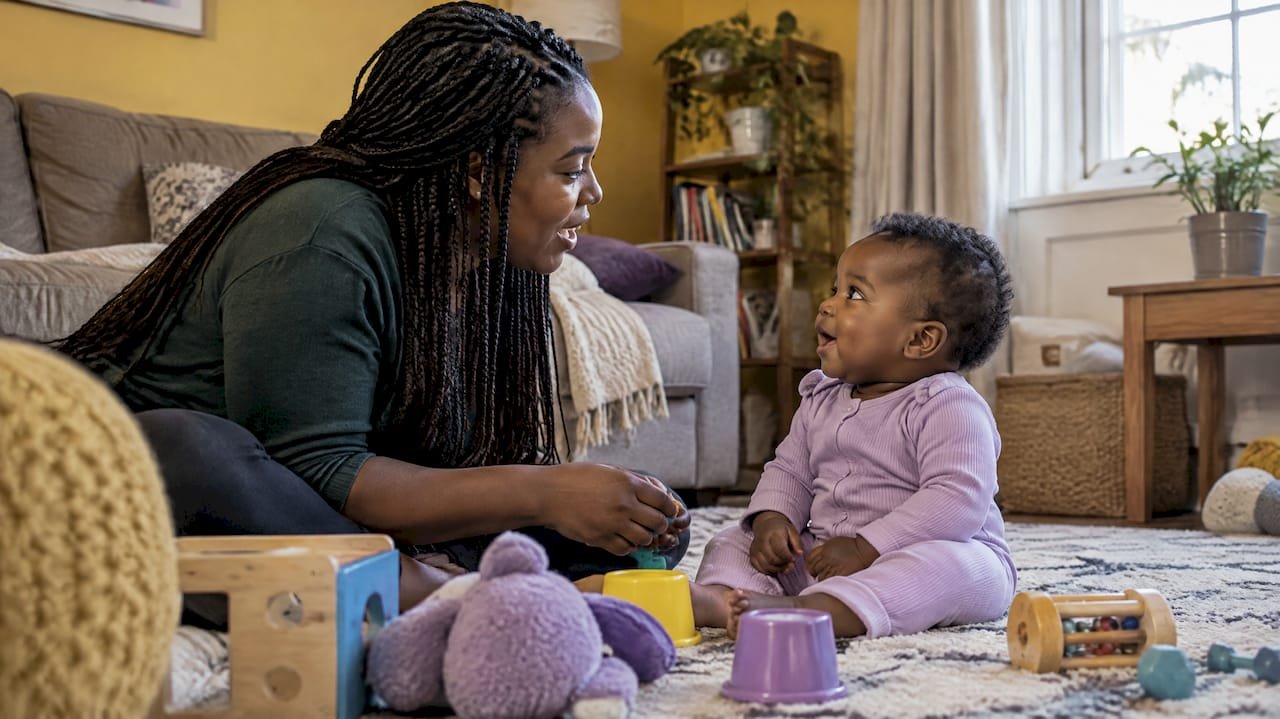
Your child’s brain is building itself fastest in the years you are living through right now, and the biggest builder is not a toy or a flashcard. It is you: your voice, your face, your responses and the games you play together. This guide explains what brain development actually is, what happens between birth and age 4, and how to support it in ordinary moments, without special equipment and without adding screen time. If you want a daily game that does the planning for you, Mooshie gives you one short, age-matched game a day using things already in your house.
TL;DR
- The brain grows faster in the first three years than at any other time, and about 90 percent of its development is complete by age 5.
- Connections are built through back-and-forth interaction: talking, singing, eye contact, comfort and play.
- Play is not a break from learning. For a baby or toddler, it is the main way the brain learns.
- The NHS advises avoiding screen time under 2 (other than shared activities like video calls) and keeping it to about an hour a day for ages 2 to 5.
- A few minutes of focused attention counts. You do not need special toys, and you do not need to be “on” all day.
Table of Contents
- What brain development actually means
- Why the first years matter so much
- The building block: back-and-forth with you
- What play builds, age by age
- Screens and the developing brain
- Supporting brain development when you have no time and no toys
- Worried you are behind? What typical looks like
- One game a day, chosen for your child
- Our view
- FAQ
- Sources
What brain development actually means
Brain development is the process by which a child’s brain forms, grows and builds connections. Lurie Children’s Hospital describes it as starting before birth and continuing into the mid-20s. Three things happen along the way:
- Neurons multiply. Brain cells are produced rapidly.
- Connections speed up. Pathways are wrapped in a coating (myelin) that makes signals travel faster.
- Unused circuits are pruned. The brain trims what it does not use so the busy pathways work efficiently.
A newborn arrives with around 100 billion brain cells, but, as the NHS Best Start in Life page explains, those cells have few connections between them yet. Love, affection and closeness help wire them up.
The scale is striking. Harvard’s Center on the Developing Child reports that more than 1 million new neural connections form every second in the first few years of life. Sensory pathways (seeing, hearing, touch) develop first, then early language, then higher thinking skills.
The part of the brain behind planning, behavior and self-control, the frontal lobe, keeps developing into early adulthood. So when a two-year-old screams on the supermarket floor, it is not a character flaw. The part of the brain that would help them stop is simply years from being finished.
Why the first years matter so much
The UK government’s Healthy Beginnings guidance says a baby’s earliest experiences, starting in the womb, shape their brain development, and that in the first two years the brain has a remarkable capacity to absorb information and adapt to its surroundings. Coventry City Council’s five to thrive parent guide says the brain grows and changes faster in the first three years than at any other time.
Clinicians describe this as plasticity. A young brain is ready to be shaped, so early experiences set either a sturdy or a fragile foundation for thinking, emotions and social skills. That is the encouraging side of the science: the everyday things you already do are the raw material.
It is not a reason to panic. Nobody is asking you to run a curriculum for a 9-month-old. The research points to something much simpler and much more doable: responsive, warm, regular interaction.
The building block: back-and-forth with you
Harvard researchers call it serve and return. Your baby “serves” by babbling, pointing, making a face or crying. You “return” with eye contact, words, a smile or a cuddle. Each exchange builds and strengthens the connections behind communication and social skills.
The NHS lists the everyday things that help build healthy connections: talking, singing, eye contact, responding to sadness with warmth, and touching, stroking, rocking, feeding, cuddling and comforting. According to the same NHS page, close bonding helps babies manage emotions, develop confidence, learn and build resilience.
The NHS Healthier Together service puts the same idea into five daily building blocks, Respond, Cuddle/Engage, Relax, Play and Talk, and says making the most of little moments together helps the brain grow and develop. Coventry’s guide says it plainly: the most important thing that happens to your baby is you.
Why calm matters as much as stimulation
A brain that is regularly flooded with stress hormones has a harder time building. The NAEYC article on caring relationships reports that from birth to age 3, stress can have an especially adverse effect on brain development, and that secure attachment buffers it. Everyday stress is normal. What matters is a caregiver who comes back, soothes and repeats that pattern.
The same article notes that in early brain growth, experience creates expectation. Children whose caregivers respond positively come to expect good things from other people and explore more. That is how kindness and security begin, long before a child can say “please”.
Calm is a skill you can teach too. The five to thrive guide suggests ending exciting play with a wind-down, using soft lighting and gentle sounds, and using a close cuddle, rhythmic rocking and shushing in a dark room to reset an over-stimulated baby. If tantrums are your daily reality, our 5-minute calming activities are built for exactly those moments.
What play builds, age by age
For a baby or toddler, play is the learning. ZERO TO THREE’s overview of brain development describes even newborns as little scientists, imitating faces and testing how the world works. It reports that infants as young as seven months can detect patterns, and that by 18 months toddlers recognize that other people may want different things from them, an early form of empathy.
The five to thrive guide recommends following your child’s lead, counting, singing and action games, creative play with blocks, paper or dolls, exploring shapes, colors and textures, and pretend games. It says play helps children make sense of the world, think and plan, and develop social skills.
Here is roughly what to expect, using the NHS-linked HDFT Children’s Health Service guide:
| Age | What you may see |
|---|---|
| About 15 months | A few words |
| From 18 months | An explosion of new words; pretend play, like drinking from a toy cup, begins |
| About 2 years | 2 to 3 word sentences such as “Mummy drink”; starting to play games with other children |
| About 3 years | 3 to 5 word sentences and plenty of “why” questions |
The same guide notes that toddlers between 1 and 3 often show frustration, sadness or anger through tantrums because they do not yet have the words. More language means fewer meltdowns, so everything that grows words also helps with behavior.
Pretend play is serious work
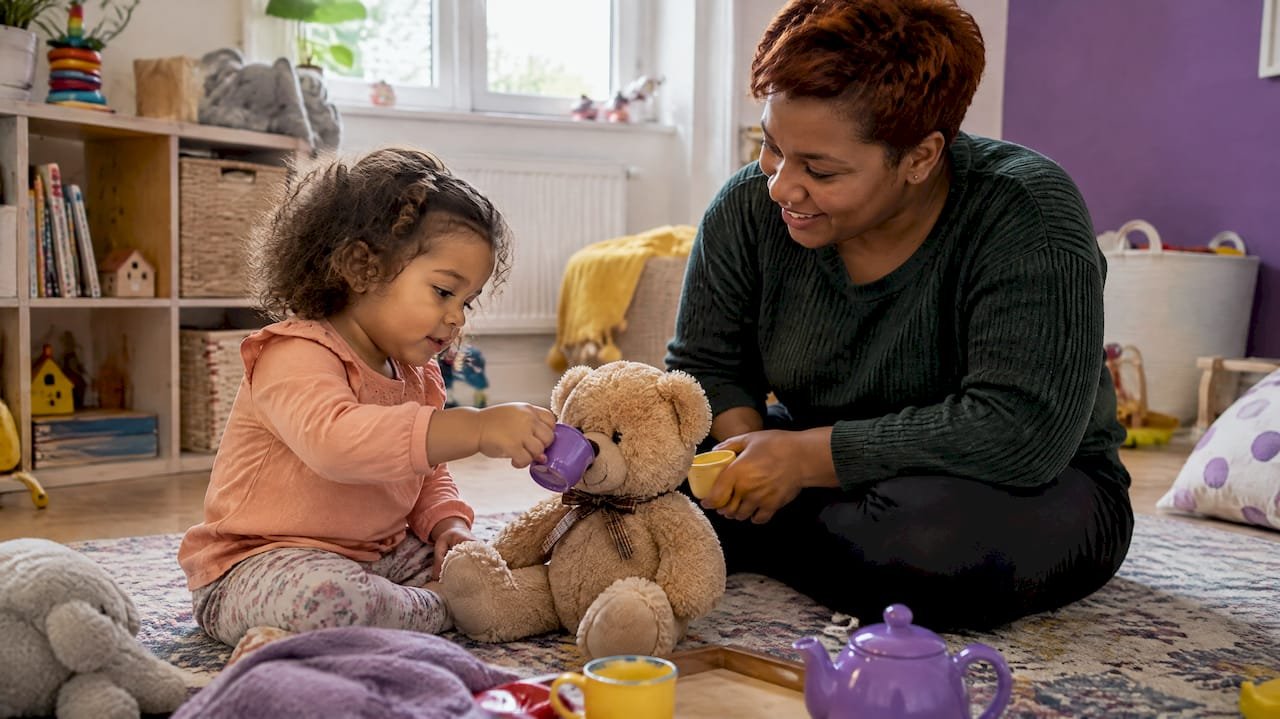
When your toddler feeds a teddy or answers a banana phone, they are practicing imagination, language and understanding other people. If you want to go deeper, there is a good explainer on pretend play development in toddlers. Join in rather than direct: let them be the cook, and you be the hungry customer.
Talking your way through play
The NHS advises commenting rather than asking questions. Instead of “What color is that?”, try “That was a big roll, I nearly missed it!” and then give your child time to answer. Children learn best when they are interested in the activity, so follow what they are already looking at. Our guide on narrating play for language growth shows how this sounds in practice, and our speech and language activities give you more ways to start.
Screens and the developing brain
This is the part many parents feel guilty about, so here are the facts. The NHS screen time guidance for under 5s says:
- Avoid screen time under 2, other than shared family activities such as video calling.
- For ages 2 to 5, keep it to about an hour a day, and less if possible.
- Choose slow-paced, predictable content over fast-paced, social-media-style video.
- Keep bedrooms and mealtimes screen-free, avoid background screens, and avoid screens in the hour before bed.
- Watch and talk about content together rather than leaving a child alone with it.
The same page links large amounts of screen time with negative effects on social, emotional, language and brain development, as well as sleep, eyesight and healthy weight.
The practical answer is not a perfect screen-free house. It is giving your child something better to do at the moments you would normally reach for a screen: the tired hour before dinner, the wait at the GP, the morning you are on maternity leave and have not spoken to another adult. That is where a short, ready-made game earns its place.
Supporting brain development when you have no time and no toys
The good news from the NHS Healthier Together Healthy Day for a Child page is that all you need for child-led play is whatever your child is interested in right then. That could be a toy, a bird outside the window, a fire truck going past, or just you and the funny faces and sounds you make together. It suggests doing it for a set time as part of your daily routine.
So a realistic day might look like this:
- Morning: two minutes of face-to-face chat while you change or dress them. Pause after each sound they make.
- Out and about: name what you both see. Wait for their reply, even if it is a point.
- Teatime: one pretend game with a spoon and a cup.
- Bedtime: a slow wind-down, a song, a cuddle.
That is brain-building, and none of it needs a purchase. If your time is truly tight, our bonding activities for toddlers, which take 2 to 15 minutes, and our low-prep activities by skill area show how short these moments can be. For how this lines up with what nurseries do, see EYFS activities at home. The Early Years Foundation Stage is the framework that sets out learning and development stages for children in England from birth.
Worried you are behind? What typical looks like
Children develop at different speeds. The NHS advises being patient, as some toddlers take longer than others to learn new skills. For reference, NHS Healthier Together lists these among 2-year milestones: noticing when others are hurt or upset, pointing to things in a book when asked, saying at least two words together such as “More milk”, and kicking a ball. By 4, children typically pretend to be something else in play and say sentences of four or more words.
Speak to your health visitor or GP if your 2-year-old has lost skills they had before, feels very stiff or very floppy, uses one side of the body more than the other, cannot walk by themselves, or mostly walks on tiptoes. Also raise any worry that keeps nagging at you. Asking early is part of good parenting, and you will not be wasting anyone’s time.
One game a day, chosen for your child
Knowing what helps is one thing. Finding the energy to think of it at 4:30 pm is another. Mooshie is a free-to-download app for parents of children aged 6 months to 4 years. Each day it gives you one short game chosen for your child’s age and stage, using things already in the house. It tells you how to play, the exact words to say, and what the game is building in your child’s brain.
You hold the phone. Your child never touches it. The game is something you do together, so the time on the phone is yours, and the time with your child is face to face.
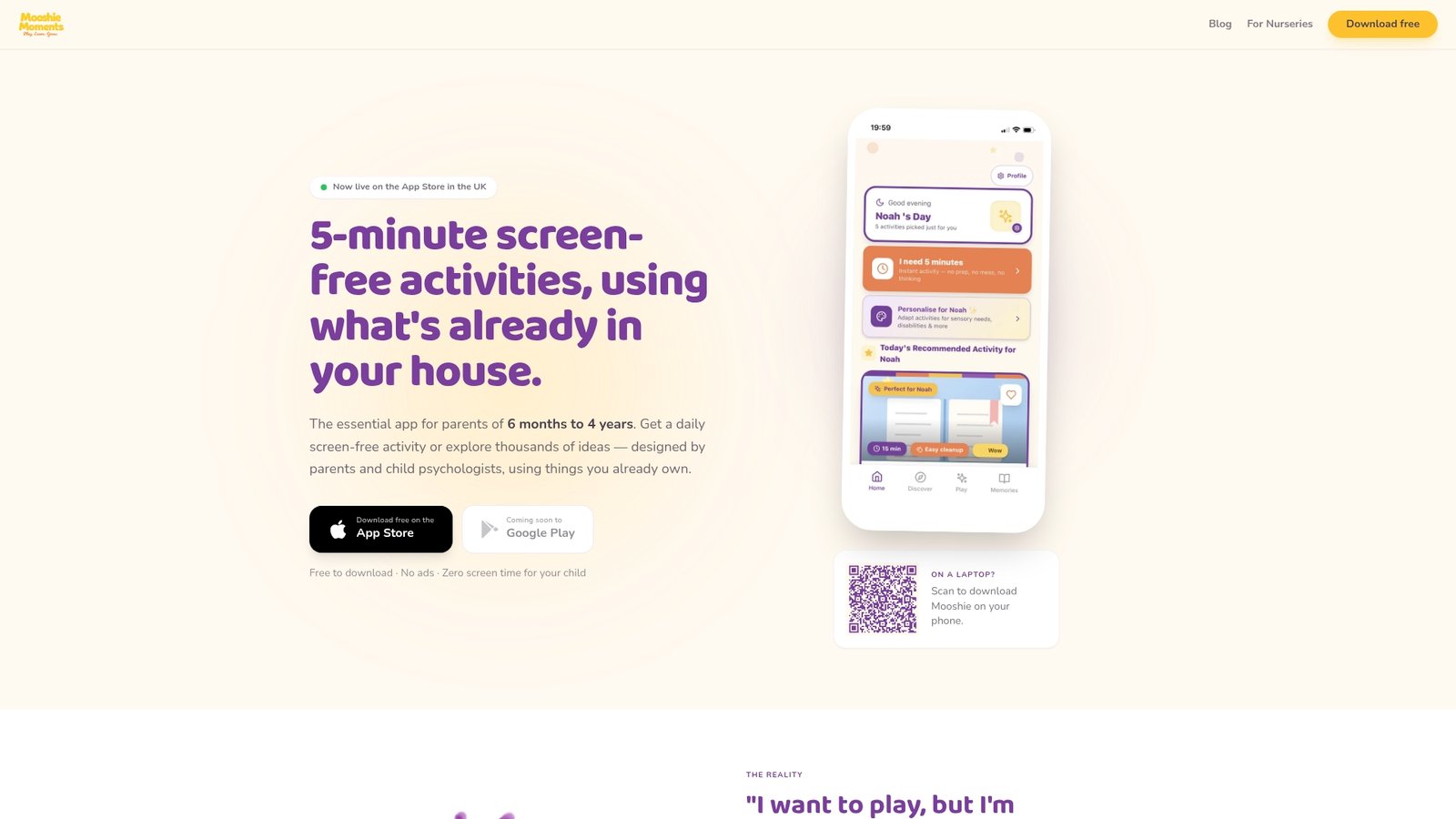
If you are a parent, grandparent or carer who wants that daily nudge, take a look at Mooshie. If you run a nursery or early years setting, we also offer a Partnership Pack and home-learning resource for your families.
Our view
We built Mooshie around one belief: a child’s brain grows through the people who love them, not through a screen.
The research is reassuring and demanding at once. It says the early years matter enormously, and it says what matters is warm, responsive, everyday interaction. Most parents already want to give this. What gets in the way is not love, it is time, tiredness and not knowing what to do with a 14-month-old at 4:30 pm.
That is why Mooshie gives one game a day, picked for your child’s age and stage, with the exact words to say and a plain explanation of what it builds. You do not have to plan, shop or guess. The parent holds the phone and the child never touches it, so the game stays between the two of you.
We also care about the whole child. Smarter matters, but so do creative, happy, helpful and kind. Those grow from the same back-and-forth moments, and a few good minutes a day is a strong place to start.
samit
FAQ
When is a child’s brain development most important?
Brain development starts before birth and continues into the mid-20s, but the early years are the fastest. The NHS says most brain growth happens before age 5, so the years from birth to 4 are a rich time to focus on responsive, loving interaction.
Does playing with my toddler really help their brain?
Yes. Back-and-forth exchanges such as talking, singing, pretend play and following their lead help build the connections behind language, thinking and social skills. Short, regular moments count, and the NHS encourages making the most of little moments together.
How much screen time is okay for a baby or toddler?
The NHS advises avoiding screen time under 2, other than shared activities like video calls. For ages 2 to 5 it suggests about an hour a day, less if possible, with slow-paced content, no screens at mealtimes or in bedrooms, and no screens in the hour before bed.
Do I need special toys to boost my child’s brain?
No. The NHS says child-led play needs only whatever your child is interested in at the time, whether that is a toy, something outside, or you making funny faces and sounds together. Everyday items around the house work well for most games.
When should I talk to someone about my child’s development?
Contact your health visitor or GP if a 2-year-old has lost skills, feels very stiff or floppy, favors one side of the body, cannot walk alone or mostly walks on tiptoes. You should also speak to them whenever something worries you, as children develop at different speeds.
Sources
- Brain Development in Early Childhood, Lurie Children’s
- Healthy Beginnings: applying All Our Health, GOV.UK
- five to thrive parent guide, Coventry City Council
- InBrief: The Science of Early Childhood Development, Center on the Developing Child at Harvard
- Serve and Return, Center on the Developing Child at Harvard
- Building a close relationship with your baby, NHS Best Start in Life
- How to support your child’s development, NHS Healthier Together
- Caring Relationships: The Heart of Early Brain Development, NAEYC
- Brain Development in Babies and Toddlers, ZERO TO THREE
- Child Development, HDFT Children’s Health Service
- Healthy Day for a Child, NHS Healthier Together
- Baby and toddler screen time guidance, NHS Best Start in Life
- The Role of Pretend Play Development in Toddlers
Recommended
- Best Brain Development Apps for Babies and Toddlers UK 2026
- UK Parents: Low Prep Toddler Activities by Skill Area in 2–15 Minutes
- Speech and Language Activities to Help Your Toddler Talk
- Problem Solving Activities for Toddlers Using Things at Home
Want play ideas matched to your child's age?
Mooshie Moments gives you simple, guided play ideas for ages 6 months to 4 years. Try 3 free activities a week.
Download free on the App StorePart of our guide: Toddler activities by age · Compare toddler activity apps
More like this
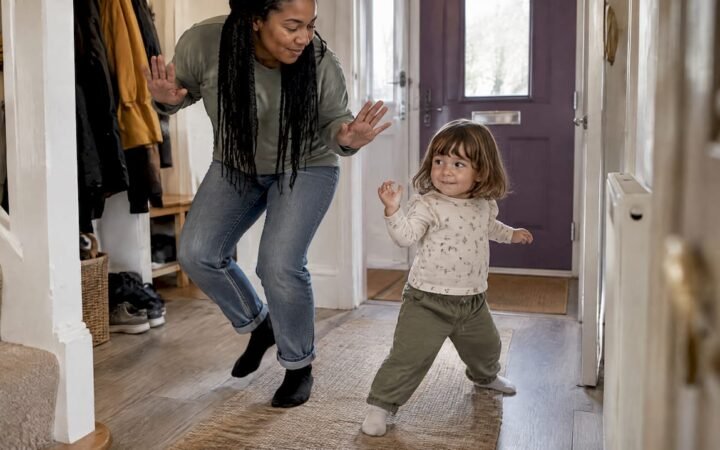
Focus Activities for Toddlers: Short Games That Work at Home
Simple, screen-free focus activities for toddlers, with realistic attention spans by age, 5-minute games from household items and what to do when…

Praise vs Encouragement for Toddlers: What to Say
Praise vs encouragement for toddlers: the real difference, what to say in play and tantrums, and simple swaps you can use today,…
Queue Games for Toddlers: 12 Screen-Free Ideas
Easy queue games for toddlers that need no kit and no screen: ideas by age, how to keep them short, and how…