
Best brain development apps for babies and toddlers (2026)
A child’s brain grows fastest before age 5, and it grows through play and conversation with you. Seven apps that help you make that time count.
- Free to download
- No account needed
- No screen time for your child
 On a laptop?
Scan to get Mooshie on your iPhone.
The quick answer
- Our pick for brain-building games (we make it): Mooshie Moments: playful brain training for 6 months to 4 years. Every game shows a Brain Boost explaining what it builds.
- Best free option: Vroom, free brain-building tips for everyday routines, from birth to 5.
- Best for a full programme with videos: Kinedu, from pregnancy to 6.
- Good to know: no app can raise a child’s IQ. The good ones help you play in ways that build the skills a growing brain needs.

The apps at a glance
Swipe the table to see every column →
| App | Who uses the screen | Ages | Free version | Paid (UK) |
|---|---|---|---|---|
| Mooshie Moments | Parent only | 6 months to 4 years | 3 free games a week, no account | £9.99 a month or £29.99 a year, 7-day free trial |
| Vroom | Parent only | Birth to 5 years | Whole app is free, no in-app purchases | Free |
| Kinedu | Parent (watches a video, then plays) | Pregnancy to 6 years | Limited activities, articles, milestones, baby tracker | Several App Store prices, £3.99 to £59.99; 7-day free trial |
| BabySparks | Parent (watches a video, then plays) | 0 to 3 years | Sample activities and milestone information | App Store lists £3.99 to £29.99, plans not named |
| Lovevery | Parent only | 0 to 36 months (app store listing) | 28-day free trial of the app | Included with Play Kits: £80 per kit (0 to 12 months), £120 per kit (1 to 4 years) |
| Pathways.org Baby Milestones | Parent only | Mainly birth to 3 | Whole app is free | Free |
| CBeebies Parenting | Parent (website) | Pregnancy to 5 years | Everything is free | Free |
Prices and features checked November 2026 from each app’s own website and the UK App Store. Where the App Store lists several prices without naming the plan, we give the range. Prices can change, so check before you subscribe.
What really builds a young brain
Brain scientists keep finding the same thing: in the early years, brains are built through back-and-forth with caring adults. A baby babbles and you answer; a toddler points and you name it. Harvard’s Center on the Developing Child calls this serve and return. Play, talk, songs, books and sleep do the heavy lifting, not flashcards or screens.
So we chose apps that help the grown-up do more of that, and checked each one on who holds the screen, what ages it covers, what is free and what it costs in pounds. We left out apps that make promises about IQ. We make Mooshie, so it is first, but every entry has a fair “best for”.

Our picks, one by one
1. Mooshie Moments
Best for: Parents who want to see what each game builds in their child’s brain
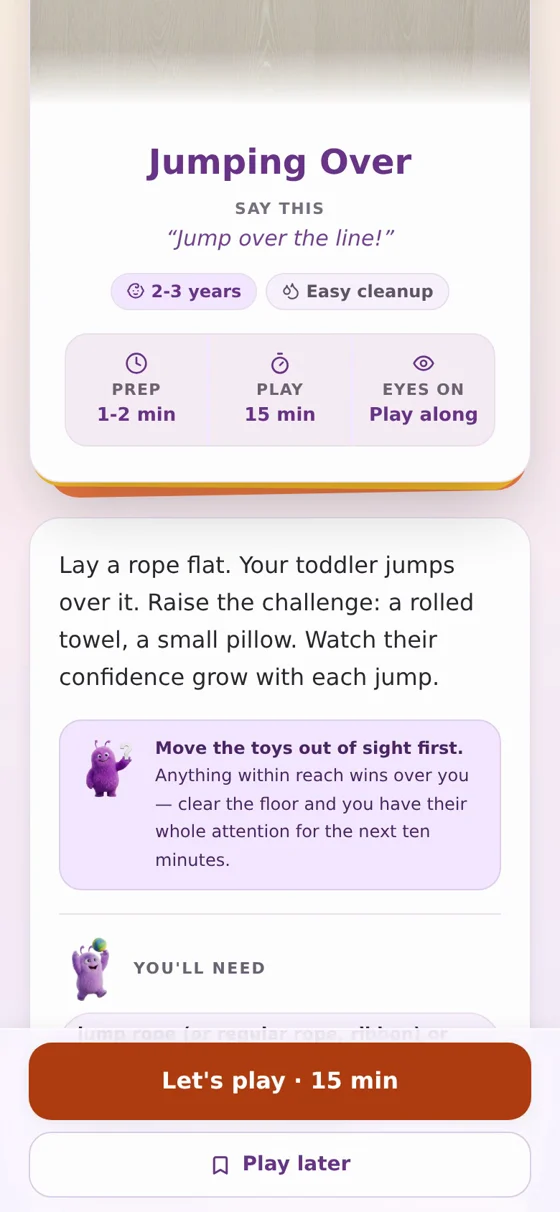
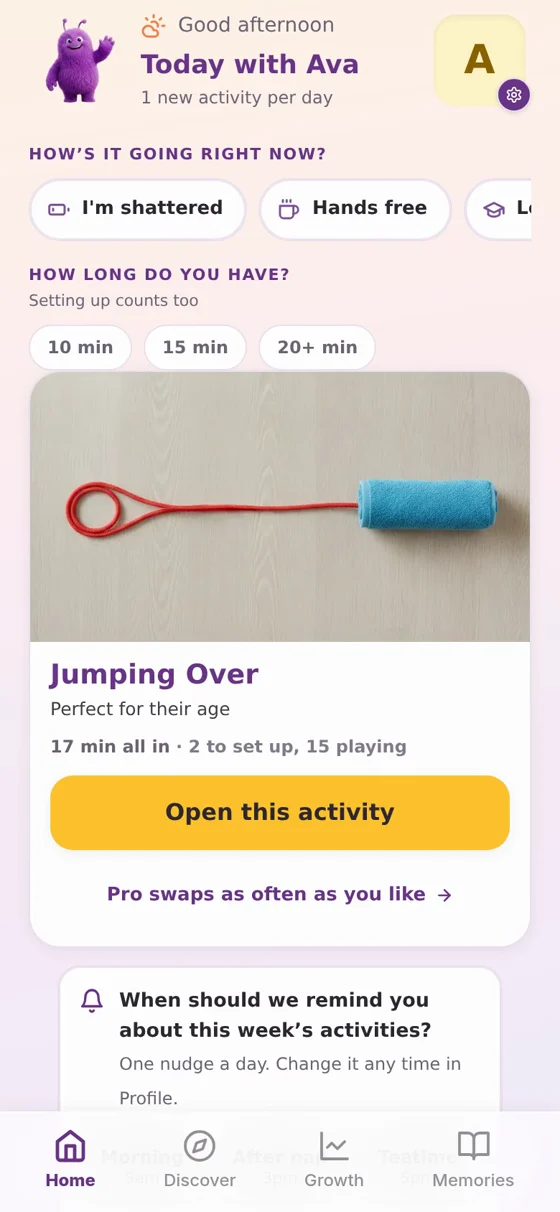
Mooshie is for you, not your child. Tell it your little one’s age, how much time you have and how the day is going, and it picks one game from 5,918, mostly using things you already have at home. Each game gives you the steps, the exact words to say and a Brain Boost on what it builds. You hold the phone and your child never touches it. To be clear about the gaps: it is iPhone only for now, it has no video demos, and it starts at 6 months.
2. Vroom
Best for: Free, quick brain-building tips for everyday routines
Vroom, from the Bezos Family Foundation, gives parents short tips that turn mealtime, bathtime and bedtime into brain-building moments, built on five basics: look, follow, chat, take turns and stretch. It covers birth to 5, is completely free and has no in-app purchases. It is US-made and has very few UK ratings, and the tips are short prompts rather than full games.
3. Kinedu
Best for: A full programme with video demos and milestone tracking
Kinedu starts with a short development check, then builds a daily plan of video activities for your child’s stage, with milestone tracking, articles and a baby tracker. It covers pregnancy to age 6. Most of the library needs a subscription, and the UK App Store shows several prices without naming every plan, so check before the 7-day trial ends.
4. BabySparks
Best for: Budget-minded parents of under-3s who like to watch a demo first
BabySparks gives you a daily programme where every activity has a short video, plus milestone tracking and weekly reports. You can add up to 5 children to one account. The programme stops at age 3, and the free version is limited to sample activities.
5. Lovevery
Best for: Families who already have, or plan to buy, Lovevery Play Kits
The Lovevery app is the companion to the Play Kits toy subscription: week-by-week guidance, play ideas for each toy and expert answers. Everything matches the toys you have. After a 28-day free trial, full access needs an active Play Kits subscription, and most ideas centre on Lovevery’s own toys.
6. Pathways.org Baby Milestones
Best for: A free milestone tracker with videos of real babies
Made by a US non-profit, Pathways is completely free and shows what babies typically do and when, with short videos, play activities and simple trackers. Its milestones follow US guidance rather than the NHS, so use your red book and health visitor as your main UK reference.
7. CBeebies Parenting
Best for: Free, trusted UK ideas, especially for early talking
BBC Tiny Happy People now lives inside CBeebies Parenting, a free BBC website with age-banded activities, short films and talking tips from pregnancy to 5, backed by UK partners including the RCSLT. It is a website, so there are no reminders or tracking, and its main focus is talking and communication.
Five everyday brain builders (no app needed)
- Talk back and forth: leave pauses for your little one to answer, even with a babble. See our serve and return guide.
- Narrate play: describe what they are doing as they do it. See narrating play.
- Play games with rules: stop-and-go games build focus and self-control. See our executive function activities.
- Solve small problems: let them work out how to get the toy out of the box. See problem-solving activities.
- Read and sing together: every day, even for a few minutes.
Smarter, and kinder too
Brain development isn’t only about letters and numbers. The same years build creativity, handling big feelings, helping out and caring for others. Mooshie’s games are spread across all of these on purpose, so your little one grows up smarter, more creative, happier, more helpful and kinder. For ideas on the feelings side, see our emotional development activities and kindness and sharing activities.
Try Mooshie free this week.
3 games every week, free. No account, nothing to buy, and your child never touches the phone.
Which one fits your family?
- You want one game a day and to know what it builds: Mooshie Moments.
- You want free tips for everyday routines: Vroom.
- You want a full programme with video demos: Kinedu or BabySparks.
- You want to track milestones for free: Pathways.org Baby Milestones.
- Talking is the priority: CBeebies Parenting, free from the BBC.
If you are worried about your child’s development, talk to your health visitor or GP.
Parents and experts on Mooshie
“I used to spend 30 minutes looking for an activity on Pinterest, get overwhelmed, and just turn on the TV. Mooshie takes 5 seconds.”
“Finally, an app that tells me to put my phone away. The activities are actually doable with stuff I have in my junk drawer.”
“As a pediatric OT, I love that these activities build core developmental skills without feeling like ‘homework’ for parents.”
Questions parents ask
What is the best brain development app for babies and toddlers?
For playful brain-building games from 6 months to 4 years, we think Mooshie Moments is the best fit, though we make it. Vroom is the best free option, and Kinedu suits parents who want a full programme with videos.
Can an app make my child smarter?
No app can promise that. What helps a young brain most is play, conversation and care from the adults around it. A good app helps you do more of that by giving you the right game and the right words at the right time.
Are brain training games good for toddlers?
Toddlers don’t need screen-based brain training. The best brain training for a toddler is play: stacking, pretending, sorting, talking and games with simple rules, played with a grown-up.
When does a child’s brain develop the most?
A child’s brain develops fastest in the first five years, especially the first three. That is why everyday play and talk in these years matter so much.
Is Mooshie Moments on Android?
Not yet. Mooshie is on iPhone only for now, through the UK App Store, with Android coming later. If you use Android today, Khan Academy Kids, CBeebies Learn and Kinedu are all available there.
Make memories. Build skills. Play together.
Your first game is ready as soon as you tell us their age.