5 Minute Emotional Activities for Toddlers Using Household Items

Short, playful interactions you already do are the fastest way to help toddlers name and manage feelings, and you can start in five minutes. Naming a feeling out loud (“you look frustrated!”) and using calm, connected responses when emotions get big are two of the simplest tools you have. An app builds on these same ideas, turning everyday moments into quick, screen-free activities that support real emotional growth.
TL;DR:
- Responding with emotion words during daily routines enhances toddlers’ emotional vocabulary and builds their recognition skills.
- Short, playful activities like puppet play or mirror games, repeated regularly, reinforce feeling identification through fun and familiar scenarios.
- Using the 3 Rs approach and sensory tools immediately calms big emotions while modeling steady adult behaviors crucial for toddler regulation.
- Tiny, daily interactions are more effective for emotional growth than rare, elaborate sessions, making it simple to incorporate into busy routines.
- An app can provide tailored, screen-free prompts based on household items and your child’s age to support consistent emotional development.
Table of Contents
- 1. Activities that build emotional vocabulary and skills
- 2. Turning daily routines into emotion-building moments
- 3. Calming strategies for the big emotions
- 4. Why these approaches work
- 5. Author’s note: real parenting, tiny wins
- 6. Try Mooshie Moments for quick, research-backed prompts
- Sources
- FAQ
1. Activities that build emotional vocabulary and skills
You do not need a craft cupboard for this. A few minutes, a mirror, or an old sock can do the job.
- Emotion charades: Take turns pulling silly faces (happy, sad, surprised) and guessing the feeling together. It helps toddlers connect facial expressions to feeling words. Works well during toddlerhood.
- Puppet play: Turn a sock or spoon into a character and act out a small feeling, like being scared of thunder. Pretend play lets toddlers explore emotions safely through a character rather than head-on. Best from 2 years and up.
- Calm-down corner: Set up a cushion or box with a soft toy and a picture of a calm face. Having a known spot to retreat to helps toddlers learn that big feelings pass. Suitable from around 18 months.
- Music and movement: Play music and act out feelings through movement, stomping for anger, swaying for calm. Moving the body alongside a feeling word helps toddlers link sensation to language.
- Feelings book: Flip through a photo album or draw simple faces and name what each one might feel. Repeated exposure to feeling words builds recognition over time.
- Mirror games: Make a face together in the mirror and name it. Toddlers learn to read expressions faster when they can see their own.
- Pretend care: Have your toddler “look after” a doll or teddy who is upset. Nurturing play builds early empathy and comforting behavior.
- Serve-and-return micro-moments: Notice when your toddler points, babbles, or reaches, and respond right away with words or a smile. These brief exchanges are some of the most reliable ways to build emotional and language circuits, and they take seconds, not minutes.
- Keep sessions under five minutes so they fit into nap gaps or dinner prep.
- Repeat favorites often. Toddlers process feelings through repetition, so replaying the same puppet scene isn’t a sign you’re stuck, it’s the point.
Pro Tip: Attach one activity to something you already do daily, like brushing teeth or getting into the car seat, so it becomes automatic rather than another task on your list.
2. Turning daily routines into emotion-building moments
You don’t need extra time in the day. Nappy changes, meals, and transitions already offer chances to practice serve-and-return, the responsive back-and-forth exchange that supports early brain and emotional development.
Serve-and-return works in four simple steps: notice your toddler’s cue, respond warmly, name what’s happening, then give them a moment to respond back. It works because it’s brief and built into what you’re already doing.
- Nappy changes: “You’re wriggling, are you feeling impatient? Almost done.”
- Mealtimes: “You pushed the bowl away, does that mean you’re full or you don’t like it?”
- Transitions: “Leaving the park is hard, I can see you’re sad. Let’s wave bye-bye to the swings.”
For younger toddlers, stick to one or two feeling words at a time (happy, sad, mad). Older toddlers, closer to 3, can handle more specific words like frustrated, worried, or proud. Waiting a beat after you speak matters too, toddlers need extra processing time before they can respond.
3. Calming strategies for the big emotions
When a meltdown hits, NHS guidance points to a simple sequence called the 3 Rs: Regulate, Relate, then Reason.
Regulate first: get low, breathe slowly, and soften your voice. “I’m here, let’s breathe together.” Relate next: show you understand before you fix anything. “That was really disappointing.” Reason comes last, once your toddler is calm enough to listen: “Next time, we can ask before grabbing.”
A few sensory tools help toddlers settle:
- Blowing bubbles together to slow the breath.
- Squeezing a soft toy or stress ball.
- Rocking or swaying gently.
- Stomping feet to release tension.
- Warm water play at the sink.
- A weighted blanket or heavy hug.
Pro Tip: Stay calm yourself first. Toddlers often mirror the adult’s state, so a steady voice does more than any script.
If big emotions feel constant, intense, or paired with a loss of skills your toddler once had, it’s worth mentioning to a GP or health visitor for extra support.
4. Why these approaches work
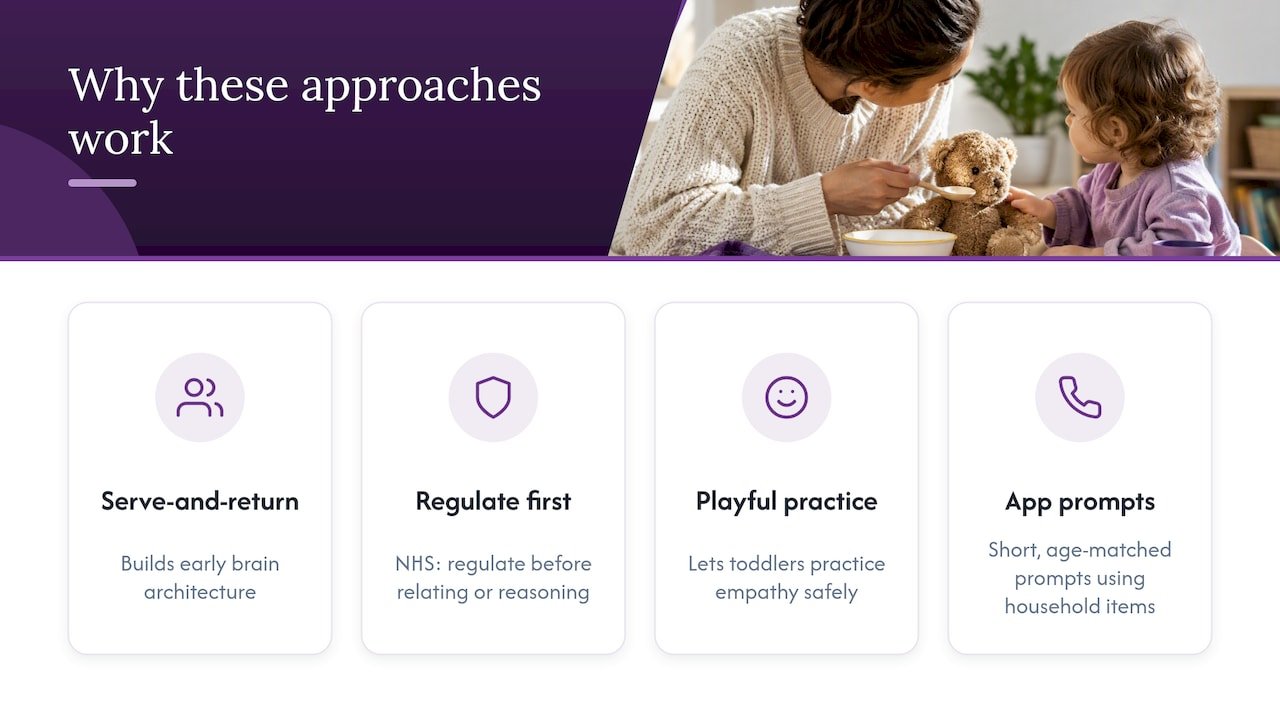
The core ideas behind these activities aren’t new. Responsive, back-and-forth exchanges, known as serve-and-return, build early brain architecture and support both language and emotional growth. The NHS recommends regulating before relating and reasoning, because a toddler’s brain simply can’t problem-solve while it’s flooded with feeling. And playful scenarios, like puppet shows or pretend care, help toddlers practice empathy in a low-stakes way.
An app takes these same principles and turns them into short, specific prompts using whatever is already in your kitchen drawer, matched to your toddler’s age and however many minutes you actually have.
Small, daily, responsive moments do more for emotional growth than occasional elaborate ones.
5. Author’s note: real parenting, tiny wins
Big feelings, yours and your toddler’s, are normal, not a sign you’re doing it wrong. Pick one activity from this list and try it today rather than waiting for the “right” moment. Small, regular interactions beat rare, perfect ones every time.
— samit
6. Try Mooshie Moments for quick, research-backed prompts
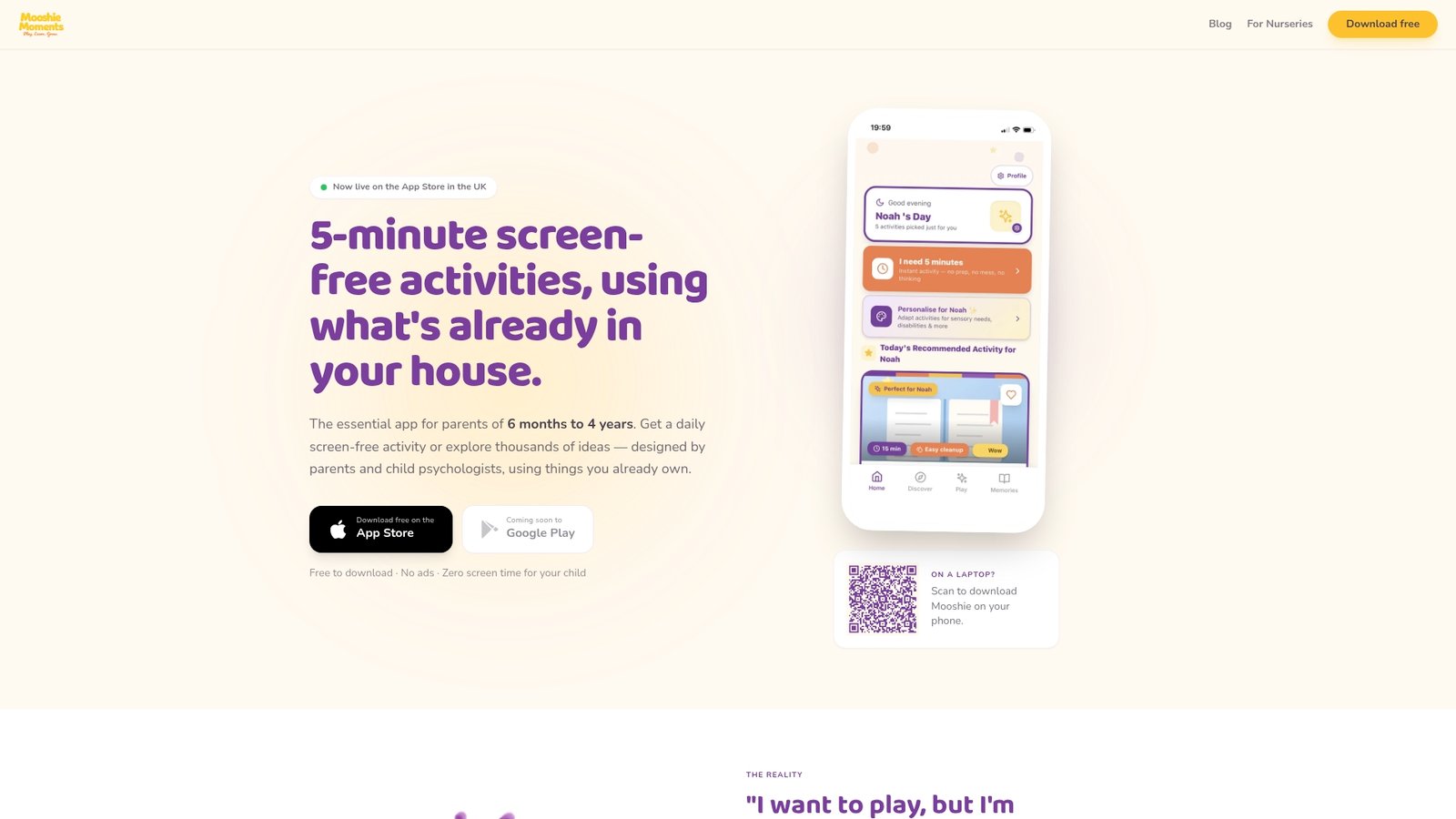
An app gives you age-targeted, screen-free activity ideas using things you already own, matched to however much time and energy you actually have. If today’s list felt useful, the app has a full library of prompts like it, ready in a few taps. Start with 40 fun 2-year-old activities or explore the full app at Mooshiemoments.
Sources
- Help your toddler with their emotions – Best Start in Life – NHS
- Serve and Return — Center on the Developing Child at Harvard University
- Learning about emotions through play — UNICEF Serbia
- 24–36 months social-emotional development — Zero to Three
FAQ
What are some emotional activities for toddlers?
Simple options include emotion charades, puppet play, mirror games, and feelings books using photos or drawings. Each one gives toddlers a chance to practice naming and expressing feelings through play rather than direct instruction.
How can I help my 2-year-old learn emotional regulation?
Start by naming feelings as they happen, then model calm breathing or a gentle hug when emotions rise. Following the 3 Rs, regulate first, relate second, reason last, gives toddlers a repeatable pattern to lean on.
What are the key milestones in emotional development for toddlers?
Toddlers move from basic emotion recognition toward early empathy and cooperative play as they approach 24 to 36 months. Responsive attention from caregivers during this stage is linked to stronger regulation skills later on.
How do I help a 3 year old with big emotions?
Get down to their level, keep your voice calm, and name what you see before offering any fix. Once they’ve settled, a short, simple explanation helps them understand what happened and what to try next time.
Recommended
- 40 Fun 2 Year Old Activities to Start Right Now
- 12 Low Prep Toddler Activities for Grandparents With Seated Options
- Junk Modelling for Toddlers: Easy EYFS-Aligned Activities
- Taste Safe Sensory Play: Top 10 Ideas for Mouthing Toddlers
Want a new idea every day, matched to your child's age?
Mooshie Moments gives you simple, guided play ideas for ages 6 months to 4 years.
Download free on the App StoreMore like this

Babysitting Toddlers: 12 Low Prep Ideas and Why They Help
Explore 12 low prep toddler activities for babysitters, with developmental benefits, age adaptations, UK safety advice, and optional activity coaching.

10 EYFS Backed Sock Games for Toddlers Under Five Minutes
Ten EYFS aligned sock games to start in under five minutes, each with a one line developmental benefit, simple adaptations, and two…

Busy Parents: 12 No Prep Shopping Activities for Toddlers
Busy parents: keep toddlers learning and calm at the store with 12 no prep, screen free activities that take under five minutes…