Emotion Coaching for Toddlers: What to Say and Do
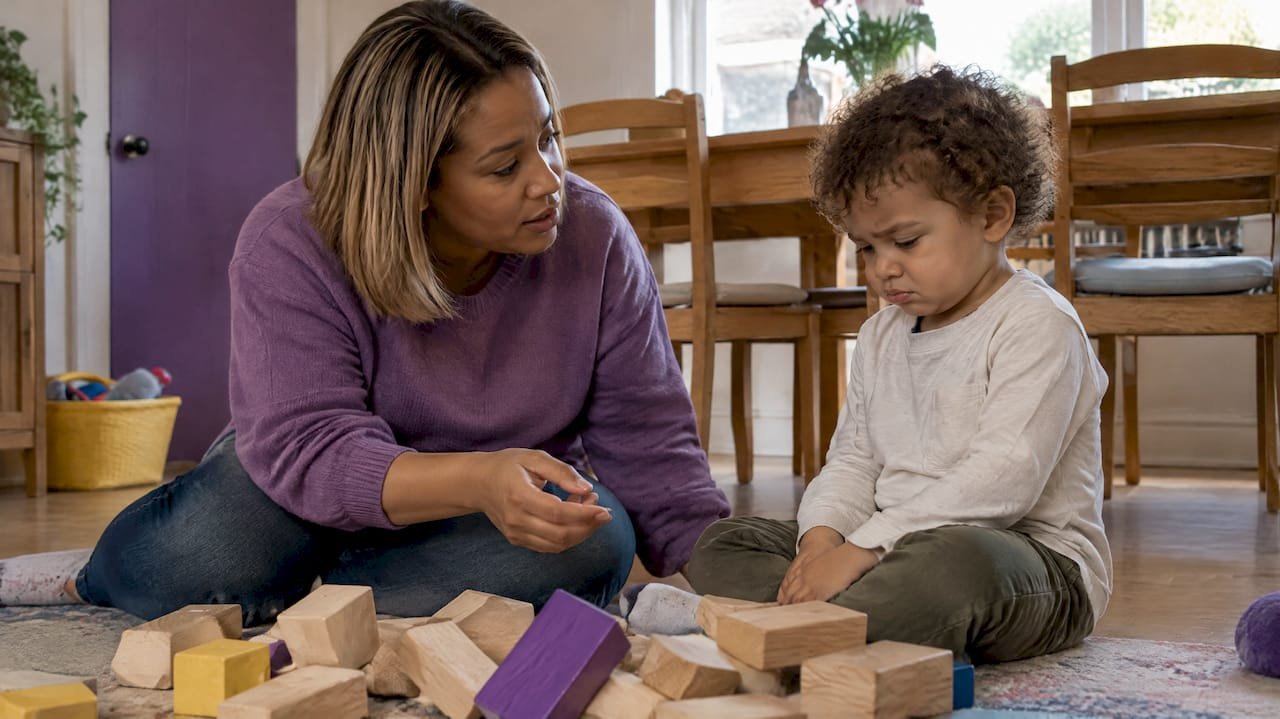
Emotion coaching means helping your toddler name what they feel, showing them you understand, and then guiding what they do next. It works best in small, repeated moments rather than in the middle of a meltdown. That is why we built Mooshie around one short game a day: a few minutes of play with the exact words to say gives you regular practice at the skill, long before the next tantrum arrives.
This guide covers what emotion coaching is, the steps to follow when feelings run high, the phrases that help, and how to practice through everyday play without a screen in sight.
TL;DR
- Emotion coaching has a simple order: stay calm yourself, name the feeling, show you understand, set a limit on behavior if needed, then help your child find what to do.
- Toddlers cannot talk their way through big feelings yet. Naming the feeling for them is how they learn the words.
- Coaching works best at the first signs of upset or after the storm has passed, not at the peak of a tantrum.
- Short, playful practice on calm days makes the words feel familiar when you need them.
- If outbursts are persistent or worrying, talk to your GP. The Young Minds Parent Helpline is 0808 802 5544.
Table of Contents
- What emotion coaching actually is
- Why toddlers find feelings so hard
- What to do in the moment: five steps
- Words that help
- Timing: coach early, or coach after
- Practice on calm days, through play
- Limits are part of the kindness
- One approach across every caregiver
- Make it a daily habit with Mooshie
- When to ask for help
- FAQ
- Sources
What emotion coaching actually is
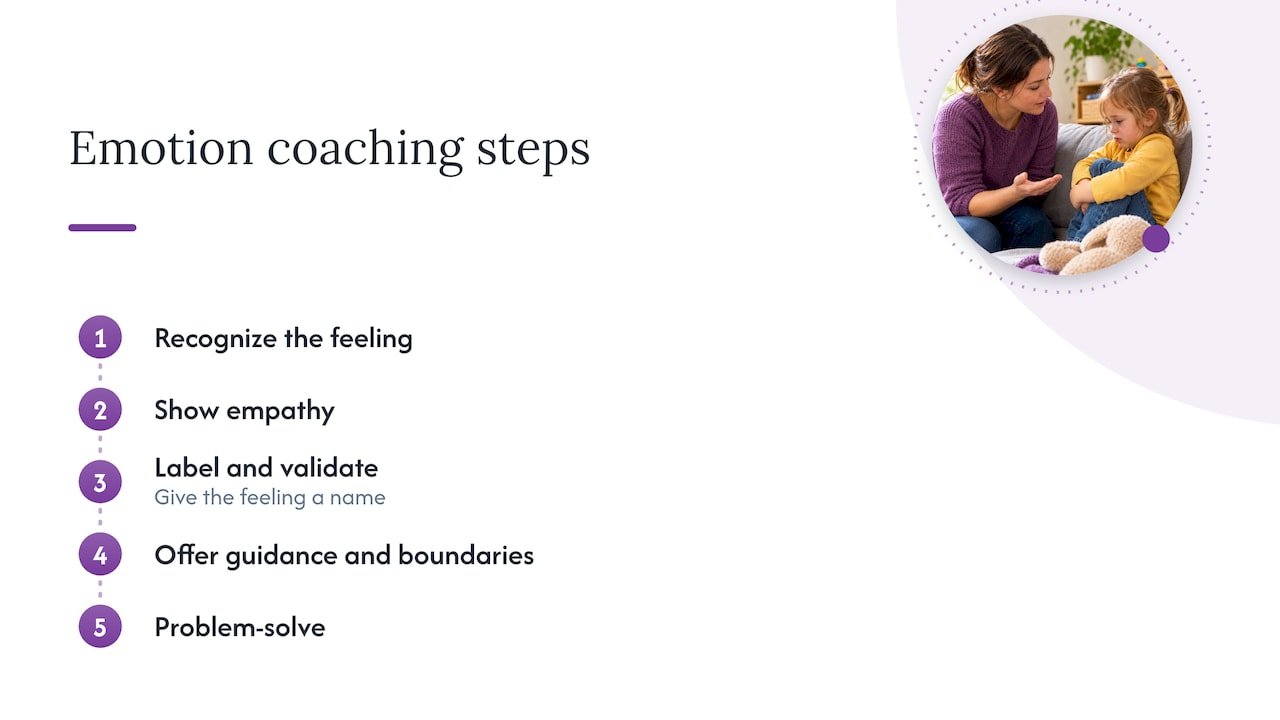
The Department for Education’s early years guidance describes basic emotion coaching steps: recognizing the feeling, showing empathy, labeling the feeling to validate it, offering guidance and boundaries, and then problem-solving. Giving children words and meanings for emotions lets them practice handling feelings as they come up. The guidance describes a path from a 2-year-old pointing to an “angry” icon to a 4-year-old explaining complex feelings.
That last point matters if you feel behind. Nobody expects a two-year-old to say “I am frustrated because the tower fell.” Your job is to say it for them, again and again, until they can say it themselves.
Research backs the effort. An Oklahoma State University fact sheet from January 2025 reports that training parents in emotion coaching improves children’s behavior problems and increases their emotion knowledge and emotion regulation, which are linked to making and keeping friends.
The Education Endowment Foundation calls the underlying idea co-regulation: sensitively supporting children to manage their feelings and actions so that, over time, they learn to do it alone. You lend your calm until they have their own.
Why toddlers find feelings so hard
If your almost-three-year-old seems more emotional than ever, that is normal. GOV.WALES explains that tantrums are very common between 2 and 3 years. They happen when children are frustrated, stressed, tired, hungry, jealous, frightened or unhappy, and at this age strong feelings overwhelm them and they struggle to put them into words.
Regulation develops gradually. A Bradford Council early years table describes 1 to 2 year olds as having outbursts and tantrums driven by single emotions. By 3 to 6 years, children can usually put emotions into words, explain causes and consequences, and begin to respond to reason. So a toddler who cannot be reasoned with is not being difficult. They are at the stage where the skill has not yet arrived.
The NHS says the same thing in plain terms: before you respond, take a few deep breaths and remember that your toddler is learning, not being naughty.
What to do in the moment: five steps
Guidance from the NHS, the CDC and GOV.WALES overlaps a lot. Put together, it gives you a routine you can hold in your head.
- Calm yourself first. The CDC advises that a pause can be three deep breaths or a longer break such as a walk, because speaking to a child’s feelings before you have calmed yourself can accidentally dismiss them. If your child is safe, you can take that breath.
- Keep everyone safe and stay close. The CDC says to make sure your child is safe, stay near, and give time and space. A cuddle if they want one, or simply sitting nearby with a calm voice, is enough.
- Name the feeling. Use short, simple words. The NHS suggests saying something like “I can see that you’re feeling angry that you can’t find your toy.”
- Set the limit, kindly. All feelings are fine, but not all actions are. The NHS example: it is okay to feel angry, everyone feels angry sometimes, but it is not okay to push others.
- Help them move on. Once they are calm, offer a simple choice or a next step, and reconnect with a hug or a book.
The order matters. The CDC explains that rushing into problem-solving too early can dismiss the child’s emotions and make things worse. Feelings first, then limits, then solutions.
The NHS “3 Rs”
The NHS Best Start in Life guide gives an easy way to remember it. Regulate by soothing and naming the feeling. Relate by showing love, such as a cuddle once they are calmer. Reason only when your toddler is calm. Reasoning during the storm is the step that most often goes wrong, because a toddler in full distress cannot take in an explanation.
Check the basics
GOV.WALES suggests a quick check using HALT: Hungry, Angry, Lonely, Tired. Connecting the feeling to the behavior can sound like, “I think you are tired and that’s why you are throwing your toys.” Raisingchildren.net.au adds that planning around known triggers helps, for example shopping after a nap rather than before it.
Words that help
You do not need a script for life, just a handful of phrases you can reach for when you are tired. Here are ones drawn from official guidance, adapted for everyday use.
| Situation | What you can say | Where it comes from |
|---|---|---|
| Toddler is upset about a lost toy | “I can see you’re feeling angry that you can’t find your toy. I’m here with you.” | NHS |
| Everyday happy moment | “I can see you’re feeling happy that we’re playing peekaboo.” | NHS |
| Screen or favorite thing switched off | “I know you’re really mad that I turned the TV off. It’s okay to feel mad. Would you like to read or play with blocks now?” | Zero to Three |
| Tricky moment, you are not sure why | “I wonder if that was tricky for you because…” or “It’s hard when…” | Devon County Council |
| Feelings are big, control feels lost | “Do you want your red pajamas or your striped ones?” | AAP |
The small choice in the last row is worth a closer look. The American Academy of Pediatrics notes that a choice gives a toddler back a feeling of control, and that praising them when they use words helps them swap tantrums for communication. NHS Healthier Together also recommends limited “this or that” choices, and staying calm without long debates.
The EEF also suggests naming body sensations, for instance: you might feel hot, or notice your heart beating quickly, when you are angry. That links the feeling to something the child can notice in their own body.
Timing: coach early, or coach after
This is where many parents get discouraged. You try the words in the middle of a full tantrum and nothing changes. That is expected. The University of Wisconsin Extension says emotion coaching is unlikely to work during a full tantrum and should be used at the first signs of upset, when you are calm and have time. It also suggests aiming to use it around 30 to 40 percent of the time, so you do not need to be perfect.
Raisingchildren.net.au agrees that talking about emotions is best after your child is calm. During the storm, your job is just to stay close and keep them safe. The CDC says to wait until both of you are calm before coaching.
That gives you three windows:
- Before: at the first whine, frown or stomp, name it quickly and calmly.
- During: stay close, stay calm, say very little.
- After: reconnect, name what happened, and talk about what to try next time. GOV.WALES notes it is fine to say sorry if you lost your cool, and you do not need to revisit the behavior later.
Practice on calm days, through play
A skill that is only used in a crisis is hard to learn. Play lets toddlers rehearse feelings with no pressure. All About Young Children notes that by three, children often have words for feelings like happy, sad, mad and scared, and may pretend to cry in play to try on feelings. Play is central to how they learn social and emotional skills.
Official guidance points the same way. The DfE suggests supporting self-expression through stories, drawing, crafts, roleplay and general play, naming feelings with visual supports. GOV.WALES recommends reading, singing and playing games together, and advises avoiding too much time with television, tablets and smartphones.
Here are simple ways to do it with things already at home:
- Feelings faces with a mirror. Pull a happy, sad and cross face together and say the word each time. Bradford’s guidance lists mirror work and talking about emotions through play for this age.
- Puppet or teddy troubles. Let a soft toy drop its snack and feel sad, then help it. The EEF recommends puppets, role play and stories for teaching coping techniques.
- Turtle breathing. The EEF gives the example of tucking in like a turtle and taking a deep breath, then asking later, “When do you think that might help you?”
- Story time. Pause on a page and ask how the character feels. Our ideas for research-based storytelling with toddlers are a good place to start.
- A calm corner. The AAP suggests a soft blanket, books or a favorite stuffed animal, plus belly breaths. Our list of 5-minute calming activities gives more low-prep ideas for it.
- Heavy work. Devon’s framework suggests carrying a loaded backpack or pushing a wheelbarrow to support regulation.
For a broader set of quick games, see our guide to toddler activities by skill area, and for connection-building moments, our bonding activities for toddlers.
Limits are part of the kindness
Emotion coaching is not permissive. The feeling is always accepted, and the behavior sometimes is not. The CDC advises setting limits on hurtful behavior and offering simple choices, and NHS Healthier Together stresses keeping rules, boundaries and adult behavior consistent, reliable and predictable.
If you want to think more about how limits shape a toddler’s development, this piece on the role of boundaries in toddler development gives a helpful angle. A calm “I won’t let you hit, but I can see you’re cross” is a limit and a piece of coaching at once.
One approach across every caregiver
Toddlers settle faster when the adults around them respond in the same way. If you share care with a partner, grandparent, nanny or childminder, agree on a few shared phrases and one simple order of steps. Consistency is what makes the words familiar enough to work.
For nurseries and childminders, the DfE guidance suggests using feelings cards at arrival to ask children how they are, and involving parents and carers. If you run a setting, our page on activities for nurseries, daycare and childminders may help, and the Partnership Pack gives settings a ready-made home-learning resource for their families.
Make it a daily habit with Mooshie
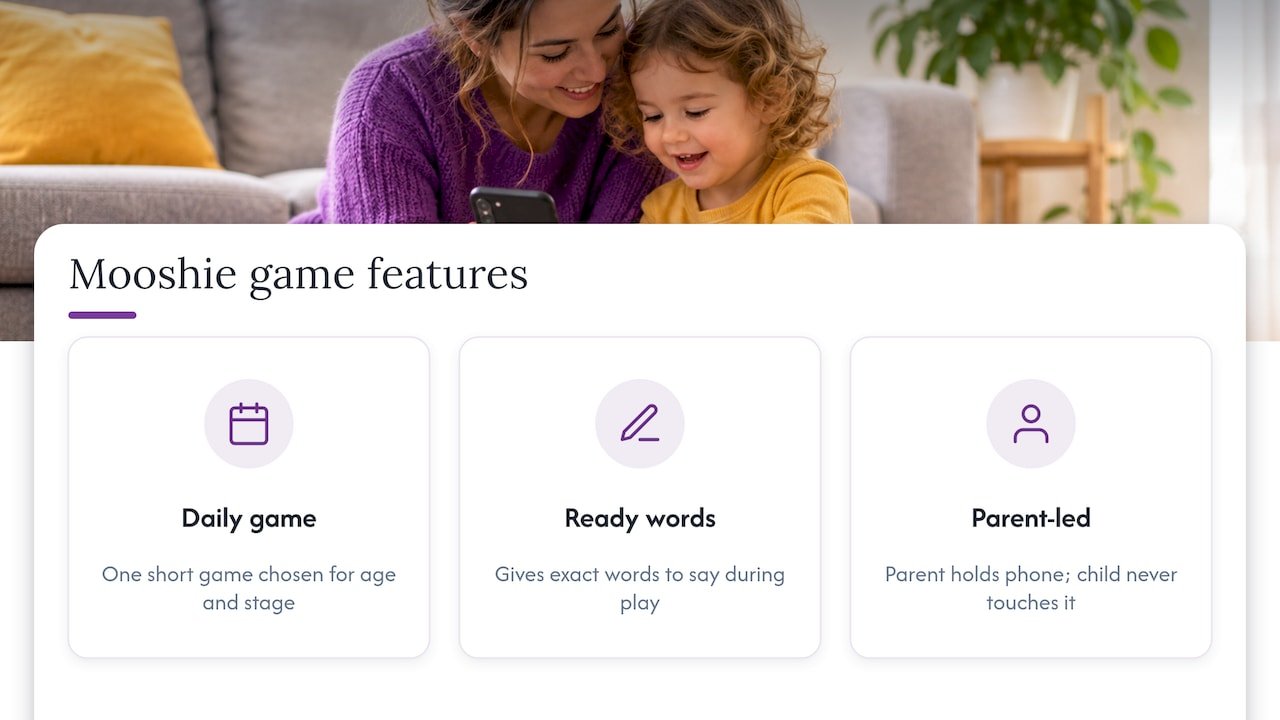
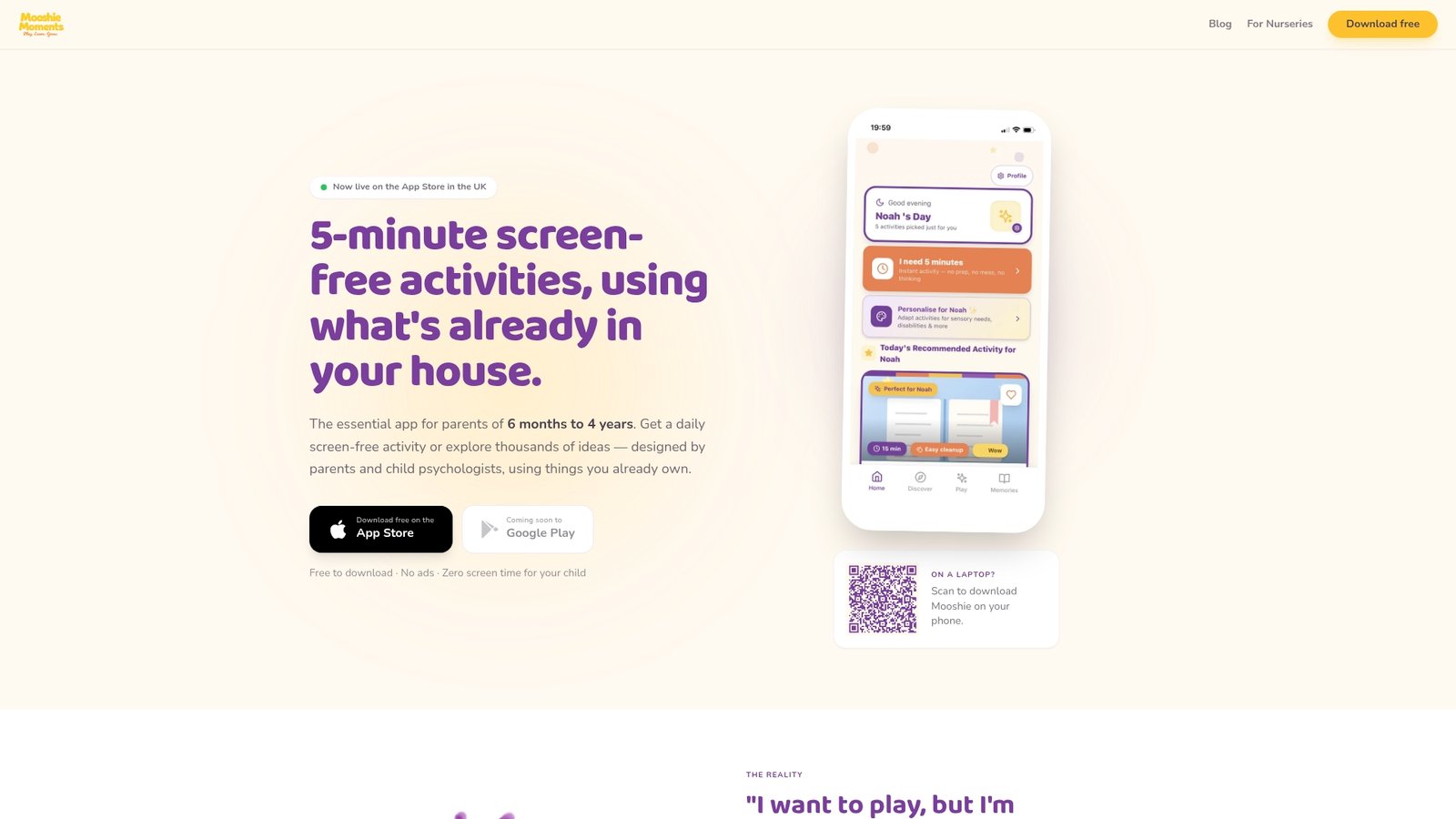
Every day, Mooshie gives you one short game chosen for your child’s age and stage, using things already in the house. It tells you how to play, the exact words to say, and what the game is building in your child’s brain. You hold the phone, and your child never touches it.
That daily rhythm suits emotion coaching, because the skill grows through repetition. Mooshie is free to download, with a subscription for premium features. You can find it at mooshiemoments.com.
What we believe about emotion coaching
We built Mooshie for parents who want to raise a child who thinks well, feels secure and treats others kindly. Those things are connected. A child who has words for feelings and a calm adult beside them has a head start on all of it.
The hard part is rarely knowing that you should name feelings. It is remembering to do it when you are tired, in a rush, or mid-tantrum. So we give you one game a day with the words already written. It takes minutes, uses things you own, and leaves the screen out of your child’s hands.
We would rather you play one short game today than plan a perfect routine for next week. Small and daily is how a toddler learns.
samit
When to ask for help
Most tantrums are a normal part of growing up. If outbursts are persistent or worry you, NHS Healthier Together advises first checking basic needs such as sleep, hunger and pain, and keeping routines and boundaries consistent. If behavior is more concerning, speak with your GP, work on a consistent plan with your child’s setting, and consider a self-referral to CAMHS (children’s mental health services). The Young Minds Parent Helpline number on that page is 0808 802 5544. If anyone is in immediate danger, call the emergency services.
FAQ
At what age does emotional regulation develop?
It builds gradually. Children aged 1 to 2 tend to have outbursts driven by single emotions, while by 3 to 6 they can usually put feelings into words and respond to reason, according to a Bradford Council stages table. Expect progress, not a switch.
How do I teach a toddler emotional regulation?
Start by calming yourself, then name the feeling and stay close. Practice calm days through play, stories and simple breathing games. Over time, your calm and your words become theirs.
Why is my almost three-year-old so emotional?
Tantrums peak between 2 and 3 years, when children get overwhelmed by strong feelings and cannot yet explain them, as GOV.WALES describes. Tiredness, hunger and frustration make it worse. Naming the feeling and checking the basics are good first moves.
Should I try emotion coaching during a full tantrum?
Mostly, no. Stay close, keep your child safe and stay calm. Coach once the peak has passed, or at the first signs of upset before it builds.
Sources
- Help for early years providers: Emotions (DfE)
- Help your toddler manage emotions (NHS Best Start in Life)
- Behaviour of concern (NHS Healthier Together)
- Your toddler 2-3 years (GOV.WALES)
- Understanding and responding to behaviour (GOV.WALES)
- Tips for Noticing and Naming Emotions (CDC)
- Help Kids Make Friends: Use Emotion Coaching (Oklahoma State University)
- Emotion Coaching (University of Wisconsin Extension)
- Managing emotions (Education Endowment Foundation)
- Handling Big Emotions (AAP)
- Toddler tantrums (Raisingchildren.net.au)
- Emotional regulation in the early years (Devon County Council)
- Stages of Emotional Development (Bradford Council)
- Your Child’s Development: 18 to 24 Months (Zero to Three)
- 18 Months to 36 Months (All About Young Children)
- The Role of Boundaries in Toddler Development
Recommended
- Speech and Language Activities to Help Your Toddler Talk
- How to Narrate Play for Your Toddler’s Language Growth
- Preparing Your Toddler for a New Baby Sibling
- Toddler Bonding Activities Busy Parents Can Do in 2–15 Minutes
Want play ideas matched to your child's age?
Mooshie Moments gives you simple, guided play ideas for ages 6 months to 4 years. Try 3 free activities a week.
Download free on the App StorePart of our guide: Toddler tantrums and big feelings · Compare toddler activity apps
More like this

9 Practical Toddler Meltdown Activities Parents Can Use in 2–5 Minutes
Practical, low prep toddler meltdown activities parents can practice for 2–5 minutes. NHS aligned timing, household items, and an app to help…

5 Minute Emotional Activities for Toddlers Using Household Items
Practical five minute activities using household items and daily routines to teach toddlers feeling words and calming skills, backed by serve and…

Kindness, Sharing and Manners Activities for Toddlers
Kindness activities for toddlers that build turn-taking before true sharing, plus manners and gratitude games your child can actually manage today.