
5 Minute Calming Activities for UK Toddlers, Screen Free & Low Prep

The most effective calming approach is simple, repetitive, low-stimulation, and screen-free: a familiar book, slow sensory play, calm music, or a predictable routine step. These best calming toddler activities work because they lower input, not add to it. Below, you’ll find which activity fits bedtime, which one rescues a meltdown in the grocery store, and which one turns a wild transition into a manageable one.
TL;DR:
- Repetitive, predictable activities like pouring water, stacking cups, or slow rocking are most effective for calming toddlers because they lower input, not add to overstimulation.
- Structured bedtime routines involving warm baths, gentle activities, and consistent cues help toddlers associate calming steps with sleep and reduce bedtime resistance.
- Short, rhythmic resets during tantrums or transitions like wall pushes, bubble blowing, or slow ball rolls can quickly restore calm within five minutes.
- Sensory play designed with safety—such as sensory bottles, water transfer, or edible playdough—can soothe mouth-inclined toddlers without risk of choking.
- Creating a calm environment with dim lighting, minimal noise, and clear space enhances the effectiveness of familiar, low-stimulation activities.
Table of Contents
- What Are the Best Calming Toddler Activities to Try First?
- Why Do These Activities Actually Calm Toddlers Down?
- How Do You Build a Calming Routine Into Bedtime?
- What Are Quick 5-Minute Resets for Tantrums and Transitions?
- Which Sensory Activities Are Safe for Toddlers Who Still Mouth Things?
- How Should You Set Up the Space for Calming Play?
- A Practical, Research-Aware Take on Calming Play
- Get Age-Matched Calming Activities Without the Guesswork
- Sources
- FAQ
What Are the Best Calming Toddler Activities to Try First?
Start with what’s already in your house. These activities work because they lean into repetition, slow rhythm, and predictable sensory input rather than novelty.
Quiet play
- A familiar picture book, read slowly with a soft voice, gives toddlers something predictable to focus on.
- Stacking cups or nesting bowls channel restless hands into a repetitive motion that settles the body.
Sensory play
- Water pouring between two cups (bath time or a shallow tray) is repetitive and rhythmic, which helps reset an overstimulated toddler in minutes.
- Playdough squeezing gives firm, repetitive pressure through the hands, which many toddlers find grounding.
Slow movement
- A gentle rock or sway, whether in your arms or a chair, delivers the kind of rhythmic motion that calms an overtired nervous system.
- Mindful games like “sleeping lions,” where everyone lies still and pretends to sleep, teach toddlers to wind down through play rather than command, according to BBC Tiny Happy People.
Bonding
- Calm music paired with a cuddle turns a transition into connection time instead of a battle.
Age matters here: a 12-month-old will engage longest with pouring and stacking, while a 3-year-old often prefers the sleeping lions game or a longer story. For more ideas sorted by stage, our guide to 2 year old activities breaks down what tends to land best at that age.
Pro Tip: Keep two or three go-to calming activities on rotation instead of a big pile of options. Toddlers regulate faster with familiar choices than with novelty.
Why Do These Activities Actually Calm Toddlers Down?
Toddlers calm through regulation, not distraction. Predictable, repetitive input (a familiar rhythm, a slow voice, the same three bedtime steps) helps an overwhelmed nervous system reorient itself, rather than papering over the overwhelm with something louder or brighter.
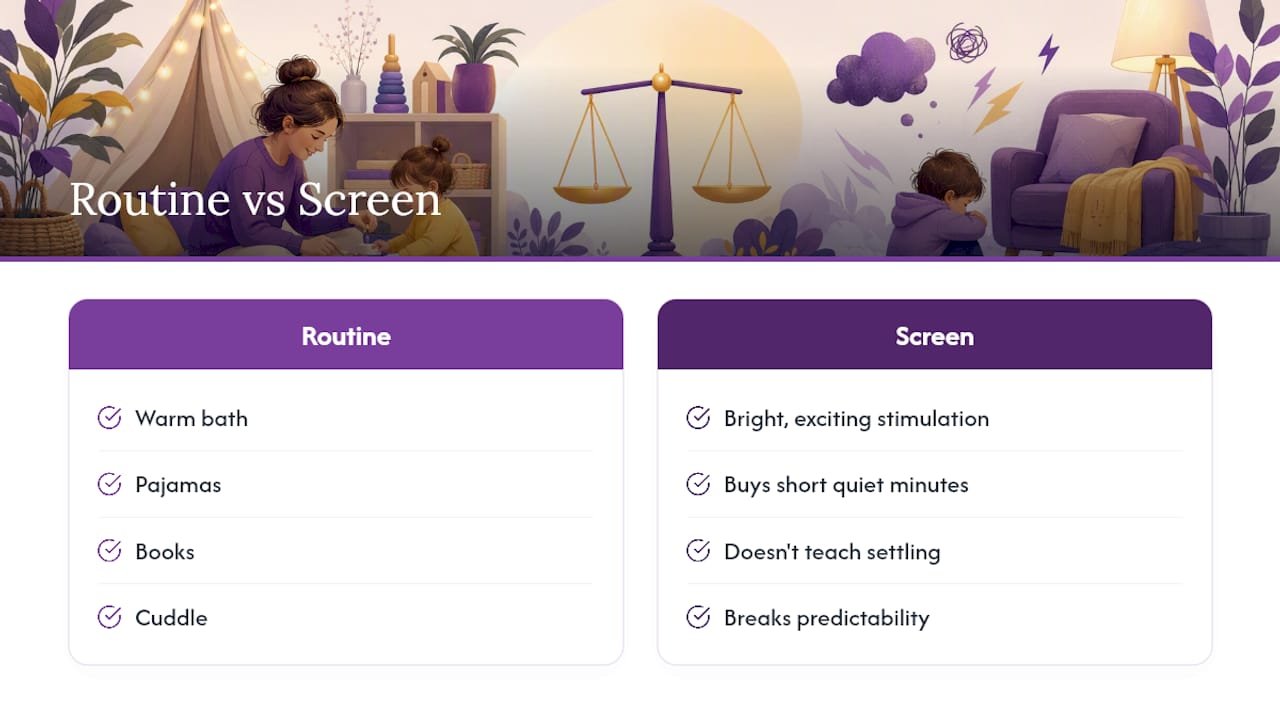
That’s the flaw in reaching for a screen or a burst of exciting stimulation when a toddler is deregulated. It might buy five quiet minutes, but it doesn’t teach the nervous system to settle. Slow, low-stimulation activities do. A consistent bedtime routine of short, predictable steps, bath, pajamas, books, cuddle, works because the child’s brain learns to anticipate what comes next. Predictability itself is calming.
How Do You Build a Calming Routine Into Bedtime?
A short, structured bedtime routine gives toddlers the same calming cues every night, which is what makes it work. Here’s a sample short sequence lasting around fifteen to twenty minutes:
- Bath (5 minutes). Warm water lowers arousal and signals the body it’s winding down.
- Pajamas and a quick sensory step (2 to 3 minutes). A firm cuddle or brief massage adds calming deep-pressure input.
- One or two books (5 to 7 minutes). Read slowly, in a soft voice, at the same time every night.
- A cuddle or quiet song (3 to 5 minutes). End here, not with more stimulation.
Use calming activities proactively, before bedtime or before a known trigger like leaving the park, rather than only reaching for them once a meltdown has started. Limit the choices you offer (“book or song?” not five options), repeat the same cues nightly, and stop the routine while your toddler is still calm rather than pushing for one more activity.
Pro Tip: If your toddler tends to get a second wind before bed, move the bath earlier in the sequence. The drop in body temperature after a warm bath helps sleepiness kick in right on schedule.

What Are Quick 5-Minute Resets for Tantrums and Transitions?
When you need calm fast, these six resets work because they’re rhythmic, repetitive, and easy to lead with a simple script.
- Water pouring. Hand over two cups and a bit of water in a tray. Say, “Watch it fill up, watch it pour out.”
- Slow ball roll. Roll a ball back and forth slowly, narrating each pass.
- Bubble breathing. Blow imaginary bubbles together, or real ones, with slow exhales.
- Wall pushes. Have your toddler push against a wall with both hands for a count of ten. The resistance delivers calming proprioceptive input.
- Single-toy repetition. One toy, one repeated action, like clicking a switch or stacking the same three blocks.
- Blanket swing. Two adults gently swing a toddler in a blanket for rhythmic vestibular input.
If five minutes of a reset doesn’t settle things, switch to a longer, quieter activity like the full bedtime-style routine rather than escalating to something louder.
Which Sensory Activities Are Safe for Toddlers Who Still Mouth Things?
Sensory play is one of the most reliable calming tools, but mouthing toddlers need setups built with safety in mind from the start.
- Sensory bottle. Fill a securely sealed bottle with water, glitter, and oil for visual calming without any choking risk. Happy Toddler Playtime recommends hot-gluing the lid shut as an extra safety step.
- Water transfer. Cups and a shallow tray of water, supervised closely, are naturally taste-safe.
- Playdough. Store-bought or homemade edible playdough covers toddlers who still mouth objects.
- Treasure basket. Fill it with large, smooth household items, wooden spoons, a soft scarf, nothing smaller than a toilet paper tube.
- Fabric sorting. Sort large fabric scraps by texture or color; skip anything with loose threads.
- Light and shadow play. A flashlight and a wall in a dim room offers visual calm with zero choking risk.
Limiting how many sensory options you set out at once actually helps, since too many choices can overwhelm rather than calm a toddler who’s already dysregulated. For a full list built specifically around mouthing safety, see our guide to taste-safe sensory play.
How Should You Set Up the Space for Calming Play?
A few environmental tweaks make any calming activity work better.
- Dim harsh overhead lights; a lamp or natural light feels less alerting.
- Turn off background TV or loud music, even if no one’s watching it.
- Clear the immediate play area of unrelated toys so one activity gets full focus.
- Check for secure lids, no loose small parts, and stay within arm’s reach during sensory play.
- For sensory-sensitive toddlers, offer fewer, simpler materials and skip strong smells or scratchy textures.
Pro Tip: If your toddler flinches at loud or sudden sounds, swap music for a low hum or white noise. Sensitivity to volume is common and easy to work around.
A Practical, Research-Aware Take on Calming Play
The instinct to entertain a dysregulated toddler out of a meltdown is understandable, but it usually backfires. What actually works is smaller and quieter than most parents expect: the same three books, the same pouring game, the same rocking motion, night after night. The activity library is built around that exact principle, featuring curated ideas matched to a child’s age and available time, so the right calming option is never more than a search away.
— samit
Get Age-Matched Calming Activities Without the Guesswork
There are screen-free alternatives to scrolling through many parenting blogs looking for one idea that fits your exhausted toddler and your limited free time. These tools filter activities by age, available time, and energy level, so you get a calming option built for right now instead of a generic list.

Every suggestion uses household items already in your home, comes with a plain-language explanation of why it works developmentally, and skips the screen entirely. Whether you need a 5-minute reset before a car ride or a fresh idea for the bedtime wind-down, the Mooshie Moments app puts age-tailored, expert-reviewed activities in your pocket. Download it and pull up your first calming activity tonight.
Sources
- Bedtime routines (Raising Children Network)
- Sleepytime games to relax your child – Activities (BBC)
- 5-Minute play activities that calm an overstimulated toddler (Lillbud)
FAQ
What is the 3-3-3 rule for toddlers?
The 3-3-3 rule isn’t a standard child-development framework, and definitions vary widely online. Rather than following an unverified rule, focus on what’s proven to work: short, repetitive, predictable activities like the ones covered above.
What are some calming activities for toddlers?
Books, stacking and pouring games, slow sensory play like playdough or water transfer, calm music, and gentle rocking all count among the best calming toddler activities. The common thread is low stimulation and repetition.
What helps a toddler calm down fastest?
Reducing input works faster than adding it. A quiet, repetitive action like water pouring or a slow rock, paired with a soft voice, typically settles a toddler quicker than a new toy or a screen.
What’s the hardest age with a toddler?
Many parents find toddlerhood especially demanding, since toddlers at this stage have big feelings but limited language to express them. Consistent, predictable calming routines tend to help most during this stretch, and apps like Mooshiemoments offer age-specific activities matched to exactly this phase.
Can screens help calm an overstimulated toddler?
Screens can quiet a toddler briefly, but they don’t teach the nervous system to self-regulate the way slow, repetitive, screen-free play does. Reserving calming time for low-stimulation activities builds a skill that lasts beyond the moment.
Recommended
- 12 Low Prep Toddler Activities for Grandparents With Seated Options
- 40 Fun 2 Year Old Activities to Start Right Now
- Junk Modelling for Toddlers: Easy EYFS-Aligned Activities
Want a new idea every day, matched to your child's age?
Mooshie Moments gives you simple, guided play ideas for ages 6 months to 4 years.
Download free on the App StoreMore like this
Babysitting Toddlers: 12 Low Prep Ideas and Why They Help
Explore 12 low prep toddler activities for babysitters, with developmental benefits, age adaptations, UK safety advice, and optional activity coaching.
10 EYFS Backed Sock Games for Toddlers Under Five Minutes
Ten EYFS aligned sock games to start in under five minutes, each with a one line developmental benefit, simple adaptations, and two…
Busy Parents: 12 No Prep Shopping Activities for Toddlers
Busy parents: keep toddlers learning and calm at the store with 12 no prep, screen free activities that take under five minutes…