
Turn Harvard’s 5 Steps Into Two Minute Serve and Return for UK Parents

Serve-and-return means noticing something your toddler does (a look, a babble, a pointed finger) and responding to it, then waiting for them to react back. It builds early language and brain connections through simple, repeated back-and-forth moments. Start right now: notice one small thing your toddler does, return it with words or a gesture, and wait a few seconds for their reply.
TL;DR:
- Responsive interactions should be practiced frequently during daily routines like meals, baths, and walks, using brief, natural moments rather than dedicated playtime.
- Pausing for at least five seconds after responding to a toddler’s cue is crucial for language development, as it allows the child to process and reply.
- The five-step serve-and-return method involves noticing the serve, returning it with response, naming what caught their attention, waiting for their reaction, and winding down naturally.
- Consistent, low-pressure responsiveness has been linked to better language skills at 18 and 24 months, but it requires prioritizing quality interaction over quantity or flashcard drills.
- Using simple prompts and natural routines helps embed serve-and-return into everyday life, making it sustainable even on busy or challenging days.
Table of Contents
- What Serve and Return Actually Means for Toddlers
- The Harvard 5 Steps for Brain-Building Serve and Return
- Low-Prep Serve-and-Return Activities for Everyday Routines
- Fitting Serve and Return Into a Busy Day
- What to Do When Serve and Return Feels Hard
- The Evidence Behind Serve and Return
- Mooshie Moments in Practice: Turning Research Into a Five-Minute Habit
- What Actually Matters Here (And What Doesn’t)
- Try Mooshie Moments for Two-Minute Activities That Actually Fit Your Day
- Sources
What Serve and Return Actually Means for Toddlers
A “serve” is anything your toddler does to get your attention. It could be a sound, a look toward the window, a reach for your cup, or a grunt while pointing at the dog. A “return” is what you do next: you notice the serve and respond to it with words, a facial expression, or a matching gesture. That’s the whole exchange. No flashcards, no timers, no special toy required.
The mechanism behind this is worth understanding, because it explains why it works better than passive entertainment. Every time you respond to your toddler’s cue, you strengthen a neural pathway tied to communication and trust. Harvard’s Center on the Developing Child describes serve-and-return as one of the core experiences that shapes brain architecture in early childhood, precisely because it’s responsive rather than one-directional. A toddler babbling at a wall gets nothing back. A toddler babbling at you, and hearing “Oh, you saw the dog!” gets a loop closed. That loop, repeated hundreds of times a week, is what builds the wiring.
This isn’t a fringe theory picked up by one parenting blog. Observational research has tracked how early responsive interactions connect to later outcomes, and the pattern holds up. One study of mother-child and father-child interactions at nine months found associations between the quality of these serve-and-return exchanges and children’s language skills measured again at 18 and 24 months. The responsiveness at nine months mattered more than how much anyone talked overall.
Here’s the short version of why this beats most other advice you’ll read about “boosting” toddler development:
- It costs nothing and needs no equipment.
- It fits into moments you’re already living through, not extra time you don’t have.
- It rewards attention and responsiveness over scripted vocabulary drills.
- It works with babble and single words just as well as full sentences.
- It’s flexible enough to survive a bad day, a distracted moment, or a fussy toddler.
Serve-and-return isn’t a program to follow. It’s a habit of paying attention and answering back, and once you see it, you’ll notice you’re already doing pieces of it without knowing the name for it.
The Harvard 5 Steps for Brain-Building Serve and Return
Harvard’s Center on the Developing Child breaks the interaction into five concrete steps, and they translate almost word for word into things you can do with a toddler today.
- Notice the serve. Watch for what your toddler is actually looking at, reaching for, or vocalizing about, rather than what you assume they mean. If your toddler stares at a bird outside, that stare is the serve, even if they haven’t said a word.
- Return the serve. Respond right away, in a way that shows you saw it. A smile, a nod, a matching sound, or a short phrase all count. “You see the bird!” works fine.
- Give it a name. Label what caught their attention. Naming builds vocabulary because it attaches a word to something your toddler already cares about at that exact second, which is when learning sticks.
- Take turns and wait. After you respond, stop talking and give your toddler space to react, whether that’s a babble, a point, or a repeated word.
- Practice endings and beginnings. Let the exchange wind down naturally, and be ready to pick up a new one when your toddler serves again. Interactions don’t need to be long to count.
None of these steps require a quiet room or a set-aside fifteen minutes. A toddler pointing at a spoon during breakfast is a full opportunity to run through all five steps in under ten seconds.
Pro Tip: Try narrating one meal a day using only steps 1 through 4, out loud, slower than feels natural. Most parents rush past step 4 (the wait) without noticing, and that’s usually the step doing the most work for language growth.
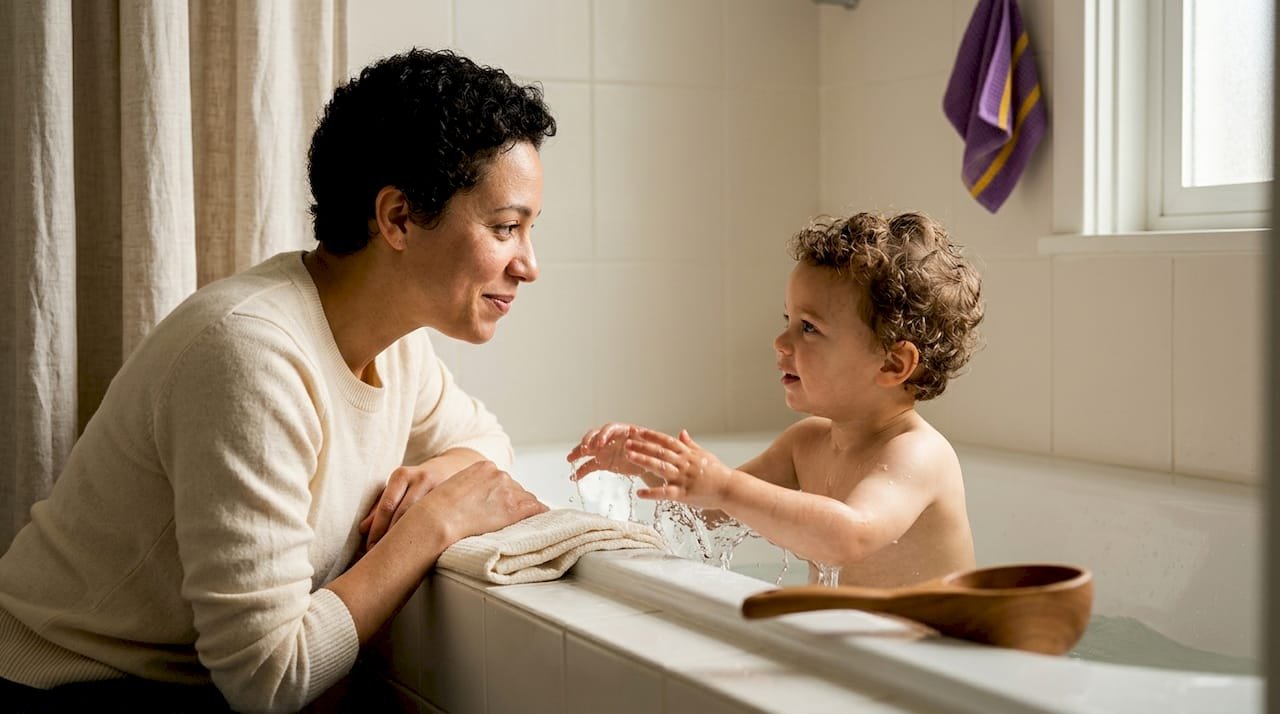
Two scripts worth memorizing. First, at bath time: your toddler splashes water, you say “Splash! You made a splash,” then pause and watch what they do next. Second, during a walk: your toddler points at a dog, you crouch down, say “Dog, woof woof,” and wait to see if they repeat the sound or point again. Both examples run the full five-step loop in a handful of seconds, and both cost nothing beyond attention.
Low-Prep Serve-and-Return Activities for Everyday Routines
You don’t need dedicated playtime to practice this. Some of the richest serve-and-return moments happen during tasks you’re already doing, which is good news if your day feels packed. UNICEF’s parenting guidance makes the same point: responsive play thrives in ordinary routines like feeding, bathing, and reading, without needing special equipment.
Meals
Mealtimes hand you dozens of natural serves without any effort on your part.
- When your toddler picks up a piece of food, name it: “Apple. You’ve got the apple.”
- If they push food away, mirror the gesture back gently and say “All done?” then wait for a response, even a headshake.
- Echo any babble sound they make with their mouth full, exaggerating your own mouth movements so they can watch.
- Offer a two-item choice (“Banana or crackers?”) and wait through the pause. The wait is the point, not the speed of the answer.
Bath time
Water naturally invites repeated motion, which makes bath time one of the easiest places to build a rhythm of turns.
- Splash once, name the splash, then hand your toddler the cup and wait to see if they copy it.
- Narrate body parts as you wash them (“Elbow! Knee!”) and pause after each word for a look, point, or sound back.
- If your toddler squeals with excitement, squeal back at a similar pitch, then go quiet and watch for round two.
Books
Reading together is serve-and-return in its most obvious form, but most parents read straight through without leaving space for a return.
- Stop mid-sentence on a familiar book and let your toddler fill in the missing word, even if it’s a guess.
- Point at a picture and wait before naming it yourself. Often a toddler will point back or babble first.
- Ask “Where’s the [animal]?” and let several seconds pass before pointing it out yourself.
For more structured phrasing you can lean on during story time, our guide on narrating play and building language breaks down specific phrases that turn ordinary picture books into language-rich exchanges.
Outside and on walks
Being outdoors multiplies the number of things your toddler might serve to you, from leaves to trucks to other kids on scooters.
- Stop when your toddler stops. Follow their gaze before deciding what’s interesting.
- Name whatever they’re looking at in three words or fewer, then wait.
- Mimic a sound they make (a bird call, a car noise) and see if they repeat it back louder or with a variation.
Adjusting for babble versus first words
If your toddler is still in the babbling stage, your return doesn’t need real words either. Match their sounds, exaggerate your mouth shape, and treat any vocalization as worth a response. Once first words start appearing, shift toward naming things clearly and slowly, since your toddler is now testing whether the word they heard matches what they meant. Both stages use the exact same five-step structure. Only the content of your return changes.
Fitting Serve and Return Into a Busy Day
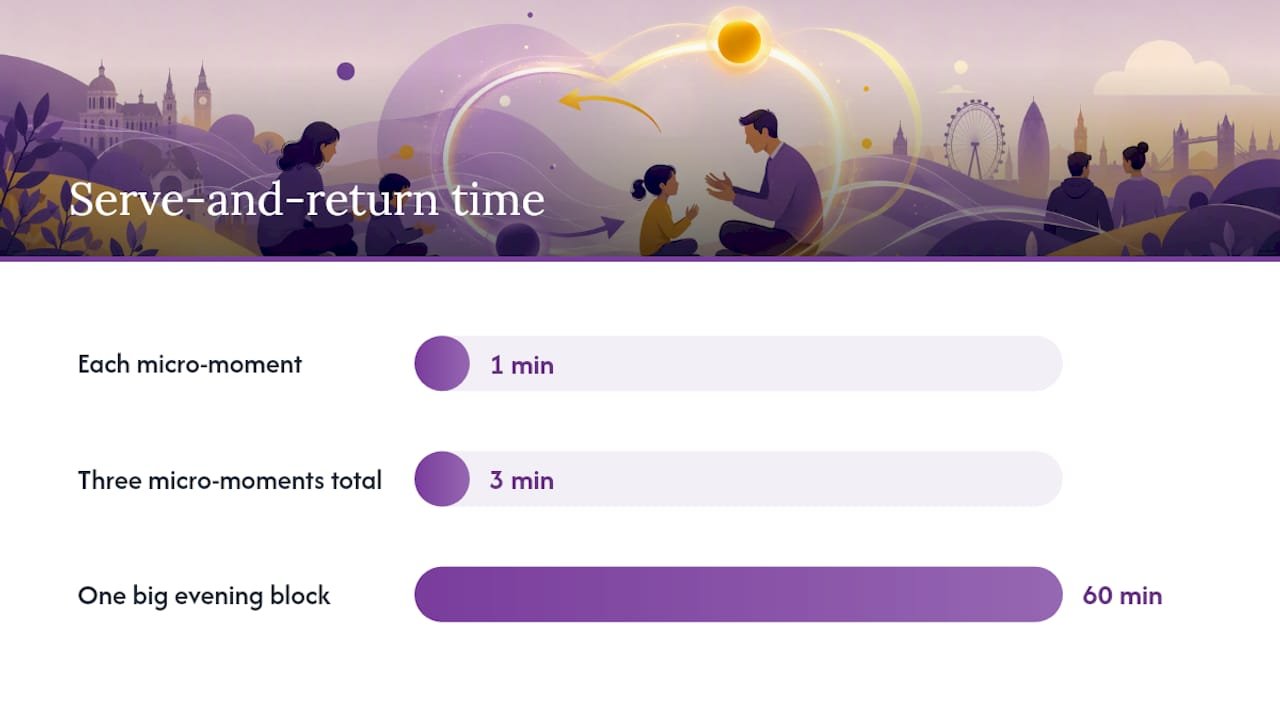
The biggest myth about this kind of interaction is that it requires long, uninterrupted play sessions. It doesn’t. Short, frequent micro-moments spread across the day do more for your toddler’s development than one exhausting hour of forced engagement in the evening.
A useful way to think about it: plan for three one-minute windows a day rather than one big block. Breakfast prep, bath time, and the few minutes before nap are natural slots that already exist in most routines, so you’re not adding anything new to your schedule, just paying closer attention during time you’re already spending together.
Everyday moments that already contain built-in serve-and-return opportunities:
- Getting dressed (naming clothing items, waiting for arms or legs to move)
- Diaper changes (narrating each step, watching for kicks or sounds in response)
- Snack time (offering choices, waiting through the decision)
- Short walks to the car, the mailbox, or around the block
- Waiting in line at the store (naming what’s around you, watching where attention goes)
Wait time is where most parents rush. The Illinois Early Learning Project notes that waiting is often the hardest part of the exchange, because silence after a question feels unnatural to adults. Toddlers need real processing time, sometimes several seconds, before they respond with a word, sound, or gesture. If you fill that silence yourself, you close the loop before your toddler had the chance to open it.
Realistic turn length matters too. A “conversation” with a young toddler might be two or three exchanges total, not a sustained back-and-forth like you’d have with an older child. That’s normal, and it’s still valuable. The goal isn’t a long conversation. It’s a completed loop: serve, return, wait, response.
Pro Tip: Count silently to five in your head after you ask a question or make a comment. It feels painfully slow the first few times, but that’s usually the exact amount of time a toddler needs to organize a reply.
Following your toddler’s lead, rather than steering the interaction toward what you think they should be learning, tends to produce more sustained engagement and supports emotional regulation and autonomy better than vocabulary drills do. If your toddler wants to talk about the vacuum cleaner for the fifth day in a row, that’s the serve worth returning, not a redirection toward something you’d rather discuss.
What to Do When Serve and Return Feels Hard
Some days this feels effortless. Other days you’re running on four hours of sleep, juggling two kids, or just staring at your phone because you need five minutes of mental quiet. All of that is normal, and none of it means you’re failing at this.
Parental stress is one of the biggest, most underdiscussed barriers to responsive interaction. Research on positive parenting strategies notes that exhaustion and overwhelm directly reduce both the frequency and the quality of caregiver responsiveness. The fix isn’t to force more interaction. It’s to protect small, intentional windows instead of trying to be “on” all day.
Practical fixes for common barriers:
- Fatigue: Pick one activity a day (even one minute) and let the rest of the day be lower-key. One focused minute beats an hour of half-attention.
- Multiple children competing for you: Narrate what you’re doing with one child out loud so the other can serve into the conversation too, even from across the room.
- Screens nearby: Put your own phone in another room during the windows you’ve chosen. Toddlers notice divided attention faster than most parents assume.
- A toddler who seems uninterested: Lower the sensory load. Move to a quieter spot, cut down on visual clutter, and use a slower, more exaggerated serve, like one clear word paired with a big facial expression, instead of a full sentence.
If your toddler consistently doesn’t respond to serves, even simplified ones, it’s worth paying attention to the pattern rather than assuming it’s just a phase. A combination of updated parenting strategies recommends watching for signals like limited eye contact, very little vocalizing even when prompted, or a consistent lack of response to their name across different settings and moods. One quiet day isn’t a red flag. A pattern that holds for weeks, especially alongside other developmental concerns, is worth raising with your pediatrician or health visitor. You know your toddler’s baseline better than any article can.
The Evidence Behind Serve and Return
The strongest single source on this topic is Harvard’s Center on the Developing Child, which frames serve-and-return not as a nice parenting technique but as one of the foundational experiences that shapes brain architecture in the first years of life. Their five-step framework, covered earlier, isn’t a marketing invention. It’s a distillation of decades of developmental neuroscience into something a tired parent can actually use at 7 a.m. on a Tuesday.
Serve-and-return interactions shape brain architecture. When an infant or young child babbles, gestures, or cries, and an adult responds appropriately with eye contact, words, or a hug, neural connections are built and strengthened, providing the foundation for later learning.
That framing matters because it shifts the goal away from teaching content (colors, numbers, letters) and toward teaching responsiveness itself. A toddler who reliably gets a return on their serves learns something more foundational than vocabulary: that communication works, that someone is listening, and that trying again is worth it.
The peer-reviewed evidence adds weight rather than just repeating the theory. A study tracking mother-child and father-child interactions found measurable associations between early responsiveness at nine months and children’s language skills at both 18 and 24 months. That’s not a single afternoon of correlation. It’s a pattern that held across two later checkpoints, in both maternal and paternal interactions.
Caution matters here too. Observational studies show association, not guaranteed causation for every individual child, and language development is affected by many overlapping factors, including temperament, hearing, and overall home environment. No single technique, including serve-and-return, is a substitute for professional evaluation if you have genuine concerns about your toddler’s development. What the evidence does support clearly is this: consistent, responsive interaction is one of the most reliable levers parents actually control, and it costs nothing to practice more often starting today.
Mooshie Moments in Practice: Turning Research Into a Five-Minute Habit
We built Mooshie Moments because we kept seeing the same gap: parents understood the theory behind serve-and-return but ran out of ideas by 4 p.m. on a hard day. The app takes the five-step framework and turns it into short, screen-free activity prompts tailored to your toddler’s age and however much time you actually have, whether that’s two minutes or fifteen.
Here’s what one activity flow looks like inside the app. You open Mooshie Moments during snack time and select a two-minute slot. It suggests naming the textures of whatever your toddler is eating (crunchy, soft, cold), which covers the “notice” and “return” steps immediately. It then prompts you with a specific phrase to try, hits the “name it” step directly, and reminds you to pause afterward—that’s the wait—before offering a follow-up prompt if your toddler responds. The app provides activity ideas based on developmental research, helping you choose prompts grounded in child development principles.
I’m samit, and I write about this because the gap between knowing the theory and actually doing it during a chaotic Tuesday afternoon is where most good parenting advice quietly dies. The app exists to close that gap, one short activity at a time.
What Actually Matters Here (And What Doesn’t)
Most advice on toddler development overweights novelty. New toys, new flashcards, new apps promising to accelerate language by some specific age. The research on serve-and-return points somewhere far less flashy: the thing that actually builds brain architecture is a parent noticing a small cue and responding to it, over and over, in moments that already exist in your day.
Where conventional advice falls short is the pressure it puts on parents to create special “learning time.” That framing backfires, because it implies ordinary moments, feeding, bathing, walking to the car, don’t count unless you’ve turned them into a lesson. The Harvard framework says the opposite. Ordinary moments are the whole point.
If you take one thing from this article, prioritize the wait, not the return. Most parents already respond to their toddler. Far fewer leave five full seconds of silence afterward. That pause is where a toddler organizes their own response, and it’s the step that gets skipped most often because silence feels uncomfortable to adults, not to toddlers.
— samit
Try Mooshie Moments for Two-Minute Activities That Actually Fit Your Day
This app offers serve-and-return prompts sized to fit various time availabilities, using common household items to make engagement easy and convenient.
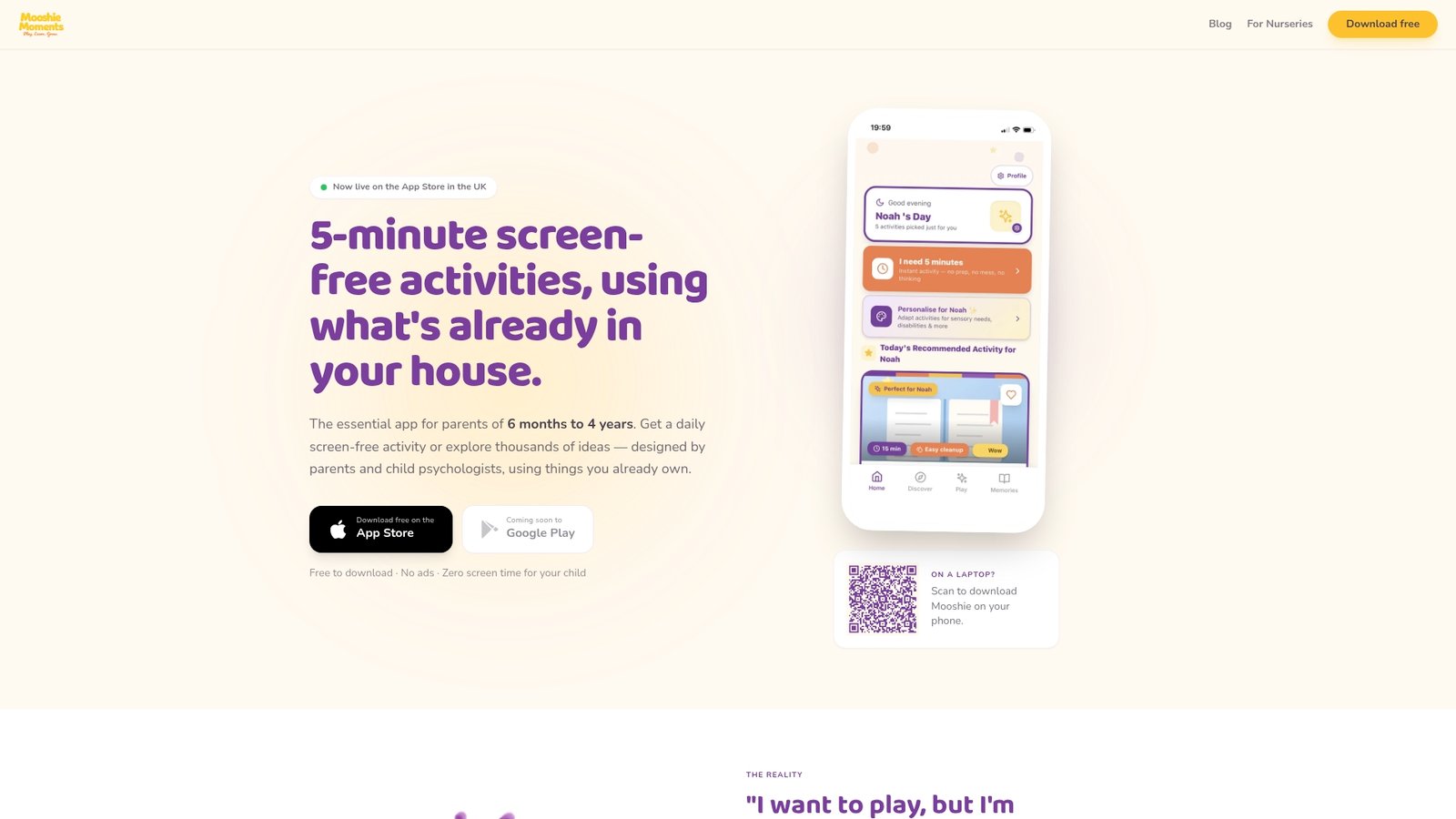
What you get inside the app:
- Activity suggestions filtered by child age
- Options sorted by available time
- Developmental information attached to each activity
- Printable prompt cards for caregivers
If naming and narrating feel like the piece you want to strengthen first, our guide on building language through narrated play pairs well with the app’s age-specific prompts. Download Mooshie Moments and pick your first two-minute activity today.
Sources
- Serve and Return: Back-and-forth exchanges
- Mother-child and father-child “serve and return” interactions at 9 months: Associations with children’s language skills at 18 and 24 months
- Playtime anytime (UNICEF parenting)
Recommended
More like this

Five Minute Routine Activities to Help Speech Delay in UK Toddlers
Quick, routine based activities UK parents can use in 5–15 minutes to support a toddler with speech delay. Evidence backed techniques and…

Three Minute Mess Free Sensory Play For UK Parents
Quick, reusable sensory activities UK parents can set up in minutes. Sealed bags, sticky wall art, safety checks, storage tips, and Mooshie…
10 Quiet Bin Ideas UK Parents Can Build in 5 Minutes
Practical, EYFS-aligned quiet-bin ideas UK parents can assemble in five minutes. Includes 10 ready bins, a five-bin rotation, safety checks, and quick...