
Five Minute Routine Activities to Help Speech Delay in UK Toddlers

If your toddler has a speech delay, start today with short, routine-embedded activities that use parallel talk, expectant waiting, and daily repetition. Get their hearing checked if you notice red flags like no gestures by around your child’s first year or no words by about 18 months. Talk to your GP about a speech and language therapy referral. Keep background noise low, offer real choices instead of yes/no questions, and fold two or three short practice moments into the day you’re already living.
TL;DR:
- If a toddler shows red flags like no gestures by age one or no words by 18 months, a hearing test and professional assessment are advised.
- Daily routines should incorporate short, predictable activities that focus on modeling language, wait time, and natural interactions rather than pressure.
- Techniques like parallel talk, expectant waiting, and offering real choices can significantly boost language development within a few weeks.
- Rotating a small set of activities across the week and modeling one level above their current skill helps monitor progress without frustration.
- Persistent lack of progress after several weeks warrants professional help, especially if skills regress or milestones are not met by specific ages.
Table of Contents
- Speech Delay Toddler Activities to Try This Week
- The Techniques Behind Every Good Activity
- Turning Everyday Routines Into Practice Sessions
- Matching Activities to Your Toddler’s Level
- When to Seek Professional Help
- How Mooshie Moments Fits Into Daily Practice
- A Short Note From Us
- Where to Read More
- Sources
Speech Delay Toddler Activities to Try This Week
You don’t need flashcards or a special room for this. You need the same ten minutes you’re already spending on breakfast, bath time, or the walk to the car. Here are ten activities worth trying first, each one built around a specific speech-language technique.
- Read the same book for a week. Pause before turning the page and wait. Repetition builds recognition of words and phrases faster than switching books daily.
- Put a favorite toy just out of reach. This prompts your toddler to request it with a word, sound, or gesture instead of grabbing it themselves.
- Sing songs with actions like “Row, Row, Row Your Boat.” The rhythm and repeated gestures make new words easier to predict and copy.
- Offer two real choices (“apple or banana?”) rather than open questions. Choices give toddlers an easy, low-pressure way to practice a word.
- Narrate bath time as you go: “Splash, splash. Wash your toes.” This is parallel talk in action, and it costs zero prep.
- Blow bubbles and wait before popping them. The pause creates a natural moment for your child to say “pop” or “more.”
- Play peekaboo or hide-and-seek with a toy. Cause-and-effect games reward early attempts at words like “gone” or “boo.”
- Name body parts during dressing (“arm in, head through”) to link words directly to sensation and action.
- Use simple sign language alongside speech for words like “more” and “all done.” This does not delay talking and often reduces frustration while your toddler builds spoken words.
- Rotate three to five short games across the week instead of introducing something new every day. Predictability helps toddlers latch onto new vocabulary.
Each of these takes a few minutes and works best repeated several times a day, tucked into moments you’re already using.
The Techniques Behind Every Good Activity
The activity matters less than how you talk during it. Speech-language therapists lean on a small set of interaction techniques, and you can learn all of them in a single afternoon.
- Parallel talk: narrate exactly what your toddler is doing, in real time, without asking them to repeat anything. If they’re stacking blocks, you say “block on block, so tall.”
- Model one word above their level. If your toddler says “ball,” you say “big ball.” If they’re silent, you supply the single word: “ball.”
- Expectant waiting: after you say something or ask a question, wait five to ten seconds before jumping in. That silence feels long, but it’s the space your toddler needs to attempt a response.
- Respond, pause, expand: your toddler points and grunts at the door, you say “out,” pause, then expand to “go outside” once they’ve had a beat to react.
Quizzing (“What’s this? Say ball!”) tends to backfire, because it puts pressure on production instead of modelling language naturally. ASHA’s guidance on child language development points to narrated routines, shared reading, and play as the more effective daily approach.
Pro Tip: Cut your own sentences in half when you talk to your toddler. Short, clear phrases land better than a paragraph of encouragement.
Turning Everyday Routines Into Practice Sessions
You’re already doing the routines. The only change is how you talk through them.
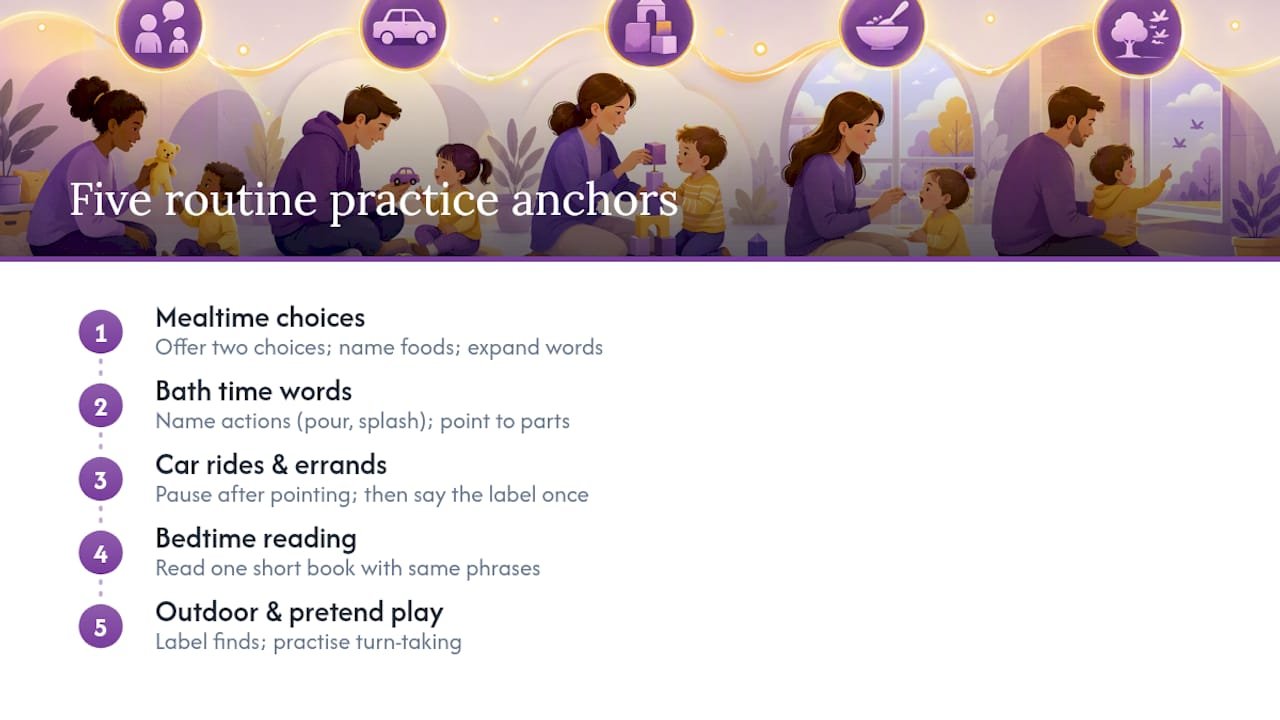
Mealtime: offer two-choice requests (“milk or water?”), name each food as you serve it, and expand one-word attempts (“more” becomes “more peas”).
Bath time: pour water and name the action (“pour, splash”), point to body parts, and repeat the same short phrase each night so it becomes predictable, like “time to wash your hair.”
Car rides and errands: slow down your labeling. Point out a dog, wait, then say “dog” once, rather than narrating everything at once. The pause matters more than the vocabulary.
Bedtime: pick one short book and read it the same way most nights. Predictable phrasing gives your toddler a script they can eventually join in on.
Outdoor and pretend play: label objects as you find them on a walk, and build turn-taking into pretend games, like taking turns “feeding” a stuffed animal. The NHS guidance on chatting and building sentences for 2 to 3 year olds specifically recommends following your child’s interests during pretend play rather than steering it.

If your household includes more than one language, early exposure to each one supports rather than confuses language development. This partner piece on raising a bilingual toddler is worth a read if that applies to you.
Matching Activities to Your Toddler’s Level
Watch what your toddler is already doing, then aim one small step ahead.
- Assess the baseline. If they’re using gestures only, your target is single words. If they’re using single words, your target is two-word combinations (“more milk”).
- Model one word above, every time. This keeps activities challenging without becoming frustrating.
- Run three short sessions a day, five to fifteen minutes each, rotating between three to five activities so nothing goes stale.
- Watch for progress markers over four to twelve weeks: more spontaneous gestures, more attempts at sounds, longer imitation of words, or new words appearing at home even if they’re not clear yet.
- Escalate if nothing shifts. No new sounds, words, or gestures after several weeks of consistent practice is a reasonable point to loop in a professional rather than wait longer.
When to Seek Professional Help
Home practice helps, but certain signs mean it’s time to get a professional opinion rather than wait it out.
- By 12 months: no pointing, waving, or other gestures.
- By 18 months: few or no words, or a strong preference for gestures over sounds.
- By 2 years: not yet combining two words, or not following simple instructions.
- At any age: losing skills your toddler previously had, which is different from a normal plateau and deserves prompt attention.
These thresholds come from KidsHealth’s guidance on toddlers who aren’t talking, and a hearing test with an audiologist is one of the first checks worth arranging, since hearing loss is a common and treatable cause of delay. From there, a practical primary-care framework published in PMC outlines the typical next steps: your GP reviews the concern, checks hearing, and refers to a speech and language therapist if red flags persist. The Royal College of Speech and Language Therapists has more detail on what UK therapy services actually involve. Keep running your short routine activities while you wait for an appointment. Waiting lists don’t mean waiting on progress.
How Mooshie Moments Fits Into Daily Practice
This app was built around exactly this kind of routine-first practice. The app suggests short, age-tailored activities using items already in your home, each one paired with simple coaching notes so you know whether you’re doing parallel talk, expectant waiting, or routine embedding without needing to memorize the theory. For toddlers who still mouth objects, Mooshiemoments also includes taste-safe sensory play ideas that pair single words with safe exploration. None of this replaces a hearing check or a speech and language therapy assessment when red flags show up. It’s a tool for the five minutes between appointments, not a substitute for one.
A Short Note From Us
Worrying about a toddler’s speech is exhausting in a way that’s hard to explain to anyone who hasn’t done it. Our favorite fix has always been the simplest one: narrating bath time, nothing fancy, just naming what’s happening as it happens. If you spot any red flags mentioned above, don’t wait it out alone. Call your GP and ask about a hearing check and a speech and language therapy referral. Small, consistent moments add up faster than one big session ever could.
— samit
Where to Read More
- NHS — Chatting and building sentences: 2 to 3 years for routine-based activity ideas.
- ASHA — Child language development for core techniques.
- PMC practical framework for red flags and referral pathways.
- RCSLT for UK therapy service guidance.
- KidsHealth — My toddler won’t talk for milestones and first checks.
If you want more ready-made ideas to rotate through the week, browse 40 activities for two-year-olds or try Mooshiemoments for age-tailored, screen-free suggestions that fit into five minutes at a time.
Sources
- KidsHealth — My toddler won’t talk
- ASHA — Child language development
- Speech and language delay in children: a practical framework for primary care physicians (PMC)
- NHS — Chatting and building sentences: 2 to 3 years
Recommended
More like this

Three Minute Mess Free Sensory Play For UK Parents
Quick, reusable sensory activities UK parents can set up in minutes. Sealed bags, sticky wall art, safety checks, storage tips, and Mooshie…
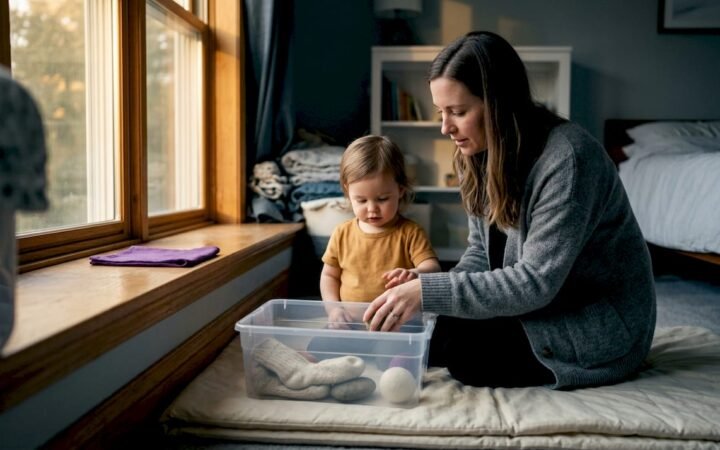
10 Quiet Bin Ideas UK Parents Can Build in 5 Minutes
Practical, EYFS-aligned quiet-bin ideas UK parents can assemble in five minutes. Includes 10 ready bins, a five-bin rotation, safety checks, and quick...
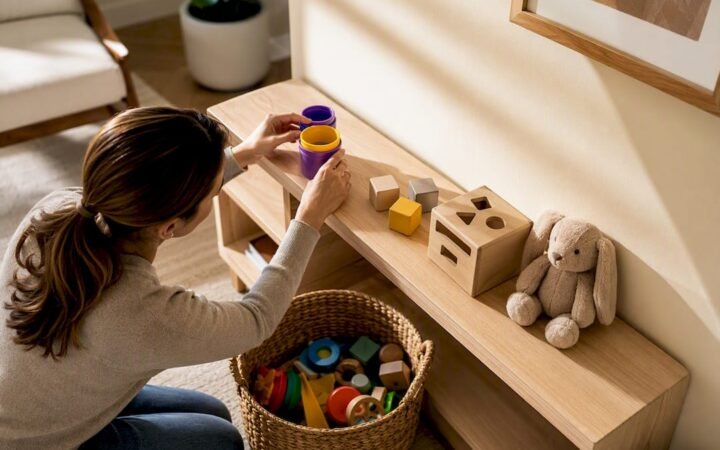
4–8 Toys: Montessori, Behavior Led Toy Rotation for Toddlers
Montessori inspired, behavior led toy rotation for toddlers. Start with 4–8 toys, set up in under 20 minutes, and refresh play without…