
No New Toys: 1–5 Minute Executive Function Activities for Toddlers

Toddlers are building three big mental skills right now: working memory, inhibitory control, and cognitive flexibility. Short, playful activities using things you already have at home, done in bursts of one to five minutes, are one of the most reliable ways to help these skills grow. You don’t need special toys or a training schedule. Just a few minutes, a bit of repetition, and your attention.
TL;DR:
- Short, rule-based activities like hide-and-find or freeze dance are most effective when repeated in brief sessions across the day to support toddler brain development.
- Progress in executive function skills varies widely, with improvements in attention span and multi-step task following consistent, adaptable play rather than fixed milestones.
- Adjust activities to suit individual temperament and needs, scaling difficulty or simplifying rules if a toddler shows signs of overstimulation or frustration.
- Modeling, assistance, and gradual independence are key to building these skills during play, with positive narration and visual cues enhancing learning.
- Most toddlers show normal variability in development; persistent difficulties beyond age 2 should prompt consultation with a healthcare professional.
Table of Contents
- What executive function actually means for your toddler
- What to expect between 18 and 36 months
- a variety of low-prep activities grouped by the skill they build
- How to run a session so it actually builds the skill
- Adjusting activities and knowing when to get extra support
- How Mooshie Moments turns this research into daily activities
- A small challenge worth trying this week
- Try Mooshie Moments for your next five minutes of play
- Sources
- FAQ
What executive function actually means for your toddler
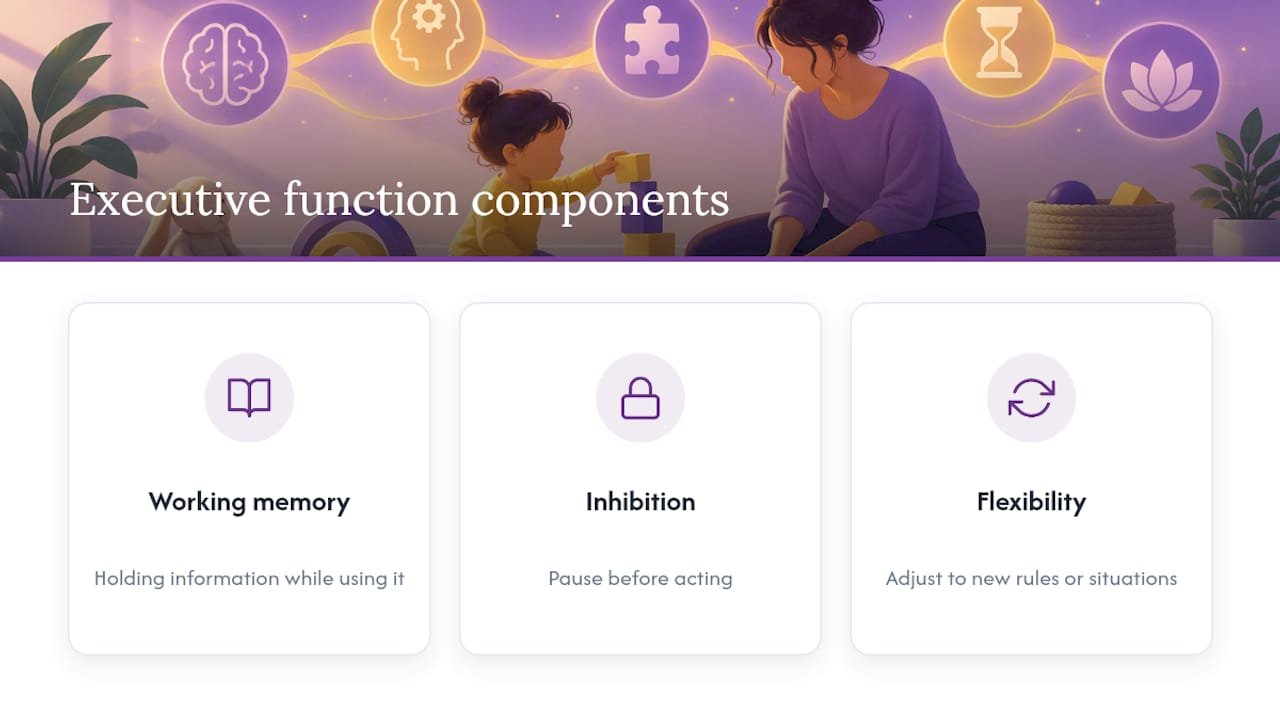
Executive function is the mental skill set your toddler uses to plan, focus, remember instructions, and shift between tasks without melting down. Researchers at the Harvard Center on the Developing Child describe it as an air traffic control system for the brain, managing the flow of information so your child can hold an idea in mind, resist an impulse, and switch gears when needed. That system has three main parts: working memory (holding information while using it), inhibitory control (pausing before acting), and cognitive flexibility (adjusting to new rules or situations).
These skills matter well beyond toddlerhood. A child who can wait their turn, remember a two-step instruction, or switch from playtime to cleanup without a meltdown is using the same mental muscles that later support reading comprehension, math problem solving, and friendships. None of this shows up overnight. Executive function develops over years, not weeks, but the same Harvard guide is clear that early experiences and repeated practice shape how strong that system becomes.
That’s good news for anyone feeling like they should be doing more. You don’t need flashcards or formal lessons. A toddler stacking cups, waiting for a turn on a swing, or playing a silly freeze game is doing real cognitive work. Your job is mostly to notice those moments and add a little structure, so the practice sticks. The activities in this guide are built around that idea: small, playful, and easy to repeat throughout an ordinary day.
What to expect between 18 and 36 months
Executive function looks different at 18 months than it does at 3 years old, and knowing the difference helps you pick activities that stretch your toddler without frustrating them. Younger toddlers, closer to 18 months, typically manage very short bursts of focused attention and can follow a single simple instruction, like “give me the ball.” Waiting even a few seconds can be genuinely hard, and that’s normal.
By 24 to 30 months, most toddlers can follow simple multi-step instructions and start attempting turn-taking, even if they still need reminders. Around 30 to 36 months, attention spans stretch further, and many toddlers can copy multi-step fingerplays, remember simple rules across a short game, and hold a made-up rule in mind long enough to apply it, like sorting red blocks into one pile and blue into another.
Progress rarely moves in a straight line. A toddler might handle Freeze Dance beautifully one day and completely ignore the “freeze” cue the next, especially when tired or overstimulated. That’s expected variability, not a setback. It’s also worth noting that toddlers growing up with more than one language often show early advantages in cognitive flexibility, likely from the mental practice of switching between languages, though every child develops at their own pace regardless of how many languages they hear.
Watch for signs of progress rather than fixed checkpoints: longer stretches of focused play, fewer reminders needed for a familiar routine, or attempting a fingerplay’s later verses without prompting. These are better markers than any single milestone chart, since normal development spans a wide range at this age.
a variety of low-prep activities grouped by the skill they build
These activities use ordinary household items and take one to five minutes each. Pick a few, rotate them through the week, and don’t worry about doing them perfectly. The Harvard handout on executive function activities for 18 to 36 month olds points to exactly this kind of short, repeated, rule-based play as effective at this age.
Working memory activities
Working memory is the skill of holding an instruction or an image in mind long enough to use it. These games ask your toddler to remember something briefly and then act on it.
- Hide and find a toy: Hide a favorite toy under one of two cups while your toddler watches, then ask them to find it. Increase to three cups as they improve.
- Add-on fingerplays: Sing “Old MacDonald” or “Five Little Monkeys” and pause before the next animal or number, letting your toddler fill in the blank from memory.
- Simple story retell: After reading a short picture book, ask “what happened to the bear?” and let them point or use a word or two to answer.
- Where did it go?: Move a small toy from your hand to a pocket while naming each step out loud, then ask your toddler to point to where it ended up.
- Copy the tap pattern: Tap a table twice, then once, and ask your toddler to copy the pattern before you add a third tap.
Pro Tip: Keep working memory games to two or three steps at most. Adding a fourth step before your toddler is ready just causes frustration instead of practice.
Inhibitory control activities
Inhibitory control is the pause button, the ability to stop an impulse and wait for a cue. These games make waiting and stopping into something fun rather than a punishment.
- Freeze Dance: Play music and dance together, then stop the music as the cue to freeze like a statue.
- Red Light, Green Light: Call out “green light” to move and “red light” to stop, starting with just a few steps between calls.
- Stop and Go song: Make up a simple tune with “go, go, go… stop!” and have your toddler walk, crawl, or wiggle until the stop cue.
- Simon Says (simplified): Give one instruction at a time, like “touch your nose,” and only follow through when you say “Simon says” first.
- Waiting for a turn with a timer: Use a simple kitchen timer during a shared activity like blocks, so your toddler can see how long they need to wait rather than just being told.
- The whisper game: Ask your toddler to use a “quiet voice” during a pretend nap for a stuffed animal, holding back the urge to shout.
- Balloon volleyball, gentle version: Bat a balloon back and forth, calling out “wait for it” before each hit to build a brief pause before acting.
ZERO TO THREE’s guidance on self-control points specifically to turn-taking and waiting games like these as effective ways to build inhibitory control between 24 and 36 months, alongside consistent routines that make the rules predictable.
Cognitive flexibility activities
Cognitive flexibility is the skill of switching gears, changing a rule, or seeing a situation a new way. These activities work best once your toddler has some comfort with a basic rule, since the fun comes from changing it.
- Sorting with a rule switch: Sort laundry or blocks by color first, then switch the rule to size, and name the change out loud (“now we’re sorting by big and small”).
- Follow the Leader with role swaps: Take turns being the leader whose movements everyone copies, switching leaders every minute or so.
- Role-play swaps: During pretend play with stuffed animals, suddenly swap who is the “baby” and who is the “grown-up” and see how your toddler adjusts.
- Opposite day game: Ask your toddler to do the opposite of a simple instruction, like sitting down when you say “stand up,” once they’re ready for a challenge.
- Shape sorter with a twist: Once your toddler knows a shape sorter, occasionally ask them to sort by color instead of shape, using the same pieces.
The Harvard handout for this age group lists Follow the Leader and simple sorting games among its core examples, both because they’re flexible enough to adjust in the moment and because they need almost no setup.
For siblings or a small group, most of these adapt easily: Freeze Dance and Follow the Leader both work better with more players, and turn-taking games like Red Light, Green Light naturally teach patience when there’s an actual line to wait in. For a single child, you become the second player, which also gives you more control over pacing.
A simple daily rhythm helps more than any single activity. Try one working memory game after breakfast, one inhibitory control game before a transition like leaving the house, and one flexibility game during afternoon play. Ten to fifteen minutes total, spread through the day, fits far better into toddler attention spans than one long session ever will.
How to run a session so it actually builds the skill
The activity matters less than how you show up for it. A few adult moves turn a game from time-filling into real practice.
Start with scaffolding: model the task fully first, then assist your toddler through it, then gradually fade your help as they get more comfortable. If you’re playing Simon Says, you might touch your own nose first, then guide your toddler’s hand to their nose, then eventually just give the instruction and wait. This model, assist, fade pattern is how most new skills get built, and it applies just as well to a memory game as to a physical one.
Keep sessions short on purpose. One to five minutes is plenty for this age, and several short bursts across a day beat one long stretch. A visible kitchen timer or a simple countdown (“three, two, one, go”) gives your toddler an external cue rather than relying on your voice alone.
Talk through what you’re doing as you play. Saying “first we put the red blocks here, then the blue ones there” out loud gives your toddler language to hold onto, which directly supports working memory and planning. Research on play and skill-building points to this kind of narration, paired with following the child’s lead rather than directing every move, as one of the more effective ways adults support these skills during play.
- Use visual cues like a printed picture card or a sand timer instead of repeated verbal reminders.
- Praise the effort and the process (“you waited so well for your turn”) rather than only the outcome.
- Keep rules simple and consistent across sessions so your toddler isn’t relearning the game every time.
Pro Tip: If your toddler is melting down mid-game, that’s a signal to shorten the session next time, not a sign the activity failed.
Clinical guidance on self-regulation, including handouts used in ADHD support programs, recommends exactly this approach: external supports like timers and visual schedules, paired with positive reinforcement, work better than punishment when a child is still learning to manage impulses.
Adjusting activities and knowing when to get extra support
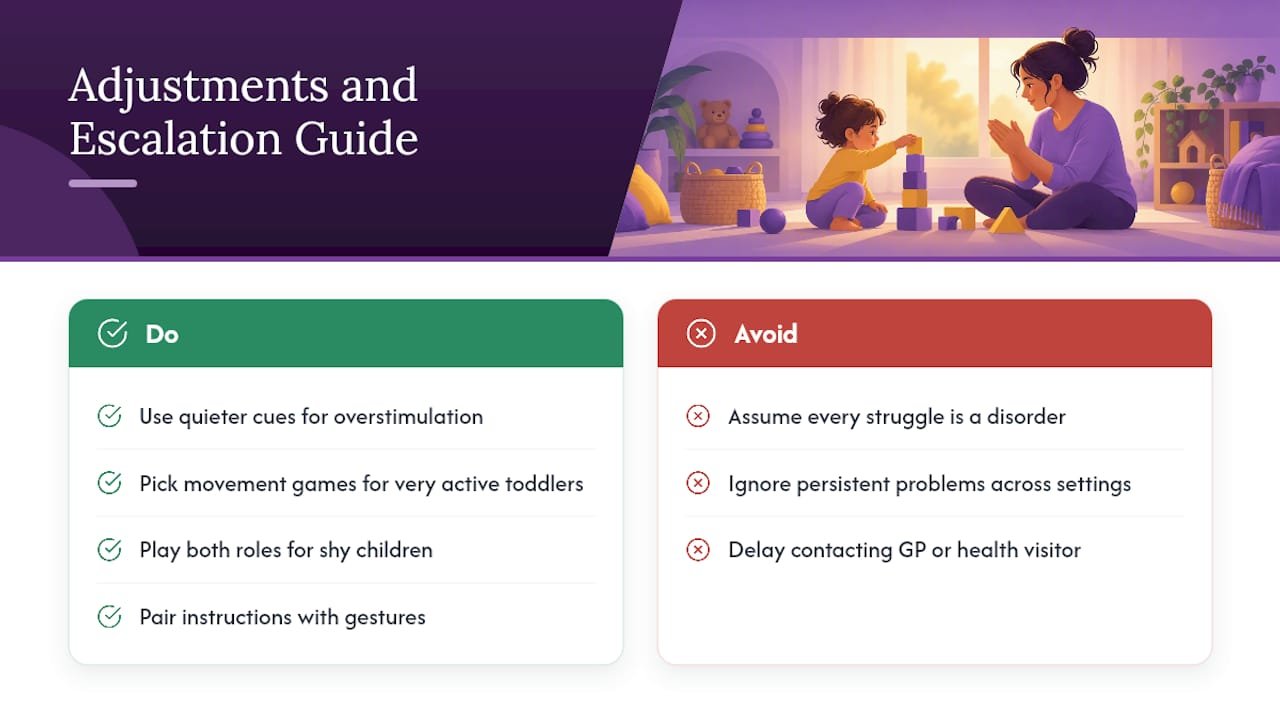
Every toddler brings a different temperament to these games, and a little adjustment goes a long way. A toddler who’s easily overstimulated might do better with a quieter version of Freeze Dance, using a hand signal instead of loud music stopping. A very active toddler might need movement-based games like Red Light, Green Light more than seated ones. A shy toddler might need you to play both roles at first before joining in themselves, and a toddler with a language delay may need instructions paired with gestures rather than words alone.
To raise the challenge, add a step (two cups becomes three), shorten the wait time between cues, or introduce a rule switch partway through. To simplify, drop back to one step, extend the timer, or play the game side by side rather than expecting turn-taking right away.
Most toddlers who struggle with a game one day and manage it the next are simply showing normal variability, not a developmental problem. But a few patterns are worth flagging to a health visitor or GP: a consistent inability to follow even one simple instruction well past age 2, significant delays in language or social interaction across multiple settings (not just at home), or behavior so persistently different from peers that it disrupts daily routines everywhere, not just occasionally.
Guidance from Great Ormond Street Hospital is clear that poor executive function is a common feature of ADHD, but it is not the same thing as ADHD or autism, and most toddlers with immature EF skills are simply developing at a typical pace. If you notice real, persistent differences across settings rather than the normal ups and downs of toddler behavior, your GP or local early years service is the right first stop.
How Mooshie Moments turns this research into daily activities
Apps exist that filter activity suggestions by child age and available time and energy, then offer screen-free activities using common household items. Some may include notes explaining the developmental purpose behind each activity.
The activity library covers exactly the kind of short, low-prep games in this guide, including a dedicated set of 40 activities for 2-year-olds and guidance on narrating play to build language and memory. Nurseries and early years settings can also access research-backed activity plans built around three daily five-minute slots, which mirrors the short-burst approach recommended throughout this guide.
None of this requires buying new toys or clearing an afternoon. It requires opening an app for thirty seconds and picking whatever fits the next five minutes.
A small challenge worth trying this week
We think about executive function work as something that happens in tiny moments, not big planned sessions. A game of Freeze Dance in the kitchen while dinner cooks, a whispered “wait for it” during a balloon toss, these small repeated moments add up more than any single perfect activity ever could.
If you take one thing from this guide, pick a single game, maybe Red Light, Green Light or a simple hide-and-find, and try it three times this week. Don’t aim for perfect focus or a tidy outcome. Just notice whether your toddler pauses a beat longer on the third try than the first. That small shift is the whole point.
— samit
Try Mooshie Moments for your next five minutes of play
If you’re nodding along thinking these activities sound great but you’ll never remember them at 4pm on a Tuesday, that’s exactly what Mooshie Moments solves. The app suggests a specific, screen-free activity based on your child’s age and how much time and energy you actually have right now, pulling from a library shaped around exactly the kind of short, research-informed play covered in this guide.
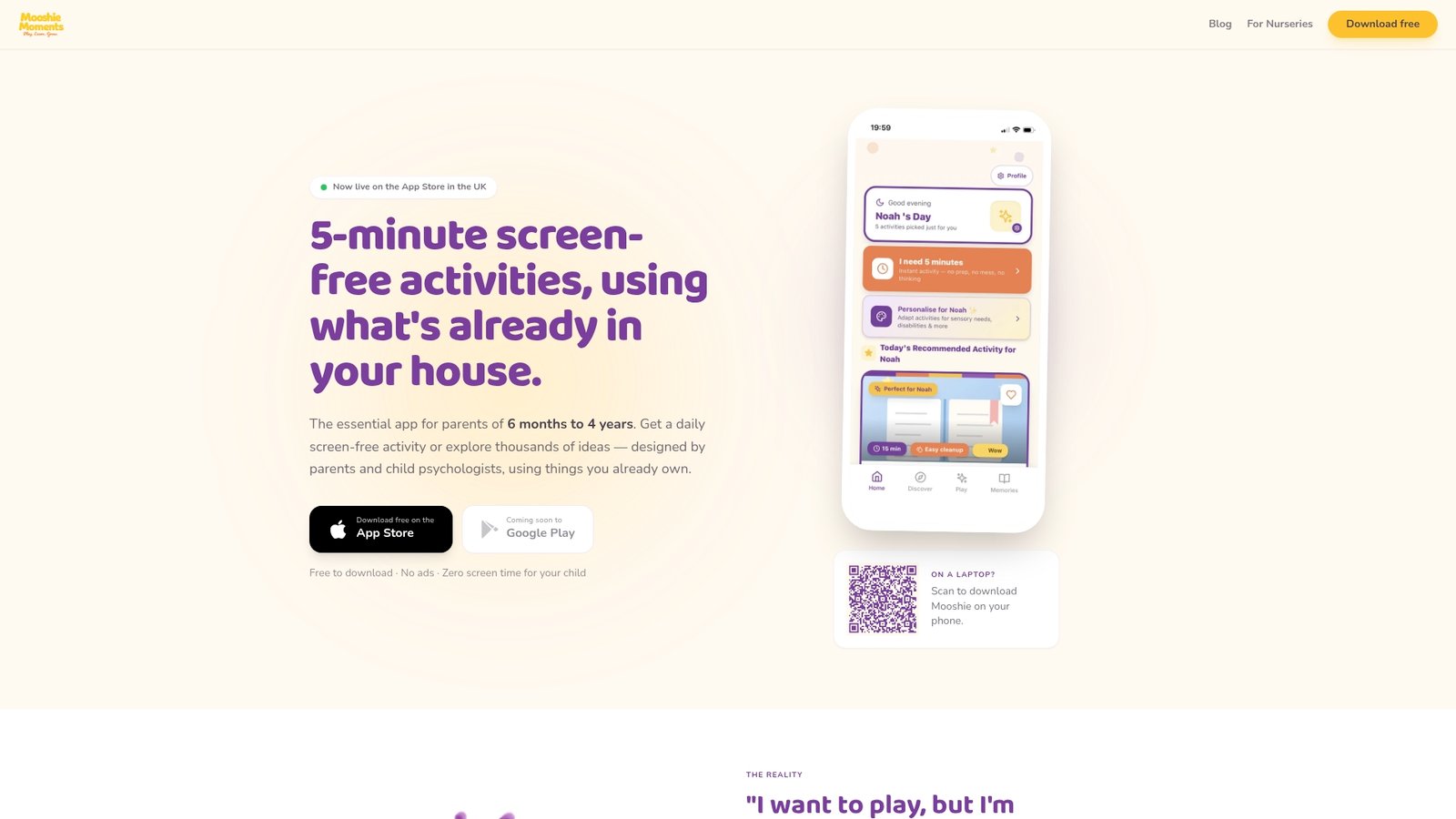
Every suggestion uses items already in your home and comes with a short explanation of the skill it builds, so you’re never guessing whether a game is worth the five minutes. Nurseries and early years settings can also explore the Partnership Pack, which includes ready-made resources and printable activity plans for group settings.
Open the Mooshie app landing page to see how it works, or head straight to the 2-year-old activity list if you want something to try in the next five minutes.
Sources
These are the sources behind the activities and guidance in this article, worth bookmarking if you want to go deeper.
- A guide to executive function: What is it, and how is it developed?
- GOSH — ADHD overview and guidance
- Impulse control — All Things ADHD series (Oxford Health)
- Helping toddlers develop self-control from 24–36 months (ZERO TO THREE)
FAQ
What are some examples of executive function skills in toddlers?
The three core skills are working memory, inhibitory control, and cognitive flexibility. In practice, this looks like remembering a two-step instruction, pausing before grabbing a toy from another child, or switching from one sorting rule to another during play, all of which develop rapidly between 18 and 36 months.
What are some executive functioning activities for kids?
Simple, rule-based games work best, including Freeze Dance, Follow the Leader, hide-and-find with cups, and turn-taking games like Red Light, Green Light. These are specifically highlighted in Harvard’s activity handout for this age group because they need almost no setup and can be played in short bursts.
Is poor executive function ADHD or autism?
Not necessarily. Poor executive function is a common feature of ADHD, but according to guidance from Great Ormond Street Hospital, it is not the same thing as ADHD or autism, and most toddlers with immature executive function skills are developing typically. A diagnosis is only considered when differences are severe and consistent across multiple settings, not just occasional struggles at home.
What is the 30% rule in ADHD?
This is not a term used in the clinical sources referenced in this guide, and definitions circulating online vary widely without a consistent clinical basis. For accurate information on ADHD diagnosis and support, a GP or health visitor is the right place to start.
Recommended
- 12 Low Prep Toddler Activities for Grandparents With Seated Options
- Junk Modelling for Toddlers: Easy EYFS-Aligned Activities
- Taste Safe Sensory Play: Top 10 Ideas for Mouthing Toddlers
Want a new idea every day, matched to your child's age?
Mooshie Moments gives you simple, guided play ideas for ages 6 months to 4 years.
Download free on the App StoreMore like this

Babysitting Toddlers: 12 Low Prep Ideas and Why They Help
Explore 12 low prep toddler activities for babysitters, with developmental benefits, age adaptations, UK safety advice, and optional activity coaching.

10 EYFS Backed Sock Games for Toddlers Under Five Minutes
Ten EYFS aligned sock games to start in under five minutes, each with a one line developmental benefit, simple adaptations, and two…

Busy Parents: 12 No Prep Shopping Activities for Toddlers
Busy parents: keep toddlers learning and calm at the store with 12 no prep, screen free activities that take under five minutes…