Best World Book Day Activities for Toddlers at Home
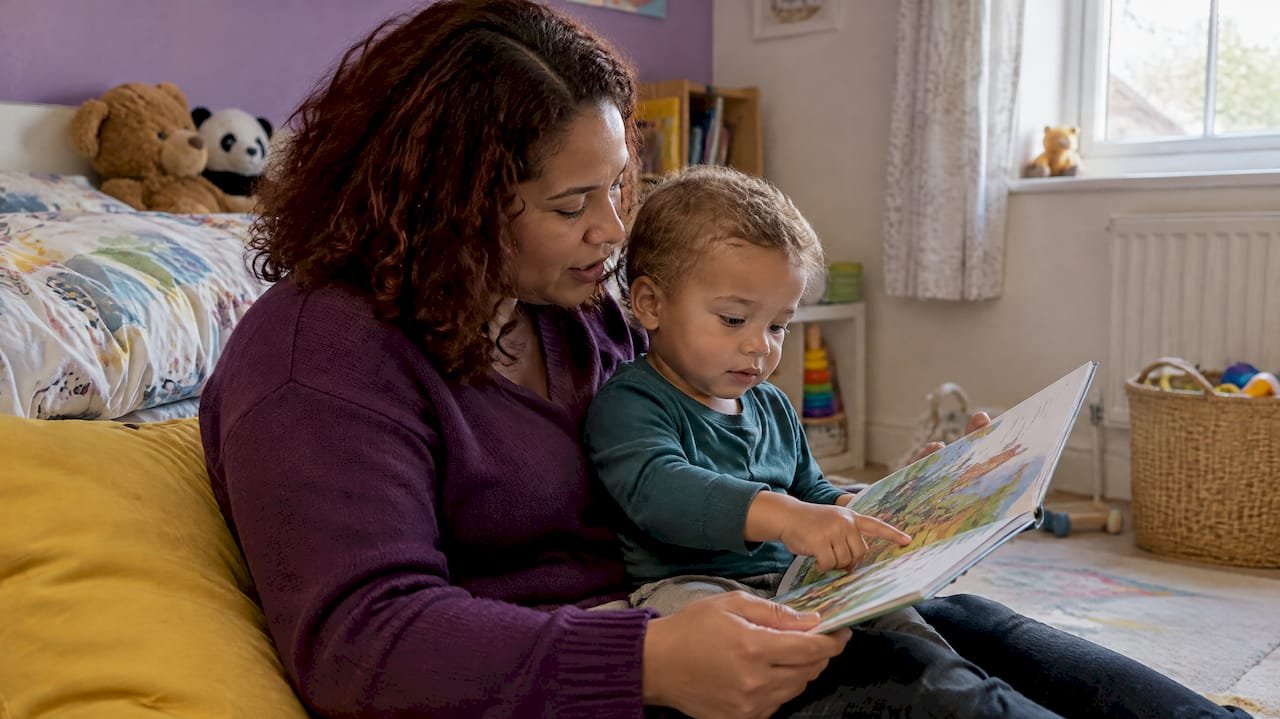
The best World Book Day activities for toddlers are short, cuddly and use what is already in your house: a favourite book, a spoon for a puppet, a blanket for a reading den, a bowl of cooled mashed potato for a story-inspired snack. You don’t need a costume. Your toddler needs your voice, your attention and a few minutes. We built Mooshie for exactly this kind of play: quick, screen-free ideas for children aged 6 months to 4 years that use household items, matched to your child’s age and the time you have.
Below you’ll find ideas sorted by what you have to hand, how to adapt them for a baby or a toddler, and the safety points worth a quick read before you start.
TL;DR
- Little and often wins: a few minutes of book time, one or ten, counts. You don’t have to finish the story or read every page.
- Turn a book into play: act it out with a puppet, build a sensory trail, cook a dish from the story or make your own simple book.
- Switch off the TV and put your own phone away while you read. Your full attention is the whole activity.
- Babies and toddlers learn about books by chewing, dropping and flipping them. That is reading at their age.
- Keep water, small objects and small foods supervised, and follow the NHS and ROSPA safety points below.
Table of Contents
- Why World Book Day works so well for under-fours
- Quick wins: five-minute book moments
- No-buy activities with things from around the house
- Bring a favourite story to life
- How to adapt for babies and toddlers
- Free and low-cost ways to get books
- Keeping it screen-free
- Safety points for story-time play
- Our view: you don’t need a costume to mark the day
- Make World Book Day the start of a daily habit
- FAQ
- Sources
Why World Book Day works so well for under-fours
World Book Day is a UK-wide celebration of books and reading, and most of what you see online is aimed at school-age children: costumes, worksheets and writing tasks. For a 10-month-old or a two-year-old, the day looks quite different, and that’s fine.
At this age, reading is rooted in everyday play. Early-years expert Karen Boardman, writing for Tes, describes reading for under-fives as growing out of daily playful experiences such as chatting, taking turns, listening and engaging with sounds and images. Babies respond to lullabies long before they understand words. So singing a nursery rhyme with actions is already a literacy activity.
The Nursery World-style tips from the National Literacy Trust, shared by the UK government’s Education Hub, say the same thing in practical terms: find a quiet spot with the TV and radio off, use funny or sing-song voices, bring in props such as puppets or a cuddly toy, and link the pictures in the book to real life.
So the goal for the day is simple. Make books feel warm, playful and part of your normal routine.
Quick wins: five-minute book moments
If you’re tired and the day is already full, start here. None of these needs preparation.
Snuggle story at a natural moment
Pick a time that already exists: bedtime, bath time or just after a nap. The National Literacy Trust tips suggest a daily snuggle story session at these times. The NDNA parents’ guide adds that sharing books while you sit or snuggle together strengthens your relationship, and that you don’t have to read word for word. You can make up the story or simply talk about the pictures. Babies are also reassured by hearing your voice.
Keep a book in your bag
The same National Literacy Trust tips suggest keeping a book in your bag for journeys. A bus ride, a queue or a wait at the doctor’s becomes a mini story time, with no screen handed over.
Peek-a-boo and mirror play
The Smart Play Network’s Twenty ways to play with books suggests holding a mirror to your baby’s face and saying “I see you” and “peek-a-boo”. Use the same voice when you lift a flap in a book.
Sing and pause
Sing a nursery rhyme with actions, then stop at a repetitive bit and let your baby or toddler “prompt” you. NAEYC, the US early-years body, recommends pausing at repeated phrases so toddlers can fill in the words, for example “Brown Bear, Brown Bear, what do…”. Keep it a conversation, not a quiz.
Animal noises
Make the noise of each animal in the picture, and match it with a toy animal or dinosaur if you have one. Toddlers love being the one who gets to say “moo”.
No-buy activities with things from around the house
This is where World Book Day gets creative without costing anything. Choose one, not all of them.
Build a reading den
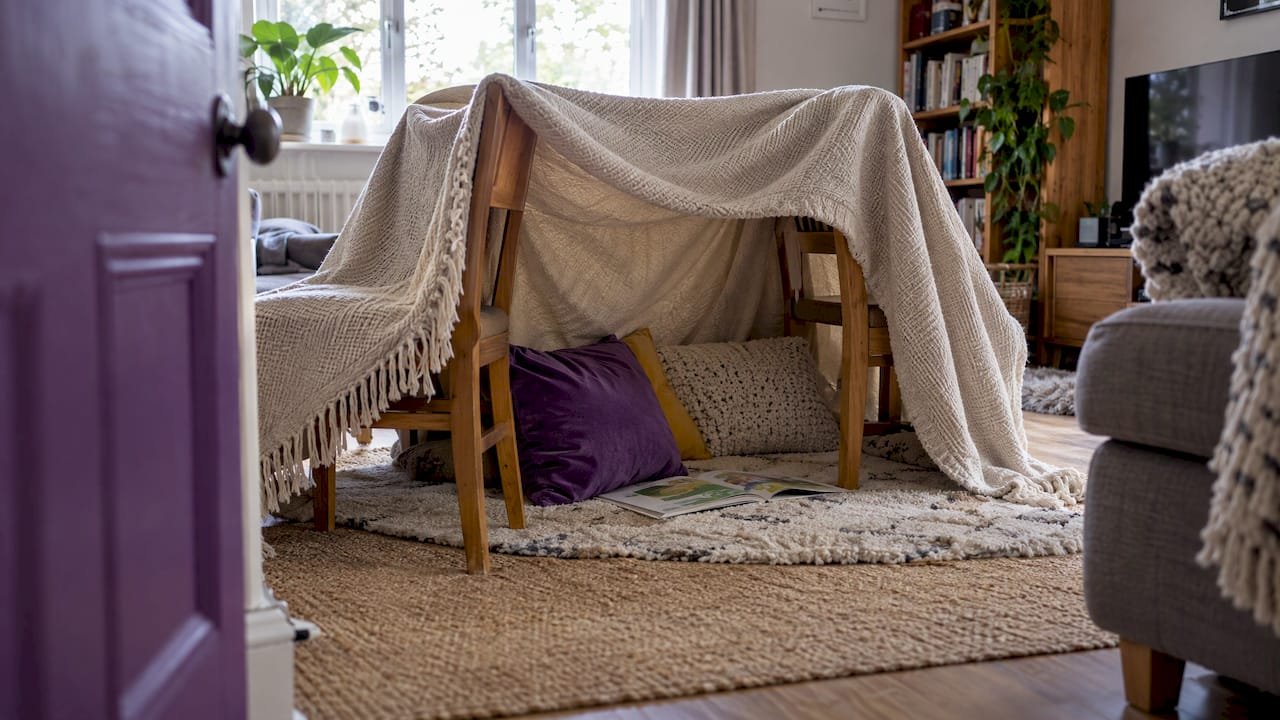
A few cushions, a blanket, a pop-up tent or a decorated book box can make a special storytelling space, as the Eastern Daily Press suggests. A World Book Day parent guide for early years also recommends a quiet, comfortable reading space at a relaxed time. A sofa and a blanket over two chairs works just as well as a tent.
Make a puppet and act it out
The Eastern Daily Press suggests a simple puppet or a folded-paper book, and using everyday objects such as a spoon, a flower or a teddy as characters. NDNA also suggests acting a book out with puppets or drawing pictures from it. A wooden spoon with a face drawn on it is a perfectly good Goldilocks. If your toddler loves a cardboard box, our cardboard box toddler activities can turn the box into a story prop. Paper plates make quick faces too, and you’ll find ideas in our paper plate crafts for toddlers.
Cook a dish from a book
Inclusive Books for Children suggests cooking from a favourite book instead of dressing up. Their example is reading Bhorta Bhorta Baby! with babies and toddlers, then making aloo bhorta: your toddler watches, mashes cooled potatoes and tastes the result. The piece argues that cooking engages all five senses and links the story to real life.

You can borrow the idea with any book that mentions food. Porridge for Goldilocks, a fruit picnic for a hungry caterpillar story, toast for a teddy bears’ picnic. Let your toddler stir, mash or pour.
Make your own book
ZERO TO THREE says families can create books together: photo books of family members, magazine cut-out word books, or crayon colour books. For a baby, a few printed family photos stapled together can become a favourite. For a toddler, glue cut-out pictures from old magazines onto folded paper and name each one together. The early-years parent guide above also suggests drawing, painting or making a collage from old newspapers, magazines and unwanted materials.
Book detective hunt
Inclusive Books for Children also describes a DIY book-detective kit made from household items: a cardboard magnifying glass, a small notebook and pencil, a homemade badge, and a fingerprint kit using washable paint or pencil rubbings. Hide a few books around the house and let your little detective find them. With a younger toddler, hide them in obvious places and cheer loudly when they’re found.
Life-size story scene
The early-years parent guide suggests using household items to make a life-size version of a story scene or character. A cardboard box becomes a boat, a rug becomes an island. It takes two minutes, and your toddler will play in it long after the book is closed.
Bring a favourite story to life
Sensory trails suit toddlers well, because they get to move rather than sit still. NAEYC’s Kathy Kinsner and Rebecca Parlakian make the point that, for toddlers, it’s better to plan actions and props that suit their activity level than to expect quiet, still sitting.
Here are three setups that need nothing you’d have to buy.
A bear hunt in the living room
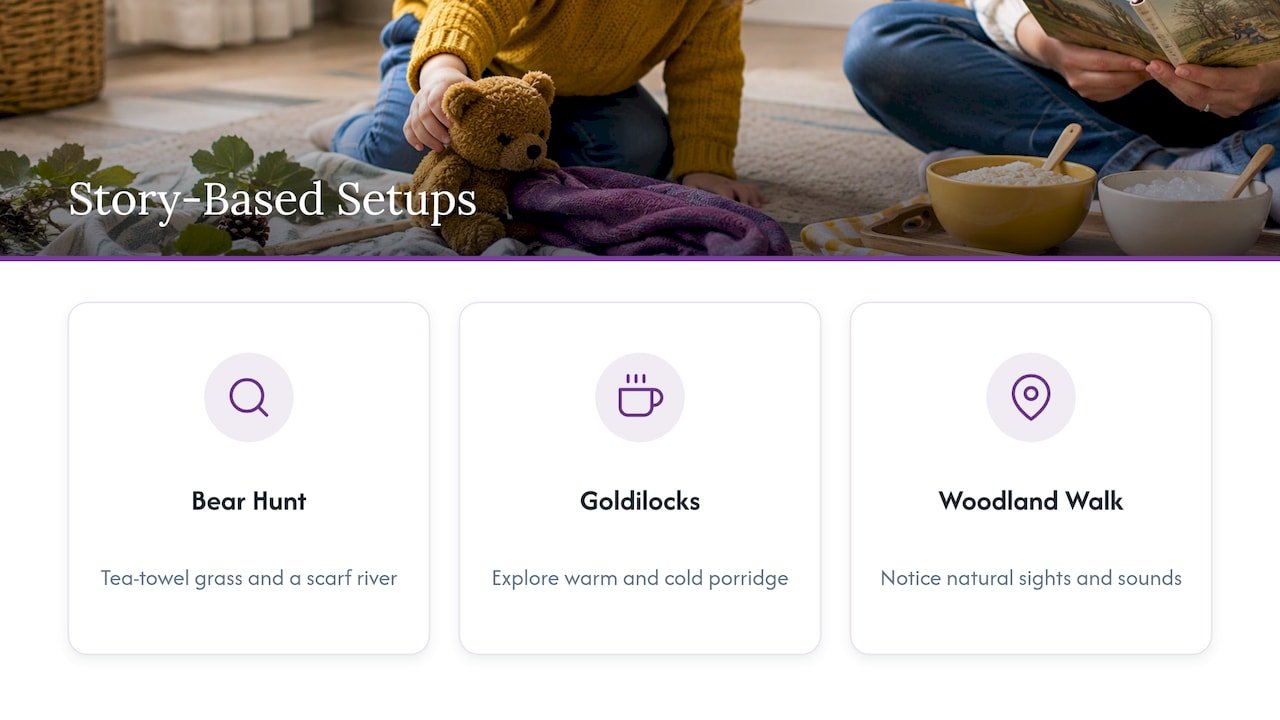
For We’re Going on a Bear Hunt, lay out a green tea towel or green paper for the “swishy swashy” grass, and use a blue scarf or blanket as the river. Walk through each part together, saying the lines in a big voice. Pause before the repeated phrases and let your toddler join in.
Porridge and bears
For Goldilocks, explore hot and cold, hard and soft, using safe items from the kitchen and the toy box. Share a little warm (not hot) porridge and a little cold one, and talk about the difference. Check the temperature yourself first, every time.
Woodland walk
The World Book Day parent guide suggests visiting local woods to experience a book setting. Notice the sounds, smells and light, and make a home for a woodland character from sticks and leaves. A local park does the job just as well. Take the book with you and read a page under a tree. Our eco-friendly toddler activities are full of ideas that use natural and recycled things you already have.
How to adapt for babies and toddlers
The same book can work for a 7-month-old and a 3-year-old. What changes is what you do with it.
| Baby (around 6 to 12 months) | Toddler (around 1 to 4 years) | |
|---|---|---|
| What they do with the book | Chew it, drop it, flip pages with their hands | Choose it, point, turn pages, copy sounds |
| Best book types | Board, cloth, bath and touch-and-feel books | Board books, familiar repeated stories, lift-the-flap |
| What you do | Use a sing-song voice, describe textures, play peek-a-boo | Pause so they can finish a phrase, ask simple picture questions |
| How long | A minute or two | One to ten minutes, repeated through the day |
For babies: let them explore
The Smart Play Network says not to worry if your child chews a book or flips pages with their hands, because board, cloth and bath books are made for playing with. NAEYC explains that babies don’t tell a read-aloud from playtime, and that chewing corners and dropping the book are how infants learn what a book is and how it works. Touch-and-feel books are a good choice, and you can describe each texture as your baby feels it.
For toddlers: follow their lead
Let your toddler pick the book from a small selection. The Scottish Book Trust advises this for babies and pre-schoolers, and suggests building reading into routines like bedtime or naptime. ZERO TO THREE adds that letting your child decide how long to spend, including lingering on a favourite page, makes reading more meaningful.
Give them time to respond with a babble, an arm wave or a point. The National Literacy Trust tips say this encourages communication development, and that you shouldn’t pressure children to name pictures.
ZERO TO THREE also says a few minutes at a time is okay, and you don’t need to finish the story.
Reading in more than one language
If your family uses more than one language, share the book in the one you feel most natural in. Some parents like to learn alongside their children too, and there are ideas for learning Mandarin together at home that show how shared time can work.
Free and low-cost ways to get books
You don’t need to buy anything new. A few routes worth knowing:
- Bookbug (Scotland). The Scottish Book Trust’s home educators resource points to free Bookbug sessions for ages 0 to 5, lasting around 30 minutes with songs, rhymes and a story, and to gifted Bookbug bags for babies, toddlers and 3-year-olds.
- World Book Day’s own resources. The 2026 £1/€1.50 books activity pack covers 18 books, with an activity sheet for each featuring reading recommendations, book chat prompts, games, creative activities and sensory ideas. Families can use the activities alongside the books or as stand-alone prompts. Check the World Book Day site for the pack that applies in the current year.
- Your own shelf. Save the Children’s UK parent hub suggests making books visible and reachable rather than putting them on high shelves, and letting children see you reading for pleasure. Rotate a small pile of books in a basket on the floor.
- Your own favourite. The World Book Day parent guide suggests sharing your favourite childhood story and starting a family and friends collection of favourite stories. Grandparents, aunties and uncles can join in with this one easily.
Keeping it screen-free
World Book Day can be a gentle reset. NDNA recommends setting a daily time without the television or tablet on, so play happens without screen distraction. Save the Children goes one step further and says to turn off screens, including your own, during reading time. The Eastern Daily Press makes the same point: put your phone away and give your child your full attention for story time.
That’s a big ask on a tired day, so keep it small. Ten minutes with the phone in another room is plenty. Build routines like bedtime stories or a weekend library visit, and the habit will carry on long after the day itself.
Safety points for story-time play
A few of the ideas above involve water, food and small props. These points come from the NHS and ROSPA.
- Water. Never leave a young child alone in the bath or playing with water. The NHS says a baby or young child can drown in less than 5 centimetres of water. This applies to bath books and water play too.
- Toys and props. Check toys for sharp edges or small parts a child could swallow, and follow age warnings: don’t give toys marked “not suitable under 36 months” to under-threes.
- Button batteries. Keep them well away from children. If one is swallowed, take your child to A&E straight away or call 999. Check any musical or light-up book for a battery compartment.
- Small objects and foods. ROSPA advises keeping small objects out of reach of children under three, and cutting small foods such as grapes, cherry tomatoes and blackberries into quarters to prevent choking. Keep that in mind for any story snack.
- Paddling pools. ROSPA advises constant supervision near any water, and emptying and tidying away paddling pools.
For homemade props, use big pieces that can’t fit in a small mouth, and stay with your child while they play.
Our view: you don’t need a costume to mark the day
At Mooshie, we talk to a lot of parents who feel pressure on days like this. A costume, a school photo, a perfect craft. But at 6 months to 4 years, the best thing you can give a child is you, paying attention, for a few minutes.
That’s why we build every activity around everyday household items, around your child’s age and around how much time and energy you actually have. We explain the developmental “why” in plain language, so you know what your child is practising while they play. And we keep it screen-free, so the moment stays between you and your child.
A book you already own is enough. Read it with a silly voice, act it out with a spoon, mash a potato. Those are the moments children remember and the ones that build bonds.
samit
Make World Book Day the start of a daily habit
If you’d like ideas like these all year round, Mooshie is a free-to-download app for parents and caregivers of children aged 6 months to 4 years. It gives you quick, screen-free activity ideas using things you already have, personalised by your child’s age, the time you have and your energy level. Each activity comes with an expert-reviewed explanation of what your child is learning and coaching tips for you.
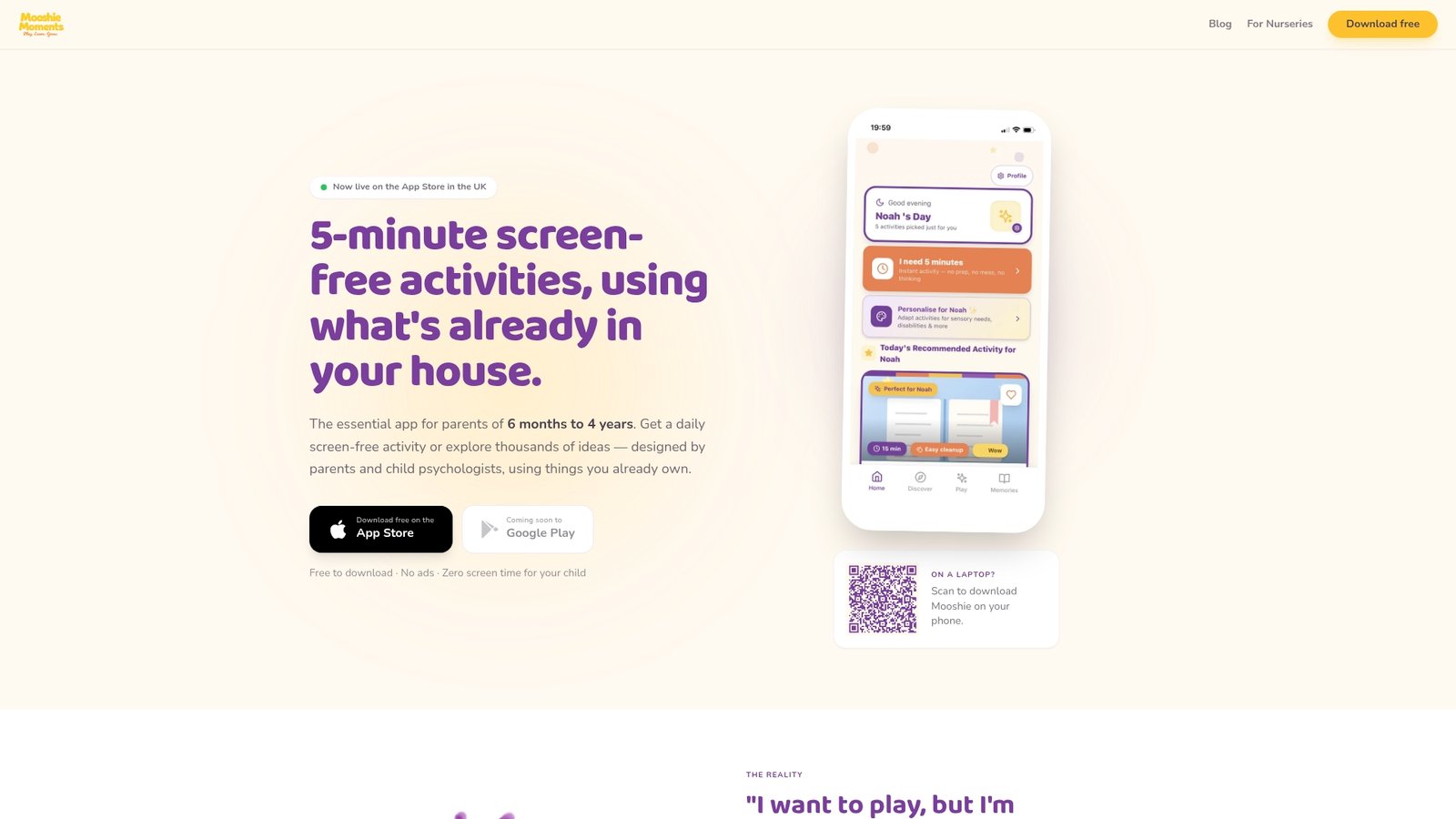
Whether you’re a parent, grandparent, auntie or uncle, you can get Mooshie here and have an idea ready the next time you ask yourself what to do with a toddler for ten minutes. If you run a nursery or early years setting, our Partnership Pack and home-learning resource is made for sharing play ideas with your families.
For more story-based play, try our storytelling ideas for toddlers or our bonding activities for toddlers that take 2 to 15 minutes.
FAQ
What is the easiest World Book Day activity for a toddler?
A snuggle story with the TV off. Pick your toddler’s favourite book, use funny voices, and pause at the repeated parts so they can join in. A few minutes is enough, and you don’t need to finish the book.
Do babies really benefit from World Book Day activities?
Yes, in the ways that suit their age. NAEYC explains that chewing, dropping and flipping a book is how infants learn what a book is. Singing, mirror play and talking about the pictures all count as shared reading.
How can I celebrate without a costume?
Try cooking something from a story, making a puppet from a spoon, building a reading den or making a simple photo book. All of these use things you already have at home, and your toddler gets your attention rather than a fancy outfit.
How long should a toddler book session last?
As long as your child is interested. The Eastern Daily Press suggests that “little and often” works, whether that’s one minute or ten. Follow your child’s lead, and stop when they move on.
Sources
- World Book Day 2023: 10 top tips for sharing books with young children, UK Government Education Hub
- 2026 £1/€1.50 World Book Day Books Activities
- World Book Day for Parents, Early Years guide
- Twenty ways to play with books with your baby and toddler, Smart Play Network
- Celebrating World Book Day: home educators resource, Scottish Book Trust
- How to build reading skills from birth, Tes
- Rocking and Rolling: Reading Aloud with Infants and Toddlers, NAEYC
- How to Introduce Toddlers and Babies to Books, ZERO TO THREE
- World Book Day activities without costumes, Inclusive Books for Children
- Parents’ Guide to Home Learning, NDNA
- Reading With Your Child, Save the Children UK
- Five ways to inspire children’s everyday storytelling, Eastern Daily Press
- Baby and toddler play ideas, NHS
- Home safety chart, ROSPA
Recommended
- Montessori Toddler Activities for UK Homes: 16 Ideas, No Shopping
- Busy Parents: 8 Easy, Research Based Storytelling Ideas for Toddlers
- Sticker Activities for Toddlers: 9 Easy Ideas for Home
Want play ideas matched to your child's age?
Mooshie Moments gives you simple, guided play ideas for ages 6 months to 4 years. Try 3 free activities a week.
Download free on the App StorePart of our guide: Toddler activities by age · Compare toddler activity apps
More like this
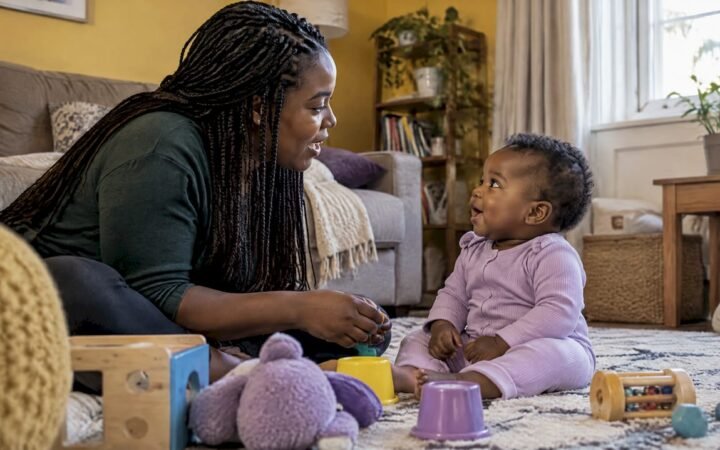
Brain Development in Babies and Toddlers: Birth to Age 4
How a baby's and toddler's brain develops from birth to age 4, what the NHS and researchers say helps, and how to…
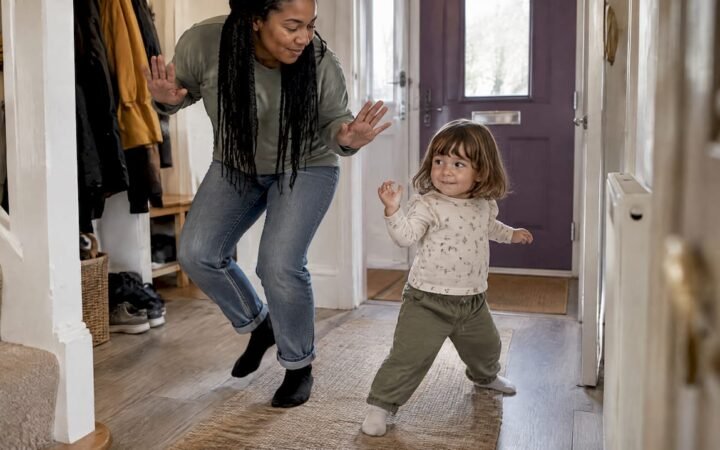
Focus Activities for Toddlers: Short Games That Work at Home
Simple, screen-free focus activities for toddlers, with realistic attention spans by age, 5-minute games from household items and what to do when…

Praise vs Encouragement for Toddlers: What to Say
Praise vs encouragement for toddlers: the real difference, what to say in play and tantrums, and simple swaps you can use today,…