
Witching Hour Toddler Activities: 12 Screen-Free Ideas

The witching hour is that stretch of late afternoon and early evening when your toddler is tired, hungry, clingy or wired, and you are running on empty too. The best way through it is short, connected play with things you already own, matched to how much energy your child has and how much you have left. Below you will find twelve ideas, how to pick the right one in 30 seconds, and how to keep it screen-free without a fight.
We built Mooshie for exactly this moment: a parent with no prep time and no new toys, needing one good idea fast.
TL;DR
- The witching hour is a common late-afternoon rough patch. It is not a sign you are doing anything wrong.
- Under 10 minutes of one-to-one play is enough to be worthwhile. Songs, a pillowcase guessing game and dancing all need nothing bought.
- Match the activity to the mood: wired toddlers need movement, frazzled ones need quiet closeness.
- The NHS says play does not need to be difficult or expensive and recommends limiting screen time.
- Stay close during water play and crafts. Safety notes are in the last section before the FAQ.
Table of Contents
- What the witching hour is, and why it feels so hard
- How to choose an activity in 30 seconds
- Movement ideas for a wired toddler
- Calm-down ideas for a frazzled toddler
- Hands-on ideas while you cook
- Adapting for a baby or an older toddler
- Keeping it screen-free
- Our view: the witching hour is a prep problem, not a parenting problem
- Safety points for quick activities
- Put Mooshie to work on the hardest hour
- FAQ
- Sources
What the witching hour is, and why it feels so hard
“Witching hour” is the name parents give to the daily window, usually somewhere between mid-afternoon and bedtime, when children fall apart more easily. Whining, clinging, tears over the wrong cup, running in circles: it all arrives at once, often just as you are trying to make tea.
The timing makes sense. By late afternoon many toddlers have used up a full day of energy and attention. Some are hungry, some are overtired, and many have been holding it together at nursery or a childminder’s and let go the moment they are home with you. Adults are tired too, so the two moods feed each other.
There is no fixed clock time. For one family it is 4pm, for another it is the hour after bath. Notice when your own child starts to wobble and plan one small thing for just before that point.
Two things help most. First, a quick snack and a drink, because hunger looks like bad behavior. Second, your attention. A few minutes of focused play often settles a child faster than a long stretch of you being nearby but busy.
How to choose an activity in 30 seconds
When you are worn out, choosing is the hard part. Ask two questions.
- What is my child’s energy right now? Bouncing off the walls, or drooping and weepy?
- What have I got left? Ten minutes of full attention, or five minutes while you stir a pan?
Then use this table.
| Your child is… | You have… | Try |
|---|---|---|
| Wired and running | 5 to 10 minutes | Cushion obstacle course, dance party |
| Wired and running | Hands busy | Laundry basket game, “What’s in the bag?” |
| Weepy and clingy | 5 to 10 minutes | Book on your lap, peekaboo, singing |
| Weepy and clingy | Hands busy | Water play at the sink, with you right there |
| Curious but calm | 10 minutes | Sensory tub, sorting game |
This is the same logic behind the app: tell us your child’s age, how much time you have and what your energy is like, and you get a suggestion that fits. If you prefer to do it by hand, the table above will get you most of the way.
Movement ideas for a wired toddler
Some toddlers need to burn off steam before anything calm will work. Give them a safe outlet first, then wind down.
1. Cushion obstacle course
Action for Children suggests building an indoor obstacle course from pillows, cushions and blankets. Lay cushions to climb over, a blanket to crawl under, a line of socks to step along. Three or four stations are plenty. Join in once, then let your toddler lead.
2. Kitchen dance party
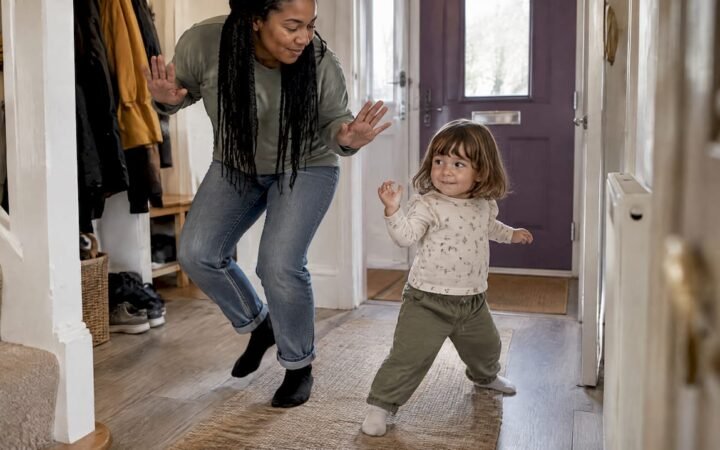
Put on a song and dance. The BBC lists dancing as a quick activity that uses nothing but you and some music. With a baby, hold them close and sway. With a toddler, freeze when the music stops and start again.
3. Laundry basket game
The NSPCC suggests turning laundry sorting into a game. Ask your toddler to throw the socks into the basket, find all the small ones, or carry the pile to the bedroom. It gives them a job, and you get the washing sorted.
4. Newspaper snowball fight
Action for Children’s toddler activity ideas include a newspaper “snowball fight”. Scrunch up old paper into balls and throw them into a box, at a wall or gently at you. It is loud, silly and over in ten minutes. Tidy-up becomes a second game: who can get the most balls in the bin?
Calm-down ideas for a frazzled toddler
If your child is past the point of running about, the goal is closeness, not stimulation.
5. Face-to-face quiet moment
The NSPCC describes a simple routine: pause, notice your child’s gaze or sounds, and respond with a smile or a sound. It needs no words and no toys. This works well for babies, and for toddlers who just need to feel seen.
6. Songs and nursery rhymes
Singing a familiar song is one of the simplest ways to settle a baby. The BBC notes that singing during feeds can soothe a baby from birth, and the NHS also recommends songs and nursery rhymes as play. Do not worry about your voice. Your toddler wants your voice, not a performance. Add actions if they are in the mood.
7. Book on your lap
The NHS says sharing books from an early age supports learning and emotional wellbeing and gives you time to bond. Pick the same favorite for the fifth night running if that is what they want. Familiar is calming.
8. Peekaboo and tickles
Peekaboo with a tea towel, a cushion or your hands is on the NSPCC’s list of everyday play ideas. The BBC also suggests silly sounds and tickles. These are quick ways to get a laugh, and a laugh often breaks the mood.
For more of this kind of thing, see our guide to 5 minute calming activities for toddlers and our ideas for bonding activities you can do in 2 to 15 minutes.
Hands-on ideas while you cook
Dinner often lands right in the middle of the witching hour. These keep a toddler busy and close to you.
9. “What’s in the bag?”
Put a spoon, a bowl, a sock and a small toy in a pillowcase. Your toddler reaches in, feels, guesses and pulls it out. The BBC suggests this game for ages 0 to 5 and notes that naming each item adds language practice. Keep the objects large enough that they cannot be swallowed.
10. Water play at the sink
The NHS lists plastic bottles, a sponge, a colander, straws, a funnel and spoons as water play items. Put a towel on the floor, roll up their sleeves and let them pour and squeeze. Our water play ideas for babies and toddlers have more set-ups. Never leave a young child alone with water, even for a moment.

11. A simple sensory tub
A baking tray with dry pasta, a few spoons and cups is enough. For toddlers who still mouth things, our list of taste-safe sensory play ideas is a good place to start, and our guide to sensory play with no new toys covers more. If your child has particular sensory needs, these sensory-friendly activities for toddlers offer flexible ideas to adapt.
12. Bubbles, adjusted by age
Action for Children describes how one activity can change with age: babies can feel bubbles popping on their skin, toddlers can chase and pop them, and older children can make their own mixture. If you have a bottle of bubbles, you have a witching hour rescue.

Adapting for a baby or an older toddler
The same idea can stretch across ages. A few examples:
- Babies (around 6 to 12 months): Keep it face to face and close. The BBC suggests dancing with a baby as a bonding activity that supports rhythm and listening, and it lists it for 10 to 12 months. Songs and quiet eye contact work from the start.
- Young toddlers (1 to 2): Short and simple. One object, one action. Let them repeat it as often as they like.
- Older toddlers (2 to 4): Add a little challenge or a role. Let them be the shopkeeper, the chef or the obstacle course designer.
Action for Children’s guidance emphasizes that the same sensory idea can be simpler or more active depending on a child’s age and abilities. Follow your child. The NSPCC frames play as watching and responding to what they show you, not directing it.
Keeping it screen-free
A tablet is the easy answer at 5pm, and no one should feel guilty about a tired day. But the NHS advises limiting children’s daily screen time, and offers songs, books and household-object play as alternatives.
There is also early evidence on screen-free evenings. In a University of Bath trial reported in March 2025, 105 families with toddlers aged 16 to 30 months followed a seven-week programme that replaced screens in the hour before bed with calming play, reading or puzzles. The toddlers had more efficient night-time sleep and fewer night awakenings. The researchers say larger studies are needed, so treat it as encouraging rather than settled.
A few tricks make screen-free easier:
- Have a “witching hour box” in mind, not a real box: three activities you could start with no setup.
- Start the activity before the meltdown, not during it.
- Keep it short. Ten minutes is a good result.
- Move the grown-up phone out of reach too. Your attention is the main ingredient.
Our view: the witching hour is a prep problem, not a parenting problem
Most parents we talk to are not short of love or play ideas in general. They are short of energy and short of time at 4.30pm, which is when thinking up something new feels impossible.
That is why we built Mooshie around quick, screen-free activities that use things already in your home. You tell us your child’s age, how much time you have and how much energy you have left. We give you an idea that fits, with a plain-language note on why it helps your child’s development and a coaching tip for making it work.
We also built it for the whole family circle. Grandparents, aunties and uncles can pick up an activity without bringing a single toy, and still have a meaningful ten minutes together. Play does not need to be perfect. It needs to be there, and easy enough that you will actually do it.
samit
The lines above are written as a quick-read note from the team. The point stands: the best witching hour activity is the one you can start in under a minute.
Safety points for quick activities
Quick does not mean careless. A few simple rules:
- Water: The NHS advises close supervision for water play and warns that a baby or young child can drown in less than 5 centimetres (2 inches) of water. Stay within arm’s reach and empty containers afterwards.
- Small items: Action for Children advises staying with babies and young children during crafts and watching for small choking hazards, sharp items and things they should not put in their mouths.
- Household objects: Before you hand anything over, check it is too big to swallow, has no loose parts and has no sharp edges.
If you are worried about your child’s choking, breathing or any injury, call 999 or contact your GP or NHS 111 for advice.
Put Mooshie to work on the hardest hour
If you would like these ideas ready when you need them, Mooshie is a free-to-download app for parents and caregivers of children aged 6 months to 4 years. It offers a library of quick, screen-free activities that use common household items. You can filter by your child’s age, the time you have and your energy level, and every activity comes with an expert-reviewed explanation of the developmental why and coaching tips. Premium features are available by subscription through the App Store.
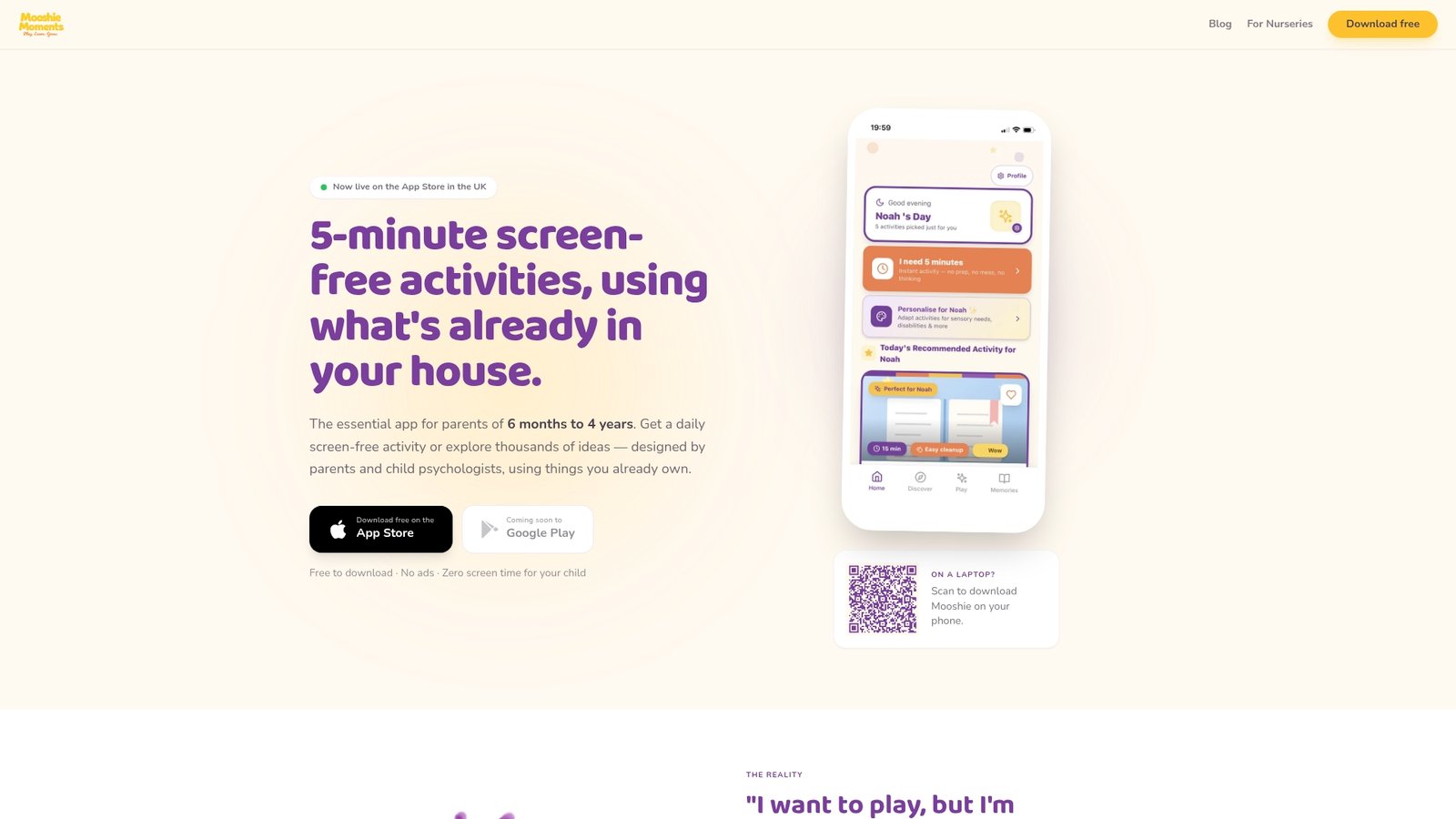
Running a nursery, childminding setting or early years group? Our Partnership Pack and home-learning resources give families something to take home.
FAQ
How long does the toddler witching hour last?
It varies from child to child. For many families it is somewhere between an hour and a couple of hours in the late afternoon or early evening. Notice when it starts in your home and plan one short activity just before it.
What do I do with a toddler who will not settle at all?
Start with the basics: a snack, a drink and a cuddle. Then offer one calm, close activity such as a book on your lap or a song. If they are wired, let them move first with a cushion course or a dance, then wind down.
Can I keep my 2 year old busy while I cook?
Yes. Water play at the sink, a pillowcase guessing game or a sensory tray give them something to do within sight of you. Choose items that are too big to swallow, and stay close for anything involving water.
Is it okay to use screens sometimes?
One hard evening does not undo anything. The NHS advises limiting screen time and, if your child does watch, knowing what they are watching and watching together so you can talk about it. Having a few screen-free ideas ready makes the choice easier.
Sources
- Baby and toddler play ideas, NHS
- Look, Say, Sing, Play, NSPCC
- Activity ideas for toddlers for fun and learning, Action for Children
- What is sensory play and why is it important? Action for Children
- 15 Quick Activities for Babies That Take Less Than 10 Minutes, BBC
- Screen-free bedtimes boost toddler sleep, University of Bath
Recommended
- Morning Activities for Toddlers: Quick, Screen-Free Ideas
- Best Boredom Busters for Toddlers: Easy, Screen-Free Ideas
- Toddler Boredom Busters: 20 Screen-Free Ideas for Home
- Toddler Activities With No Supplies: 25 Ideas to Try Now
Want play ideas matched to your child's age?
Mooshie Moments gives you simple, guided play ideas for ages 6 months to 4 years. Try 3 free activities a week.
Download free on the App StorePart of our guide: Toddler activities by age · Compare toddler activity apps
More like this

Brain Development in Babies and Toddlers: Birth to Age 4
How a baby's and toddler's brain develops from birth to age 4, what the NHS and researchers say helps, and how to…
Focus Activities for Toddlers: Short Games That Work at Home
Simple, screen-free focus activities for toddlers, with realistic attention spans by age, 5-minute games from household items and what to do when…

Praise vs Encouragement for Toddlers: What to Say
Praise vs encouragement for toddlers: the real difference, what to say in play and tantrums, and simple swaps you can use today,…