Cognitive Skills for Toddlers: What They Are and How to Build Them
Cognitive skills are the thinking tools your toddler uses to notice, remember, solve problems and make sense of the world. They grow fastest through everyday play with you, not through flashcards or screens. That is why we built Mooshie around one short game a day, matched to your child’s age and stage, with the words to say and a plain explanation of what it builds.
TL;DR
- Cognition is a toolkit: attention and perception come first, then memory, problem-solving and pretend play.
- NHS milestones at 2 and 30 months include using both hands together, simple problem-solving and pretend play.
- Short, shared, screen-free play with things from around the house builds these skills well.
- Follow your child’s lead, comment rather than quiz, and repeat favourite games.
- Talk to your health visitor or GP if your child has lost skills they once had.
Table of Contents
- What cognitive skills actually are
- What to expect, age by age
- Why play is how toddlers build these skills
- Simple ways to build each skill at home
- How to play so it really builds thinking
- Screens and thinking skills
- A simple day that fits in thinking time
- Perspective
- Try a daily game with Mooshie
- When to talk to a professional
- FAQ
- Sources
What cognitive skills actually are
The BBC’s Tiny Happy People site, quoting a child-development expert, describes cognition as a toolkit of skills for taking in information from the world and using it. It starts with basics such as perception and attention, then adds tools like memory and problem-solving.
In a toddler, that looks like this:
- Attention: staying with a game or a book for a short while.
- Memory: remembering where something was hidden, or what comes next in a song.
- Problem-solving: working out how to reach, open, fit or stack.
- Pretend play: using one thing to stand for another.
- Understanding language and instructions: following what you say and what it means.
The same BBC page notes that early signs of symbolic play appear at one to two years, and that memory changes are easiest to see after two to three years. So a 14-month-old and a 34-month-old will show very different things, and both are normal.
What to expect, age by age
Milestones are a guide, not a test. They show the direction your child is heading.
| Age | What you might see | Source |
|---|---|---|
| 12 months | Puts one object with another, such as a spoon in a cup | NHS Greater Manchester guide |
| 18 months | Recognises miniature objects, pretends to feed themselves, loves peek-a-boo | NHS Greater Manchester guide |
| 2 years | Holds something in one hand while using the other, tries switches and buttons, plays with more than one toy at once | NHS Healthier Together |
| 30 months | Pretends (feeds a block to a doll), solves simple problems like using a small stool, follows two-step instructions, knows a colour | NHS Healthier Together |
| 5 years | Counts to 10, uses words like yesterday and tomorrow, pays attention for 5 to 10 minutes | NHS Healthier Together |
A few examples make these concrete. A 2-year-old who puts the lid back on a container is using both hands for different jobs. A 30-month-old who says “Put the toy down and close the door” and does both is following a two-step instruction. A child who washes teddy and puts him to bed is stringing a sequence together, which the NHS guide describes as sequenced pretend play at around two years.
The American Academy of Pediatrics’ HealthyChildren.org adds that two-year-olds start to work out some problems in their heads, match shapes and begin to understand simple time ideas like “You can play after you finish eating.”
Why play is how toddlers build these skills
The Welsh Government’s early childhood framework states that play takes concentration and attention, teaches perseverance and problem-solving, and that sensory exploration creates strong neural pathways, which repetition then strengthens.
Two things follow for a busy parent:
- Short is fine. A few minutes of full attention beats a long, distracted session.
- Repeating is the point. When your toddler wants the same game for the tenth time, their brain is strengthening a pathway.
Simple ways to build each skill at home
You do not need special toys. The Department for Education’s Development Matters guidance suggests open-ended resources such as blocks, lengths of fabric, smooth shells and pebbles for babies and toddlers to explore.
Memory
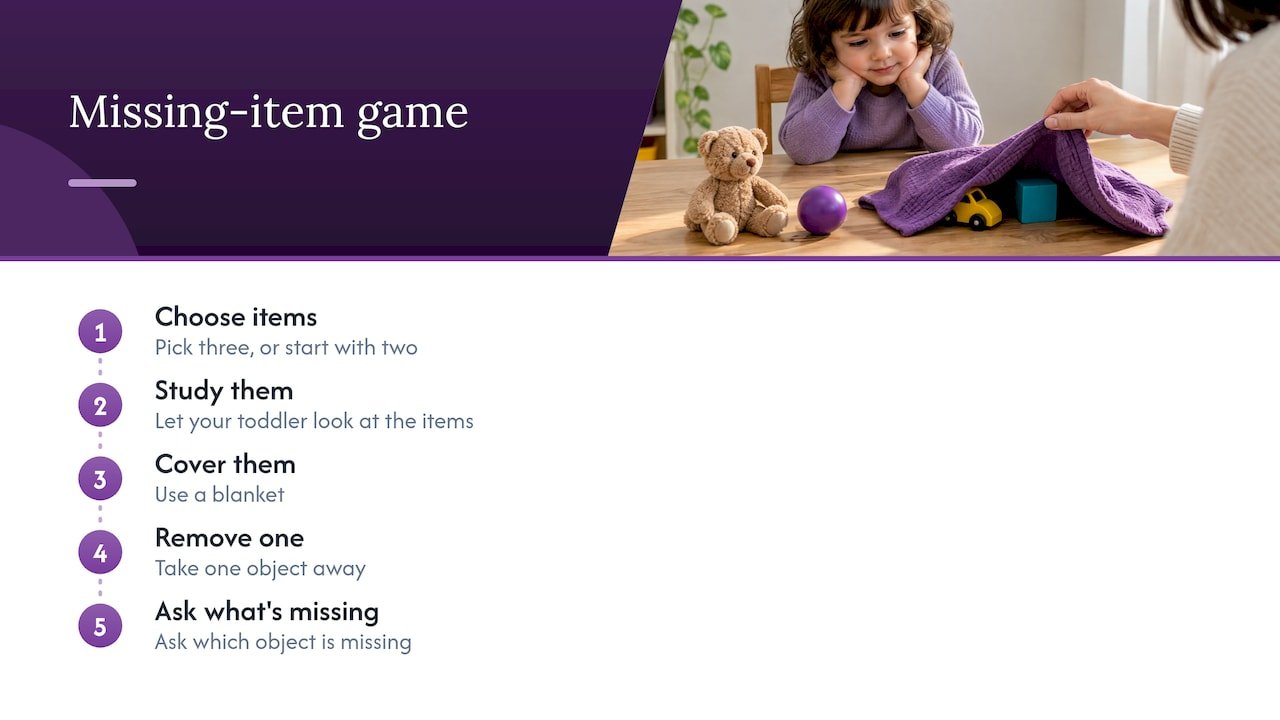
Try the missing-item game from an NHS play guide for 24 to 36 months. Pick three items, let your child look, cover them with a blanket, take one away and ask which one is missing. Start with two items if three is too many.
Talking about yesterday and tomorrow also works. The same guide suggests asking what happened yesterday and what is going to happen tomorrow, which builds vocabulary and a sense of the order of events.
Attention and following instructions
Musical statues and Freeze give your child a reason to listen and follow directions. For younger toddlers, a people game like peek-a-boo teaches taking a turn, starting and ending a game and paying attention. Play it all the way through many times with the same words and actions, then pause at a key moment and wait for your child’s response.
Problem-solving
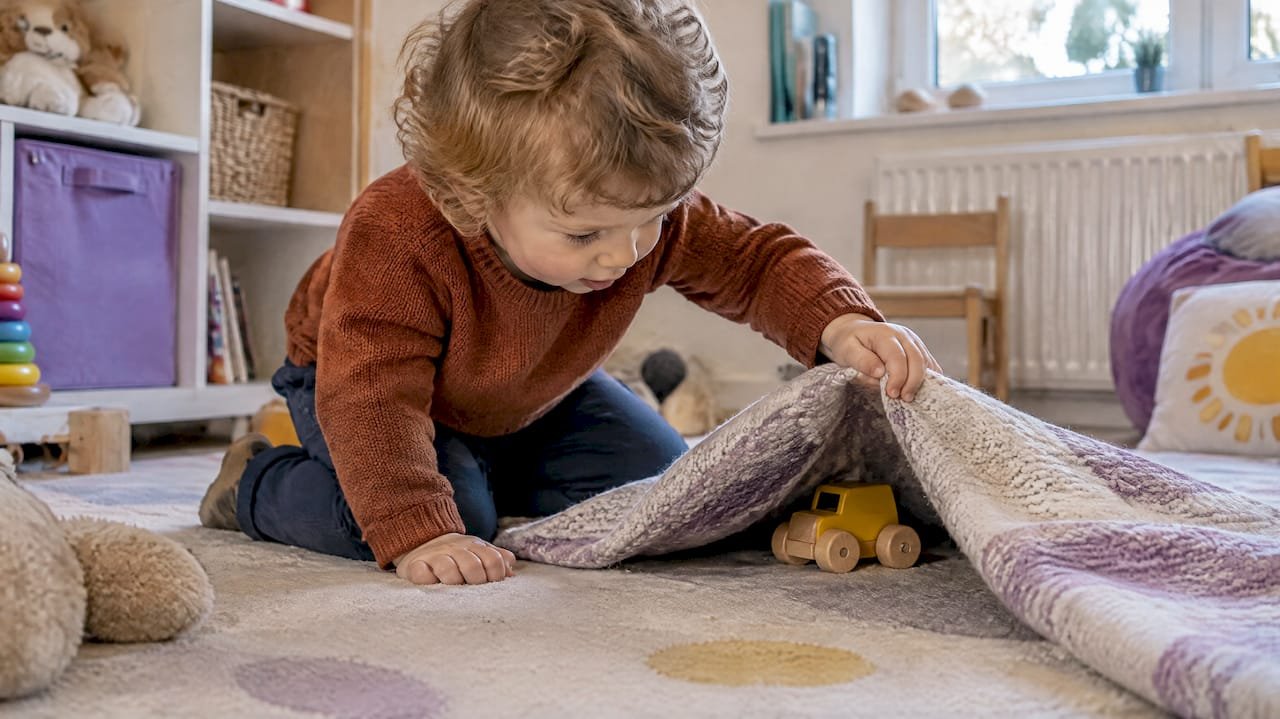
Building and copying block structures, matching shapes and sorting objects by colour or fruit are all good. Hiding a toy under a cloth and letting your child work out how to find it gives them room to try different approaches. We have more ideas in our guide to problem-solving activities using things at home and a set of shape activities for two-year-olds.
A treasure hunt is a good one too. If your child gets stuck or frustrated while searching, a calm word and a hint helps them try another way, much like the ideas in these water confidence games for kids, where children learn to keep trying while looking for a hidden object. For indoor and outdoor versions, see our toddler scavenger hunt ideas.
Pretend play and imagination
A UK play toolkit for 0 to 3-year-olds suggests turning everyday objects, such as a sock, a stone or a spoon, into characters with voices. It also suggests playing head, shoulders, knees and toes, first copying you, then leading, and notes these games develop attention, listening, memory and self-expression.
Shops, dressing up and feeding a toy are all pretend play. Let your child decide how the game goes. The toolkit advises stepping in only if something is unsafe or hurtful.
Language and turn-taking
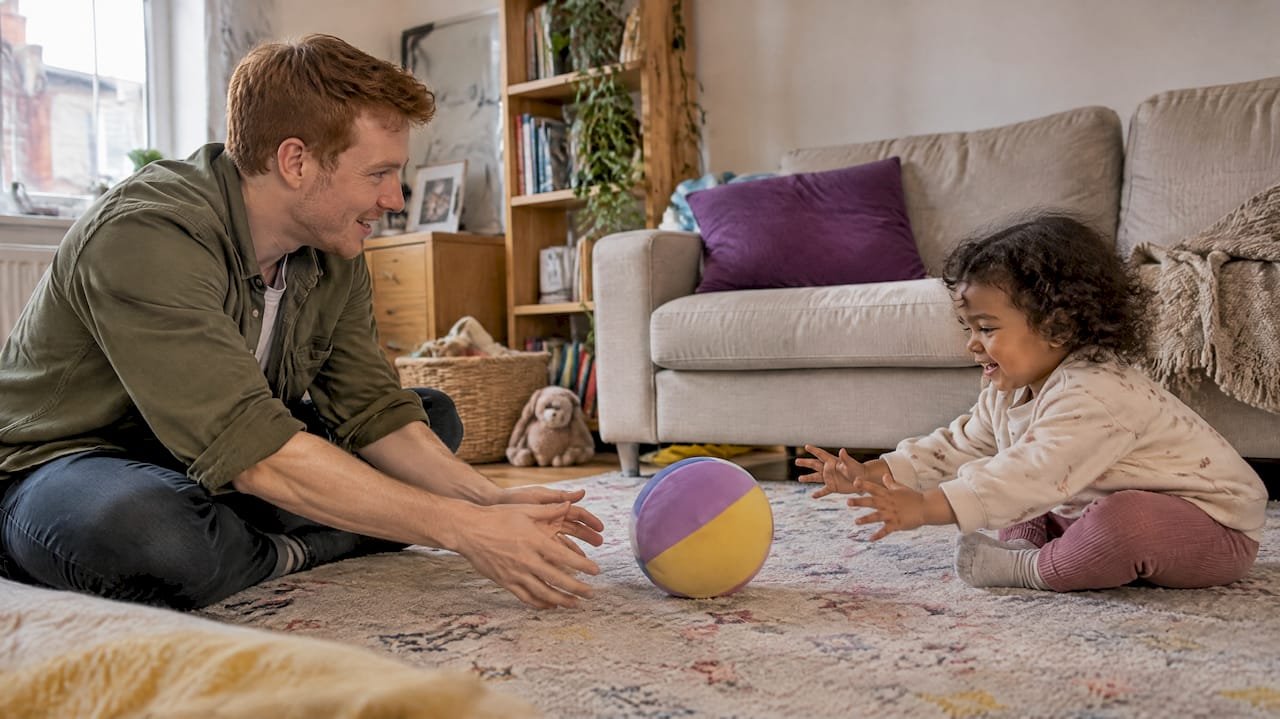
Rolling a ball back and forth, or building a tower and knocking it down, are short turn-taking games. The NHS Royal United Hospital guide for 9 to 12 months also suggests reading together and letting your baby turn the pages.
How to play so it really builds thinking
The way you play matters as much as the game. NHS Healthier Together describes child-led play: notice what your child is interested in, join in, wait and watch, and comment rather than question. “That was a big roll, I nearly missed it!” does more than “What colour is the ball?”
It explains that children learn best when they are interested, and that leading helps them build communication skills and learn how to influence things around them.
A few habits help:
- Put screens out of sight. The UK toolkit advises turning screens off or putting them away so your child knows you are focused on them.
- Follow when they switch. If they drop the game and pick up a spoon, go with the spoon.
- Respond to frustration first. The NHS’s Five to Thrive approach, described on NHS Healthier Together, suggests answering the feeling before carrying on, like rebuilding a fallen tower of blocks together.
That last point matters when tantrums hit. The same page explains that a toddler’s brain is not yet developed enough to express needs easily or to understand how other people feel, which is why frustration is so common.
Screens and thinking skills
The independent Early Years Screen Time Advisory Group report from March 2026 recommends that under-twos avoid screens except for shared bonding activities such as video calls and looking at photos. For two to five-year-olds it recommends no more than an hour a day, ideally in chunks of 30 minutes or less, not at mealtimes or near bedtime, and with solo use kept to a minimum. It also recommends avoiding background TV, which distracts young children from playful and learning activities.
For busy days, this is where a ready-made plan helps. Our low-prep activities by skill area and morning activities for toddlers give you something to reach for in two to fifteen minutes.
A simple day that fits in thinking time
You do not need a schedule. Try fitting small games into things you already do:
- Breakfast: let your child hold a cup in one hand and lift the lid off a pot with the other.
- Getting dressed: ask them to find the red sock, then the blue one.
- Tidy-up: sort toys into two boxes, by colour or by type.
- Walk or bath time: talk about what happened earlier and what is coming next.
- Before bed: read together and let your child turn the pages.
Each takes a couple of minutes, and together they cover attention, memory, sorting and language.
Perspective
Most parents we talk to worry that they are not doing enough to help their child’s brain grow. The good news is that the building blocks are already in your house: a spoon, a cup, a sock, a blanket.
What parents often lack is not toys but a clear idea of what to play today, what to say, and why it matters. That is why Mooshie gives you one game a day, chosen for your child’s age and stage, with the exact words to say and a plain explanation of what it builds in their brain.
You hold the phone and your child never touches it. The game happens between the two of you, which is where thinking skills, kindness and security grow together. We want children who think well, create freely, feel secure, pitch in and treat others kindly.
samit
Try a daily game with Mooshie
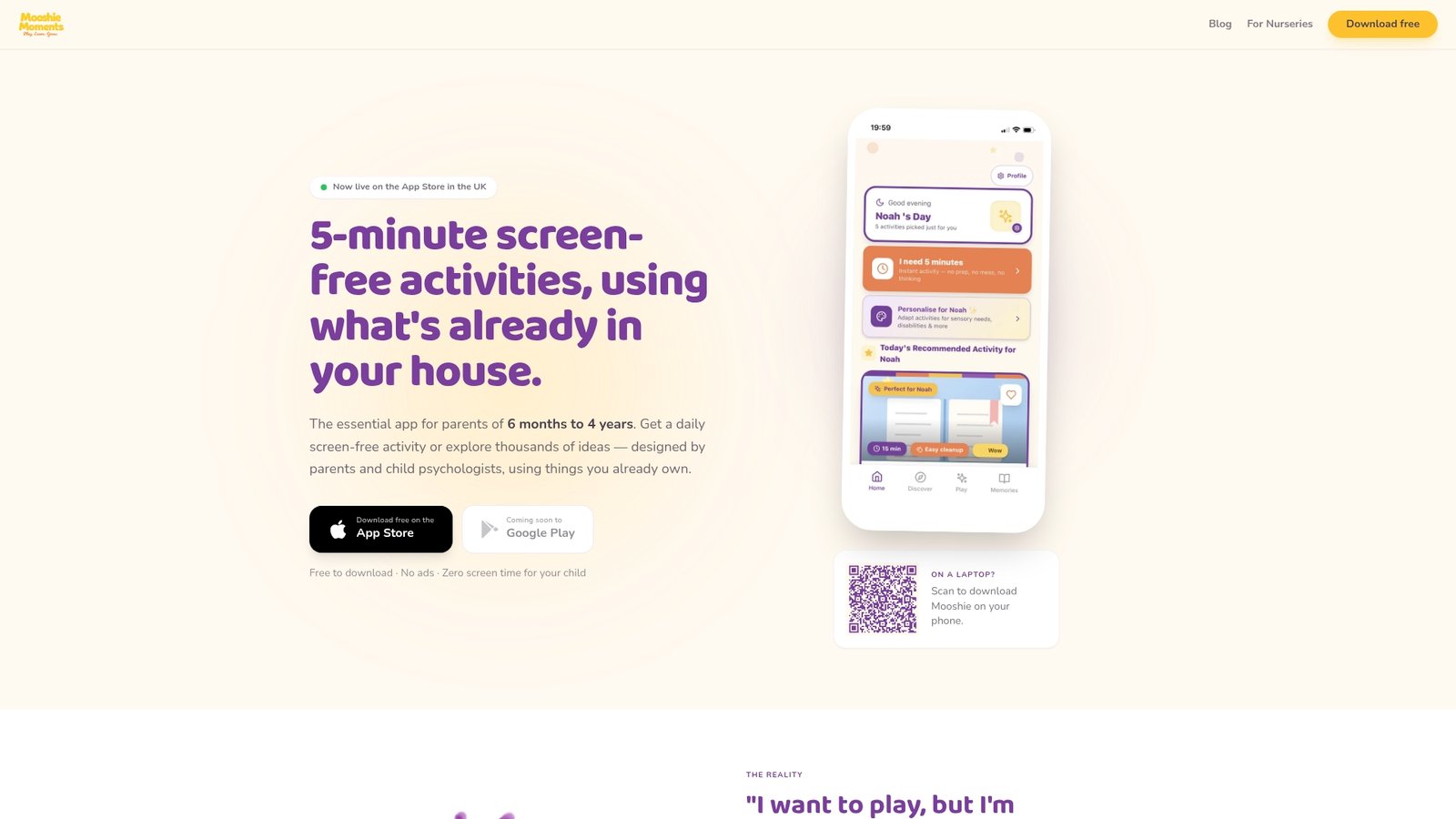
Mooshie is a free-to-download app for parents of children aged 6 months to 4 years. Each day it gives you one short game using things already in the house, with how to play, what to say and what the game is building. Take a look at Mooshie and play today’s game with your toddler.
If you run a nursery or early years setting, our Partnership Pack and home-learning resource is designed to share this kind of play with your families.
When to talk to a professional
Milestones vary, and most children catch up in their own time. NHS Healthier Together says to seek advice early if you are concerned about how your child moves, acts, learns, speaks or plays, and urgently if your child has lost skills they once had.
At 2 years, contact your health visitor or GP if your child:
- has lost skills
- feels very stiff or floppy
- moves their limbs in repetitive, jerky or strange ways
- uses one side of the body much more than the other
- finds it hard to balance or falls a lot
- can’t walk by themselves, mostly walks on tiptoes or hasn’t started to run
In the UK, routine development reviews usually happen at 9 to 12 months and at 2 to 2.5 years, normally with your health visitor. They are a good time to raise any questions.
FAQ
What are some examples of cognitive skills in toddlers?
Attention, memory, problem-solving, pretend play and following instructions are the main ones. A toddler might find a hidden toy, stack blocks, feed a doll or follow a two-step request like “Put the toy down and close the door.”
Can I help my toddler’s cognitive development without buying toys?
Yes. Everyday objects such as blocks, fabric, containers, kitchen utensils and scrap paper all work, and the UK self-regulation booklet recommends at least an hour of unstructured, technology-free play daily. Short games with you count towards that.
How much screen time is suitable for toddlers?
The 2026 UK advisory group report recommends that under-twos avoid screens apart from shared bonding activities, and that two to five-year-olds have no more than an hour a day. Liverpool’s Family Information Service gives the same guidance, adding less if possible.
Should I worry if my toddler is not hitting every milestone?
Milestones show a general direction, and children develop at different speeds. If you are concerned, or your child has lost a skill, speak to your health visitor or GP, who can look at the whole picture.
Sources
- BBC Tiny Happy People: Understanding cognitive development
- NHS Healthier Together: How to support your child’s development
- NHS Healthier Together: Healthy day for a child
- NHS Healthier Together: General information about child development
- HealthyChildren.org: Cognitive development in 2-year-olds
- Welsh Government: Quality Framework for Early Childhood Play, Learning and Care
- NHS Greater Manchester: The development of play and interaction skills
- NHS ELFT: Toy and play guide, 24 to 36 months
- NHS Royal United Hospital: Helping my baby learn through play, 9 to 12 months
- Department for Education: Development Matters
- Early Years Screen Time Advisory Group report
- Liverpool Family Information Service
- UK play toolkit for 0 to 3-year-olds
- Promoting young children’s self-regulation skills through play
- Water confidence games for kids
Recommended
- UK Parents: Low Prep Toddler Activities by Skill Area in 2–15 Minutes
- Focus Activities for Toddlers: Short Games That Work at Home
- Problem Solving Activities for Toddlers Using Things at Home
- STEM and Science Activities for Toddlers
Want play ideas matched to your child's age?
Mooshie Moments gives you simple, guided play ideas for ages 6 months to 4 years. Try 3 free activities a week.
Download free on the App StorePart of our guide: Toddler activities by age · Compare toddler activity apps
More like this
Brain Development in Babies and Toddlers: Birth to Age 4
How a baby's and toddler's brain develops from birth to age 4, what the NHS and researchers say helps, and how to…
Focus Activities for Toddlers: Short Games That Work at Home
Simple, screen-free focus activities for toddlers, with realistic attention spans by age, 5-minute games from household items and what to do when…

Praise vs Encouragement for Toddlers: What to Say
Praise vs encouragement for toddlers: the real difference, what to say in play and tantrums, and simple swaps you can use today,…