10 Low Prep Screen Free Shape Activities for Parents of 2 Year Olds
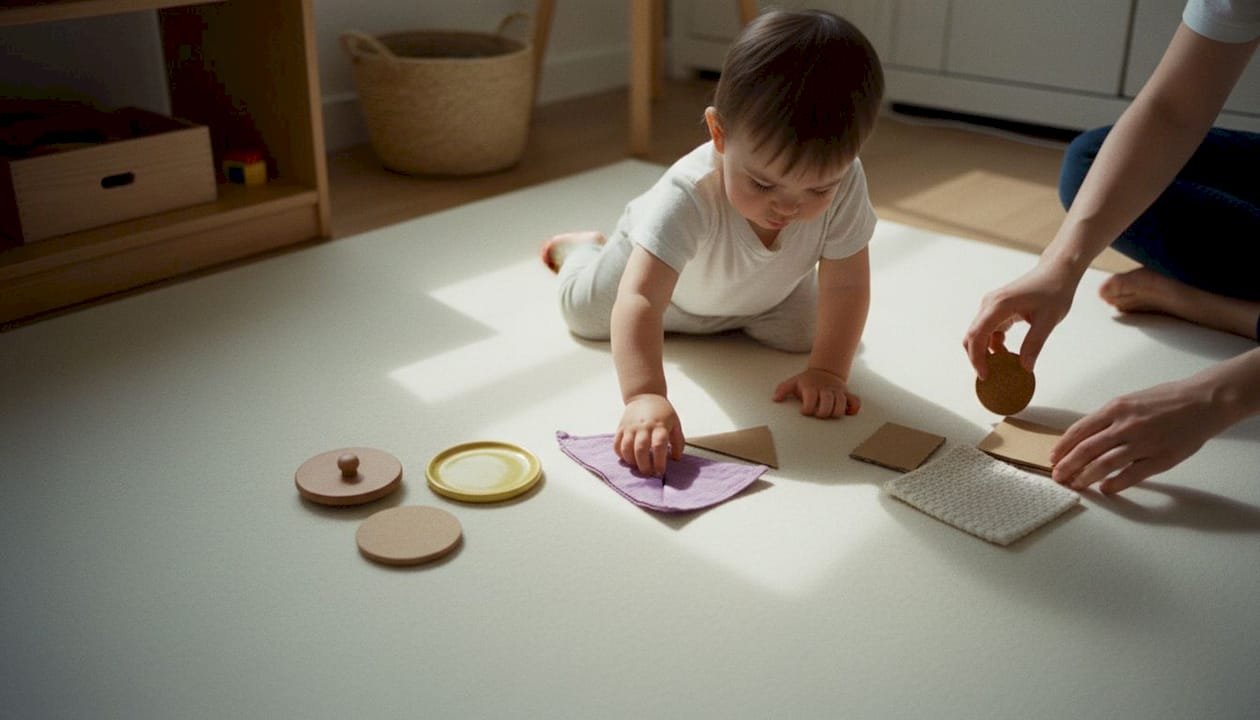
Use short, play-based activities with everyday household objects to teach shapes to toddlers, and you’ll see progress faster than any flashcard set can offer. Around age two, kids learn best through hands-on, repeated play rather than instruction. Below you’ll find ten screen-free activities that fit a toddler’s attention span and development, backed by research on early shape recognition, plus tips from Mooshie Moments on making the moments count.
TL;DR:
- Toddlers develop shape recognition skills mainly between 18 and 24 months through hands-on, repeated play with household objects, not flashcards.
- Activities like shape hunts, sorting with tins, and building with blocks enhance categorization, motor skills, and spatial vocabulary critical for early learning.
- Using simple language combined with gestures and touch during play boosts shape vocabulary and understanding, especially when paired with spatial terms.
- Materials should be large, safe, and non-toxic, with activity adjustments made for developmental stages to promote generalization and size comparison.
- Early shape recognition predicts future language and cognitive skills, emphasizing the importance of consistent, interactive play in everyday routines.
Table of Contents
- 1. Ten Ready-to-Run Shape Activities You Can Start Today
- How Do You Talk Your Toddler Through Shape Play?
- What Materials Keep Shape Play Safe and Simple?
- How Do You Adjust Activities as Your Toddler Grows?
- What Does the Research Say About Early Shape Play?
- Fitting Five Minutes of Shape Play Into a Real Day
- How Mooshie Moments Makes Shape Play Even Easier
- Where to Read More on Early Shape Learning
- Sources
- FAQ
1. Ten Ready-to-Run Shape Activities You Can Start Today
You don’t need a craft cupboard full of supplies. Most of these use things already sitting in your kitchen or recycling bin.
- Shape hunt. Send your toddler around the room to find things shaped like a circle, square, or triangle. This builds categorization skills and gets them moving, and you can raise the challenge by hiding paper shapes for them to spot.
- Shape sorting with tins or boxes. Cut shape-matching holes into a shoebox lid and let your toddler post blocks or bottle caps through the right slot. It’s a simple motor and matching task that also teaches patience when a shape doesn’t fit the first try.
- Craft-stick shapes. Lay out lolly sticks or pasta pieces and help your toddler build a triangle or square on the table. This activity connects shape names to construction, and toddlers who aren’t ready to build alone can trace a shape you’ve already made.
- Circle printing with cups. Dip the rim of a cup in paint and stamp circles onto paper. It’s a taste of art and geometry together, and swapping cup sizes shows toddlers that circles come in different scales.
- Shape tunnel or obstacle course. Cut a large circle or square opening into a cardboard box for crawling through. This adds gross motor practice to shape learning, so toddlers who tire of tabletop activities stay engaged.
- Block building. Stack wooden or foam blocks into towers and walls, naming each shape as you place it. NAEYC’s guidance on block play notes it supports spatial concepts like on, above, and next to, and a small rotating set of four to eight blocks keeps interest fresh.
- Feely box. Place large, safe shapes inside a bag or box and have your toddler guess by touch alone. This strips away visual cues and forces them to describe what they feel, which builds vocabulary faster than looking ever could.
- Simple inset or jigsaw puzzles. Wooden shape puzzles with knobs are ideal for two-year-olds still building fine motor control. Start with three or four pieces and add more once they master the set.
- Matching cards from paper. Draw or print pairs of shapes and turn matching into a memory game. This works well for quieter moments, like right before nap time.
- Shape song with movement. Sing a simple shape song and act out each one with your arms and body. Movement paired with words helps toddlers remember shape names longer than sitting still ever would.
Pro Tip: Narrate as you go: say the shape name once, then repeat it in a new sentence a few minutes later so it sticks without feeling like a drill.
Pro Tip: Offer just two shape choices at a time for toddlers who get overwhelmed, then add a third once they’re confident.
How Do You Talk Your Toddler Through Shape Play?
The words you use during play matter as much as the activity itself. Start with the shape’s name, then add a spatial word to stretch the sentence: “That’s a circle. Put the circle on top of the square.” This kind of layered language is exactly what UK early-years guidance on spatial reasoning recommends for building early math foundations.
Try lines like these during play:
- “Can you find something shaped like a triangle under the table?”
- “The square goes next to the circle. Which one is bigger?”
- “You put the block inside the box. Where else could it go?”
Combine talking with gesture and touch. Pointing at a shape while naming it, then letting your toddler hold and turn it, uses three senses at once, which tends to hold attention longer than words alone. For more scripts like these, our guide on narrating play for toddlers has plenty of ready-made lines.
Pro Tip: Ask “what do you notice?” instead of naming the shape first. Letting your toddler describe it builds thinking skills before vocabulary.
What Materials Keep Shape Play Safe and Simple?
Stick with card, large wooden shapes, foam pieces, and non-toxic paint. These hold up to toddler hands and don’t pose a choking risk when sized correctly.
- Avoid small magnets, tiny beads, buttons, or anything with a battery, since these are serious hazards for a mouthing toddler.
- Choose taste-safe swaps like cooked pasta shapes or oat-based dough for sensory play when your toddler still explores with their mouth. Our taste-safe sensory play guide has more ideas along these lines.
- Store shapes in a labeled bin or tin so setup takes seconds next time, which makes you far more likely to repeat the activity.
How Do You Adjust Activities as Your Toddler Grows?
For toddlers around 18 to 24 months, scale down: use bigger shapes, offer fewer choices, and guide their hands through the motion the first few times.
- For toddlers past 30 months, introduce non-canonical shapes, like a stretched triangle or a lopsided square, since understanding children’s learning styles in early years can help tailor varied examples that assist them in generalizing categories rather than memorizing one perfect version.
- Add counting sides or comparing sizes once basic names are solid.
- Progress from simple matching, to sorting by a property like color or size, to describing why a shape belongs in a group.
What Does the Research Say About Early Shape Play?
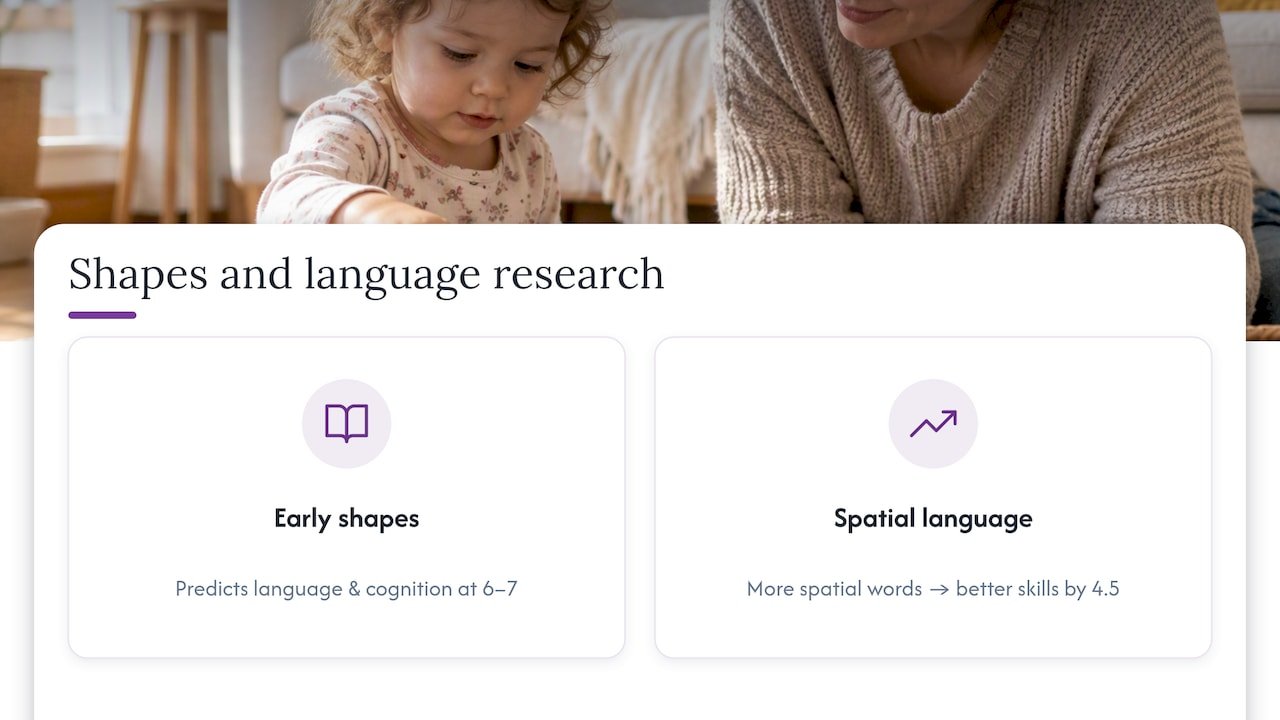
Shape recognition isn’t just a cute milestone. A 2019 study in Frontiers in Psychology found that shape recognition at around 20 months predicted language and cognitive skills measured at 6 to 7 years old.
Early shape skills at about two years old predicted language and cognitive outcomes years later, according to the Frontiers 2019 study, suggesting these early games carry weight well beyond toddlerhood.
Spatial language exposure adds another layer. Research summarized by the Learning Research and Development Center found that toddlers who heard more spatial words went on to use more spatial language themselves and performed better on spatial problem-solving tasks by age 4.5. Short, frequent, language-rich sessions seem to matter more than long, occasional ones.
Fitting Five Minutes of Shape Play Into a Real Day
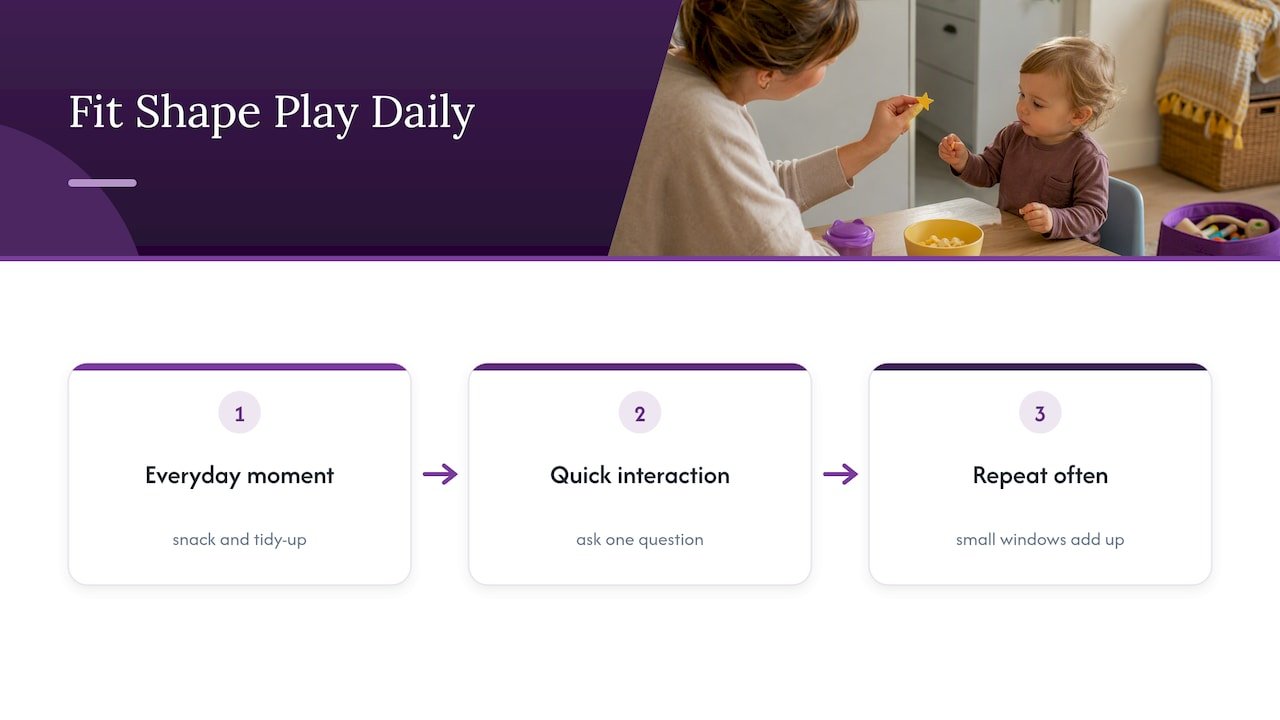
Picture snack time. Crackers are shaped like squares, an orange slice looks like a half circle, and a quick “can you find the round one?” turns eating into a shape hunt without adding a single task to your day.
Tidy-up works the same way. Sorting toys into round bins and square boxes while chatting about shapes takes minutes and asks nothing extra of you. Progress here comes from showing up in these small windows again and again, not from getting every session perfect.
— samit
How Mooshie Moments Makes Shape Play Even Easier
Some days you have the energy for a full activity list, and some days you barely have five minutes before the next meltdown. An app is available that suggests quick, screen-free activities matched to your child’s age and however much time you’ve actually got, using things already in your home.
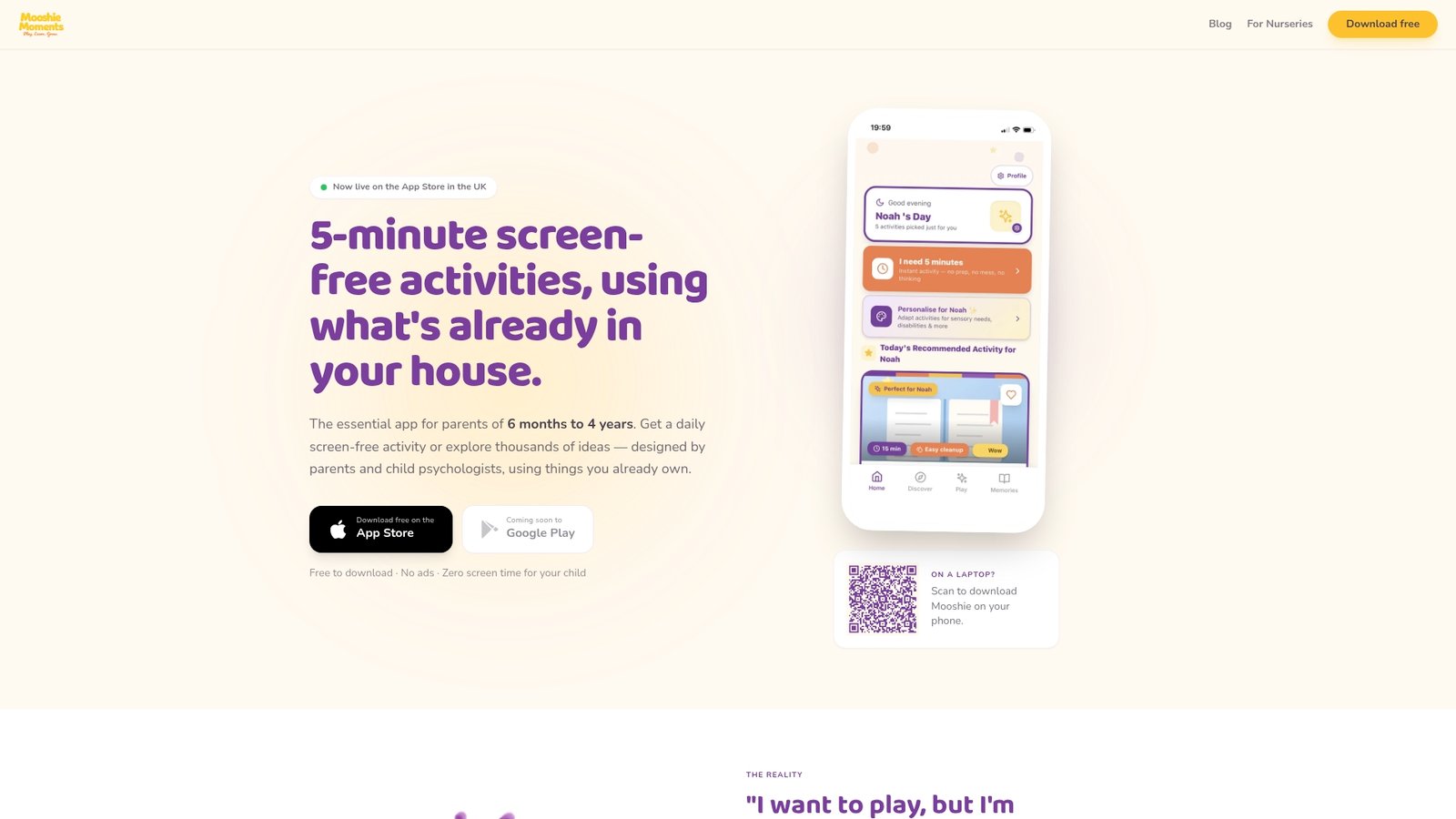
- Activities come with a plain-language explanation of the developmental benefit, so you know why a shape sort matters, not just that it does.
- Everything aligns with early-years learning goals without requiring you to buy a single extra toy.
- Nurseries and early-years settings can access a dedicated Partnership Pack for ready-made resources and family engagement tools.
Browse the free activity library at Mooshie Moments or check out 40 more activities for two-year-olds to keep the momentum going. Premium features unlock a deeper library, while the core app stays free to explore.
Where to Read More on Early Shape Learning
- Frontiers in Psychology (2019): links early shape recognition to later language skills.
- UK early-years spatial reasoning guidance: practical vocabulary tips for caregivers.
- NAEYC on block construction: classroom-tested spatial play ideas.
- Temple Infant Lab, Verdine et al.: how toddlers generalize shape names.
Sources
- Early shape recognition predicts later language and cognitive outcomes — Frontiers in Psychology (2019)
- Help for early years providers: Spatial reasoning (UK government guidance)
- Rocking and Rolling: Block construction in toddler settings — NAEYC
FAQ
What are some activities for toddlers to learn shapes?
Shape hunts, sorting boxes, block building, and feely boxes are all effective, low-prep options for toddlers. Each uses everyday items and pairs a shape name with hands-on movement, which helps the concept stick faster than flashcards alone.
At what age do toddlers recognize shapes?
Many toddlers start recognizing basic shapes like circles and squares by 18 to 24 months, with skills expanding through age three. Research on shape name learning shows toddlers begin applying names to less typical shape examples by around 30 months.
What are some fun games for identifying shapes?
Shape songs with movement, feely box guessing games, and circle printing with cups all turn shape learning into play rather than a lesson. Rotating between quiet activities and active ones, like a shape tunnel, keeps a toddler’s interest longer.
What activities support children’s understanding of shape?
Block play, guided shape sorting, and matching games all build understanding, especially when paired with spatial words like “next to” or “inside.” NAEYC’s research on block construction points to this kind of hands-on manipulation as key to spatial reasoning growth in toddlers.
Recommended
- 12 Low Prep Toddler Activities for Grandparents With Seated Options
- 40 Fun 2 Year Old Activities to Start Right Now
- Junk Modelling for Toddlers: Easy EYFS-Aligned Activities
Want a new idea every day, matched to your child's age?
Mooshie Moments gives you simple, guided play ideas for ages 6 months to 4 years.
Download free on the App StoreMore like this
Babysitting Toddlers: 12 Low Prep Ideas and Why They Help
Explore 12 low prep toddler activities for babysitters, with developmental benefits, age adaptations, UK safety advice, and optional activity coaching.
10 EYFS Backed Sock Games for Toddlers Under Five Minutes
Ten EYFS aligned sock games to start in under five minutes, each with a one line developmental benefit, simple adaptations, and two…
Busy Parents: 12 No Prep Shopping Activities for Toddlers
Busy parents: keep toddlers learning and calm at the store with 12 no prep, screen free activities that take under five minutes…