Valentine’s Activities for Toddlers: Easy Ideas at Home
Updated 20 October 2026 · 10 min read
You don’t need glitter, a craft shop trip or a Pinterest board to make Valentine’s Day fun for a toddler. A few red scraps, a wooden spoon, a sheet of paper and ten minutes of your full attention will do it. Below you’ll find ideas for babies from about 9 months up to four-year-olds, how to adapt each one for age, and the safety checks worth doing before you start.
Valentine’s Day is on 14 February, so there is plenty of time to try these out. Most of them work all year round, and many can be re-themed for Easter with the same household items.
TL;DR
- Everything here uses things you already own: paper, crayons, kitchen tools, scraps of red or pink fabric, and a basket.
- Match the activity to your child’s age. Treasure baskets suit babies from around 9 months, secret-message hearts suit older toddlers.
- Check every homemade item against the small parts rule before it goes near a child under three.
- Describe what your toddler is doing rather than quizzing them. It builds language without pressure.
- Set up, step back and let them explore. Short and unhurried beats long and elaborate.
Table of Contents
- Why keep Valentine’s Day simple with toddlers
- Before you start: a quick safety check
- Quick ideas by age
- Valentine’s treasure basket (from about 9 months)
- Heart pot-and-spoon play (12 months and up)
- Post the hearts (18 months to 2 years)
- Secret-message hearts (2 to 3 years)
- Heart color match (2 to 4 years)
- Love letter delivery (2 to 4 years)
- Cuddle tea party (all ages)
- How to make any activity better
- Our perspective: Valentine’s Day is for grown-ups getting off their phones too
- Want more ideas like these?
- Doing the same for Easter
- FAQ
- Sources
Why keep Valentine’s Day simple with toddlers
Most Valentine’s content for toddlers is built around crafts: glue, glitter, printable templates. Those can be lovely. But if you are tired, they can also feel like one more job, and a toddler often cares more about squishing the paper than about the finished card.
Play is how young children learn. An NHS leaflet from Central and North West London NHS Foundation Trust says play is how a child learns and offers activity ideas for language, thinking and movement. Its approach fits tired households well: fold language and play into things you are already doing, like dressing and mealtimes, rather than treating play as an extra task needing special kit.
So think of Valentine’s Day as a theme you lay over ordinary play. Hearts, red, pink, “I love you” and cuddles are the only things that need to change.
Before you start: a quick safety check
Homemade activities are only as safe as the items in them. Do this once, in a minute, before any of the ideas below.
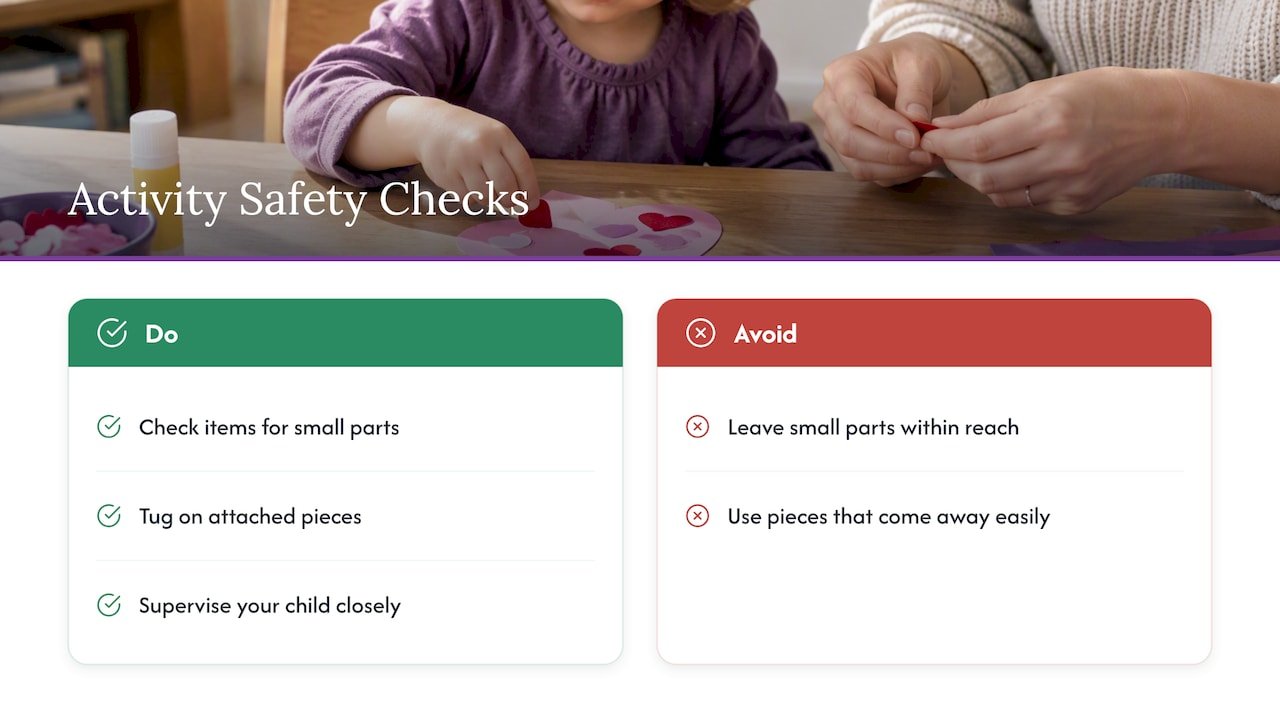
Check for small parts. The UK’s Toys (Safety) Regulations 2011 apply to toys sold here, and the official test for choking risk uses a small parts cylinder. At home, the usual shortcut is a toilet roll tube: if an item or a piece that could come off it fits inside, it is not for a child under three. GOV.UK publishes regular safety reports, such as this one on a squishy toy listing removed from Amazon because it contained small parts presenting a choking risk. Marketplace items labeled “toddler” or “educational” are not guaranteed safe, so check them yourself.
Give things a tug. Pull on pom-poms, felt shapes, ribbons and anything stuck on. If a part comes away easily, leave it out. The same GOV.UK site lists a wooden fishing toy recall where a magnet could detach and cause a high choking risk, which is a good reminder to be careful with magnets, beads and anything that can pop off.
Stay close. Supervise all of these. If your child still mouths everything, our guide to taste safe sensory play has ideas where a mouthful is no problem. For choosing clean, suitably sized materials, this parent’s guide to sensory play and child development is a useful read.
If you have a specific worry about choking or your child’s development, speak to your health visitor or GP.
Quick ideas by age
Here is a snapshot. Details for each follow.
| Age | Activity | Time | Skill it supports |
|---|---|---|---|
| 9 to 18 months | Valentine’s treasure basket | 5 to 15 min | Touch, hearing, early language |
| 12 months and up | Heart pot-and-spoon play | 5 to 10 min | Grasping, cause and effect |
| 18 months to 2 years | Post the hearts | 5 to 10 min | Hand-eye coordination, turn-taking |
| 2 to 3 years | Secret-message hearts | 10 to 15 min | Fine motor, cause and effect |
| 2 to 4 years | Heart color match | 5 to 10 min | Sorting, color words |
| 2 to 4 years | Love letter delivery | 10 to 15 min | Pretend play, language |
| All ages | Cuddle tea party | 10 min | Bonding, social skills |
Valentine’s treasure basket (from about 9 months)
A treasure basket is a low, sturdy basket filled with everyday objects, ideally in natural materials. Education North Tyneside describes it as a sensory play setup using household objects rather than bought toys.
What to put in:
- A wooden spoon and a whisk
- A scrap of red felt or a soft pink scarf
- A clean metal bowl or a small tin to bang
- A large wooden ring or a smooth heart-shaped wooden item, if you have one
- A big card heart cut from a cereal box (no sharp edges)
- A fabric napkin in red or pink
The food-shop trick: a bunch of fresh herbs or a clean lemon adds smell. Skip anything small enough to fit through the toilet roll tube.
How to play: Put the basket on the floor, sit nearby and say nothing for a minute. Let your baby choose. Then describe what they do: “You’ve got the soft pink scarf.” Education North Tyneside also stresses setting the scene and then stepping back, so the child can explore at their own pace. A quiet room, with the TV off, helps them stay with it longer.
Want more along these lines? Our post on sensory play ideas with no new toys is full of them.
Heart pot-and-spoon play (12 months and up)
This is the easiest one in the article. Give your toddler a saucepan, a wooden spoon and a few hearts cut from card or felt. They will tip, stir, bang and post.
The Care Learning guide to loose parts play lists items like metal bowls, fabric, baskets and wooden rings as ways to support touch, sound and early exploration in baby rooms. Buckets, bags, baskets and tubes work in toddler rooms. Kitchen items give you all of that for free.
There is a modest risk element, too. The same guide supports a risk-benefit approach: handing toddlers real tools like wooden spoons builds confidence and fine motor control, as long as the items are clean, in good repair and the right size for the child.
Post the hearts (18 months to 2 years)
You need: an empty tissue box or a shoebox with a slot cut in the lid, and 6 to 10 paper hearts cut from cereal box card.
- Cut a slot a little wider than the hearts.
- Show your toddler once how a heart goes in.
- Let them have a go, and cheer when one disappears.
- Tip the box out and start again. Repeat as long as they like.
Posting is a classic for hand-eye coordination, and the repeat is the point. Toddlers love making something vanish and reappear. If you want more activities like this, see our ideas for hand-eye coordination and fine motor skills.
Secret-message hearts (2 to 3 years)
This one feels like magic. Happiest Baby suggests it as a screen-free Valentine’s idea: draw a message on paper with a white crayon, then reveal it with diluted food coloring.
You need: white crayon, white paper, a little food coloring in water, a brush or sponge.
- Draw a big heart or a few swirls with the white crayon. Your toddler can scribble too.
- Water down the food coloring in a shallow dish.
- Hand over the brush and let them paint across the page.
- Watch the heart appear.
It works fine motor control through the brushwork and teaches cause and effect: paint here, the picture shows up. For similar hands-on hearts, this craft ideas roundup has more inspiration.
A few practical notes:
- Put your toddler in old clothes and lay newspaper down. Food coloring stains.
- Use a small amount of coloring, and keep it away from mouths. If your toddler still tastes everything, use the taste-safe ideas above instead.
- Expect a mess. A page that is all red is still a win.
Heart color match (2 to 4 years)
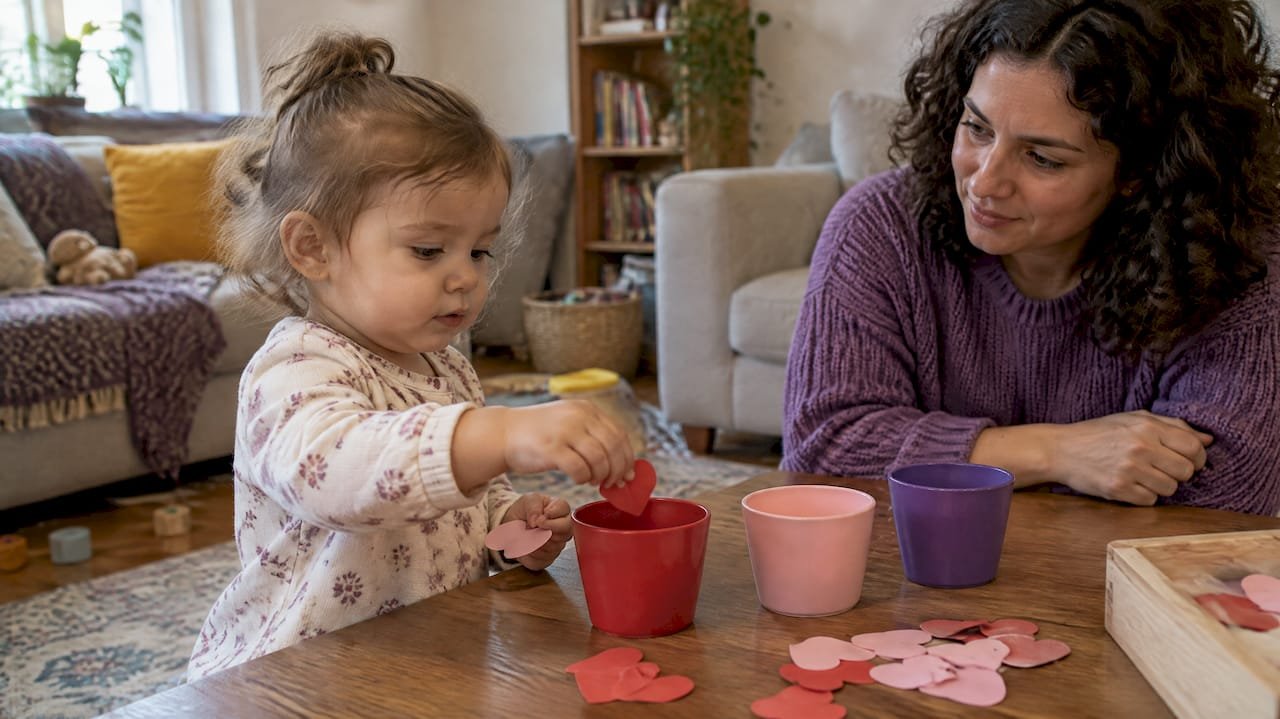
Cut hearts from paper in two or three colors, such as red, pink and white. Lay out a few cups or bowls the same colors, or just draw circles on a page.
Ask your toddler to help you “put the hearts home”. Avoid quizzing them. Instead of “What color is this?”, say “You’re putting the red heart in the red cup.” Experts at BBC Tiny Happy People say that describing play rather than testing it builds confidence and vocabulary without making toddlers feel they are being tested.
For five-minute sorting games using things you already own, try our color sorting activities. If your child is ready for numbers, they pair well with counting games that need no kit.
Love letter delivery (2 to 4 years)
Pretend play makes this one work. Give your toddler a few paper “letters”, or envelopes made from scrap paper, and a bag or basket to carry them in. Then be the postbox, a teddy’s front door and Grandma’s house.
BBC Tiny Happy People says pretend play lets children try out words they’ve heard, and teaches taking turns and problem-solving. Letters give you plenty of that: “Who is this one for?”, “Knock knock!”, “Thank you for my letter!”
Your toddler can make a mark on each letter (any scribble is a message), and you can write a few words for them if they want. If they are keen on this, our storytelling ideas for toddlers and early literacy activities carry on from here.
Cuddle tea party (all ages)
Sit on the floor with a few cups, a teapot or jug, some teddies and a blanket. Pour pretend tea. Take turns to “serve” each other. Add cuddles whenever the mood strikes.
It costs nothing, takes ten minutes and is as much about bonding as it is about play. For more ways to connect in short bursts, see our toddler bonding activities.
How to make any activity better
The activity is only half of it. How you play matters more.
Watch, wait, listen
BBC Tiny Happy People suggests a simple technique for 18 to 24 month olds: watch what interests your child, wait for them to start or respond, then comment on what they are doing. In practice, you sit down, say nothing and let them pick up the spoon. Then you say, “You’re stirring!” It is low pressure, and it follows their lead rather than yours.
We go through this in more depth in how to narrate play for your toddler’s language growth and in our speech and language activities.
Set up, then step back
If you hover and direct, toddlers tend to wait for you. If you set the scene and sit back, they experiment. Keep the space calm, turn off background noise and stay within reach.
Keep it short
Five minutes of full attention is plenty for most toddlers. If they walk away after two, that was the activity. Pick it up again later, or tomorrow.
Our perspective: Valentine’s Day is for grown-ups getting off their phones too
We built Mooshie Moments for parents of children aged 6 months to 4 years who are tired and short of ideas. When we think about Valentine’s Day, we see the same pattern we see everywhere: lots of products and printables, not much help for the parent who has ten minutes and nothing to hand.
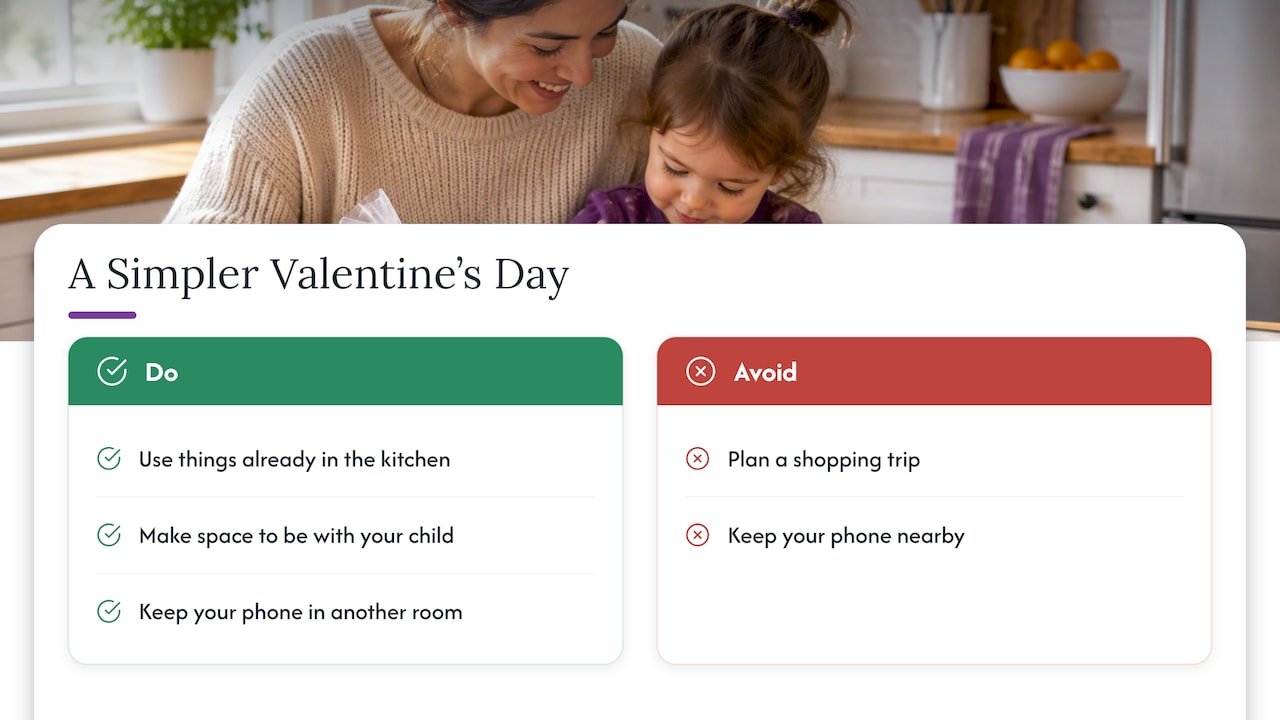
Our view is that a Valentine’s activity shouldn’t need a shopping trip. The best ones use things already in the kitchen, take little setup, and make space for you to be with your child. That is also why we explain the developmental “why” behind each activity in plain language. When you know that posting hearts builds hand-eye coordination, or that describing play builds vocabulary, you can do it with confidence, and you can keep going in your own way once the day is over.
We also think playing with your child is one of the few times a phone can safely stay in another room. Valentine’s Day is a good excuse to try it.
— samit
Want more ideas like these?
If you’d like a fresh, quick idea any day of the year, Mooshie gives you screen-free activity ideas for children aged 6 months to 4 years, matched to your child’s age and the time you have, using things from around the house. Each one comes with a short explanation of what it helps and a coaching tip. If you run a nursery, childminding setting or early years group, take a look at our Partnership Pack for nurseries.
If you’d like to browse before you download, our guide to low prep toddler activities by skill area is a good place to start.
Doing the same for Easter
If you landed here looking for Easter ideas, the same approach carries over. Swap the red and pink for yellow, green and white, hide card eggs in a basket instead of posting hearts, and use the treasure basket with spring-themed fabric and kitchen items. The age guidance and small parts checks above still apply.
FAQ
What can I do with my toddler for Valentine’s Day?
Pick one or two simple things, like a treasure basket, posting paper hearts or a cuddle tea party. Use items from around the house and keep each one to about ten minutes. Following your toddler’s lead matters more than making anything look perfect.
What are good Valentine’s activities for a one-year-old?
Try a treasure basket with safe household objects, or give them a pot, a wooden spoon and a few card hearts. These are suitable from around 9 to 12 months with close supervision. Check every item against the small parts rule first.
Are homemade Valentine’s crafts safe for toddlers?
They can be, if you choose materials carefully. Avoid beads, loose pom-poms, magnets and anything small enough to fit inside a toilet roll tube, and tug-test anything that is stuck on. If you are unsure, ask your health visitor or GP.
How do I keep a toddler interested for longer?
Set things up, then sit back and let them lead. Describe what they’re doing instead of quizzing them, and keep the room quiet. Short, repeatable activities usually hold attention better than long, complicated ones.
Sources
- Central and North West London NHS Foundation Trust: play and development leaflet
- GOV.UK: Product Safety Report, Christmas Squishy Toys sold via Amazon
- GOV.UK: Product Recall, wooden magnetic fishing toy
- Education North Tyneside: Treasure Baskets
- Care Learning: What is Loose Parts Play in Early Years?
- Happiest Baby: Valentine’s Activities and Crafts for Toddlers
- BBC Tiny Happy People: The Toddler Club, Pretend Play Ideas
- BBC Tiny Happy People: Activities for 18 months to 2 year olds
Recommended
- Busy Parents: 12 No Prep Shopping Activities for Toddlers
- Toddler Bonding Activities Busy Parents Can Do in 2–15 Minutes
- Babysitting Toddlers: 12 Low Prep Ideas and Why They Help
- Montessori Toddler Activities for UK Homes: 16 Ideas, No Shopping
Want a new idea every day, matched to your child's age?
Mooshie Moments gives you simple, guided play ideas for ages 6 months to 4 years.
Download free on the App StoreMore like this
Toddler Scavenger Hunt: Easy Ideas for Home and Garden
Easy toddler scavenger hunt ideas using things you already have: indoor, garden and nature walk hunts, by age, with safety tips and…

Camping With Toddlers: Activities That Work at the Campsite
Easy camping activities for toddlers using what you already have: nature play, campfire-free games, rainy-day ideas and safe-play tips for UK campsites.
Eco-Friendly Toddler Activities Using Things You Already Have
Simple eco-friendly toddler activities using things you already have: water play, nature hunts, junk modelling and garden play, with safety tips for…