
Busy Parents: 8 Easy, Research Based Storytelling Ideas for Toddlers
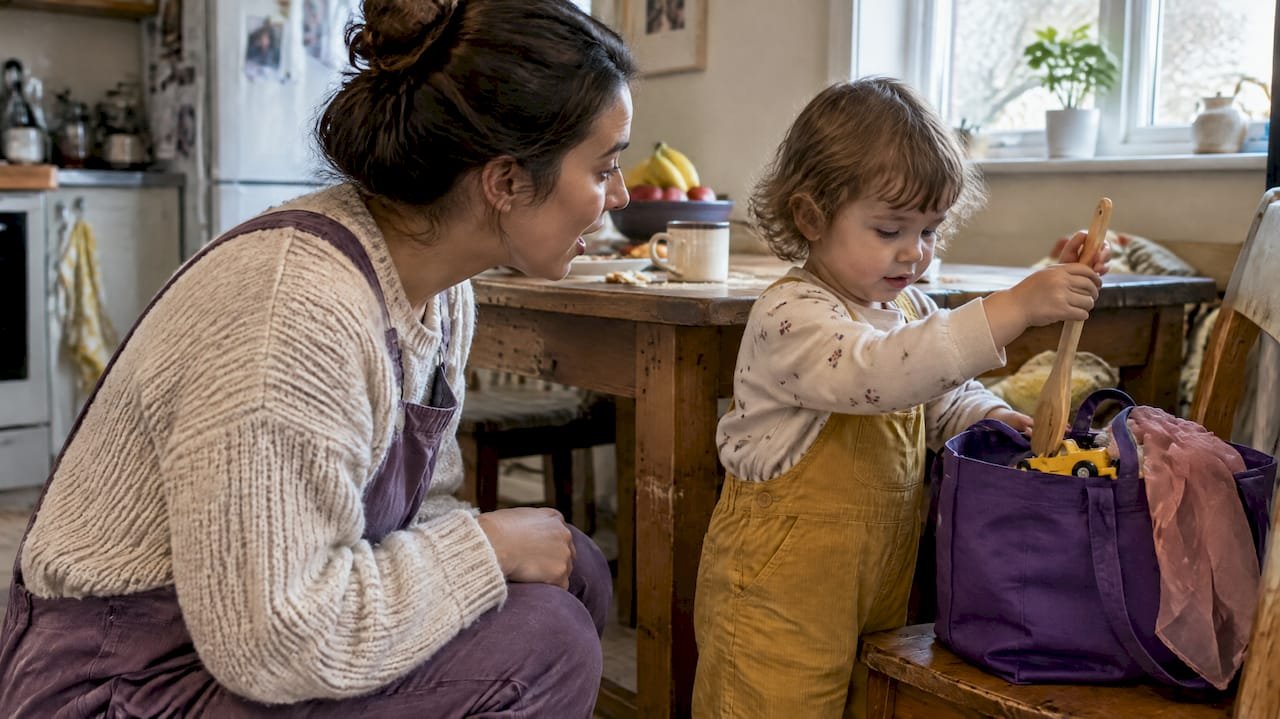
Yes: short, play-based storytelling activities you can do with everyday household items help toddlers build language and imagination, and you can start today. These quick, low-prep ideas work in five minutes or less, fit short attention spans, and group easily by type, from sensory play to puppets to simple retelling games you can repeat at bedtime.
TL;DR:
- Repetition and routine are key, with toddlers often asking to hear the same story multiple times to build vocabulary and confidence.
- Short, five-minute storytelling activities using household items—like story bags, texture trays, or puppets—fit easily into busy schedules and attention spans.
- Using basic story structures such as who, where, when, and what happens next helps toddlers organize and recall sequences even before full sentences develop.
- Engagement increases when caregivers ask open-ended questions, pause for responses, and let children steer the plot or choose props.
- Incorporating diverse characters, settings, and languages in storytelling fosters inclusivity and broadens cultural understanding in young children.
Table of Contents
- 1. Quick, Themed Storytelling Activities You Can Try Today
- 2. How to Adjust Activities for Your Toddler’s Attention Span
- 3. A Simple Story Scaffold: Who, Where, When, What Happens Next
- 4. What the Research Says About Storytelling and Language
- 5. Fitting Storytelling Into Busy Family Life
- 6. Getting Parents and Caregivers Involved
- 7. Encouraging Toddlers to Join the Story
- 8. Bringing Cultural Diversity Into Storytime
- 9. What Actually Moves the Needle in Toddler Storytelling
- Try Mooshie Moments for Age-Matched Story Prompts
- FAQ
- Sources
1. Quick, Themed Storytelling Activities You Can Try Today
You do not need a craft cupboard or a lesson plan to tell a good story with your toddler. A few household items and five spare minutes are usually enough.
Interactive prompts work well because they turn your toddler from a listener into a storyteller. Fill a tote bag or pillowcase with three or four random objects (a spoon, a toy car, a scarf) and let your child pull one out to start a story. Pause mid-sentence during any story and ask “what happens next?” so your toddler fills in the blank, which is a core idea behind practitioner guidance on creating a storytelling culture.
Sensory storytelling adds texture to the words. A shallow tray with rice, dried pasta, or shredded paper becomes a beach, a forest floor, or a snowy field for a two-line story you narrate as your child digs through it. Scented items (a cinnamon stick, a piece of orange peel) can anchor a simple “what do you smell” story about a kitchen adventure.
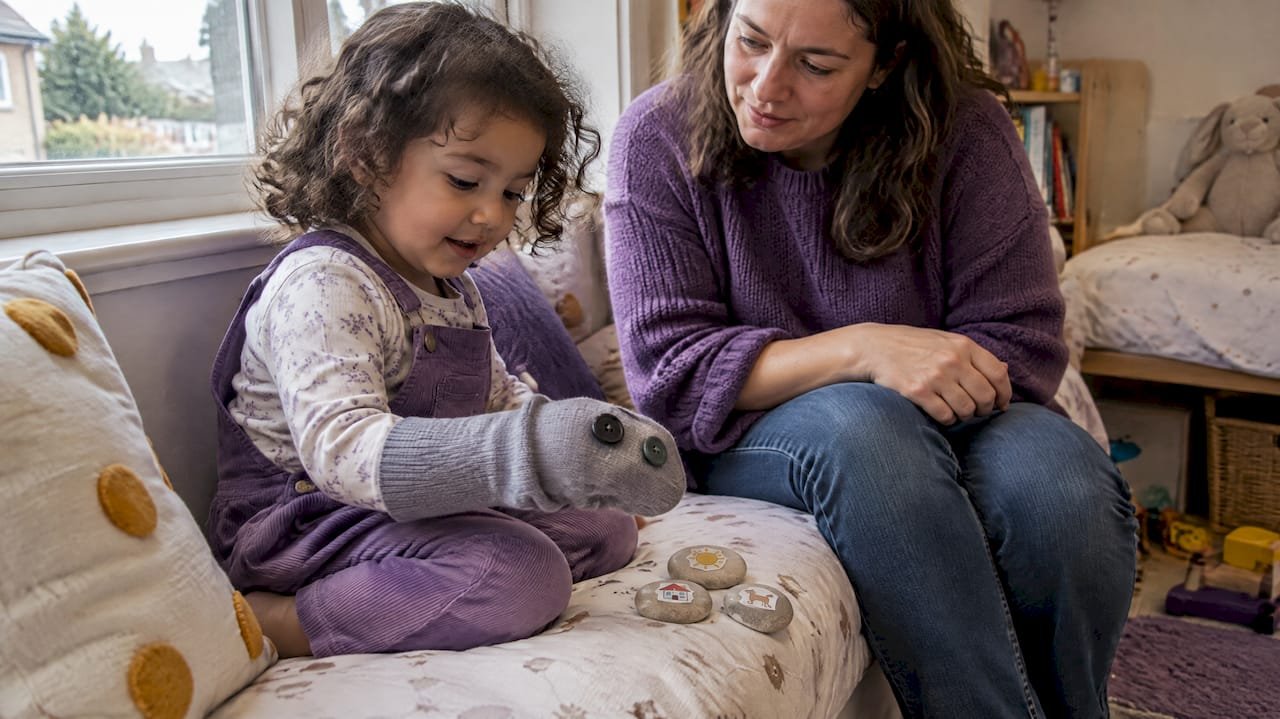
Puppets and props give shy toddlers a character to hide behind. A sock with two button eyes becomes a storyteller in seconds, and story stones (plain pebbles with a sticker of a sun, a house, or an animal) let your child pick three and invent a plot around them, an approach Twinkl’s practitioner guidance also recommends.
Movement and song turn narration into a game. Act out a simple story with big gestures (stomp like a giant, tiptoe like a mouse) or add sound effects your child supplies on cue, like a car engine or a dog bark.
Small-world and role-play scenes recreate a story with toys already in the house. Line up a few animals or cars and walk through a short scene, then hand your toddler the next turn.
Recording and retelling close the loop. Simple storyboard cards (three or four squares showing beginning, middle, end) help your child sequence events, and writing down your toddler’s own words, even if they are just two or three, shows them their story matters.
- Story bag: pull an object, build a sentence around it.
- Pause-and-prompt: stop mid-story and ask what happens next.
- Texture tray: rice, pasta, or fabric scraps become a scene.
- Sock puppet: instant character for shy talkers.
- Story stones: pick three symbols, invent a plot.
- Sound effects game: child supplies the noises.
- Small-world retell: toys act out a short scene.
- Storyboard cards: three squares for beginning, middle, end.
Pro Tip: Keep a small basket of story props by the sofa so you can grab one without searching for materials mid-tantrum.
2. How to Adjust Activities for Your Toddler’s Attention Span
Every toddler’s stamina for sitting still is different, and the same activity can flex to fit a two-minute window or a longer one.
- Try the five-minute version: pick one prop, tell one short story, and stop before interest fades rather than pushing for a full plot.
- Lean on repetition and ritual: toddlers often ask for the same story again, and repeating it word for word builds confidence and vocabulary faster than constant novelty.
- Use vocabulary-first scaffolding: focus on naming objects and actions before worrying about plot, since single words and short phrases come before full sentences.
Your role is to model language, expand on what your child says (“dog” becomes “big brown dog”), and then wait. Pausing for a response, even a long one, gives your toddler room to try. For bilingual or multilingual children, lean on visual cues, repeat key words in both languages, and add gestures so meaning carries even when vocabulary is still building. For more age-specific ideas, see our guide to activities for two year olds.
3. A Simple Story Scaffold: Who, Where, When, What Happens Next
A basic structure helps toddlers organize a story instead of rambling, and it works whether you are reading a book or making one up on the spot.
- Who: ask “who is in our story?” and let your child name a character.
- Where: ask “where are they?” using a picture or a toy as a cue.
- When: keep it simple, “once upon a time” or “today” works fine.
- What happens next: the open question that invites your child to add the plot.
This Who/Where/When/What-happens-next pattern, paired with simple visual symbols, is a structure recommended for children between three and five years old to help them understand and recall sequences. A puppet mini-story might go: “Who is a bear. Where is in the woods. When is this morning. What happens next, the bear finds a berry.” A story-bag version works the same way, with each pulled object answering one part of the scaffold.
4. What the Research Says About Storytelling and Language
A 20-week program combining shared storybook reading with guided play produced about two additional months of progress in oral language for three and four year olds in trial settings. That is a meaningful jump from a relatively short, structured routine.
Modeling language and giving children permission to change the story, treating words as loose parts, encourages ownership and more frequent storytelling.
This dialogic approach, where an adult asks open questions and expands on a child’s answers rather than just reading aloud, appears across practitioner guidance on building a storytelling culture. Short daily sessions, or several times a week, tend to fit real family schedules better than one long weekly storytime.
5. Fitting Storytelling Into Busy Family Life
Most families do not need a bigger block of time, they need a routine that sticks. Two five-minute storytelling moments, one in the morning over breakfast and one at bedtime, cover the day without asking for anything extra.
This idea can be supported by using apps that suggest quick, screen-free activities matched to your toddler’s age and the time you have available. Suggestions that include plain-language explanations of developmental benefits can help you understand the value of a five-minute puppet story.
— samit
6. Getting Parents and Caregivers Involved
Storytelling works best when more than one adult in a child’s life joins in, because toddlers hear new vocabulary and new storytelling styles from each person.
Grandparents, aunts, uncles, and babysitters can all take a turn with a story bag or sock puppet, and a seated version works fine for anyone who cannot get down on the floor; our guide to low-prep activities for grandparents has seated options built in. Low-tech prompts, like a flip-book of story cards, raise a caregiver’s confidence to improvise a story, as the National Literacy Trust’s family resource points out, and that confidence is often the missing piece rather than time or materials.
Sharing one story prop between two caregivers, say a parent in the morning and a grandparent in the evening, also gives a toddler the comfort of repetition while keeping the voice and details slightly different each time. Even a quick text update (“we did the sock puppet story again, he added a dinosaur”) keeps everyone looped into what is working.
7. Encouraging Toddlers to Join the Story
A toddler who feels like a character in the story, not just an audience member, stays engaged longer. Ask open questions rather than yes-or-no ones: “what color is the dragon” invites more than “is the dragon red.”
Letting your child steer the plot, even into something silly, matters more than sticking to a tidy ending. Narrating your child’s own play back to them, a technique covered in our piece on narrating play, is one of the simplest ways to model storytelling language without setting up a separate activity. Props help too: handing your toddler the puppet or the story stone to hold gives them physical ownership of their turn.
When attention drifts, changing your own position, kneeling down or moving to a different spot, often re-engages a toddler faster than raising your voice, a technique experienced practitioners rely on according to EEF’s early years guidance. Moving to a small-world play area or adding a tactile prop can do the same job.
8. Bringing Cultural Diversity Into Storytime
Stories that reflect different families, languages, and traditions give every toddler a chance to see themselves and to learn about lives different from their own. This does not require new purchases: adapting a familiar story’s characters, setting, or food to match your own background, or a friend’s, is enough.
Using story stones or puppets with a mix of skin tones, clothing styles, and family structures broadens the cast without any extra planning. Folk tales and oral traditions from different cultures also tend to use the same simple structures, like repetition and call-and-response, that already work well with toddlers.
For bilingual families, telling the same short story in two languages across the week reinforces vocabulary in both and shows a toddler that more than one way of saying something is normal and welcome. Inviting a grandparent or relative to share a story from their own childhood, even a simple one, adds a layer of family history that a book alone cannot.
9. What Actually Moves the Needle in Toddler Storytelling
The advice that gets repeated most, read more books, is not wrong, but it is incomplete. What the evidence actually points to is interaction: an adult pausing, asking a real question, and waiting for an answer does more for language than finishing a story quickly and moving on.
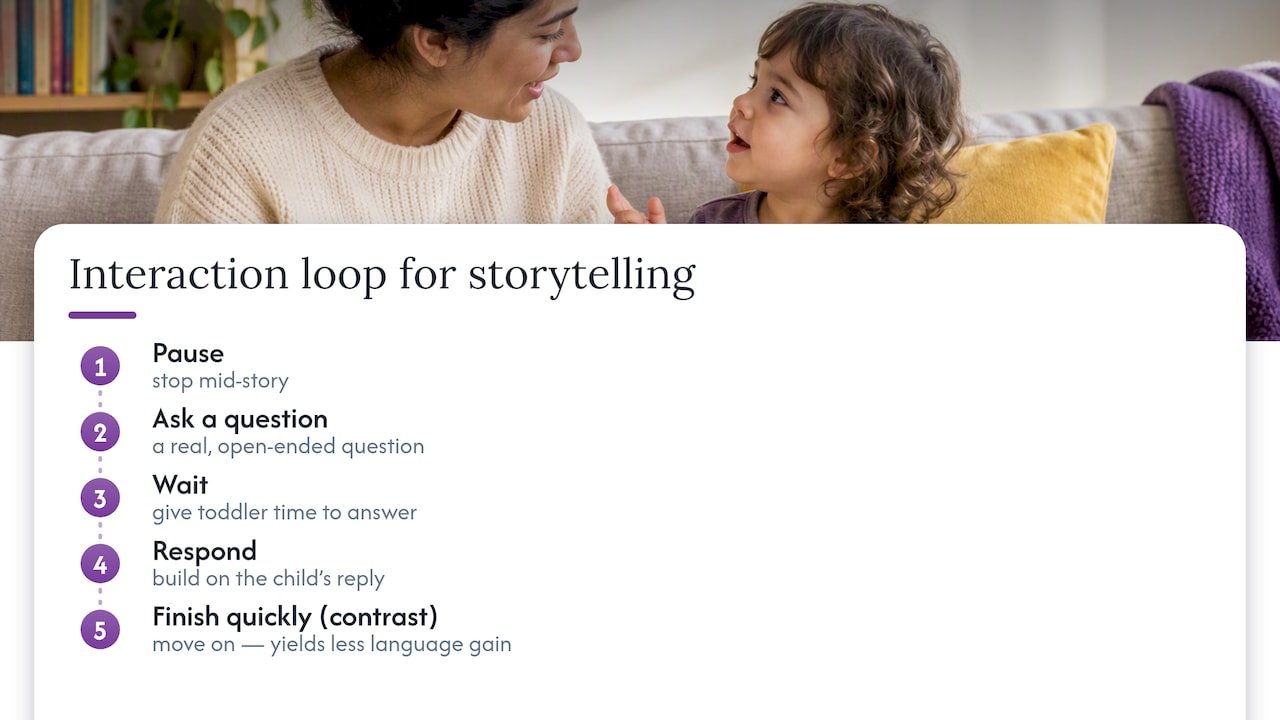
Many parents assume storytelling means a tidy picture book read start to finish. In practice, a sock puppet and a made-up plot about a lost sandwich can do just as much work, and it is often easier to fit into a five-minute window than settling in for a full book.
If you take one thing from this, prioritize repetition over variety. A toddler asking for the same story a fourth time is not boredom, it is practice, and practice is where the vocabulary and sequencing skills actually land. Save the new story ideas for when your child asks for something different, not because a schedule says it is time to change it up.
Try Mooshie Moments for Age-Matched Story Prompts
If you like the idea of these activities but want someone else to do the matching, some apps suggest low-prep, screen-free activities tailored to your toddler’s age and available time. Such suggestions often include plain explanations of the developmental thinking behind them, drawn from child-development research.

Explore the app at Mooshie Moments, or if you work in a nursery or early years setting, take a look at the Partnership Pack for printable story prompts and home-learning resources you can share with families.
FAQ
What are the 5 C’s of storytelling?
Definitions of the “5 C’s” vary across sources, and no single version is standard in early years practice. Rather than a fixed framework, caregivers of toddlers get more mileage from the simpler Who, Where, When, What-happens-next scaffold covered above.
What are some activities for telling a story?
Story sacks, sock puppets, story stones, texture trays, and simple storyboard cards all work well with toddlers and need little to no setup. Picking one object and building a two-line story around it is often the fastest way to start.
What age do toddlers start telling stories?
Toddlers typically begin stringing together simple narrative ideas, like naming a character and one action, from around two to three years old, often with an adult’s prompts and expansions. Full sequencing (beginning, middle, end) tends to develop further between three and five years old.
What are some good storytelling sessions for kids?
Short sessions of two to five minutes, repeated once or twice a day, tend to work better for toddlers than one long sitting. Linking a story moment to a daily routine, like breakfast or bedtime, makes it easier to keep going.
Sources
- The power of story in the early years | EEF
- Create Stories With Me | National Literacy Trust
- Top 10 storytelling activities for toddlers | Twinkl
Recommended
- How to Narrate Play for Your Toddler’s Language Growth
- 40 Fun 2 Year Old Activities to Start Right Now
- Junk Modelling for Toddlers: Easy EYFS-Aligned Activities
- Taste Safe Sensory Play: Top 10 Ideas for Mouthing Toddlers
Want a new idea every day, matched to your child's age?
Mooshie Moments gives you simple, guided play ideas for ages 6 months to 4 years.
Download free on the App StoreMore like this
Babysitting Toddlers: 12 Low Prep Ideas and Why They Help
Explore 12 low prep toddler activities for babysitters, with developmental benefits, age adaptations, UK safety advice, and optional activity coaching.

10 EYFS Backed Sock Games for Toddlers Under Five Minutes
Ten EYFS aligned sock games to start in under five minutes, each with a one line developmental benefit, simple adaptations, and two…
Busy Parents: 12 No Prep Shopping Activities for Toddlers
Busy parents: keep toddlers learning and calm at the store with 12 no prep, screen free activities that take under five minutes…