
Five Minute Early Maths Moments for UK Parents, EYFS Aligned
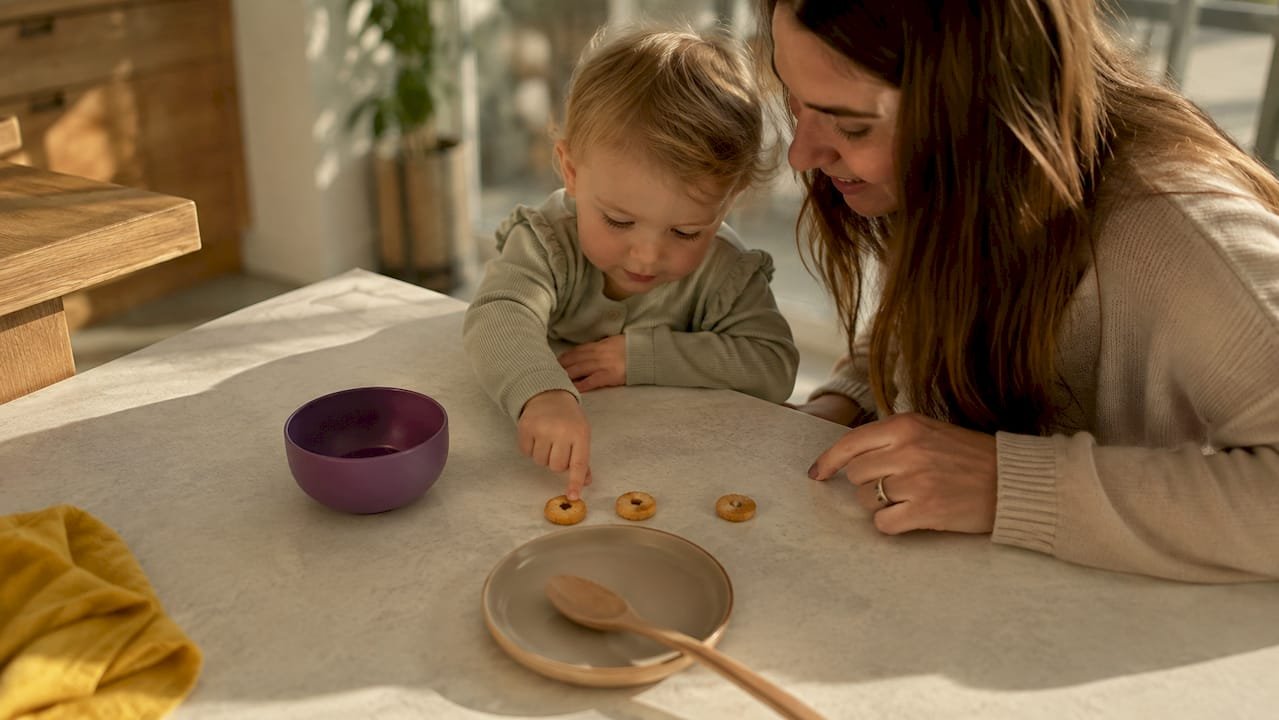
The single best thing you can do for early years maths at home is skip the flashcards and lean into short, playful, screen-free moments woven through the day. Three or four minutes of counting socks or spotting shapes on a walk beats a scheduled lesson. This approach lines up with the EYFS framework, guidance from the Education Endowment Foundation, and the everyday activities inside Mooshiemoments.
TL;DR:
- Incorporating counting, shape recognition, and measuring into daily routines provides more meaningful math learning than formal lessons or flashcards.
- Using household objects like toys, kitchen tools, and recycled materials allows children to develop spatial reasoning, number sense, and comparison skills effortlessly.
- Short, playful activities of two to five minutes, repeated frequently throughout the day, build confidence and understanding without overwhelming young children.
- By age four, most children should be able to count to ten, recognize small quantities automatically, and compare objects by size and weight.
- Consistent encouragement, narration, and adapting activities to the child’s interests lead to better early math development than structured instruction alone.
Table of Contents
- Number Sense: Subitising, Counting, and Recognition You Can Try Today
- Shape and Spatial Play: Building Geometry Through Everyday Play
- Measures and Comparison: Pouring, Baking, and Timers as Math Tools
- Turning Daily Routines Into Math Moments
- What to Expect by Age, and When to Get Extra Support
- Ready Resources and Low-Prep Games Worth Trying This Week
- How the Evidence Lines Up With Everyday Practice
- A Parent’s Micro-Plan for This Week
- Mooshiemoments: A Low-Prep Way to Keep This Going
- Sources
Number Sense: Subitising, Counting, and Recognition You Can Try Today
Subitising is a fancy word for a simple skill: recognizing “how many” at a glance, without counting one by one. You already have the tools for this. Hold up three fingers and ask, “How many?” Roll a dice and see if your child can call the number before counting the dots. Line up five toy cars, then take one away and ask what changed.
Counting works best with a consistent set of objects in a single session, whether that’s socks, buttons, or wooden blocks, so your child focuses on quantity rather than getting distracted by different shapes and colors. Swap the object type next time to help the skill generalize.
- 6 to 18 months: count aloud during nappy changes or bath time; your child absorbs the rhythm of numbers before they can say them.
- 18 months to 2 years: count stairs together, one number per step.
- 2 to 3 years: use dice games and “how many spoons” at snack time.
- 3 to 4 years: count forward and backward, and start touching each object as you count it.
Pro Tip: Keep counting sets under ten items for toddlers. Bigger numbers only add confusion before the basics feel automatic.
Shape and Spatial Play: Building Geometry Through Everyday Play
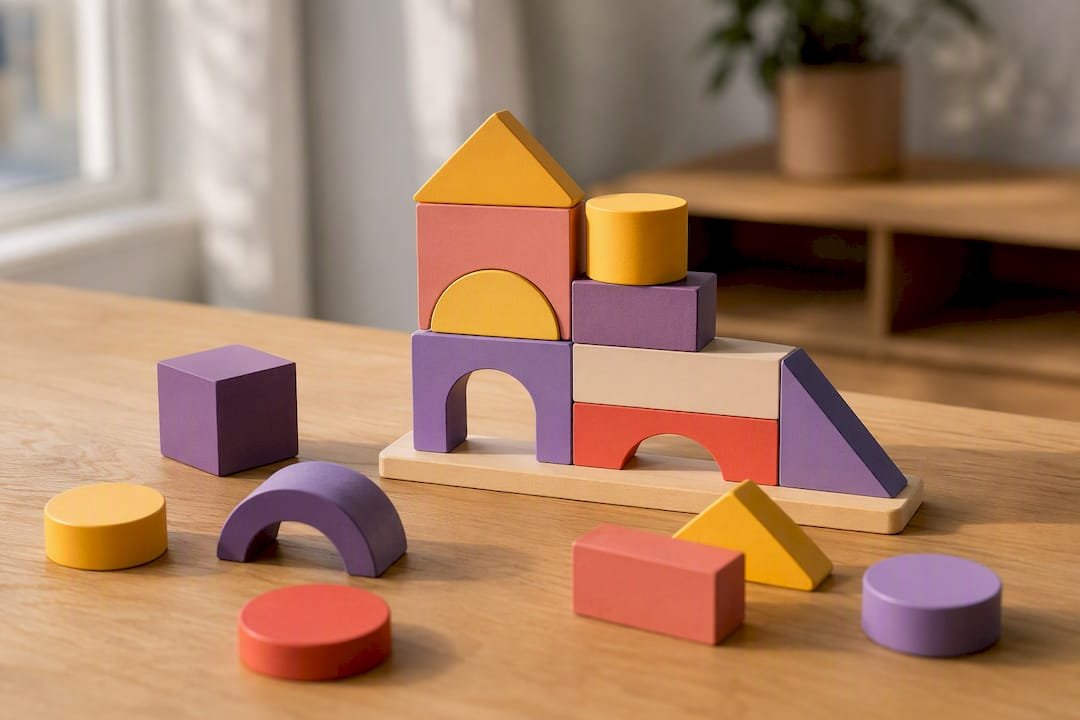
Spatial thinking underpins later maths, from fractions to geometry, and it starts with block towers and cardboard tubes, not worksheets. Children who stack, sort, and fit objects together are quietly practicing the same skills they’ll need for measurement and problem solving years later, a point backed by the EEF’s early mathematics evidence store.
Try these at home:
- Go on a shape hunt around the kitchen (a plate is a circle, a cereal box is a rectangle).
- Build a tower and talk about “taller,” “shorter,” and “next to.”
- Sort recycling into groups by shape before it goes in the bin, using leftover boxes and tubes the way junk modelling activities do.
Storybooks are underused for this. Almost any picture book can spark spatial talk. Ask “what’s on top of the box?” or “which one is bigger?” as you read. Keep vocabulary simple at first (big, small, round), then add words like “curved” or “beside” once your child is confidently using the basics.
Measures and Comparison: Pouring, Baking, and Timers as Math Tools
Kitchen play is one of the richest, lowest-prep ways to teach measures. A set of measuring cups, a kitchen timer, and some water in the sink cover size, capacity, and time all at once.
- Pour water between two cups of different sizes and ask which holds more.
- Set a timer for two minutes during tidy-up and race to beat it.
- Weigh two pieces of fruit in your hands and ask which feels heavier.
Narrate as you go: “This cup is fuller,” “That took longer,” “The apple is heavier than the grape.” Language like this, more than the activity itself, builds the comparison skills EYFS expects by age four.
Turning Daily Routines Into Math Moments
You don’t need extra time in the day. Snack time, tidying, and the walk to the shops already carry maths inside them, and the EEF’s guidance on everyday routines points to exactly this kind of repeated, low-effort exposure as one of the most reliable ways young children build number sense.
- At snack time, ask your child to count out crackers or split fruit into equal halves.
- While tidying, sort toys by size or count how many go back in the box.
- At the shop, compare prices (“this one costs more”) or count items into the basket.
- On a walk or drive, spot and count red cars, or count steps to the corner.
Narrate what you’re doing in plain language rather than turning it into a quiz. “You’ve got two now, one more makes three” sticks better than “What’s two plus one?” Short and frequent beats long and occasional. Two minutes at snack time, three times a day, adds up to more real practice than one weekend maths session ever will.
What to Expect by Age, and When to Get Extra Support
Progress in early maths rarely moves in a straight line, and that’s normal. The EYFS framework sets rough expectations, not a race to win.
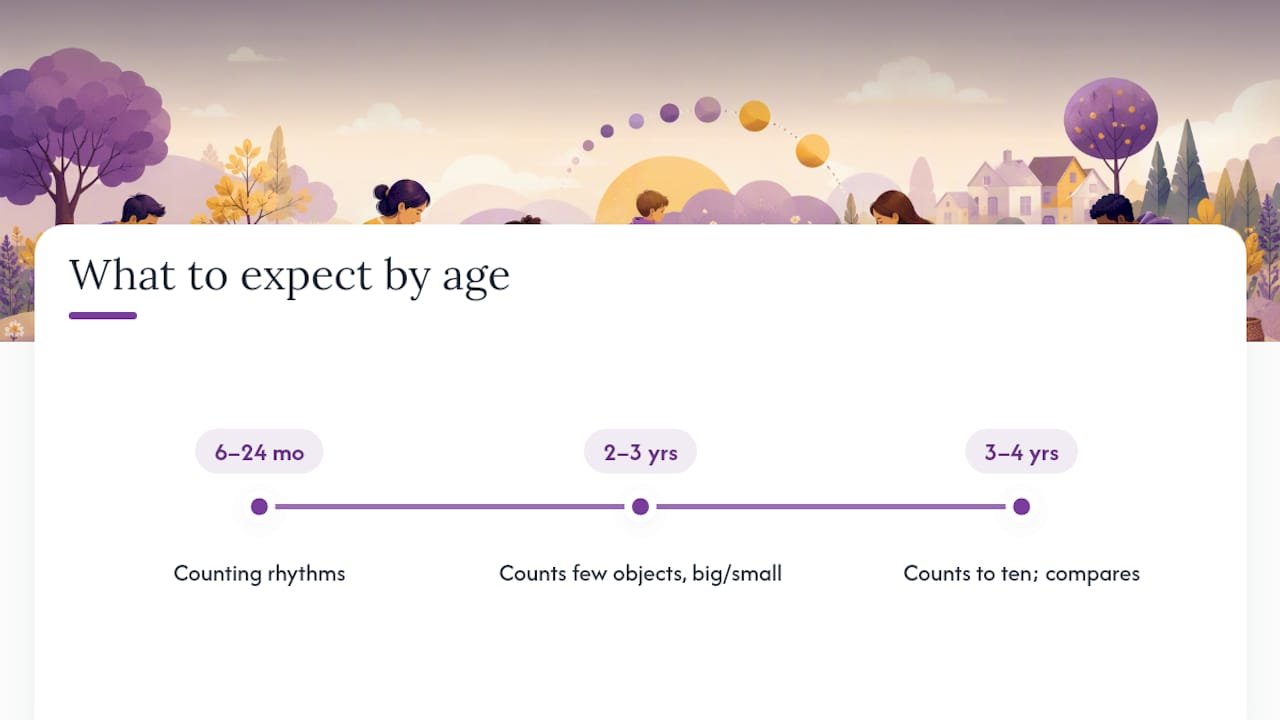
By 6 to 24 months, children usually respond to counting rhythms and simple number words. By 2 to 3 years, most can count a few objects aloud, even if the numbers come out of order, and start noticing “big” versus “small.” By 3 to 4 years, children typically count to ten with reasonable accuracy, recognize small quantities without counting, and compare sizes using words like “more” and “less.”
If your child shows little interest in numbers or shapes by age four, or struggles to follow simple counting games most days, it’s worth mentioning to your nursery key worker or health visitor. One quiet week rarely means anything on its own.
Ready Resources and Low-Prep Games Worth Trying This Week
You don’t need to build activities from scratch every day. A handful of resource types cover almost everything:
- Picture books with strong visual patterns, even ones not marketed as “maths books.”
- Simple board games with dice or counters, which quietly teach number recognition.
- Printable EYFS-style activity sheets for structured but screen-free practice.
- NRICH’s early years pages, which offer low-prep prompts built specifically for parents at home.
- BBC Bitesize’s early years maths section, useful for short games when a screen genuinely helps rather than replaces play.
Adapt anything to your child’s current obsession. A dinosaur-mad three-year-old will count dinosaurs far more happily than counters.
How the Evidence Lines Up With Everyday Practice
The pattern across UK guidance is consistent: routines, storybooks, and everyday objects (manipulatives, in the research language) do more for early maths than formal instruction ever could at this age, according to the EEF’s early years maths guidance. Praise for effort, rather than labeling a child as “good” or “bad” at numbers, also shapes confidence early, per National Numeracy’s guidance.
An app builds its activity library around that same logic: short, EYFS-aligned prompts that take about five minutes, adapted to a child’s age and a parent’s energy that day, with partnership packs extending the same approach into early years settings.
Short, repeated, playful exposure to numbers and shapes through ordinary household moments does more for a young child’s mathematical confidence than any structured lesson ever could at this age.
— samit
A Parent’s Micro-Plan for This Week
Start small. Day one: count snacks at breakfast, spot shapes on a walk, sort laundry by color before bed. Day two: swap in a dice game, a water-pouring session, a counting rhyme at bath time. Day three: repeat what worked. Praise effort, not “being clever,” and skip phrases like “I was never good at maths either,” as suggested in this guide practical pour parents. On tired days, one two-minute moment still counts.
Mooshiemoments: A Low-Prep Way to Keep This Going
This is a shortcut for parents who like this approach but don’t have time to plan it every day. Instead of searching for age-appropriate maths ideas each evening, it hands you a tailored five-minute activity based on your child’s age, your energy level, and what’s already lying around the house.
Every suggestion is built around real play, not worksheets or screens, and reflects the same EYFS-aligned thinking behind the routines covered above, from counting games to spatial play with junk modelling materials. Nurseries can extend the same activities home through Mooshiemoments’ partnership packs for early years settings, keeping what happens at nursery consistent with what happens at snack time or bath time at home. If your child is between 6 months and 4 years old, browse the full activity library and try tonight’s suggestion before bedtime.
Sources
Recommended
More like this
Five Minute Routine Activities to Help Speech Delay in UK Toddlers
Quick, routine based activities UK parents can use in 5–15 minutes to support a toddler with speech delay. Evidence backed techniques and…
Three Minute Mess Free Sensory Play For UK Parents
Quick, reusable sensory activities UK parents can set up in minutes. Sealed bags, sticky wall art, safety checks, storage tips, and Mooshie…
10 Quiet Bin Ideas UK Parents Can Build in 5 Minutes
Practical, EYFS-aligned quiet-bin ideas UK parents can assemble in five minutes. Includes 10 ready bins, a five-bin rotation, safety checks, and quick...