
Low Mess Diwali for Toddlers: 12 EYFS Aligned Activities in 5 Minutes
Here are 12 toddler-safe, low-prep Diwali activities you can run at home or in a nursery, with EYFS-friendly adaptations built in. Every one uses everyday materials, works on a large activity tray for easy cleanup, and swaps real flames for LED tealights. The app has age-based prompts if you want ready-made versions of these ideas without the planning.
TL;DR:
- Toddlers under two should focus on taste-safe materials like uncooked rice and pasta, avoiding small, choking hazards like lentils and pom-poms.
- Activities should take less than 15 minutes, use a large activity tray, and be supervised closely to ensure safety and minimize mess.
- Reusable printable templates and activity packs can streamline preparation and enhance engagement across multiple days.
- Short, visual story readings paired with tactile activities are more effective than lengthy explanations for introducing Diwali concepts.
- Focus on hands-on, sensory, and physical development activities, like rangoli, diya crafts, and simple decorations, to deepen understanding over time.
Table of Contents
- Diwali Activities for Toddlers: 12 Low-Prep Ideas to Try This Week
- How to adapt these activities by age and EYFS goal
- Setup, safety, and keeping mess to a minimum
- A simple Diwali activity timetable for busy weeks
- How Mooshiemoments turns these ideas into ready-made plans
- Torans and simple hanging decorations
- Where to find printable activity sheets and craft templates
- Diwali storytime picks that actually hold a toddler’s attention
- Songs and rhymes that make Diwali stick
- What Diwali means, explained simply for toddlers
- What actually matters when you’re planning Diwali with a toddler
- Get ready-made Diwali activity packs without the planning
- Sources
Diwali Activities for Toddlers: 12 Low-Prep Ideas to Try This Week
These are the activities we come back to every year, chosen because they take five minutes to set up and hold a toddler’s attention far longer than that. Each one lists what you need, how to set it up fast, a safety note, and the main skill it builds. Grab a large activity tray before you start. It contains the mess, doubles as a portable play station, and lets you move a whole activity from the kitchen to the living room without spilling a thing.
-
Sensory firework tray. Fill a tray with dried pasta, black paper cutouts of night sky, and colorful pom-poms for “fireworks.” Setup takes two minutes: tip the pasta in, scatter the pom-poms. Watch for choking risk with pasta and pom-poms if your toddler still mouths objects. This builds fine motor skills as little hands pinch and place pieces.
-
Colored rice rangoli. Dye rice in zip-top bags with a few drops of food coloring and let it dry on a tray overnight. Toddlers spoon it into simple circle or flower outlines drawn on paper. It’s fully taste-safe if the rice is uncooked and colored with food-grade dye, though supervise mouthing toddlers anyway. This is a strong hand-eye coordination builder.
-
Dried lentil rangoli. Same idea as the rice version, but lentils are bigger and easier for smaller hands to grip. Pour lentils into shallow bowls sorted by color. Lentils are a choking hazard for children under two, so this suits the 2–3 year band best. It supports color recognition and pincer grip.
-
Footprint or handprint rangoli. Paint a toddler’s palm or foot and press it onto paper in a circular pattern to mimic a rangoli design. Keep a damp cloth ready for quick wipe-downs. Use washable, non-toxic paint only. This is a lovely one for body awareness and turn-taking if siblings are involved.
-
Paper lanterns. Fold a sheet of colored paper accordion-style, glue the ends into a loop, and hang with string. Pre-fold the paper before your toddler joins in, then let them decorate with stickers. Skip glitter or small beads if your toddler still puts things in their mouth. Great for shoulder and wrist strength through folding motions.
-
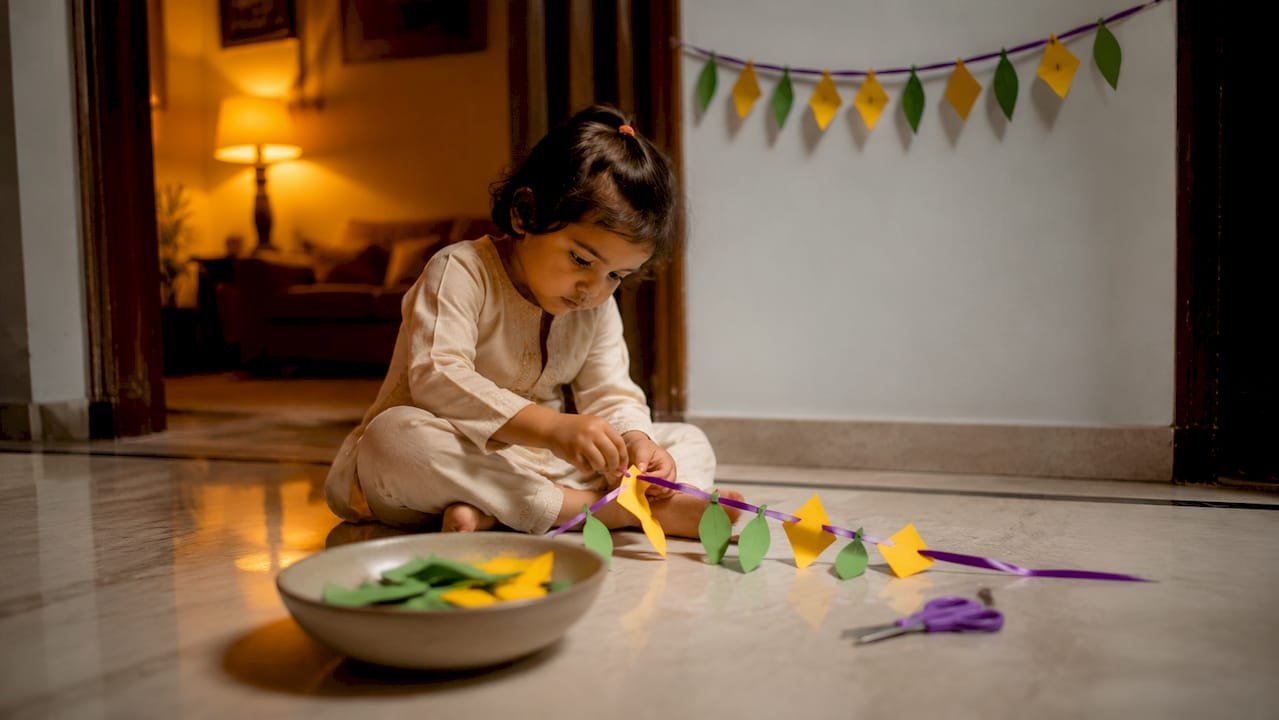
Pom-pom garland toran. String pom-poms or fabric scraps onto ribbon to hang across a doorway, echoing a traditional toran. Pre-thread half the garland so the activity stays short. Watch string length around toddlers under two. This works on bilateral coordination as one hand holds and the other threads.
-
DIY LED diya from a toilet roll. Cut and fold a toilet paper tube into a diya shape, paint it, and pop in a battery LED tealight instead of a flame. No open flame ever. This is a safe favorite for junk modelling with toddlers and builds early cutting and shaping skills under supervision.
-
Salt dough diya (no flame). Mix flour, salt, and water into a simple dough, shape into a small bowl, and let it air dry for a day or two before painting. Keep dough supervised since flour dough isn’t meant to be eaten. This activity is strong for pressing, squeezing, and pinching, all key building blocks for a future pencil grip.
-
No-cook sweet tasting. Offer a simple platter of dried fruit, coconut flakes, and mild spiced yogurt to introduce Diwali flavors without any cooking or sugar work involved. Cut all pieces smaller than a grape to avoid choking. This builds vocabulary as you name each taste and texture together.
-
Diwali memory match cards. Print a simple Diwali memory match game with diya, rangoli, and firework images, then play a scaled-down version with just four or six pairs. Laminate the cards if you want them to survive sticky fingers. This is one of the better early memory and matching exercises you can run in under ten minutes.
-
Firework painting with forks. Dip a plastic fork in paint and press it onto black paper to create a firework burst pattern. Do this outdoors or over a tray. Short, contained sessions of five to ten minutes work best, and a fork with rounded prongs avoids any poke risk. It’s a fun twist on mark-making that builds wrist control.
-
Puja thali role-play. Set up a small tray with a toy bowl, fabric scraps, plastic flowers, and an LED tealight so toddlers can copy the motions of a puja without any real fire or breakable items. This supports imaginative play and early cultural understanding through hands-on repetition rather than explanation.
How to adapt these activities by age and EYFS goal
A 9 to 12-month-old will explore mostly through mouth and grasp, so lean on the sensory tray and footprint rangoli with close supervision and nothing smaller than a golf ball nearby. A 12 to 24-month-old can manage simple scooping and pressing, which makes colored rice rangoli and the toilet-roll diya realistic goals, even if the end result looks more abstract than decorative. By 2 to 3 years, most toddlers can follow a two-step instruction, so lentil rangoli, fork painting, and memory match cards fit well.
- Rangoli: swap rice for large buttons or foam shapes with younger toddlers; add pattern copying for older ones.
- Sensory tray: keep pieces large and few for babies; add sorting by color or size for 2 to 3-year-olds.
- EYFS mapping: rangoli and threading support physical development, role-play and naming foods support communication and language, and any painting or craft supports expressive arts and design.
Setup, safety, and keeping mess to a minimum
A large activity tray is the single best investment for Diwali play. It contains rice, lentils, or paint in one spot, and you can carry the whole setup to wherever your toddler wants to play, which matters when energy runs low toward the end of the day. Messy play works best when toddlers are active participants, not passive watchers, so resist the urge to do the pouring or gluing for them even when it’s slower.
- Stick to taste-safe fillers (uncooked colored rice, cooked pasta) for toddlers under two who still mouth objects.
- Skip lentils, small pom-poms, and beads for that same age group.
- Use LED tealights exclusively. Battery versions look convincing and remove any burn risk entirely.
- Check every material for choking hazards before it goes on the tray, not after.
Pro Tip: Pre-portion your rice, lentils, and pom-poms into small yogurt pots the night before. Swapping a used pot for a fresh one takes ten seconds and resets the whole activity without a mid-play cleanup.
A simple Diwali activity timetable for busy weeks
Diwali typically runs across five or six days, which gives you room to spread activities out instead of cramming everything into one afternoon.
- Day one, decorating: paper lanterns and the pom-pom toran, hung up together as decorations for the rest of the week.
- Day two, sensory and creative: rangoli (rice or lentil version) plus firework painting.
- Day three, family sharing: no-cook sweet tasting and puja thali role-play with grandparents or siblings joining in.
If you only have one day, run three short windows instead: a quiet 5-minute sensory tray in the morning, a 10 to 15 minute messy craft like rangoli after lunch, and a social wind-down with sweets or role-play in the evening. Reuse the same tray and leftover pom-poms across all three slots to cut prep to almost nothing.
How Mooshiemoments turns these ideas into ready-made plans
Running twelve activities from scratch takes real planning, and Diwali week is rarely the calmest week on the calendar. The app builds activity suggestions around your toddler’s age and however many minutes you have free, so you’re not scrolling for ideas at 4pm with a tired toddler pulling at your sleeve.
- Personalized prompts by age band and available time, from a spare five minutes to a full session.
- Research-backed nursery activity plans that map cleanly onto EYFS outcomes for early years settings.
- Junk modelling guides for diya and lantern crafts using recycled household bits.
- Taste-safe sensory play resources for households with toddlers who still mouth everything.
The point isn’t to replace the activities above. It’s to remove the decision fatigue of picking, prepping, and adapting them on a week when you already have enough going on.
Torans and simple hanging decorations
A toran is traditionally a string of leaves or flowers hung across a doorway to welcome guests, and it’s one of the easiest Diwali decorations to turn into a toddler craft because the finished product doesn’t need to be neat to look festive. Cut felt or paper into simple leaf or diamond shapes ahead of time, punch a hole in each, and let your toddler thread them onto ribbon or wool in whatever order they choose.
For toddlers who aren’t ready for threading, pom-poms glued onto a pre-cut ribbon strip give the same visual effect with less fiddly hand control required. A paper plate with fringed edges and a hole cut in the middle, hung with string, also works as a quick alternative and takes under five minutes to prepare.
Hang the finished toran somewhere your toddler can see it every day rather than tucking it away. Pointing at it and naming the colors or shapes turns a one-off craft into a small daily language activity for the rest of the festival. Baker Ross has printable toran and garland templates if you want a ready-cut shape instead of free handing your own, which saves a good ten minutes of prep time.
Where to find printable activity sheets and craft templates
You don’t need to design your own rangoli outlines or diya templates from scratch. Twinkl publishes EYFS-aligned Diwali packs with large-activity-tray ideas, simple outline sheets for rangoli patterns, and matching games sized for early years settings rather than older primary classes.
Baker Ross runs a library of craft guides built around actual product templates, including tealight holder cutouts and salt-painting rangoli boards, which is useful if you’d rather buy a kit than gather loose materials yourself. TeachToddler focuses specifically on baby and toddler adaptations, recommending LED diya swaps and rangoli alternatives like colored rice, stickers, and chalk rather than traditional powders that aren’t practical around a two-year-old.
Print in batches before the festival starts. Laminating a handful of the reusable ones, like memory match cards or rangoli outlines, means you can wipe them clean and use them again next year instead of reprinting from scratch.
Diwali storytime picks that actually hold a toddler’s attention
Storytelling works best for toddlers when it’s short, visual, and paired with something to touch or point at, not read cover to cover in one sitting. Look for picture books with bright illustrations of diyas, rangoli patterns, and fireworks. Board books with simple repeated phrases about lights, family, and sweets tend to land better than text-heavy retellings of the Ramayana, which suit older children more than toddlers.
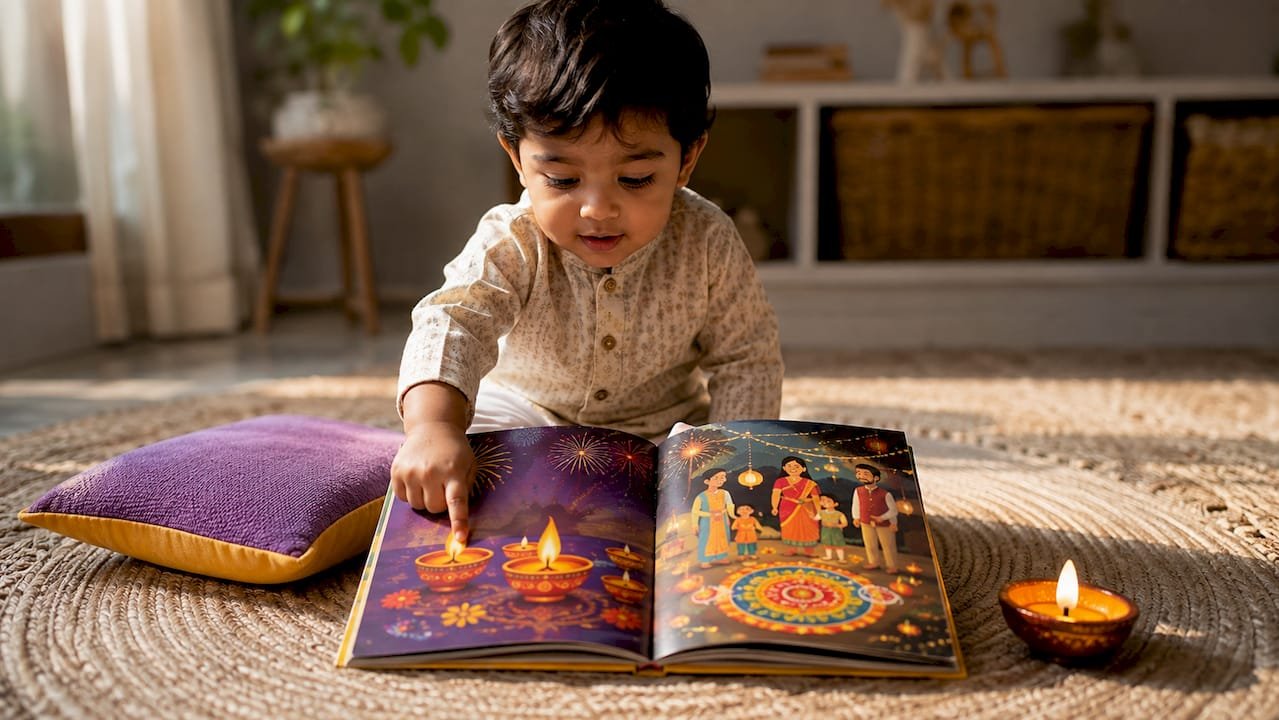
Keep a session to five minutes or less. Point at the pictures and name what you see rather than reading every line, and let your toddler flip back to a favorite page as many times as they want. Pairing a book with a matching activity, like reading about diyas right before making the toilet-roll LED version, reinforces the vocabulary far better than the story alone.
Songs and rhymes that make Diwali stick
Toddlers absorb rhythm and repetition long before they absorb explanations, so a simple made-up song about lighting diyas or spinning in new clothes does more for engagement than any factual description of the festival. Adapt a familiar tune, like “Twinkle Twinkle,” and swap in Diwali words: lights, sweets, family, stars. The melody is already familiar, so your toddler joins in almost immediately.
Clapping games work well too. A simple call-and-response where you say “light the diya” and your toddler claps or mimes lighting a candle turns an abstract idea into a physical action they can repeat on their own. Keep any song under a minute and be ready to repeat it five or six times in a row. Repetition is what makes it memorable, not novelty.
What Diwali means, explained simply for toddlers
Diwali is often called the festival of lights, and that’s genuinely the easiest way to introduce it to a toddler. Explain it as a time when families light diyas, decorate their homes, wear new or bright clothes, and share sweets with people they love. Skip the deeper religious and historical context entirely at this age. It’s not that it doesn’t matter, it’s that a two-year-old absorbs almost none of it through explanation and nearly all of it through doing.
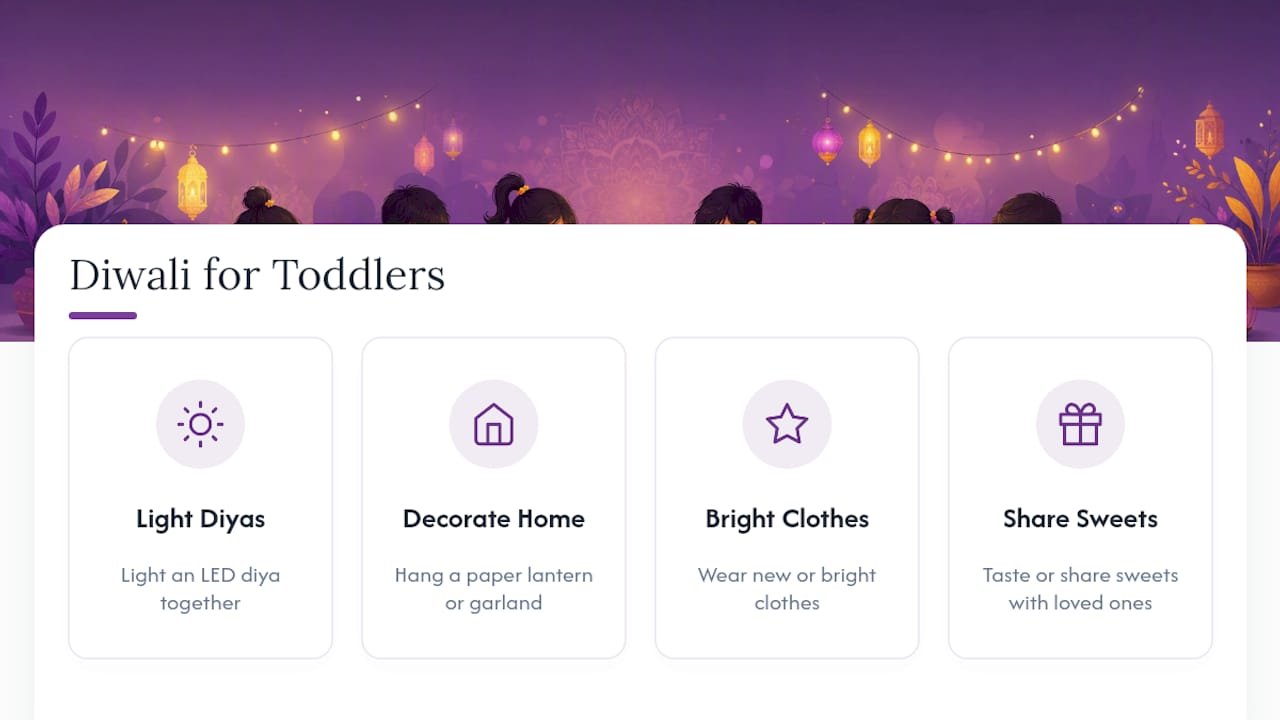
Toddlers build their understanding of a festival through repeated, hands-on experience rather than a single conversation. Lighting an LED diya together, tasting a new sweet, or hanging a paper lantern all teach more about what Diwali feels like than any verbal summary ever could. If you’re asked why we light diyas, a simple answer like “to make things bright and happy” is honest and age-appropriate without overcomplicating it.
Over a few years of repeating these same activities, the meaning deepens on its own. A three-year-old who has helped light diyas twice before will start connecting the light with warmth, family, and celebration without needing it spelled out.
What actually matters when you’re planning Diwali with a toddler
Most Diwali activity lists for toddlers read like a Pinterest board: pretty, occasionally impractical, and light on why any of it matters developmentally. The gap I keep noticing is between what looks good in a photo and what a toddler can actually do without frustration or a safety risk. Lentil rangoli looks charming online, but it’s the wrong call for a fifteen-month-old who still explores with their mouth. That distinction rarely makes it into the glossy activity round-ups.
The activities that hold up under real scrutiny share three traits: they’re taste-safe or supervised closely, they take under fifteen minutes, and they double as a developmental exercise rather than a purely decorative one. Skip anything that requires a naked flame or unsupervised small parts, no exceptions worth taking. If you only prioritize one thing this Diwali, make it the large activity tray. It’s the unglamorous piece of kit that makes every single craft on this list faster to run and easier to clean up, which is usually the difference between doing an activity once and doing it every day of the festival.
— samit
Get ready-made Diwali activity packs without the planning
Mooshiemoments gives you the same kind of low-prep, EYFS-aligned activities covered here, already sorted by your toddler’s age and however many minutes you have to spare. Instead of piecing together a rangoli template, a safety check, and a developmental note yourself, the app hands you all three in one prompt.
Everything in this article is free to try at home right now. If you want a wider library of ready-made packs for the rest of Diwali week and beyond, browse activities built for toddlers around age two and see what fits your afternoon. It takes less time than scrolling for ideas, and it’s built specifically for the age and energy level you’re working with today.
Sources
- Messy play (Cambridgeshire & Peterborough Children’s Health)
- When is Diwali? (Royal Museums Greenwich)
- Diwali craft ideas | Baker Ross
Recommended
More like this

Five Minute Routine Activities to Help Speech Delay in UK Toddlers
Quick, routine based activities UK parents can use in 5–15 minutes to support a toddler with speech delay. Evidence backed techniques and…
Three Minute Mess Free Sensory Play For UK Parents
Quick, reusable sensory activities UK parents can set up in minutes. Sealed bags, sticky wall art, safety checks, storage tips, and Mooshie…
10 Quiet Bin Ideas UK Parents Can Build in 5 Minutes
Practical, EYFS-aligned quiet-bin ideas UK parents can assemble in five minutes. Includes 10 ready bins, a five-bin rotation, safety checks, and quick...