Best Camping Activities for Toddlers: Easy Ideas That Work
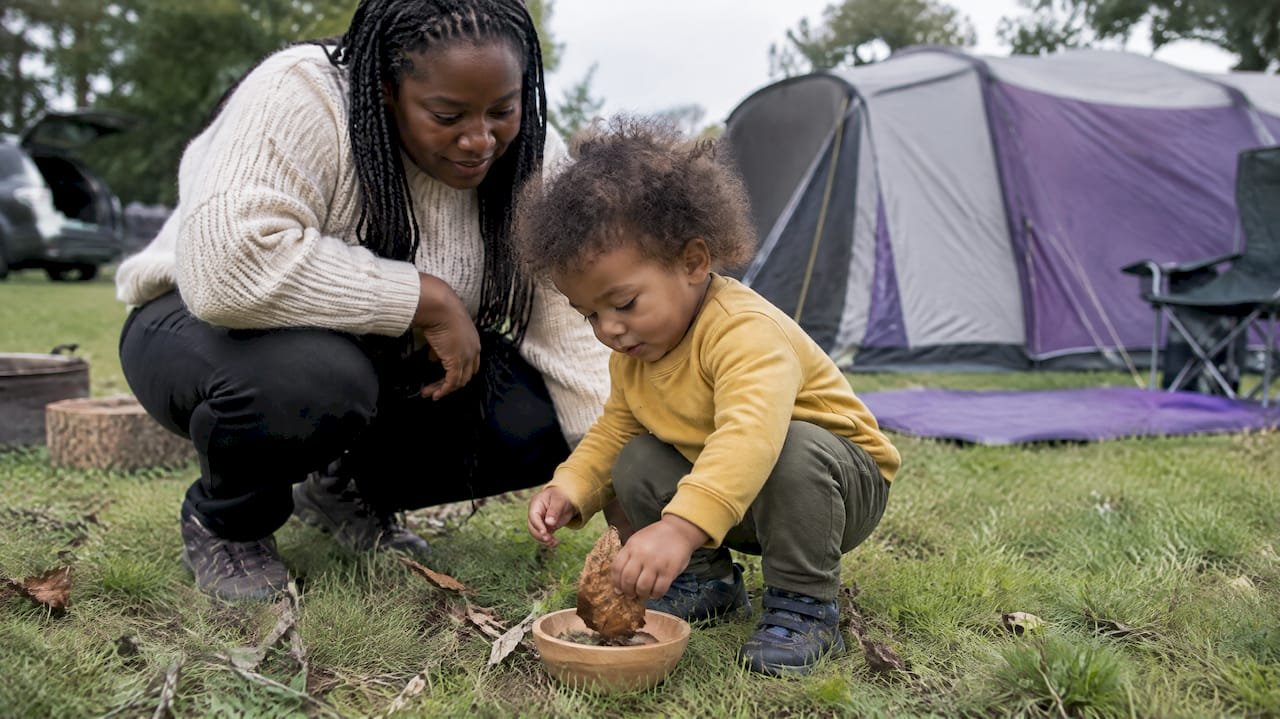
The best camping activities for toddlers are the simplest ones: collecting things, pouring, hiding and finding, knocking down and building up, all done with what you packed for dinner or found on the grass. A toddler does not need a camping toy set or a planned programme. They need you close, a few safe objects and time to repeat the same game ten times. Below you will find ideas for every part of the day, how to adjust them for a 1-year-old or a 3-year-old, and the safety points worth knowing before you pitch the tent.
We built Mooshie Moments for exactly this moment: you are tired, the tent is half up, and someone small is asking for something to do. Our app gives you quick, screen-free ideas using household items, matched to your child’s age and the time you have.
TL;DR
- Toddlers do best with open-ended, repeatable play: filling and emptying, nature collecting, hiding and finding, and simple skittles.
- Pack ordinary kitchen items (bowls, spoons, sieves, a plastic jug, socks) rather than buying camping toys. The NHS says play does not need to be difficult or expensive.
- Keep tents, stoves and water in mind first: stoves outside and away from tent walls, and an adult within arm’s reach of any water.
- Talking through what you see, hear and touch is the best learning tool at a campsite, and it costs nothing.
- Plan three or four short activities per day, not a schedule. Short, fun and flexible beats ambitious.
Table of Contents
- What makes a camping activity work for a toddler
- Nature play: the easiest activities at any campsite
- Kitchen-bag games: what to pack instead of camping toys
- Activities by moment of the day
- Rainy-day and low-energy options
- Adapting for age and attention span
- Keeping camping play safe
- Screen-free camping, and why it helps
- Our view: fewer props, more of you
- Try Mooshie on your next trip
- FAQ
- Sources
What makes a camping activity work for a toddler
A good campsite activity for a child aged 1 to 3 has four features. It uses things you already have. It takes under two minutes to set up. It can be done sitting, crawling or toddling. And it still works on the third repeat.

That last point matters more than most parents expect. The Muddy Puddle Teacher notes that toddlers often love repetitive, practical experiences such as filling and emptying containers, and that the repetition is valuable. So when your child tips the same cup of water out for the fortieth time, you are not failing to entertain them. You are watching them practice.
It also helps to know that toddlers do not need organized entertainment. TeachToddler describes the goal as letting them explore at their own pace with loose supervision. At a campsite that is easy to do: the grass, the stones, the sticks and the sky are already the activity. Your job is to stay close, name things and keep them safe.
If you have a baby as well as a toddler, the same ideas stretch down. Inspiring Scotland’s outdoor play guide suggests laying a baby on a blanket, describing sights, sounds, smells and textures out loud, and singing nature-themed rhymes. For toddlers it suggests letting them crawl or toddle on grass, leaves, moss, soil or sand and touch natural objects, asking “Where is the…?” as you go.
Nature play: the easiest activities at any campsite
Nature play is the first thing to reach for because the equipment is already around you. Our nature play ideas for toddlers go into more detail, but these are the ones that suit a campsite best.
A nature collection in a bowl or bucket
BBC Tiny Happy People suggests building a nature collection from safe natural items such as twigs and leaves that your child can touch and describe. Give your toddler a bowl, walk the edge of the pitch and let them choose. Say what each thing is: “rough bark”, “soft leaf”, “heavy stone”.
The same BBC page points to RHS guidance on potentially harmful plants in gardens and green spaces. At a campsite, that means you check what is picked before it goes near a mouth. Skip berries, mushrooms and anything you cannot name, and keep stones bigger than a toddler’s fist so nothing small gets swallowed.
Treasure under the leaves
In autumn, BBC Tiny Happy People suggests hiding something simple, like a conker or a toy, under a pile of leaves for your child to find. They get hands-on with the leaves, and you get to ask what the treasure looks and feels like. A conker, the BBC notes, is smooth and shiny. Hide a wooden spoon or a favorite cuddly toy for younger toddlers, since conkers are a choking and swallowing risk for the very smallest.
Walk, stop, listen
One small habit changes a walk around the site. A speech and language expert quoted by the BBC recommends pausing to look, listen and chat, using descriptive words like the snap of twigs, the crunch of leaves and the splash of puddles. Little children, she says, can find copying noises like “woof” a stepping stone to words like “dog”. So when a dog barks two pitches away, you have a language lesson.
A picture scavenger hunt
Wonderyears suggests using pictures rather than words for a toddler’s nature scavenger hunt. Draw or print a leaf, a stick, a stone and a feather on a piece of paper (or on the back of the pasta packet). Your toddler does not need to find everything. Finding one thing is a win.
If you want more of this kind of thing at home as well as away, our sensory play ideas use the same everyday-objects approach, and a parent’s guide to sensory play and child development explains why touching and feeling different textures matters for young children.
Kitchen-bag games: what to pack instead of camping toys
You do not need a branded camping toy set. Most of the best equipment is already in your kitchen cupboard.
Water and pouring play
Inspiring Scotland’s guide suggests water play using items from around the house, such as plastic jugs, spoons, sieves, pots and pans, in a tub or bowl of water outside. The NHS adds plastic bottles for pouring and squirting, a sponge, a colander, straws, a funnel and spoons, and says anything unbreakable will do.
A washing-up bowl on a groundsheet is enough. Our water play ideas for babies and toddlers have more variations if your toddler takes to it.
One safety rule sits above all the fun. The NHS warns that a baby or young child can drown in less than 5 centimeters (2 inches) of water, and says never to leave a young child alone with water. A bowl counts. Stay within arm’s reach, and empty it when you finish.
Skittles from rubbish
BBC Tiny Happy People suggests a game of skittles using rolled-up socks as the ball and empty bottles or toilet roll tubes as the skittles. It describes the game as brilliant for a toddler’s coordination and communication skills. In a separate piece on homemade bowling pins, the BBC adds that counting how many skittles are still standing builds number vocabulary.
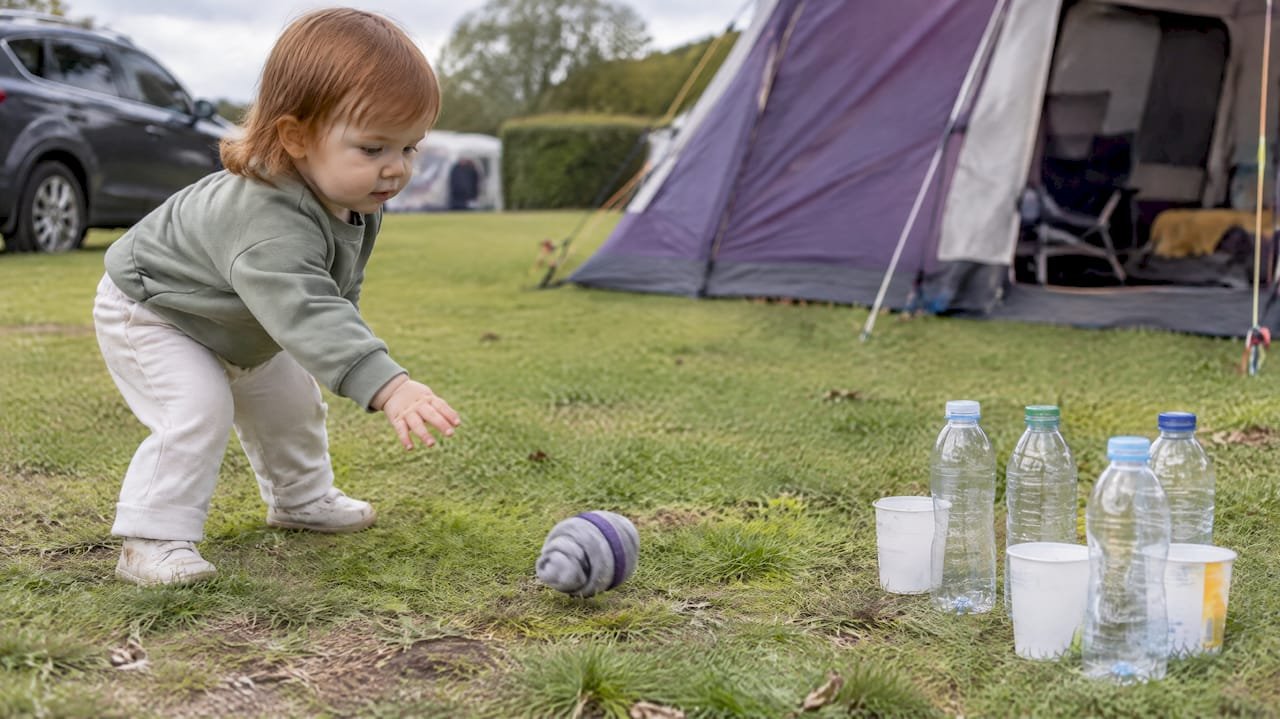
At a campsite this is a dinner-time lifesaver. Line up the empty drinks bottles and yogurt pots, then let your toddler knock them down. You set them up again. Repeat.
A nature kitchen
BabyBreaks recommends a nature kitchen: an old bowl, a pan, a wooden spoon, a cup of water and natural ingredients collected nearby. It is mud pie cooking, which most toddlers adore. Keep it to leaves, grass and sand rather than anything edible-looking, so the line between play food and real food stays clear.
Loose parts
The Muddy Puddle Teacher recommends loose parts for screen-free play: sticks, stones, pinecones, cardboard, fabric, crates, tubes, containers, baskets and natural materials, letting children decide what they become. A cardboard box from the food shop becomes a car, a house or a drum. Pack one.
Dig site
The Crazy Outdoor Mama suggests a dig site with a shovel, a dump truck and open-ended toys like cups and buckets. If your pitch has a patch of soft ground or sand, give your toddler a spoon and a bucket and let the digging begin.
Activities by moment of the day
Camping days are long. Breaking them into moments makes it easier to have something ready when you need it.
| Moment | Activity | What you need |
|---|---|---|
| Arriving, while you pitch | Nature collection | A bowl or bucket |
| Morning | Picture scavenger hunt | Paper and a pen |
| After lunch | Pouring and water play | Washing-up bowl, jug, sieve, spoons |
| Late afternoon | Skittles | Empty bottles or tubes, rolled-up socks |
| Cooking time | Nature kitchen or dig site | Old bowl, spoon, soil or sand |
| Evening | Stories and songs | Just you |
Cooking time is the hardest hour
Dinner is usually the moment parents most need something to keep a toddler busy, and it is also when the stove is on. Give your toddler the nature kitchen or the skittles in an area clearly separate from the cooking. Always cook outside, well away from the tent, with the stove on stable ground, as nidirect’s camping safety advice puts it. That advice also says to keep lighters and matches out of children’s reach.
Bedtime wind-down
Evening play can be quiet. The Department for Education notes that a story, rhyme or song on a screen cannot match one told and performed by an engaged adult who makes eye contact, uses different voices and changes pace and volume. That is your torch-lit bedtime story, delivered with funny voices, in a sleeping bag. It needs no battery and no wifi.
Rainy-day and low-energy options
Rain at a campsite is a given in the UK. The Muddy Puddle Teacher lists screen-free outdoor activities including puddle jumping, measuring sticks, collecting leaves, building dens, making nature pictures, creating obstacle courses, exploring shadows, washing toys outside, moving water through guttering and giant chalk drawings.
For a toddler on a wet camping day, the easiest of those are:
- Puddle jumping. Waterproofs on, and go. Pack a spare set of clothes.
- Washing toys outside. A bowl, a sponge and the muddy toy car. It doubles as a clean-up.
- A den. Drape a spare blanket over two chairs, or use the awning if you have one.
- An obstacle course. Crawl under the guy rope (the cord holding the tent down, with someone watching), step over a log, walk round the cool box.
If the whole family is stuck in the tent, stay with the sensory basics. Derbyshire Family Health Service suggests a treasure basket of natural household items like spoons, short pieces of material and a sponge for babies, and the same idea works for early toddlers. Check there are no small parts, and choose toys that suit the child’s age.
On a low-energy day, ours too, this is the whole plan: sit down on a blanket, put a basket of safe objects in front of your toddler and name each thing they pick up. That is real play, and it counts.
Adapting for age and attention span
Babies, 6 to 12 months. Put a blanket on the ground and lie them on it. Derbyshire Family Health Service advises taking your baby outside to touch grass, leaves, sand and water to build sensory skills. Offer everyday objects like wooden spoons, pans and plastic bottles with rice or pasta in, but only if the bottles are sealed so nothing can come out.
Young toddlers, 12 to 24 months. They want to move and to put things in and out of containers. Pouring, dumping, collecting and pushing a ride-on toy across the grass all work. Inspiring Scotland’s guide mentions taking ride-on toys or push-and-pull toys outdoors.
Older toddlers, 2 to 3 and a bit. They want to do what you are doing. Let them carry the bowl, “cook” in the nature kitchen, help knock in a peg (with you holding the mallet) and find the picture on the hunt. Pretend play starts to appear, so a stick becomes a spoon or a wand.
Short attention spans. Two minutes is a fair time for one activity. When your toddler walks off, they have finished. Do not push for a second round of something that has run its course. Move to the next thing, or just let them wander for a while.
Keeping camping play safe
Camping adds hazards that your garden does not have. Here are the points that matter most for under-5s, all from official sources.
Fire and cooking
GOV.UK fire safety outdoors guidance says tents and caravans should be at least six metres apart and away from parked cars, never to use candles in or near a tent and never to cook inside a tent. It also says to keep cooking appliances away from tent walls, not to cook near flammable materials or long grass and to consider a carbon monoxide alarm when staying in a tent. The same guidance says everyone should know how to put out burning clothing: stop, drop and roll.
For toddlers, this comes down to one practical rule: draw a line. The stove, the fire and the lighters are on one side, and the play area is on the other. Some sites ban open fires or barbecues entirely. The DofE Dartmoor information pack, for example, states that no open fires or BBQs are permitted for backpack camping on Dartmoor.
Water
Beyond the bowl rule above, natural water needs more care. nidirect warns that swimming in a river, lake or the sea is different from swimming in a pool, with currents, changing conditions and hidden dangers, and advises never swimming in a disused quarry. With a toddler, keep them well back from the edge and hold their hand.
Drinking water matters too. The DofE Dartmoor pack warns that contaminated water in streams and rivers, caused by run-off from farming and human activity, may cause stomach upsets and a potentially serious condition. It advises using tap or bottled water where possible, or boiling water in rural areas. So play with stream water if you like, but keep the drinking water separate.
Wildlife, land and leave-no-trace
The Scottish Outdoor Access Code asks campers to use small tents, camp well away from buildings and roads, avoid enclosed fields with crops or farm animals and take away all belongings and litter. It also says to go to the toilet at least 30 metres from lochs, rivers and burns, then wash your hands with water or sanitizer. That last point is useful with toddlers who are potty training: bring a small potty and plan where to empty it.
The DofE pack also asks campers not to disturb wildlife, particularly during lambing and bird breeding season, from 1 March to 31 July. If your toddler wants to follow the sheep, explain that we watch from a distance.
One more point from the BBC: when you spot rocks together, do not take your discoveries home from public spaces like beaches, since laws protect the natural environment and UK wildlife. A “look and put back” game solves that and is a good routine for toddlers anyway.
A pre-play safety scan
Before a new activity, take ten seconds to check four things: anything small enough to swallow, anything sharp, anything hot and any water. Then sit down and play.
Screen-free camping, and why it helps
Many parents take a tablet “just in case” and then barely need it. The official guidance gives you a good reason to leave it in the car. Best Start in Life advises that for under 2s screen time should be avoided other than for shared activities that encourage bonding, interaction and conversation, and for ages 2 to 5 it should be kept to one hour a day, and less if possible. The Department for Education’s early years guidance gives the same limits for early years settings.
A campsite is an easy place to follow this. There is nothing to prepare, and the whole day is time to be together. The NHS tells parents that your child will learn more from you than from any toy. Camping puts that into practice: nobody is on a laptop, and everybody is outside.
For more ways to connect in short bursts, see our toddler bonding activities. And if your camping habit is mostly a long weekend at the nearest site, our camping with toddlers guide and our screen-free outdoor activities for UK toddlers are a good next read.
Our view: fewer props, more of you
We hear the same thing from parents, grandparents and carers: the idea is rarely the problem. The problem is being tired, with ten minutes to fill and nothing to hand.
That is why we think the best camping activity is the one that uses what is already in front of you. A spoon, a bowl, a sock, a leaf. When an activity needs a shopping trip, it often does not happen. When it needs only what is in the car, it does.
We also believe in explaining the “why”. When you know that pouring builds coordination, or that naming a leaf builds vocabulary, a simple game stops feeling like filler. In Mooshie, every activity comes with a plain-language developmental explanation, reviewed by experts, and coaching tips to help you play along.
And we think play should get you off your phone, not onto it. Mooshie is designed so that you find an idea quickly, then put the phone down and give your child your attention.
samit
Try Mooshie on your next trip
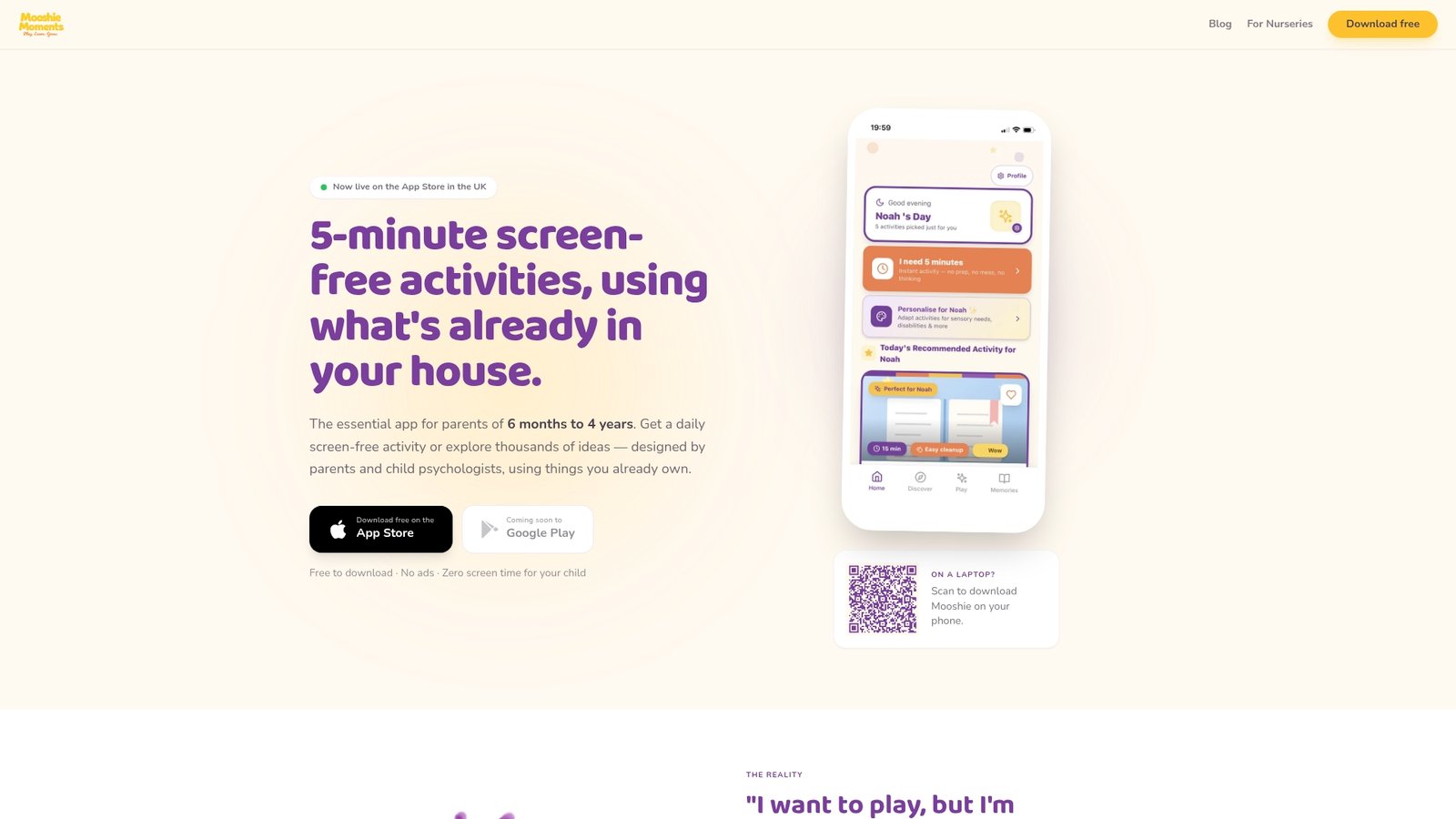
If you would like ideas ready before you leave, Mooshie is a free-to-download app for parents and carers of children aged 6 months to 4 years. It gives you quick, screen-free activities that use common household items, personalized by your child’s age, the time you have and your energy level. Each one comes with an expert-reviewed explanation of what your child is learning and coaching tips for how to play. You can download Mooshie here and have a few ideas saved for the tent.
Grandparents, aunts and uncles who take a toddler on a weekend away can use it too: no toys needed, just what is in the bag.
FAQ
What should I bring camping with a 2-year-old?
Bring a washing-up bowl, a jug, a sieve and some spoons, a few empty bottles, spare socks, a cardboard box, a blanket and a picture scavenger hunt sheet. Add a spare set of clothes and waterproofs. You can leave the camping toy set at home, because the NHS says play does not need to be difficult or expensive.
Can I go camping with a 2-year-old?
Yes, many families do. Choose a site with easy access to toilets, keep the stove and fire well away from the play area, and stay within arm’s reach of any water. Start with one night close to home, so you can see how your toddler copes before you go further.
How do you keep a toddler busy while camping?
Plan short, simple activities and expect your toddler to repeat them: a nature collection, pouring water, skittles with empty bottles and hiding things under leaves. Two minutes on each is plenty. Describing what you see, hear and touch as you go turns ordinary moments into language practice.
Is screen time okay on a camping trip?
Official UK guidance says to avoid screens for under 2s, except for shared activities like video calls that encourage bonding, and to keep it to an hour a day or less for ages 2 to 5. A campsite gives you plenty to do instead, such as stories, songs and nature play.
Sources
- Baby and toddler play ideas, NHS
- Connecting babies and young children to nature, Inspiring Scotland
- What can I do outside today with kids? BBC Tiny Happy People
- How to make your own homemade bowling pins, BBC Tiny Happy People
- 7 family-friendly autumn activities, BBC Tiny Happy People
- 25 fun and free family activities for summer, BBC Tiny Happy People
- Screen-free ideas EYFS, The Muddy Puddle Teacher
- Your baby’s development 6 to 12 months, Derbyshire Family Health Service
- Fire safety outdoors, GOV.UK
- Fire and summer safety advice, nidirect
- Camping, Scottish Outdoor Access Code
- Dartmoor information pack, DofE
- Screen use, Department for Education early years help
- Baby and toddler screen time guidance, Best Start in Life
- Sensory play and child development: a parent’s guide
Recommended
- Camping With Toddlers: Activities That Work at the Campsite
- Best Park Games for Toddlers: 12 Easy Ideas, No Gear Needed
- Nature Play Ideas for Toddlers: 12 Simple Activities to Try
- Ten Minutes: Screen Free Outdoor Activities for UK Toddlers
Want play ideas matched to your child's age?
Mooshie Moments gives you simple, guided play ideas for ages 6 months to 4 years. Try 3 free activities a week.
Download free on the App StorePart of our guide: Toddler activities by age · Compare toddler activity apps
More like this
Winter Activities for Toddlers: Indoor and Outdoor Ideas for Cold, Dark Days
Short outdoor games, cosy play for dark afternoons and ice experiments for toddlers, with ideas by age and tips on staying warm…
Camping With Toddlers: Activities That Work at the Campsite
Easy camping activities for toddlers using what you already have: nature play, campfire-free games, rainy-day ideas and safe-play tips for UK campsites.
Christmas Activities for Toddlers: Easy Ideas at Home
Easy Christmas activities for toddlers using things you already have at home: sensory trays, simple crafts, games and traditions, plus safety tips…