
12 Budget Friendly Busy Bag Ideas for Toddlers: Pack in 15 Minutes
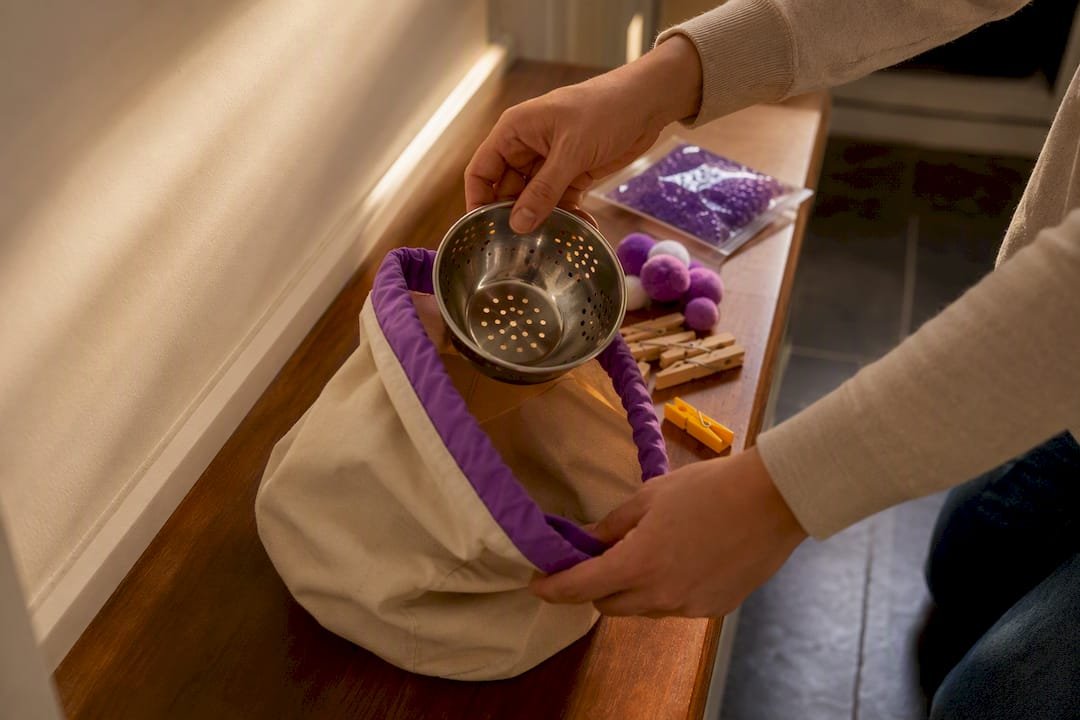
A busy bag is a small, self-contained activity, usually kept in a zip pouch or tub, that gives your toddler 10 to 15 minutes of focused, independent play. The four types that work best are sensory bags, fine-motor sorting activities, sticker or felt storytelling sets, and mini play-dough kits. Each one targets a real skill, keeps mess low, and costs almost nothing to put together.
TL;DR:
- Busy bags targeting sorting, threading, or storytelling are most effective for toddlers 12 to 24 months as they focus on core motor and cognitive skills.
- For each situational use, select low-mess, self-contained activities like sensory bags or clip-on matching sets to prevent loose pieces and mess.
- Keep busy bags simple with three to six items, labeled by age and situation, and rotate them regularly to maintain novelty and engagement.
- Avoid small, loose parts for toddlers under 3 unless supervised closely, and replace brittle or cracked pieces to ensure safety during play.
- Ready-made activity packs tailored to specific age groups and developmental goals simplify assembly and support age-appropriate skill development.
Table of Contents
- Top Busy Bag Ideas Toddlers Actually Enjoy
- Which Busy Bag Works Best for Each Situation
- How to Assemble and Pack a Busy Bag in 15 Minutes
- Safety Rules Every Busy Bag Should Follow
- Keep a Rotation System So Bags Stay Fresh
- Why Developmentally Focused Play Matters (and How Mooshie Moments Helps)
- Matching Busy Bags to Your Toddler’s Age and Stage
- Using Busy Bags to Build Independent Play
- Sneaking Colors, Shapes, Numbers, and Letters Into Play
- Adapting Busy Bags for Sensory Sensitivities and Special Needs
- One Habit That Made Busy Bags Actually Work
- Ready-Made Busy Bag Packs From Mooshie Moments
- Sources
Top Busy Bag Ideas Toddlers Actually Enjoy
You don’t need a Pinterest board full of matching containers to make a good busy bag. You need one skill, a few items, and a pouch. Here are the ideas that consistently earn their keep, whether you’re stuck in a waiting room or just need fifteen quiet minutes at home.
- Pipe-cleaner colander threading. Poke pipe cleaners through the holes of a kitchen colander. This builds fine motor control and bilateral coordination for toddlers 18 months and up. Keep the pipe cleaners tethered or supervise closely so nothing ends up in a mouth.
- Sticker scene sheets. A blank page and a sheet of reusable stickers gives a toddler real peeling practice and a creative outlet. Store the stickers in a sealed pouch so they don’t dry out or scatter.
- Muffin-tin sorting. Pom-poms, dry cereal, or big buttons dropped into muffin cups build sorting skills and pincer grip. This one needs supervision since small pieces invite mouthing.
- Felt board storytelling. A felt board with cut-out shapes supports narrative play and imagination, and because the pieces stick to the board, almost nothing goes missing.
- Taped sensory bag. Hair gel and small flat toys sealed inside a zip-lock bag, then taped shut, deliver sensory input without any mess. Tape the seal twice for good measure, and check out taste-safe sensory options if your toddler still mouths everything.
- Mini play-dough kit. A small tub of dough works hand muscles and has a calming effect during meltdowns. Seal it tightly between uses and pick a taste-safe recipe for younger toddlers.
- Magnetic fishing. Paper fish with a paperclip, plus a magnet tied to a stick, build hand-eye coordination fast. Make sure the magnet is glued or taped securely so it can’t come loose.
- Clothespin color match. Clip painted clothespins onto matching colored cards to build grip strength and color recognition. Skip small painted pegs for toddlers who still mouth toys.
- Lacing cards. Threading large beads or laces through holes strengthens the same bilateral coordination as the colander activity, just in a flatter, more portable format.
- Pom-pom tong transfer. Kitchen tongs and a bowl of pom-poms teach tool use and fine motor control at the same time. It’s one of the simplest setups on this list and one of the most repeatable.
- Mini treasure dump. A small pouch of novel household objects (a whisk, a spool, a smooth stone) taps into pure curiosity. Screen each item for sharp edges or swallow risk first.
- Button or peg pattern cards. Older toddlers who’ve outgrown basic sorting can replicate simple patterns with buttons or pegs, which introduces early math concepts like sequencing.
Simple, low-prep activities like these tend to hold attention longer than elaborate sensory bins, mostly because there’s less setup standing between your toddler and actually playing.
Which Busy Bag Works Best for Each Situation
The right busy bag changes depending on where you’re using it. A restaurant table and an airplane tray have very different rules.
- Restaurants: Stick to low-mess, low-loss options like sticker scenes, Velcro cards, or felt strips. Skip anything with more than a few loose pieces, since they end up on the floor within minutes.
- Car rides: Self-contained activities win here. A taped sensory bag stuck to a tray, lacing cards, or a felt board all survive bumps in the road without scattering across the back seat.
- Flights: Go TSA-friendly. Sticker activities, play-dough in a small clear tub, and laminated lacing cards all clear security easily. Leave magnets and loose liquids at home.
- Shopping trips: Attachable activities make cart time bearable. Clip a clothespin match set to the cart bar, or loop a pipe cleaner around the handle for threading.
- Waiting rooms: Calming, quiet activities work best. Play-dough, a sealed sensory mat, or a soft board book keep the volume down in a room full of strangers.
Pro Tip: Keep one “flight only” busy bag pre-packed year round. You’ll never scramble at the airport, and the novelty of a bag your toddler hasn’t seen in months does half the work for you.
How to Assemble and Pack a Busy Bag in 15 Minutes
You don’t need special supplies to build a working busy bag stash. A few basics go a long way.
Gather these first:
- Clear zip pouches or small tubs
- Velcro dots for attaching activities to trays or car seats
- Contact paper or a laminator for durable cards
- A muffin tin and small containers for play-dough
- Tape or elastic bands to seal sensory bags shut
Then follow this quick process:
- Pick one activity and one target skill (sorting, threading, storytelling).
- Collect three to six items for it, no more.
- Load everything into a labeled pouch, marking the age range or best-use situation on the front.
- Tuck the finished pouch into your grab-bag or diaper bag.
Budget-wise, dollar stores and charity shops cover most of what you need, and several Dollar Tree busy bag builds cost less than $5 total and still buy 20 minutes of peace. Reuse what’s already in your kitchen drawer, too. Egg cartons, spare buttons, and an old colander all work as well as anything bought new. Laminating paper pieces or covering them in contact paper also stretches their lifespan considerably, so you’re not rebuilding the same bag every month.
Safety Rules Every Busy Bag Should Follow
Age matters more than enthusiasm here. Toddlers under 3 should generally avoid small loose parts like buttons and beads unless you’re supervising closely, since those are classic choking hazards.
- Swap small pieces for large, chunky ones if your toddler still mouths objects.
- Choose taste-safe sensory materials, like sealed hair gel bags or edible-safe dough, for younger toddlers.
- Tape zip-seal sensory bags shut on both sides of the closure.
- Check felt board seams regularly and replace anything with loose stitching.
- Swap brittle plastic pieces before they crack into sharp fragments.
- Wipe down play-dough tubs and washable surfaces between each use.
For toddlers 12 to 24 months, simple play activities that support coordination and problem-solving work better than anything overly complex, which is exactly why the sealed, chunky-piece versions above tend to outperform fussier setups at this age.
Keep a Rotation System So Bags Stay Fresh
Novelty is the whole engine behind busy bags. A bag your toddler has seen fifty times stops working, no matter how good the activity is.
- Keep a small stash at home, plus a couple loaded into your grab-bag or car at all times. Build multiple bags total, then swap a few out regularly.
- Label bags by day or situation so you’re not digging through the pile mid-meltdown.
- Refresh old favorites by changing the prompt, re-theming the stickers, or hiding one surprise item inside.
A rotating system of this size keeps things interesting without asking you to build a new bag every single week.
Why Developmentally Focused Play Matters (and How Mooshie Moments Helps)
Targeted play activities, the kind that build fine motor skills, sensory processing, and early language, do more for toddler development than passive entertainment ever will. Busy bags work because they’re small enough to focus on one skill at a time.
- Mooshie Moments builds activities tailored to your child’s exact age and however much time you actually have.
- Every activity comes with a short developmental explanation, so you know what skill you’re building and why.
- Printable busy bag packs and rotation guidance take the planning off your plate entirely.
- Try the 40 Fun 2 Year Old Activities pack for a ready-made busy bag lineup you can print tonight.
Matching Busy Bags to Your Toddler’s Age and Stage
A busy bag built for an 18-month-old and one built for a nearly-3-year-old shouldn’t look the same, even if they share a theme.
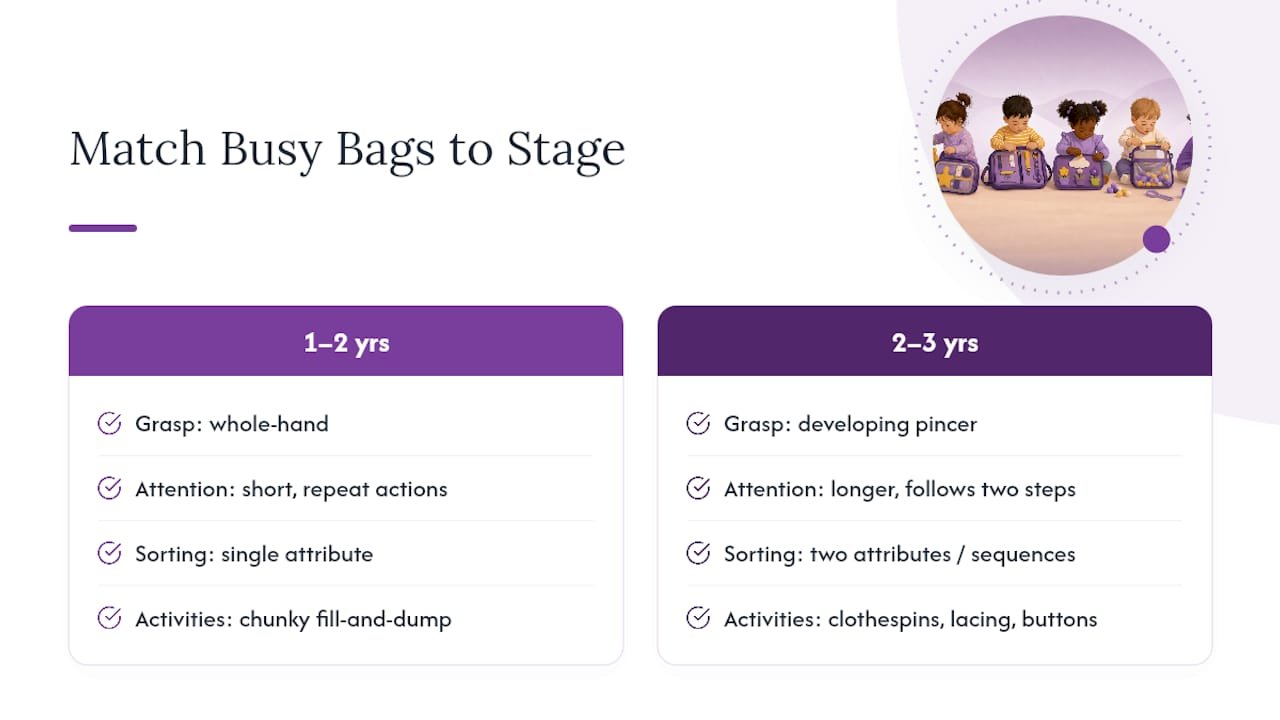
Toddlers between 1 and 2 years old are still working on basic grasp, cause and effect, and simple sorting. At this stage, favor big, chunky pieces: a colander with thick pipe cleaners, a muffin tin with jumbo pom-poms, or a fill-and-dump container with two or three objects. Keep the skill target narrow. One action, repeated, teaches more than a busy bag with five different tasks crammed inside. This is also the age where mouthing is still common, so self-contained, sealed activities like taped sensory bags do more heavy lifting than anything with loose parts.
By 2 to 3 years old, most toddlers have better pincer grip, longer attention spans, and a growing interest in categories: colors, shapes, and simple sequences. This is where clothespin color matching, lacing cards, and button pattern cards start to click in a way they couldn’t six months earlier. You can also introduce light problem-solving, like sorting by two attributes instead of one, or following a two-step instruction (“put the red ones in the cup, then close the lid”).
If you’re not sure which stage your toddler fits, watch how they handle a simple task. A child who dumps and scatters pieces without much interest in the sorting part is still solidly in the younger stage, no matter what the calendar says. Adjust the busy bag, not the age label.
Using Busy Bags to Build Independent Play
The real goal of a busy bag isn’t just distraction. It’s teaching your toddler to sit with one task, work through mild frustration, and stay engaged without you narrating every step.
Start small. A toddler who’s never had independent play time won’t sit for fifteen minutes on day one, and that’s fine. Begin with a two or three minute window, sitting nearby but not intervening unless something’s unsafe. Gradually stretch that window as your toddler gets more comfortable working alone.
Resist the urge to correct or redirect too quickly. If your toddler is “sorting wrong” by your standards, but staying engaged and exploring the pieces, let it run. The self-regulation piece comes from sticking with a task through small frustrations, not from doing it perfectly. Narrating play out loud in short bursts, rather than constant instruction, also helps toddlers build the internal language they eventually use to talk themselves through tasks solo.
A quiet transition ritual helps too. Saying the same phrase every time (“busy bag time, then snack”) signals what’s coming and reduces resistance. Toddlers regulate better when they know what to expect next, and a consistent busy bag routine gives them exactly that.
Sneaking Colors, Shapes, Numbers, and Letters Into Play
Busy bags are a natural fit for early academic concepts, mostly because toddlers don’t notice they’re “learning” when the activity still feels like play.
Color recognition slots easily into clothespin matching or pom-pom sorting: swap plain pom-poms for a rainbow set and ask your toddler to group by color instead of just transferring them. Shapes work well with felt board pieces cut into circles, squares, and triangles, since your toddler can name the shape while placing it on the board. For numbers, a muffin tin with numbered stickers inside each cup turns simple sorting into early counting practice; ask “how many in this cup?” instead of just “put them in.”
Letters take a bit more setup but pay off fast. Write a single letter on a lacing card or sticker sheet and pair it with the sound it makes. You don’t need a full alphabet kit right away. One or two letters per busy bag, rotated weekly, sticks better than a bag crammed with all 26 at once.
The key is restraint. A busy bag with a color theme, a shape theme, and a number theme all crammed together usually overwhelms the activity’s actual purpose. Pick one educational concept per bag, and let the fine motor or sensory task carry the rest of the engagement.
Adapting Busy Bags for Sensory Sensitivities and Special Needs
Standard busy bag ideas need some adjusting for toddlers with sensory sensitivities, and a few small swaps make a big difference.
For toddlers who avoid messy textures, skip play-dough and gel-based sensory bags entirely. Dry sensory options like rice, dry pasta, or textured fabric squares inside a sealed pouch offer similar input without the wet or sticky feel that triggers aversion. For toddlers seeking more input, weighted items (a small fabric bag filled with rice, sewn shut) or textured fidgets can go into the same pouch format as any other busy bag.
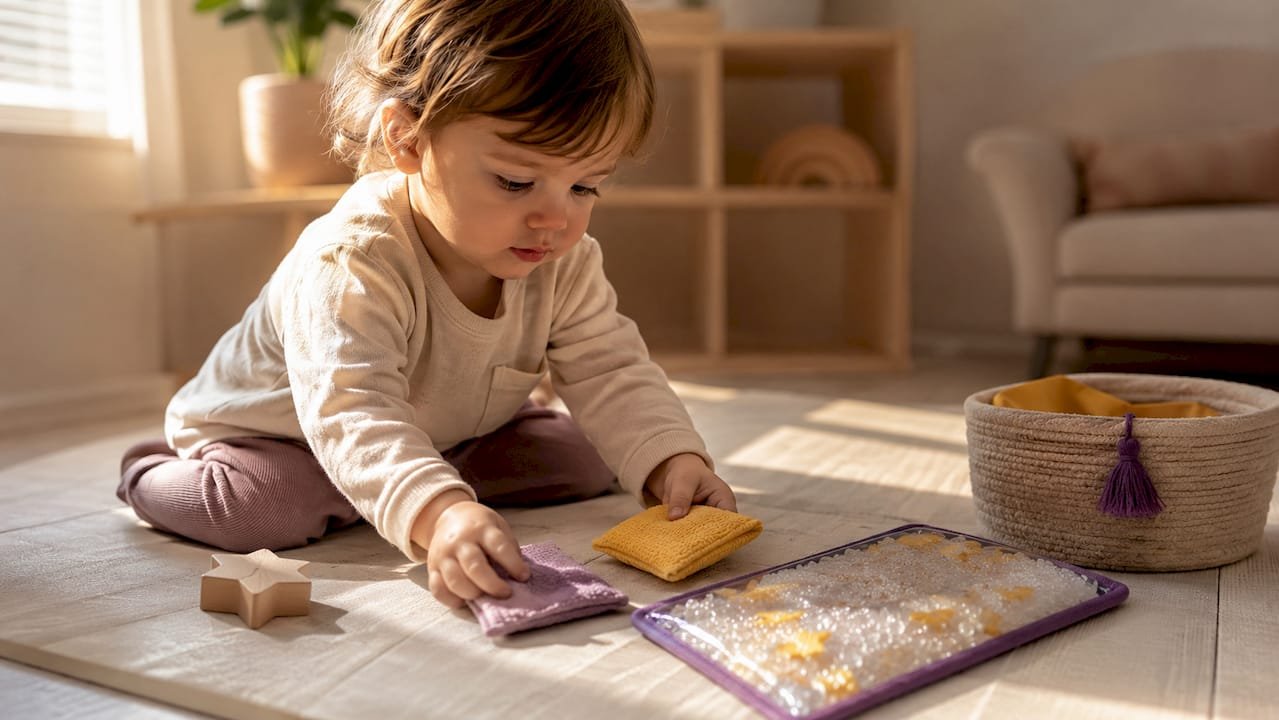
Sound sensitivity matters too. Skip anything crinkly or squeaky if loud, unpredictable noises cause distress, and lean toward soft felt pieces or smooth wooden shapes instead.
For toddlers who need extra visual structure, laminated cards with a clear “before and after” picture (an empty tin next to a full one) help signal what the task actually is, reducing frustration before the activity even starts. Keep the same activity available across multiple bags rather than constantly introducing new ones. Predictability, not novelty, is often what helps here, which flips the usual rotation advice on its head. Watch your toddler’s reaction closely and adjust one variable at a time, whether that’s texture, sound, or visual complexity, rather than overhauling the whole bag at once.
One Habit That Made Busy Bags Actually Work
Keeping one sealed “emergency only” bag, never rotated, built real anticipation. My toddler treated it like a prize. Try holding one bag back and watch the difference.
— samit
Ready-Made Busy Bag Packs From Mooshie Moments
Mooshie Moments gives you what a Pinterest board can’t: activities already matched to your toddler’s exact age, sorted by how much time you actually have, so you’re never guessing whether a busy bag idea is too easy or too advanced. Every activity comes with a plain-language developmental note, so you know what skill it’s building without digging through parenting forums.
If you’re assembling busy bags for a 2-year-old specifically, the 40 Fun 2 Year Old Activities pack gives you a ready-made lineup you can print and pack tonight. Caring for a nursery or early years group instead? The Research Backed Nursery Activity Plans offer three short daily activity slots you can adapt into shared busy bag stations. Download the app and try a free activity plan today.
Sources
- Busy Bags for Toddlers: 20 Mess-Free Activities for Restaurants, Cars, and Waiting Rooms | TeachToddler
- Easy screen-free activities for toddlers: Low-effort ideas that buy you 30 minutes – Motherly
- Play activities for 12 to 24 months | Zero to Three
Recommended
More like this
10-Minute Loose Parts Play for UK Toddlers: Toilet-Roll Safety
Start loose parts play in 10 minutes with household items. Follow the toilet-paper-roll safety check, rotate materials, and try quick, low-prep activities...
Start in 5 Minutes: Screen Free Rainy Day Activities for UK Toddlers
Quick, screen-free rainy day activities UK parents can start in five minutes. Age-matched, energy-level rotations, low-cost supplies and tidy cleanup tips.
Research Backed Nursery Activity Plans: 3 Daily 5 Minute Slots (UK)
Research backed nursery activity plans for UK parents: age matched, low prep household activities in 5–15 minutes, plus a one‑page weekly microplan…