Best Park Games for Toddlers: 12 Easy Ideas, No Gear Needed
Updated 23 October 2026 · 10 min read
The best park games for toddlers are short, flexible invitations, not contests with rules. Think a color hunt, a duck walk, rolling a ball back and forth or a stop-and-go stroll. You need no kit, no prep and no more than a few minutes of your energy. Below you’ll find twelve games we like, how to adapt them from baby to age four, and how to keep things safe without taking the fun out.
TL;DR
- Pick one movement and one rule. If your toddler comes back for another turn, extend it. If not, move on.
- Most games need nothing. Water, the right clothes and maybe one soft ball are plenty.
- Match the game to the age: babies watch and point, young walkers copy, older toddlers can follow simple rules.
- Keep “stop” games inside a clear boundary, away from roads, car parks and moving equipment.
- Short bursts count. The NHS says toddlers need at least 180 minutes of activity across the day, and it does not all have to happen in one go.
Table of Contents
- Why simple park games work so well
- How to make a game work with a toddler
- 12 park games for toddlers
- Games by age at a glance
- A 5-minute plan when you are short on energy
- Keeping park play safe
- What our team thinks about park games
- Take more ideas with you
- When the weather says no
- FAQ
- Sources
Why simple park games work so well
A park gives your toddler space, fresh air and things to look at. What turns it into play is you. The NHS explains that playtime supports language, problem-solving, decision-making, movement and social skills. The value comes from the shared back and forth, not from fancy equipment.
There is a movement angle too. The NHS physical activity guidelines say toddlers aged 1 to 2 should be active for at least 180 minutes (3 hours) a day, spread across the day. That can include light activity such as standing, moving, rolling and playing, as well as running and jumping. So a two-minute game followed by a wander around the grass still counts.
That should take some pressure off. You are not running a session. You are offering a few small ideas and seeing which one your child picks up.
How to make a game work with a toddler
Most park games fall flat for the same reason: they come with too many rules. Toddlers usually need a clear, tiny invitation first. These habits help:
- Show, don’t explain. Take the first turn yourself. Do the duck walk before you ask anyone to copy it.
- Ask one question at a time. “Can we find something red?” works better than a list of instructions.
- Follow their interest. If they ignore your game and stare at a dog, the dog is now the game. Talk about the dog.
- Keep it short. Five minutes is a perfectly good game.
- Let them lead after the first turn. Join in briefly, then step back.
The BBC Tiny Happy People park activities make the same point about responsive play: notice what grabs your child’s attention and talk back about it, using lively words linked to what they see and hear.
12 park games for toddlers
Each game below uses things the park already has. We’ve given a rough age fit, but toddlers vary a lot, so treat it as a guide.
1. Color hunt
Best for: around 18 months to 4 years.
Say, “Can we find something red?” Point, touch, name it. Pick a new color when interest dips. Younger toddlers will mostly watch you find things, and that is fine. Older ones can start choosing the color themselves.
If your child enjoys this at home too, our color sorting activities carry the same idea indoors.
2. Duck walk and animal moves
Best for: 18 months and up.
Waddle like a duck, hop like a frog, stomp like an elephant. Ask, “Can you copy my duck walk?” Animal movements build balance and coordination, and they are silly enough to make most toddlers laugh. They also give you new words and sounds to use. This kind of copying and imitation sits at the heart of pretend play in toddlers, where your child starts to act out what they have noticed.
3. Roll the ball
Best for: 12 months and up.
Sit a few steps apart on the grass and roll a soft ball back and forth. The NHS lists rolling, throwing, catching and kicking a soft ball among its suggestions for keeping toddlers active in its guide to keeping your baby or toddler active. Start with rolling, then try a gentle kick once your child is steady on their feet. If you want more of this kind of skill-building, see our ideas for hand-eye coordination.
4. Touch the tree
Best for: 18 months and up.
Pick a tree. Walk to it and touch it with your hand, then your knee, then your elbow. Walk back. One movement, one rule, done. It is a small game, and it gets a reluctant walker moving without a fight over the buggy.
5. Follow the leader
Best for: 2 to 4 years.
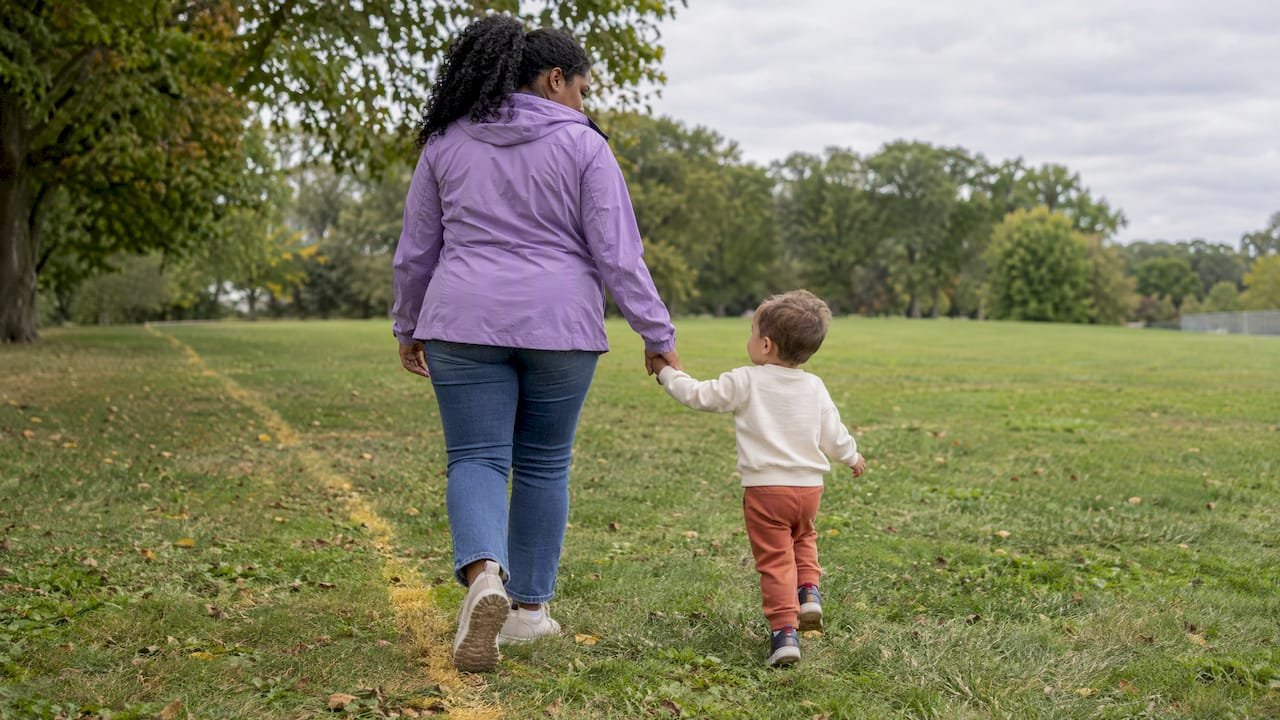
Walk in a wiggly line and add a move: a tiptoe, a wave, a big step. Then swap, and let your toddler lead. Being the leader is a big deal at this age. Use paths, grass and low steps that are already there.
6. Duck and sound spotting
Best for: babies to 3 years.
If there is a pond, ask, “Where are the ducks?” If not, listen for birds, dogs or a distant bus. Copy the sounds back. For babies, this is the whole game: point, name it, make the noise, wait for a reaction. The BBC page notes that animal spotting, colour hunts and sound games are especially useful for babies and late toddlers because they invite you to talk about what the child is already watching.
7. Stop and go
Best for: 2 to 4 years.
Walk or run, then freeze when you raise your hand. Swap roles when your child gets the hang of it. This is the park version of Red Light, Green Light. One firm rule: use it only inside a clearly bounded area, away from roads, car parks and moving play equipment. A stop game is not a replacement for supervision, because many toddlers cannot reliably stop on request yet.
8. Follow the line
Best for: 2 to 4 years.
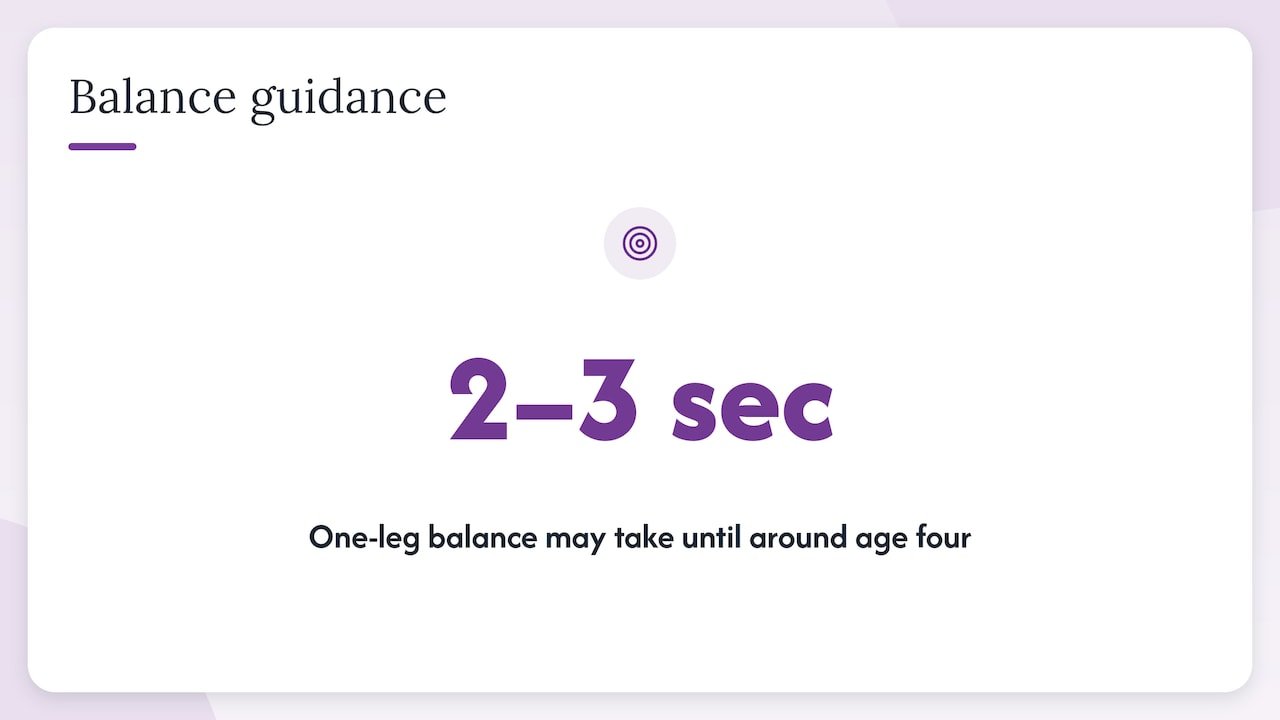
Find a path edge, a painted line or a row of paving slabs and walk along it. Berkshire Healthcare NHS Foundation Trust’s balance guidance suggests playgrounds, varied surfaces, stepping-stone-style routes and lines for practising balance. Keep it wide and easy. The same guidance notes that a child may not balance on one leg for two to three seconds until around age four, so don’t expect toddlers to manage older-child versions.
9. Two-feet jumping
Best for: around 2 to 4 years.
Jump off a low step or over a crack in the path with both feet. Hopscotch-style jumping with two feet comes first. One-foot challenges can wait until later. Hold a hand if your child wants it, and let them decide how high is high enough.
10. Nature noticing
Best for: all ages.
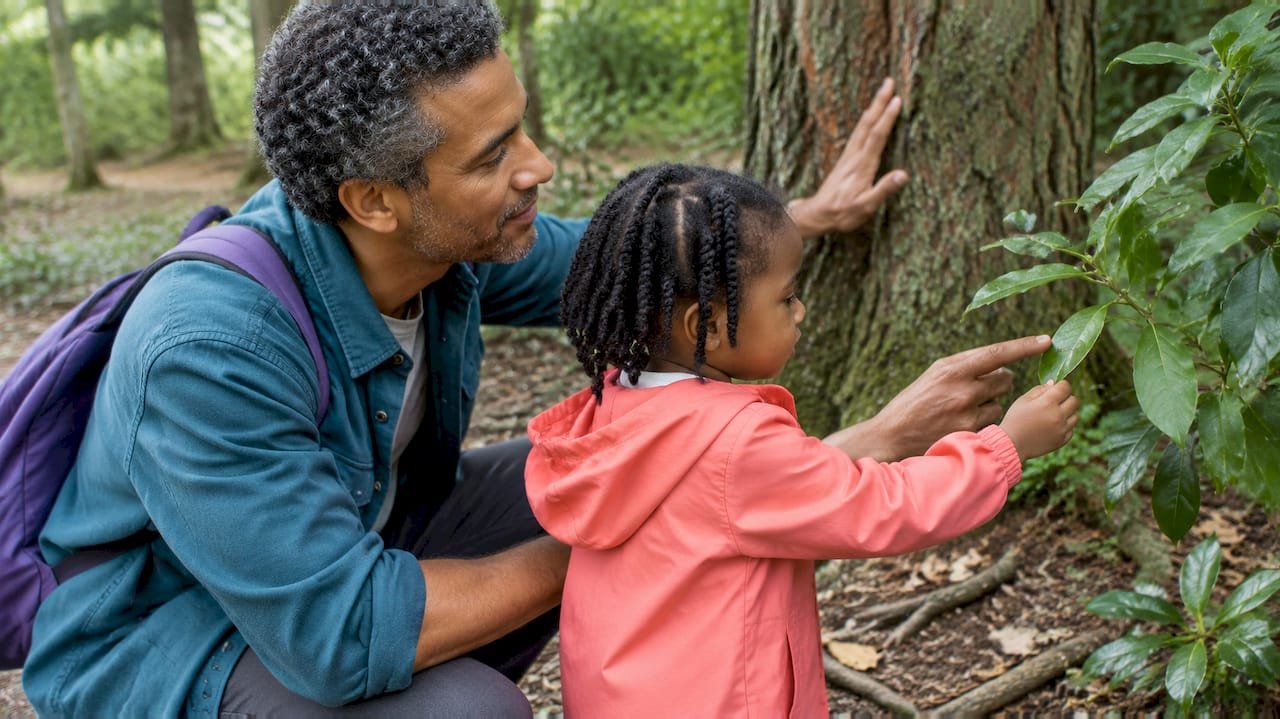
Collect nothing small and loose for babies who mouth things. Instead, point out leaves, bark, puddles and clouds. Feel the rough bark, then the smooth leaf. Use words like crunchy, soft, bumpy. This is a quiet game for the end of a visit, when energy is low but your child does not want to leave yet.
11. Hide-and-seek, toddler style
Best for: 2 to 4 years.
Hide behind a tree in plain sight, with your feet sticking out. Hide-and-seek is on the NHS list of active play ideas. At this age, the fun is mostly in the “Where’s Mummy?” moment, so make it easy to win and keep it close.
12. Playground words
Best for: 12 months to 3 years.
On the swing, say “push” and “stop.” On the slide, say “up” and “whee.” On the roundabout, say “round and round.” The BBC notes that a trip to the park is a good chance to learn action words while having fun on the swings, slides and roundabouts. If this is something you’d like to do more, our guide to narrating play shows how, and our speech and language activities have more ideas.
Games by age at a glance
| Age | What it looks like | Good games |
|---|---|---|
| Baby (6 to 12 months) | Watching, reaching, crawling where it’s safe | Sound spotting, nature noticing, singing action songs |
| Early walker (12 to 18 months) | Wobbly walking, big interest in balls | Roll the ball, playground words, walking to a tree |
| Toddler (18 months to 2 years) | Copying, short bursts of running | Duck walk, color hunt, follow the leader |
| Older toddler (2 to 4 years) | Understands simple rules, likes turns | Stop and go, follow the line, two-feet jumping, hide-and-seek |
A 5-minute plan when you are short on energy
Some days you’ve got a tired child and a tired you. Here is a plan that asks very little:
- Minute one: walk in and look around. Pick one thing to point at.
- Minutes two and three: play one game, such as rolling a ball or finding something red.
- Minute four: if your toddler wants more, take another turn. If not, let them wander.
- Minute five: finish with something calm, such as spotting ducks or touching bark.
Extend the game only if your child comes back for another turn. That is the signal. If they wander off, the game was a success anyway.
Keeping park play safe
Good play involves a bit of risk, and the aim is to manage it sensibly. The Health and Safety Executive’s statement on children’s play says the goal is not to eliminate risk, but to weigh up risks and benefits and control the real dangers. Accidents can happen, but fear should not lead adults to remove every challenge.
Here is what that looks like in practice:
- Check the area first. Look for broken glass, damaged equipment, unsafe water and traffic. Read the park’s signs and rules.
- Choose a clear boundary. Keep games within a space you can see and your child can understand.
- Stay away from roads and car parks. The Healthier Together guidance recommends teaching road awareness and using safer crossing points. When toddlers walk near roads, it suggests a harness or wrist strap where appropriate, with the adult walking kerb-side.
- Hold hands when needed. If your child cannot reliably stop when asked, stay close.
- Watch small things with babies. Keep small loose objects such as stones and conkers away from babies who mouth items.
If you are worried about your child’s balance or movement, talk to your health visitor or GP.
What our team thinks about park games
We built Mooshie Moments for grown-ups who are tired, short on time and out of ideas. We think the park is the easiest place to play, and the easiest place to get stuck on your phone.
Here is how we see it. You do not need a plan, and you do not need to buy a thing. Every game on this page works because it is small: one movement, one rule, one invitation. The park itself does the rest.
We also believe it helps to know the “why”. When you know that copying a duck walk builds balance, or that naming a color builds language, a five-minute game feels worth it. That is why every activity in our app explains the developmental reason in plain words, with no extra prep and no new purchases. And we like that it gets you off your own screen so you can be present for the moment your toddler looks up and says “look!”
— samit
Take more ideas with you
If you want fresh ideas when you’re standing in the middle of a park with a toddler and a blank mind, Mooshie can help. Tell the app your child’s age and how much time and energy you have, and it suggests quick, screen-free activities using everyday things. Each one comes with a simple explanation of what it builds. For a wider look at what is possible once you step outside, see our guide to screen-free outdoor activities for UK toddlers.
When the weather says no
Some of these games travel well. Duck walks, stop and go, and follow the leader all work in a hallway or living room. Our indoor obstacle course and garden activities are good back-ups, and so is our collection of music and movement ideas.
FAQ
How can I make the park more fun for my toddler?
Offer one small invitation at a time, such as “Can we find something red?” or “Shall we roll the ball?” Follow your child’s interest and add simple words and sounds. The NHS also notes that being active with your child shows them activity is enjoyable.
What are good outdoor games for a one-year-old?
Keep it simple: rolling a soft ball, spotting ducks and dogs, singing action songs and walking to a tree. Let your child walk rather than always using the buggy. For babies who are not yet walking, point out sights and sounds and let them reach and crawl only where the surface is safe.
Do I need any equipment for park games?
No. Water, weather-appropriate clothes and, if you like, one soft ball are enough. Most of the games above use paths, grass, trees and low steps that are already there. Check the area for glass, damaged equipment and traffic before you start.
How long should a park game last?
As long as your toddler is interested, and often that’s about five minutes. The NHS says activity can be spread across the day in short bursts, so a short game followed by free exploring still counts toward the 180 minutes.
Sources
- NHS: Physical activity guidelines for children under 5
- NHS: Playtime and bonding with your toddler
- NHS: How to keep your baby or toddler active
- Berkshire Healthcare NHS Foundation Trust: Balance
- Healthier Together: Keeping your child safe out and about
- HSE: Children’s play and leisure, a balanced approach
- BBC Tiny Happy People: Outdoor activities for kids, 10 fun park games
Recommended
- 15 Low Prep Garden Activities for UK Toddlers, Rain or Shine
- Ten Minutes: Screen Free Outdoor Activities for UK Toddlers
- No New Toys Needed: Sensory Play Ideas Parents Can Use With Toddlers
- 12 Low Prep Toddler Activities for Grandparents With Seated Options
Want a new idea every day, matched to your child's age?
Mooshie Moments gives you simple, guided play ideas for ages 6 months to 4 years.
Download free on the App StoreMore like this
Toddler Scavenger Hunt: Easy Ideas for Home and Garden
Easy toddler scavenger hunt ideas using things you already have: indoor, garden and nature walk hunts, by age, with safety tips and…
Camping With Toddlers: Activities That Work at the Campsite
Easy camping activities for toddlers using what you already have: nature play, campfire-free games, rainy-day ideas and safe-play tips for UK campsites.
Eco-Friendly Toddler Activities Using Things You Already Have
Simple eco-friendly toddler activities using things you already have: water play, nature hunts, junk modelling and garden play, with safety tips for…