
Low Prep Music and Movement for Busy Parents That Works in 5 Minutes
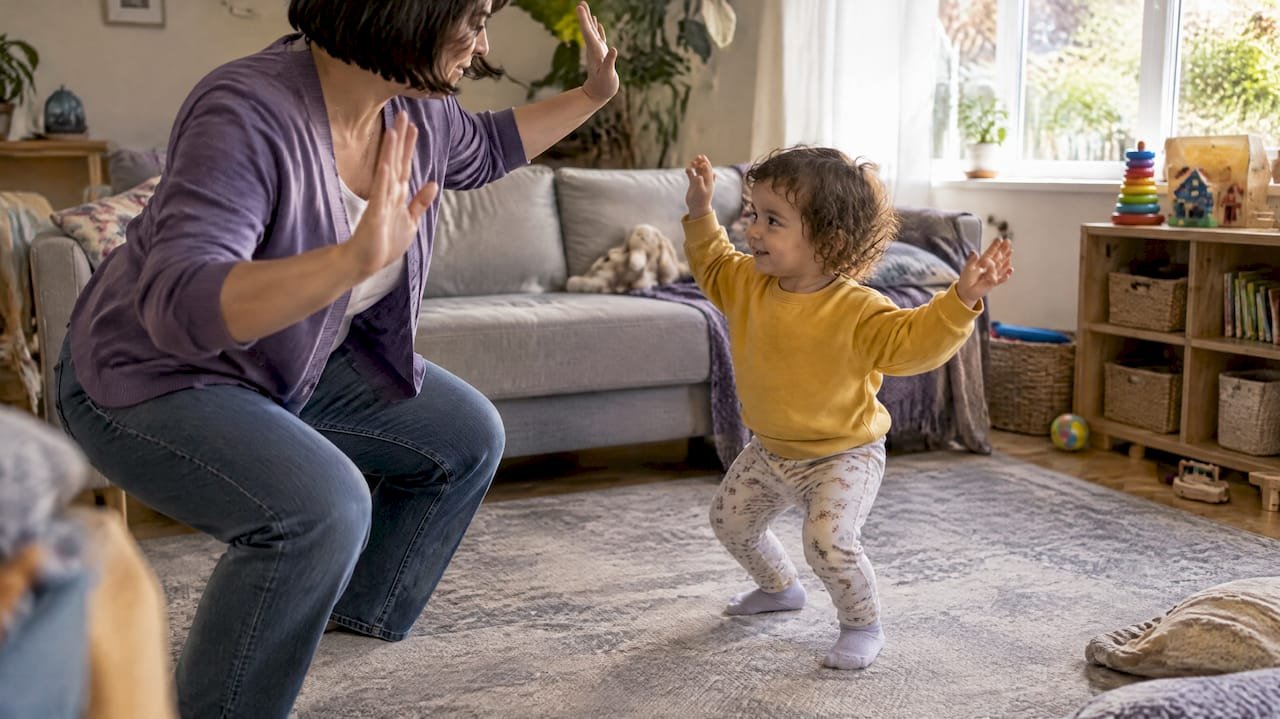
Music and movement help toddlers build motor, language, and social skills, and you can start right now with a song and a wiggle. Grab a scarf or an upturned pot, sing for a few minutes, and move together. That small burst also counts toward the 180 minutes of daily activity recommended for children aged one to five.
TL;DR:
- Toddlers benefit from active music and movement play that include simple household props, achieving developmental gains in motor, language, and social skills.
- Activities like singing call-and-response, freeze dance, and waving scarves support listening, impulse control, and pattern recognition at every age stage.
- Short, flexible sessions of two to five minutes, with warm-up and calm-down phases, effectively integrate into daily routines without needing detailed planning.
- Safe volume levels and supervised exposure are crucial to protect toddler hearing, with quieter instruments and brief headphone use recommended.
- Consistent, playful engagement in informal settings yields lasting developmental benefits, emphasizing enjoyment and routine over polish or specific skills.
Table of Contents
- 1. Simple activities you can start in the next five minutes
- 2. The developmental payoff behind the play
- 3. How to run a short session without overplanning it
- 4. Keeping the volume and the experience safe
- 5. Age-by-age ideas that grow with your toddler
- 6. The guidance and research behind these activities
- 7. A realistic note on making this stick
- Where Mooshie Moments fits into your routine
- FAQ
- Sources
1. Simple activities you can start in the next five minutes
The easiest way into music and movement is to pick a category that matches your toddler’s mood and your own energy level. None of these need special equipment. They use what is already in your kitchen drawer or toy box.
Singing and rhymes work because toddlers love repetition. Fingerplays like “Incy Wincy Spider” give small hands something to do while the words sink in. Call-and-response songs, where you sing a line and your toddler copies it, build listening and turn-taking at the same time. Look for songs with a predictable refrain and a movement cue, such as “Row, Row, Row Your Boat,” so your toddler knows exactly when to act.
Movement and dance turn any kitchen into a dance floor. Play with tempo: speed up and slow down the same song and watch your toddler adjust their steps. Freeze dance, where the music stops and everyone holds still, teaches impulse control in a way that feels like a game rather than a lesson. Follow-the-leader dancing, where your toddler copies your moves or you copy theirs, works well for shy toddlers who need a model before they try something new.
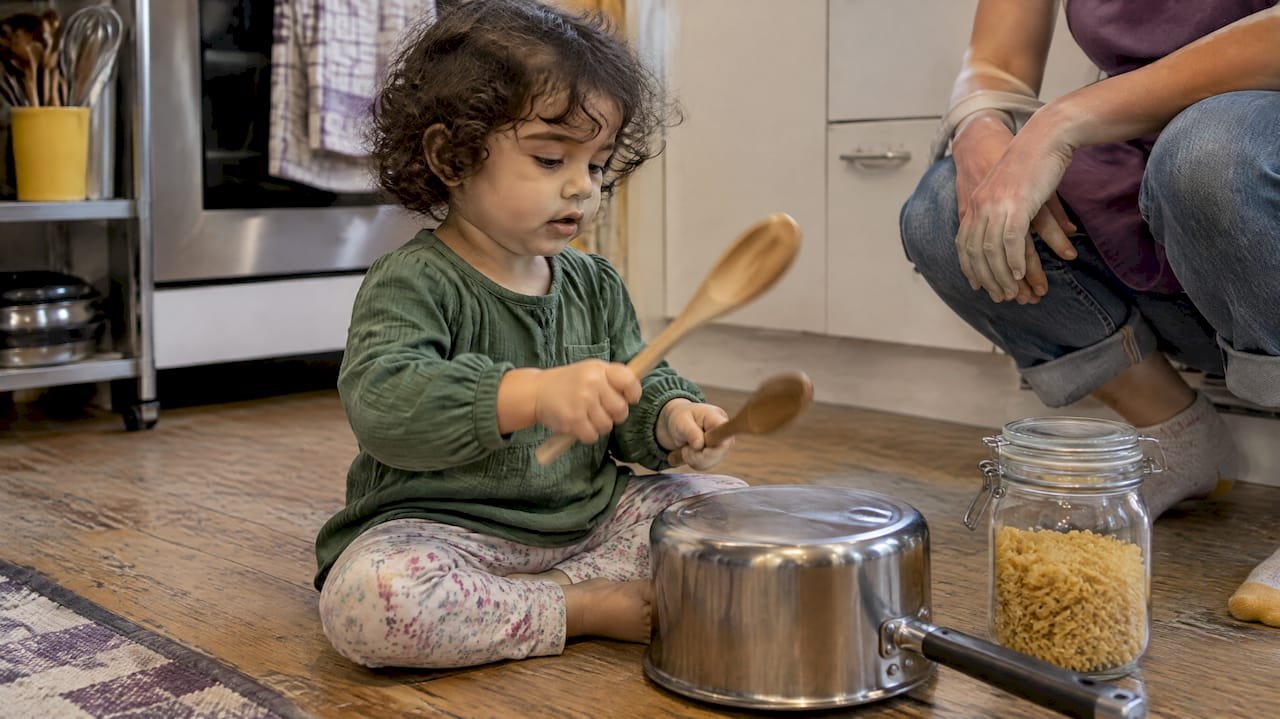
Simple instruments do not need to come from a shop. A dry pasta jar becomes a shaker. An upturned saucepan and a wooden spoon become a drum. Rhythm sticks can be two wooden spoons tapped together. The goal is not musical accuracy. It is giving your toddler a way to feel a beat in their hands, which practitioner guidance in the NHS Borders Musical Resource Pack treats as more valuable than any formal instrument.
Sensory music pairs sound with touch, as explained in this parent’s guide to sensory play and child development. Scarves or ribbons waved to slow music give toddlers a visual and tactile anchor for the rhythm. Textured props, like a soft pompom passed hand to hand on the beat, add another layer. For toddlers who mouth objects during play, our taste safe sensory play guide covers safe material choices.
Musical games and storytelling stretch the idea further. Marching to a steady beat while naming animals, or adding sound effects to a familiar story, turns music into a shared narrative. Echoing rhythms (you clap a pattern, your toddler claps it back) is a quick game that sharpens listening without feeling like a drill.
- Fingerplays and call-and-response songs build listening and turn-taking.
- Freeze dance and follow-the-leader build control and confidence.
- DIY shakers and pot drums introduce beat without buying anything.
- Scarves and textured props add a tactile layer to any song.
- Echoing rhythms turn listening practice into a quick game.
Pro Tip: Keep two or three household “instruments” sitting out in a basket. Toddlers are far more likely to start spontaneous music play when the props are already in view.
2. The developmental payoff behind the play
Music and movement are not just a way to pass ten minutes. Each category above lines up with a specific area of toddler development.
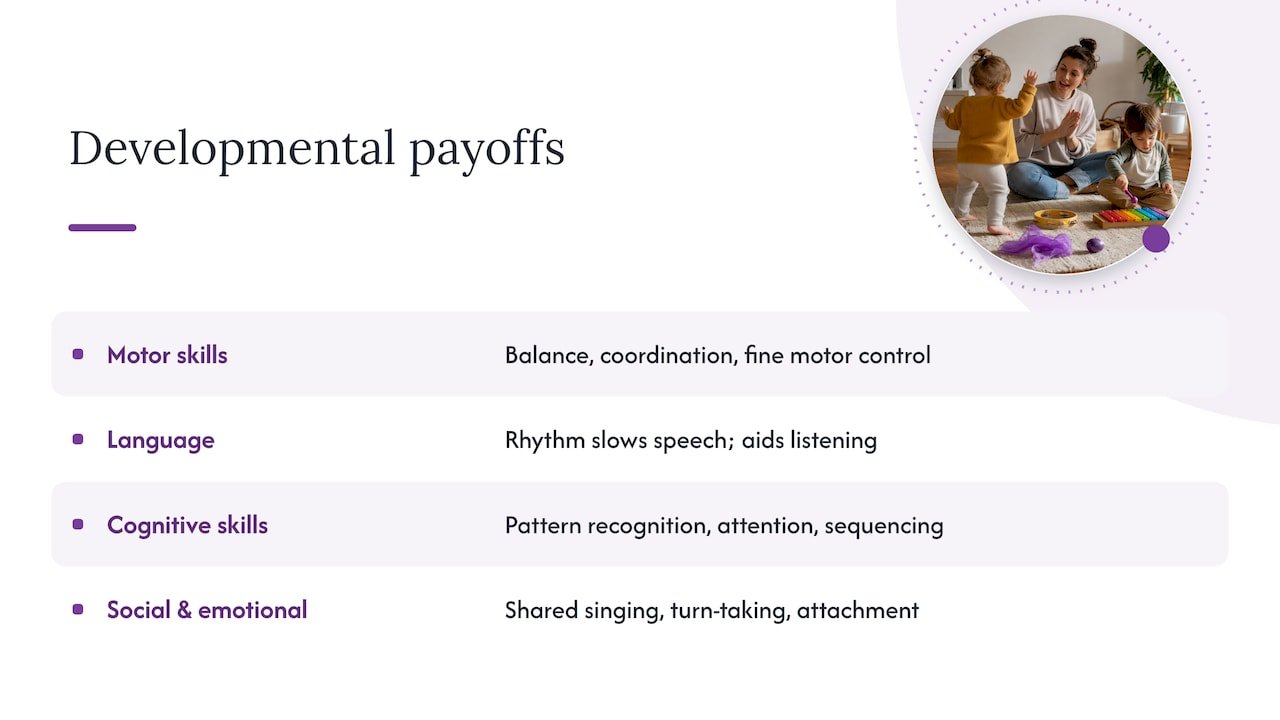
Motor skills improve through the physical side of the play. Dancing works balance and coordination, while tapping a shaker or drum builds the fine motor control needed later for holding a pencil.
Language benefits from the rhythm itself. Songs slow speech down into predictable chunks, which supports listening, turn-taking, and eventually vocabulary. Research in npj Science of Learning suggests early rhythmic engagement supports pathways that influence communication and language development later in childhood, which makes the singing and echoing games from the first section more than just fun.
Cognitive skills get a workout from pattern recognition. Predicting when a song’s chorus will repeat, or when the music will stop in freeze dance, exercises attention and sequencing.
Social and emotional growth comes from shared enjoyment. Singing together, copying each other’s dance moves, and waiting for a turn in a call-and-response game all build attachment and self-regulation.
A 2026 study reported that structured music-and-movement training produced a significant improvement in toddlers’ rhythmic skills, reinforcing that the simple, repeated games described here are doing real developmental work, not just filling time (Early Childhood Research, 2026).
3. How to run a short session without overplanning it
You do not need a lesson plan. A good music-and-movement session has a shape, not a script, and it fits into the gaps of an ordinary day.
- Warm up for one to two minutes. Start with a familiar song and simple movements, like clapping or swaying, to signal that play is starting.
- Play actively for three to five minutes. Move to dancing, instruments, or a game like freeze dance, following your toddler’s energy rather than a fixed routine.
- Calm down for one to two minutes. Slow the tempo, lower your voice, and finish with a quiet song or gentle swaying to help your toddler settle.
Scaffold the play as you go. Model the action first (shake the shaker, then hand it over), echo your toddler’s sounds back to them, and offer a choice between two songs or two props rather than open-ended options. Each small success invites them to try a bit more on their own.
Small spaces and packed schedules do not rule this out. A hallway is enough room for marching or freeze dance. In a nursery or playgroup, the same three-step flow works for a group, with one adult modeling and the others echoing. Our guide to short, repeatable nursery activity slots breaks this down further for anyone managing a group rather than one toddler.
Pro Tip: If your toddler walks away mid-song, let them. A session that ends after ninety seconds still counts. Pushing to finish a “proper” session usually backfires.
4. Keeping the volume and the experience safe
Loud music is easy to default to, especially with an excited toddler, but toddler hearing is more sensitive than an adult’s. A few simple habits keep sessions safe without dialing down the fun.
- Use the adult-ear test: if the music feels loud to you, it is louder for your toddler, so turn it down.
- Cap any headphone use at around 30 minutes at a time, based on guidance for young children’s headphone and ear defender use.
- Introduce ear defenders gradually, with short supervised wear sessions, rather than expecting a toddler to tolerate them right away.
- Increase distance from speakers or choose a quieter instrument (shaker over drum) when a space is already noisy.
For sensory-sensitive toddlers, offer choices rather than insist on full participation: a shorter burst of music, a quieter instrument, or a visual cue (like a hand signal) before the music starts can make the difference between distress and enjoyment. Guidance recommends desensitization and short, supervised sessions as the safest way to build tolerance to sound, rather than avoiding music altogether (Derbyshire Healthcare).
5. Age-by-age ideas that grow with your toddler
The same core games can flex from a wobbly first-time dancer to a confident three-year-old. The trick is adjusting one thing at a time, not reinventing the activity.
12 to 24 months:
- Sway to slow songs while holding your toddler, letting them feel the beat through your body.
- Shake a homemade rattle (rice in a sealed bottle) to a simple nursery rhyme.
- Clap hands together during a call-and-response song, even if the claps are off-beat.
24 to 36 months:
- Try freeze dance, pausing the music every 15 to 20 seconds at first.
- Introduce a pot drum and let your toddler set the tempo while you follow.
- Wave scarves to slow and fast songs, naming the difference between “slow” and “fast” out loud.
Our 2-year-old activities collection has more ready-made ideas for this stage.
36 to 48 months:
- Let your toddler lead a follow-the-leader dance, choosing the moves themselves.
- Play an echo game with longer rhythm patterns, building up from two claps to four.
- Combine instruments: shaker in one hand, marching feet, and a simple song together.
To nudge the challenge up, change only one variable at a time, such as a faster tempo, one extra dance step, or letting your toddler take the leader role, so progress stays visible and manageable.
Pro Tip: Reuse the same three or four songs across weeks. Toddlers get more out of a familiar song played often than a new one played once.
6. The guidance and research behind these activities
These activities are not improvised. The UK Chief Medical Officers’ early-years guidance recommends at least 180 minutes of physical activity a day for children aged one to five, spread across the day and including dancing and active games, which puts music and movement squarely inside daily targets rather than as an extra.
Practitioner-facing material backs the low-prep approach too. The NHS Borders Musical Resource Pack and related Musical Development Matters guidance both emphasize shared enjoyment and caregiver participation over performance, and both note that a caregiver’s voice and household props are enough: no musical training required.
On the research side, early rhythmic engagement is linked to later communication development, which gives the singing and echoing games in this article a developmental weight beyond entertainment.
A few places to put this into practice right away:
- Short, repeatable nursery activity slots for group settings.
- 2-year-old activity ideas for toddlers in that specific window.
- Grandparent-friendly, low-prep activities for caregivers with limited mobility.
7. A realistic note on making this stick
None of this needs to look like a class. The best sessions we have seen are messy, short, and tucked into something you were already doing: a splash of singing in the bath, a tidy-up song with a marching beat, a hummed tune on the walk to the shops. Consistency beats polish every time.
If you only manage ninety seconds some days, that is still a real win. The habit matters more than the length.
— samit
Where Mooshie Moments fits into your routine
![CTA image placeholder]
Finding the right activity for the right moment is the hard part, not the singing itself. Mooshie gives you age-tailored, screen-free activity ideas built around whatever is already in your house, matched to how much time and energy you actually have that day. No extra supplies, no setup, and every activity comes with a plain-language note on the developmental reason behind it.
| What you get | Why it helps |
|---|---|
| Activities tailored to your toddler’s age (6 months to 4 years) | Matches the progression described in this article without extra guesswork |
| Suggestions based on your available time and energy | Fits a three-minute window or a thirty-minute one |
| No extra purchases needed | Uses household items you already have |
- Browse more 2-year-old activity ideas to build on what you have read here.
- Nurseries and early years settings can explore the Partnership Pack for ready-made, printable resources.
If today’s session was a win, start the next one with Mooshie open on your phone and let it suggest what comes next.
FAQ
What do toddlers learn from music and movement?
Toddlers build motor skills through dancing and instrument play, language skills through rhythm and repetition, and social skills through turn-taking games like call-and-response singing. These activities also support attention and pattern recognition as toddlers predict beats and song structures.
What are some music and movement activities for toddlers?
Good starting points include singing fingerplays, freeze dance, shaking a homemade rattle, waving scarves to music, and tapping a simple pot drum. Each can run for as little as a few minutes and needs no special equipment.
How to tell if a child is musically gifted?
There is no single early sign of musical giftedness, and most toddlers who enjoy music are simply responding normally to rhythm and repetition rather than showing a special talent. A toddler who moves, sings along, or copies rhythms with enthusiasm is engaging well, regardless of whether that points to any particular gift later on.
What are the benefits of music and movement in preschool?
In preschool settings, music and movement support the same core areas as at home: motor coordination, language through rhythm and listening, and social skills through group singing and dancing. Guidance for early years practitioners frames these benefits around shared enjoyment and routine use rather than formal music lessons, which keeps the activities accessible for every child in the group.
Sources
- Gov
- Early musicality and its role in communication—npj Science of Learning (2025)
- Musical Resource Pack (Early Years) – NHS Borders
- Structured music and movement training improves rhythmic skills in toddlers – Early Childhood Research (Springer) 2026
Recommended
- Screen-Free Toddler Activities in 5 Minutes
- 12 Low Prep Toddler Activities for Grandparents With Seated Options
- Fun 9-Month-Old Activities for Busy Parents
- 40 Fun 2 Year Old Activities to Start Right Now
Want a new idea every day, matched to your child's age?
Mooshie Moments gives you simple, guided play ideas for ages 6 months to 4 years.
Download free on the App StoreMore like this
Babysitting Toddlers: 12 Low Prep Ideas and Why They Help
Explore 12 low prep toddler activities for babysitters, with developmental benefits, age adaptations, UK safety advice, and optional activity coaching.
10 EYFS Backed Sock Games for Toddlers Under Five Minutes
Ten EYFS aligned sock games to start in under five minutes, each with a one line developmental benefit, simple adaptations, and two…
Busy Parents: 12 No Prep Shopping Activities for Toddlers
Busy parents: keep toddlers learning and calm at the store with 12 no prep, screen free activities that take under five minutes…