
Research Backed Low Prep Age Based Play for UK Babies to Preschool

This page gives you low-prep, age-specific play ideas for children from newborn through age four, all using items already in your home. Every activity here ties back to research from sources like Harvard’s Center on the Developing Child and the NHS, and each age bucket includes safety notes so you can play with confidence. Written by samit for Mooshie Moments, it’s built to answer one question fast: what do I actually do with my child today?
TL;DR:
- Repetition and exploration are key for infants, with cause-and-effect and object permanence activities supporting their cognitive development.
- Around 12 months, toddlers benefit from tasks that combine movement, language, and pretend play to foster independence and early communication skills.
- Structured, rule-based games like freeze dance and sorting help toddlers develop self-control and executive functions effectively.
- For preschoolers, multi-day projects, simple board games, and imaginative scenarios nurture creativity, cooperation, and complex motor skills.
- Short, frequent play sessions based on the child’s current age and skill level promote sustained engagement and mastery without overwhelming caregivers.
Table of Contents
- Play Ideas for Newborns and Young Infants (0–5 Months)
- Play Ideas for Older Infants (6–11 Months)
- Play Ideas for 12–17 Months (Early Walkers and Early Language)
- Play Ideas for 18–23 Months (Growing Independence and Rule-Following)
- Play Ideas for 2–3 Years (Complex Pretend Play, Fine Motor, and Cooperation)
- Play Ideas for 3–4 Years (Pre-Preschool Readiness and Imaginative Play)
- Types of Play and the Developmental Benefits They Support
- How to Pick an Activity Without Overthinking It
- Why These Activities Are Trustworthy
- What Actually Works Once the Novelty Wears Off
- Try Mooshie Moments for Ready-Made, Age-Matched Activities
- Sources
- FAQ
Play Ideas for Newborns and Young Infants (0–5 Months)
At this stage, your baby’s brain is wiring itself through repetition, touch, and your face. You don’t need toys yet. You need consistency and a few minutes of focused attention, and household items work fine for that.
Tummy time is the big one. Newborns build the neck and shoulder strength they’ll need for sitting and crawling later, but many babies protest it right away. Placing a small mirror or a high-contrast black-and-white card just in front of their face during tummy time gives them a reason to lift their head. High-contrast visuals matter here because a young infant’s vision is still sharpening, and bold patterns are easier to track than pastel toys.
Try these low-prep options:
- Lay a clean burp cloth over your chest and do “tummy time on you” while reclined, so your face becomes the motivation.
- Hold a wooden spoon or rattle 8 to 10 inches from their eyes and slowly move it side to side to build visual tracking.
- Talk through a diaper change step by step, narrating what you’re doing.
- Play gentle peekaboo with a muslin cloth to introduce the earliest idea of object permanence.
Skip anything with small detachable parts, ribbons, or loose strings near the crib or play mat, since infants at this age mouth everything within reach. The NHS’s baby and toddler play guidance points out that ordinary household items, used with basic supervision, cover most of what a young baby needs developmentally.
Pro Tip: Bath time and nappy changes are already happening every day, so turn them into two-minute play windows instead of adding new tasks to your list. Narrate colors, count fingers and toes, or sing the same short song each time. Babies love repetition far more than novelty.
Play Ideas for Older Infants (6–11 Months)
Somewhere around six months, babies figure out that objects still exist even when they can’t see them, and that discovery changes everything about how they play. This is the drop-and-dump stage, and it looks like chaos but it’s actually serious cognitive work.
Cause-and-effect toys are the priority now. A baby who drops a spoon off the highchair fifteen times isn’t testing your patience on purpose; they’re running an experiment on gravity and object permanence. Give them permission to do it with items that don’t matter if they hit the floor.
- Fill a plastic cup with wooden spoons or measuring cups and let your baby dump and refill it repeatedly.
- Hide a favorite toy under a muslin cloth and encourage your baby to pull it away, reinforcing object permanence.
- Offer a push-pull toy made from an empty tissue box tied to string, supervised closely.
- Set out taste-safe sensory bins, like a bowl of cooked, cooled pasta shapes, for supervised exploring by mouth and hand.
Mouthing is normal and necessary at this age, not a bad habit to break. What matters is choosing items too large to swallow and free of button batteries, magnets, or small screws. If you want a full breakdown of what “taste-safe” actually means in practice, our guide to taste-safe sensory play walks through it in detail.
This is also when babies start connecting sounds to meaning. Narrating what they’re doing, “you’re dropping the spoon, it fell down,” feeds directly into first words a few months later. For more ideas tuned to this exact window, see our 9-month-old activities guide.
Play Ideas for 12–17 Months (Early Walkers and Early Language)
Once your toddler is upright and mobile, the goal shifts from stationary sensory play to activities that combine movement, language, and a first taste of pretend play. This is also the age when everyday chores start to double as genuinely engaging games.
Toddlers this age love feeling useful. Washing plastic toys in a shallow basin of water, carrying a small laundry basket with one item in it, or wiping down a table with a damp cloth all satisfy a real developmental drive toward competence and belonging. ZERO TO THREE’s guidance on play for 12 to 24-month-olds points to exactly this kind of practical-life play as a strong fit for the age.
Try building a week around a few of these:
- Set up a “washing station” with a small tub of water, a sponge, and a few plastic toys.
- Hand over a light basket of soft items to carry from one room to another.
- Narrate constantly, “you’re pushing the ball,” “the cup is empty now,” since children this age understand far more language than they can produce.
- Start the simplest pretend play possible: feeding a stuffed animal with a spoon, or “talking” on an old phone.
Labeling objects and actions out loud, rather than just naming nouns, gives toddlers the verb-noun combinations they need for early two-word phrases. Our guide to narrating play breaks this down into specific phrases you can use during ordinary moments, not just dedicated play time.
Play Ideas for 18–23 Months (Growing Independence and Rule-Following)
Somewhere in this window, toddlers start to grasp that games can have rules, even simple ones like “stop when the music stops.” That’s a genuinely new cognitive skill, not just a cute trick, and it’s worth building on.
Movement-and-stop games are the clearest way to practice this. “Freeze dance” using a phone playlist, or a simple “walk, walk, stop” game across the living room, gives toddlers repeated practice at inhibiting an action on cue. That skill, self-control on command, is one of the earliest building blocks of the executive function research from Harvard’s Center on the Developing Child identifies as foundational for later learning.
A few structured options worth rotating through:
- Play “stop and go” with music, pausing the song frequently so your toddler practices freezing.
- Set up basic sorting with mismatched socks, sorting by color into two laundry baskets.
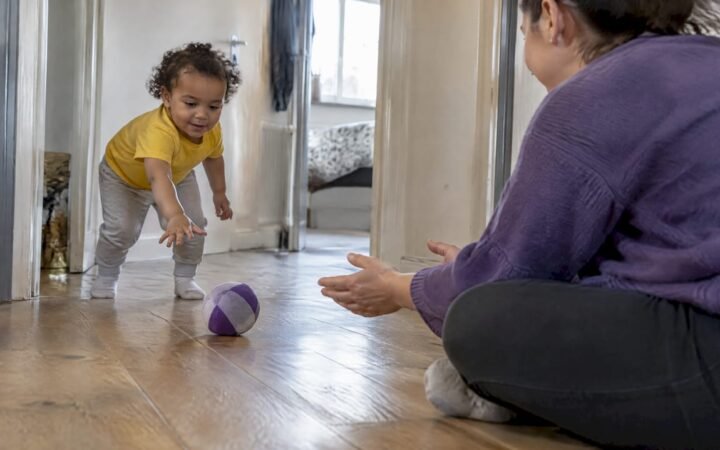
- Try a short turn-taking game, like rolling a ball back and forth, naming whose turn it is each time.
- Build a simple two-block or two-cup stacking challenge, then knock it down together and rebuild.
Keep sessions to five or six minutes at this age. Toddlers this young lose interest fast, and that’s not a problem to fix, it’s just where they are developmentally. Repeating the exact same game three days in a row usually works better than introducing something new every day, since mastery through repetition is how this age group actually learns.
Play Ideas for 2–3 Years (Complex Pretend Play, Fine Motor, and Cooperation)
This is the age where play starts to look like actual creativity rather than exploration for its own sake. Pretend scenarios get longer, fine motor control sharpens enough for real crafting, and cooperation with another child or adult becomes possible in short bursts.
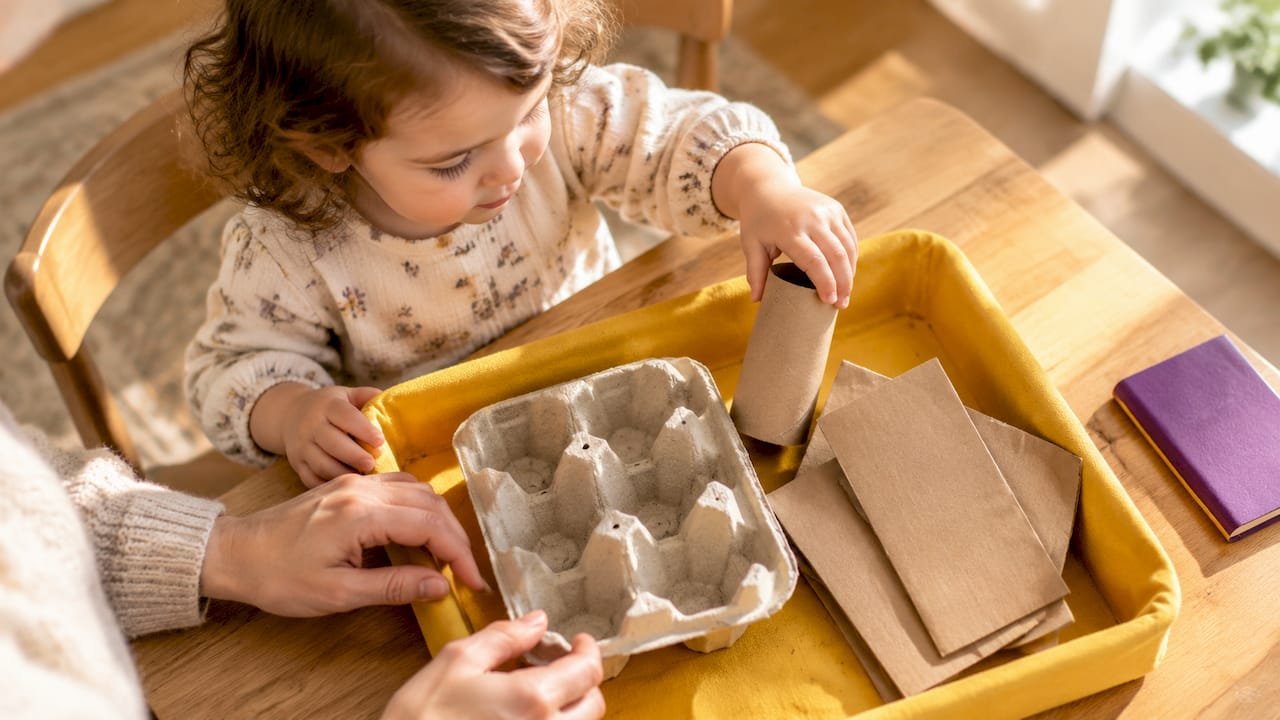
Junk modelling, gluing and taping together recycled boxes, cardboard tubes, and bottle caps into “creations”, is one of the highest-value activities at this age because it combines fine motor practice, planning, and open-ended imagination in one low-cost setup. Our junk modelling guide has a full walkthrough if you want a ready-made project.
Other strong options for this stage:
- Set out playdough with a butter knife and cookie cutters for pincer grip and hand strength.
- Practice cutting with child-safe scissors on thick paper strips, always supervised.
- Build a simple story together using stuffed animals, letting your child direct what happens next.
- Plant a fast-growing seed like cress or beans in a cup and check on it daily, introducing basic measurement with a ruler or your child’s own hand span.
Pretend play at this age also does real work on vocabulary and perspective-taking. A partner resource on pretend play development in toddlers covers how role-play scenarios build the social reasoning that shows up later in preschool friendships.
Pro Tip: Keep a small “junk drawer” of clean recyclables, bottle caps, cardboard, egg cartons, ready to go. When your toddler asks for something to do, you’ll already have a ten-minute activity within arm’s reach.
Play Ideas for 3–4 Years (Pre-Preschool Readiness and Imaginative Play)
By age three or four, attention spans stretch out enough for multi-step projects and the earliest rule-based games. This is a good stage to introduce activities that unfold over a few days rather than finishing in one sitting.
Story-based projects work well here: build a “story box” with a few small toys, and add a new chapter to an ongoing tale each afternoon. Simple board games with one or two rules, matching pairs, or a basic path-and-dice game, teach turn-taking and the frustration of losing in a low-stakes setting.
- Count and sort household objects, buttons, pasta shapes, coins, into groups by color or size.
- Play a simple matching or memory game with paired socks or kitchen items.
- Start a multi-day project, like decorating a shoebox “house” over three short sessions.
- Introduce a basic obstacle course using cushions and chairs for gross motor practice.
If your child’s attention drifts fast, break projects into five-minute chunks across several days rather than expecting one long sitting. Some four-year-olds will happily focus for twenty minutes; others need three short bursts. Both are normal, and adjusting the activity to the child, rather than the other way around, keeps play enjoyable instead of a battle.
Types of Play and the Developmental Benefits They Support
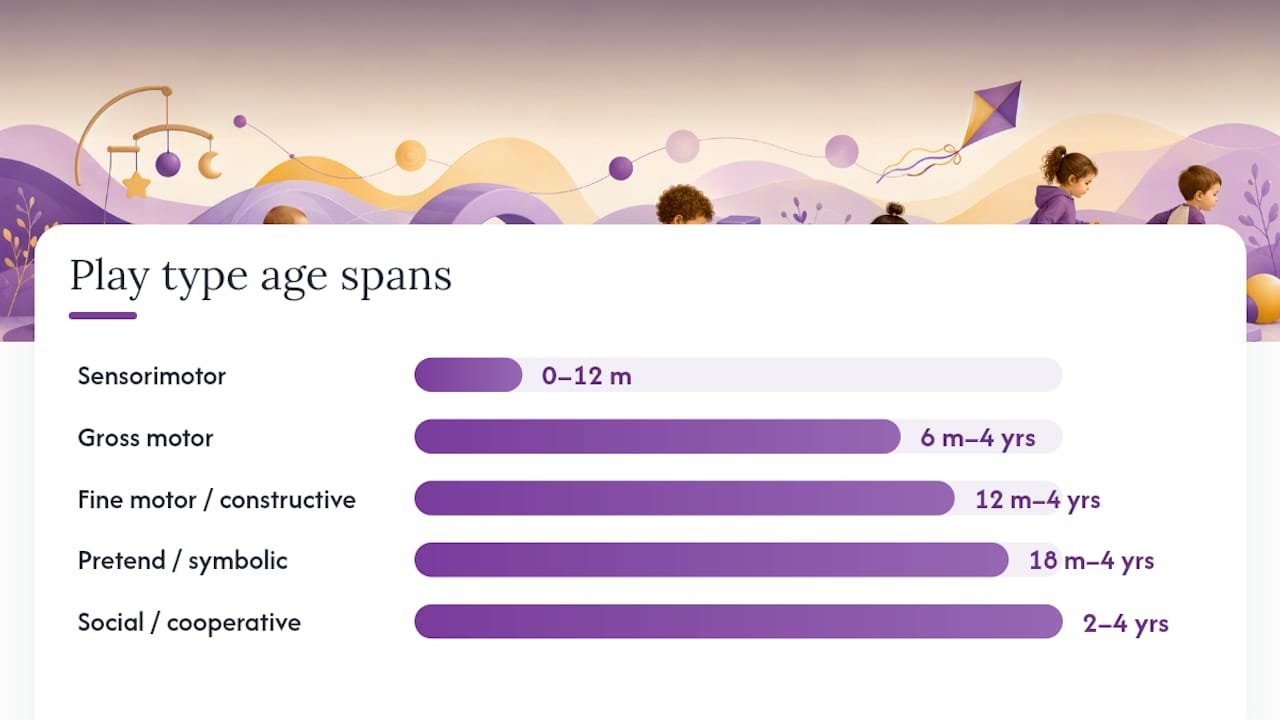
Most age-based activities fall into one of a handful of play categories, and knowing which one you’re offering helps you choose with intent rather than guesswork. Sensorimotor play (touch, taste, movement) dominates the first year. Gross motor play (crawling, walking, climbing) takes over as mobility develops. Fine motor and constructive play (stacking, cutting, building) grow through the toddler years. Pretend or symbolic play, social and cooperative play, and language-rich play all layer in from around 18 months onward, often overlapping in the same ten-minute session.
Each type maps to different long-term outcomes. UNICEF’s activity guidance for babies and toddlers notes that younger children need more adult scaffolding, while older toddlers get more benefit from peer interaction and open-ended pretend scenarios.
| Play type | Typical age range | Key developmental benefit |
|---|---|---|
| Sensorimotor | 0–12 months | Sensory processing, early brain wiring |
| Gross motor | 6 months–4 years | Balance, coordination, muscle strength |
| Fine motor / constructive | 12 months–4 years | Hand strength, pincer grip, planning |
| Pretend / symbolic | 18 months–4 years | Language, perspective-taking, creativity |
| Social / cooperative | 2–4 years | Turn-taking, empathy, self-regulation |
Executive function, the umbrella skill covering attention, working memory, and self-control, gets built across nearly all of these categories, which is why variety over a week matters more than mastering any single game.
How to Pick an Activity Without Overthinking It
You don’t need a curriculum. You need three quick filters and a routine loose enough to survive a bad night’s sleep.
- Check the age fit. Pick from the age bucket your child is actually in, not the one you wish they were in. A 14-month-old and a 22-month-old need genuinely different games.
- Match it to your energy, not just their attention span. A five-minute sensory bin beats an ambitious craft project on a day you’re running on empty.
- Repeat before you replace. If an activity worked yesterday, run it again today. Repetition is how toddlers build mastery, not a sign you’ve run out of ideas.
A gentle weekly rhythm, three slightly longer play windows and daily five-minute bursts, tends to work better than trying to fill every hour with structured activity. Short, repeated sessions spread across a week are considered developmentally sound and far easier to sustain than daily novelty.
Before any activity, run a quick safety check: no small parts within reach of a mouthing baby, close supervision for anything involving water, and a simple tidy-up habit (even a 60-second “put it back in the box” routine) so play doesn’t quietly turn into a mess that discourages you from starting again tomorrow.
Pro Tip: Set a phone timer for five minutes before you sit down to play. Knowing there’s a clear end point makes it far easier to start, especially at the end of a long day.
Why These Activities Are Trustworthy
Every activity on this page draws from established early years research rather than trend-driven parenting content. The core sources include Harvard’s Center on the Developing Child, the NHS, UNICEF, and ZERO TO THREE, organizations that specialize in child development rather than general parenting advice.
This article was written by samit, with an approach shaped by the same research base that informs the Mooshie Moments app. The app takes this same age-first, low-prep philosophy and personalizes it further, suggesting specific activities based on your child’s exact age, how much time you have, and how much energy you’re working with that day. It’s the difference between reading a list and getting the one activity that fits your actual afternoon.
What Actually Works Once the Novelty Wears Off
Here’s what surprises a lot of parents: the fanciest activity rarely wins. The plain cardboard box outlasts the character toy nine times out of ten, and the same peekaboo game your baby loved on Tuesday still works on Friday. Repetition isn’t a failure of imagination on your part; it’s how young children actually consolidate a skill.
The bigger issue isn’t knowing what to do. It’s prep overwhelm, the sense that play has to look curated to count. It doesn’t. A five-minute sock-sorting game has real developmental value, and it’s fine if your toddler gets bored after ninety seconds. Short pockets of boredom often push kids toward their own quiet, self-directed play, which is worth just as much as anything you set up for them.
— samit
Try Mooshie Moments for Ready-Made, Age-Matched Activities
Everything in this guide works without an app, but Mooshie Moments exists for the days you don’t have the bandwidth to think through which activity fits your child’s age and your available five minutes. It’s a screen-free tool that hands you the activity instead of asking you to plan one.
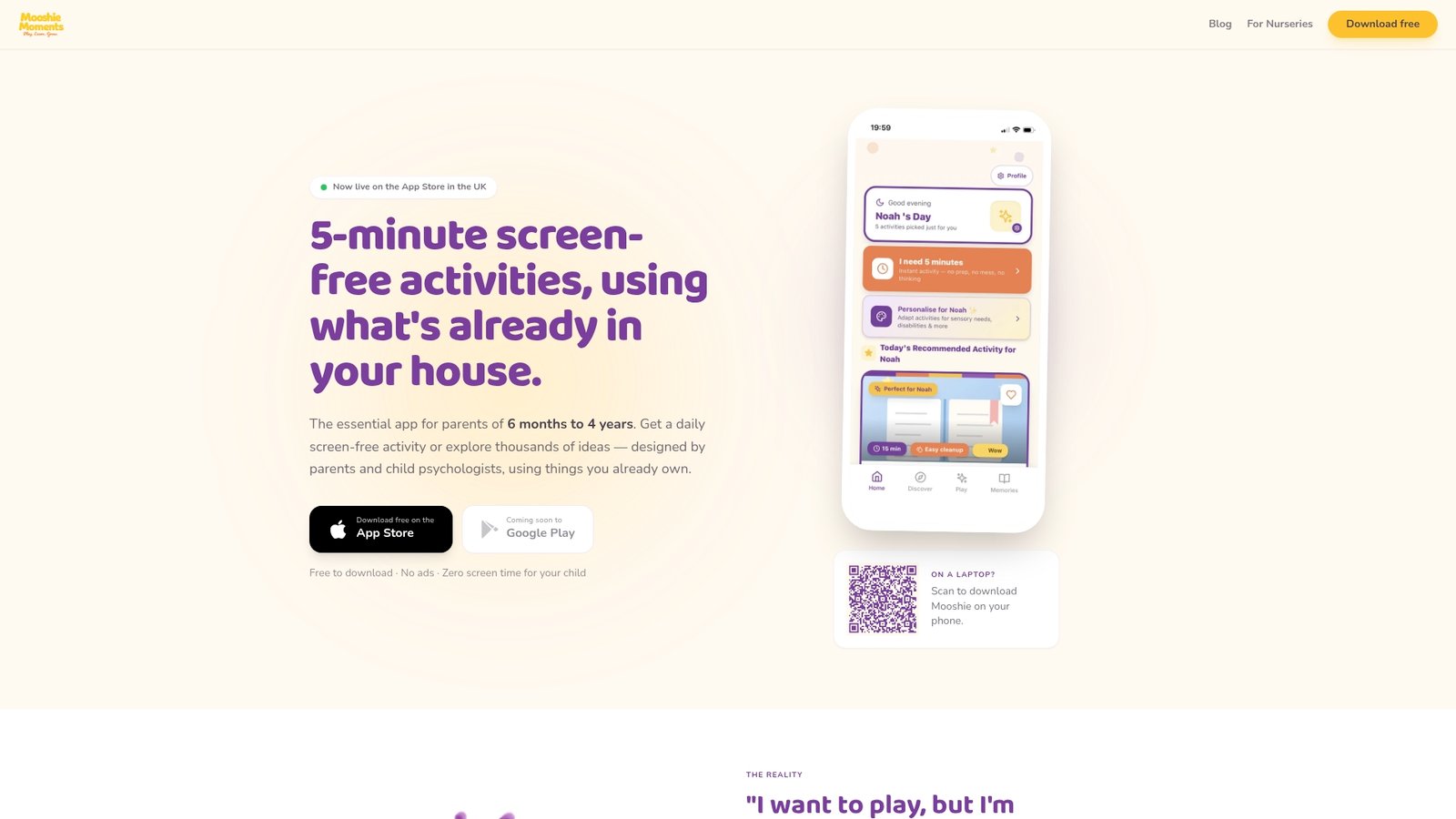
The app personalizes suggestions by child age and available time and energy, using research consistent with this article’s approach. If you’ve got a two-year-old, our 40 fun 2-year-old activities page is a strong next stop, and parents of younger babies will get more mileage from the 9-month-old activities guide. Nurseries and early years settings can also explore partnership packs built around the same age-based approach, complete with printable resources for the classroom. Download the app to get a tailored activity suggestion quickly.
Sources
- Executive function | Center on the Developing Child (Harvard University)
- 21 learning activities for babies and toddlers | UNICEF
- Play activities for 12 to 24 months | ZERO TO THREE
FAQ
What are some good play ideas for toddlers?
Simple household-item activities work best: cup stacking, sock sorting, playdough, and pretend cooking with real kitchen tools all build motor and language skills without special equipment. The NHS recommends exactly this kind of low-prep, everyday play.
What are the main types of play important in early childhood?
Sensorimotor, gross motor, fine motor and constructive, pretend or symbolic, social and cooperative, and language-rich play are the core categories most early years research points to, each supporting different skills from muscle strength to vocabulary and self-regulation.
What are five age-appropriate activities for toddlers?
Washing plastic toys in water, sorting mismatched socks by color, playing freeze dance, building simple pretend scenarios with stuffed animals, and stacking cups all fit well within the 12 to 24 month range, according to guidance from ZERO TO THREE.
How do I know what counts as age-appropriate play?
Age-appropriate play matches a child’s current motor, language, and attention abilities rather than a fixed schedule. If an activity frustrates or bores your child immediately, it’s usually a sign to shift a few weeks younger or older in the guidance you’re following.
Does Mooshie Moments suggest activities based on my child’s exact age?
Yes. Mooshie Moments personalizes suggestions using your child’s precise age between 6 months and 4 years, along with how much time and energy you have, drawing on the same research base cited throughout this guide.
Recommended
- Research Backed Nursery Activity Plans: 3 Daily 5 Minute Slots (UK)
- 40 Fun 2 Year Old Activities to Start Right Now
- 12 Low Prep Toddler Activities for Grandparents With Seated Options
Want a new idea every day, matched to your child's age?
Mooshie Moments gives you simple, guided play ideas for ages 6 months to 4 years.
Download free on the App StoreMore like this
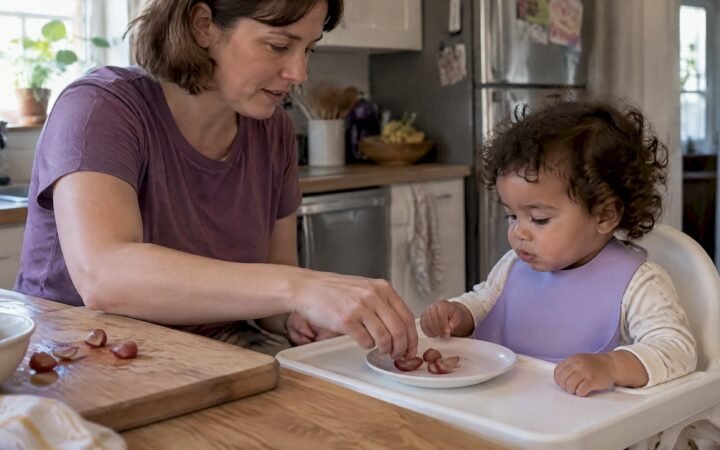
Babysitting Toddlers: 12 Low Prep Ideas and Why They Help
Explore 12 low prep toddler activities for babysitters, with developmental benefits, age adaptations, UK safety advice, and optional activity coaching.
10 EYFS Backed Sock Games for Toddlers Under Five Minutes
Ten EYFS aligned sock games to start in under five minutes, each with a one line developmental benefit, simple adaptations, and two…

Busy Parents: 12 No Prep Shopping Activities for Toddlers
Busy parents: keep toddlers learning and calm at the store with 12 no prep, screen free activities that take under five minutes…