
Fun 9-Month-Old Activities for Busy Parents
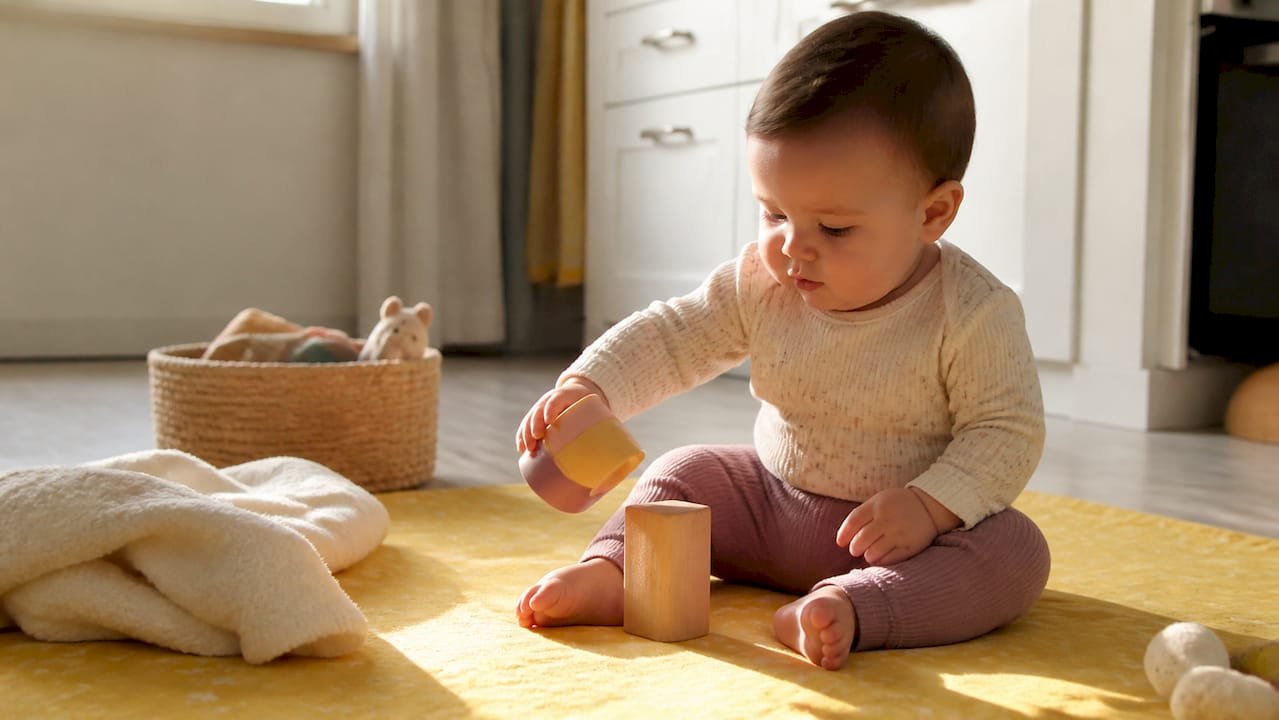
Here are 10 easy, screen-free activities your 9-month-old can try today, each one using things you already have at home.
Safety first: The AAP Bright Futures 9-month guidance recommends zero screen time at this age and advises using toys like balls, containers, and blocks to support motor and cognitive development. Always supervise play, remove any item smaller than a golf ball, and check all toys for button batteries before handing them over.
What you need (most activities): a soft blanket, a few plastic containers or cups, a wooden spoon, a pot, a board book, a small ball, and a non-breakable mirror.
10 activities to start right now:
- Sensory bin — fills little hands and builds tactile awareness
- Nature sensory corner — safe leaves and pinecones spark curiosity
- Sponge and water play — squeezing builds hand strength
- Pots and pans band — banging develops rhythm and cause-and-effect
- Stacking cups — knocking towers down is the whole point at this age
- Surprise box — pulling items out sharpens the emerging pincer grasp
- Mirror standing practice — a non-breakable mirror encourages pulling to stand
- Push-toy cruising — builds balance and early walking strength
- Peek-a-boo — teaches object permanence and delights every single time
- Board book naming — hearing words tied to pictures builds early language
Key Takeaways
Effective activities for 9-month-olds are simple, sensory-rich, and led by a present, responsive caregiver using everyday household items.
| Point | Details |
|---|---|
| Best activities to start with | Sensory bins, stacking cups, peek-a-boo, push-toy practice, and board book naming cover all key developmental areas. |
| Top safety rule | Remove anything smaller than a golf ball and check all toys for button batteries before every play session. |
| Play scheduling tip | Short bursts of 10–15 minutes mapped around naps and feeds work better than one long session. |
| Pincer grasp timing | Full pincer grasp mastery typically arrives around 11 months; at 9 months, focus on practice and exploration, not precision. |
| Mooshiemoments | The app provides age-matched, screen-free activity ideas for babies 6 months to 4 years, ready to use in minutes. |
If your baby is not babbling, not responding to their name, or not reaching for objects by 9 months, speak with your pediatrician.
Table of Contents
- What are the best 9-month-old activities to try at home?
- What milestones should a 9-month-old be hitting?
- How do you choose safe toys for a 9-month-old?
- How do you fit play into a 9-month-old’s day?
- Why do these simple activities actually matter?
- How do you introduce self-feeding at 9 months?
- How do you adapt activities for babies developing at different paces?
- What we really think about play at this age
- Mooshiemoments makes ready-made activity ideas easy to find
- Sources
What are the best 9-month-old activities to try at home?
These step-by-step how-tos cover the activities above in more depth. Each one takes under five minutes to set up.
Sensory bin
- Fill a shallow container with dry oats, crinkled paper, or fabric scraps.
- Sit your baby in front of it and let them dig in.
- Narrate what they touch: “That’s bumpy! That’s soft!”
- After a few minutes, swap one texture for another to reset interest.
Benefit: Tactile exploration builds sensory processing and focus. Variations: Use water beads (supervised closely) or a tray of cooked, cooled pasta. Safety: Stay within arm’s reach; remove anything small enough to swallow.
Nature sensory corner
- Collect a few large, smooth leaves, a pinecone, and a small rock from your yard.
- Place them on a blanket and let your baby handle each one.
- Name each item and describe its texture.
Benefit: Novel textures and shapes stimulate curiosity and early categorization. Variations: Try a seashell or a piece of bark. Safety: Check each item for sharp edges and small pieces before handing over.
Sponge and water play
- Fill a shallow dish with an inch of warm water.
- Drop in two or three kitchen sponges.
- Show your baby how to squeeze, and watch them copy you.
Benefit: Squeezing and releasing builds the hand strength that supports the pincer grasp. Variations: Add a small cup for pouring, or try this at bath time. Safety: Never leave a baby unattended near water, even a shallow dish.
Pots and pans band
- Set out a pot and a wooden spoon on the kitchen floor.
- Tap the pot yourself first, then hand the spoon to your baby.
- Add a second pot or a metal bowl to expand the “drum kit.”
Benefit: Banging teaches cause-and-effect and introduces rhythm. Variations: Hum a simple song while they play, or tap along to match their beat. Safety: Check that pot handles are cool and that no lids can trap fingers.
Stacking cups
and surprise box
- Stack three plastic cups into a tower.
- Let your baby knock it down, then rebuild it together.
- For the surprise box: drop a few soft toys into a container with a loose lid and let your baby pull them out one by one.
Benefit: Stacking and emptying develop early spatial reasoning. Pulling items out practices the hand-to-hand transfer and the beginning of the pincer grasp, as CHOC’s fine motor milestone guidance confirms. Variations: Use nesting bowls or a cardboard box with a hole cut in the top. Safety: Cups should be large enough that they cannot be swallowed.
Mirror standing
and cruising practice
- Prop a non-breakable mirror against a low, stable surface.
- Help your baby pull to stand in front of it.
- Slowly move a toy along the surface to encourage side-stepping.
Benefit: Rady Children’s Health notes that stable surfaces and push toys build the balance and strength babies need for early walking. A mirror adds visual feedback that keeps them engaged longer. Variations: Use a low coffee table or a sturdy cardboard box. Safety: Anchor the mirror so it cannot tip.
Push-toy practice
- Place a stable push toy (a laundry basket or a box of books works just as well) in front of your baby while they stand.
- Encourage them to push it forward one step at a time.
- Cheer each step.
Benefit: Builds leg strength and balance. Variations: Push a large ball across the floor together. Safety: Clear the path of rugs or obstacles that could cause a fall.
Interactive board book reading
- Sit your baby in your lap with a simple board book.
- Point to each picture and name it clearly: “Dog. Big dog.”
- Pause and wait — they may babble back.
Benefit: Hearing words tied to images builds vocabulary. Waiting for a response turns reading into a back-and-forth conversation, which Harvard’s Center on the Developing Child identifies as a key driver of early language and executive function. Variations: Use a bath book during tub time, or point to pictures in a magazine. Safety: Choose board books with rounded corners.
Pro Tip: Household items often hold a baby’s attention longer than purpose-built toys because they invite more variation. A wooden spoon and a metal bowl can become a drum, a stirring station, and a stacking game in the same ten-minute session, with no extra prep.
What milestones should a 9-month-old be hitting?
Most 9-month-olds are working on a busy cluster of new skills at once. Knowing what is typical helps you choose activities that meet your baby where they are.
Common milestones at 9 months:
- Sitting steadily without support
- Crawling, creeping, or scooting in some direction
- Pulling to stand when holding furniture
- Transferring objects from one hand to the other
- Beginning to develop a pincer grasp (thumb and index finger)
- Babbling with varied sounds (“ba-ba,” “da-da,” “ma-ma”)
- Responding to their own name
- Showing object permanence behaviors (looking for a hidden toy)
- Showing stranger anxiety or preference for familiar caregivers
From AAP Bright Futures: Sensory-rich play, daily routines, and responsive adult interaction are the building blocks of healthy development at this age. Zero screen time is recommended, with a family media plan used only when needed.
Red flags to discuss with your pediatrician:
- No babbling or response to their name by 9 months
- Not sitting without support
- Not reaching for or grasping objects
- No hand-to-hand transfer of objects
- Limited eye contact or visual engagement
- No interest in faces or social games like peek-a-boo
None of these signs alone means something is wrong, but they are worth raising at your next well-child visit. Seattle Children’s toy and play guidance also notes that exploration, stacking, and enjoying peek-a-boo are typical play behaviors for this age window.
How do you choose safe toys for a 9-month-old?
At 9 months, everything goes in the mouth. That makes material and size the two most important factors in any toy choice.
Toy safety checklist:
- No parts smaller than a golf ball (choking hazard)
- No button batteries or small magnets — these are life-threatening if swallowed, per Seattle Children’s safety guidance
- Materials safe for mouthing: BPA-free plastic, natural rubber, or food-grade silicone
- Durable enough to survive chewing without breaking into pieces
- Age-appropriate labeling (look for “6–12 months” or “12 months and up” as a guide)
- No long strings or cords (strangulation risk)
Cleaning tips: Wipe hard plastic toys with a baby-safe disinfectant wipe after each session. Fabric toys should be machine-washable. Dry all toys thoroughly before storing to prevent mold. For sensory bin fillers like dry oats or pasta, replace them every few days.
Supervising mouthing: Mouthing is normal and healthy at this age. The goal is not to stop it but to make sure everything within reach has passed a safety check. Scan the play area before each session and remove coins, small toy parts, and anything with a battery compartment.
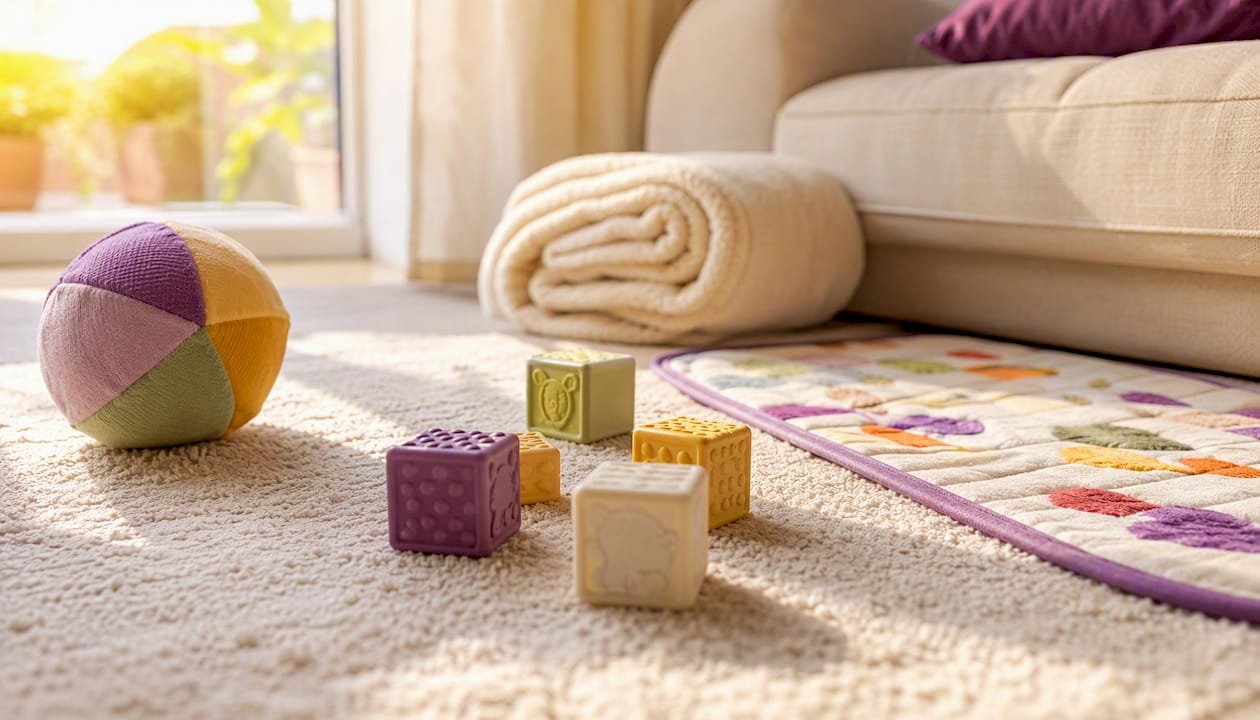
Pro Tip: Before buying any new toy, do the “toilet paper roll test”: if the item fits inside an empty toilet paper roll, it is a choking hazard for a 9-month-old.
How do you fit play into a 9-month-old’s day?
Short, frequent bursts of play work far better than one long session. Most 9-month-olds are awake for several hours between naps, which gives you natural windows to work with.
Sample day (two-nap schedule):
- Morning wake-up (30 min): Diaper, feed, then 10–15 minutes of floor play — sensory bin or stacking cups.
- Pre-nap wind-down: Board book reading in your lap, calm and quiet.
- Post-nap burst (20 min): Active play — push-toy practice, mirror standing, or a crawling course made from couch cushions.
- Afternoon feed + outdoor time: Blanket on the grass, nature sensory corner, or a short walk in a carrier or stroller.
- Pre-bedtime: Bath-time sponge play, then a board book and a song.
BabyCenter’s activity guide for 7–9 months recommends mapping short play bursts around feeds and naps exactly like this, rather than trying to sustain one long play period.
To help a busy baby use energy safely:
- Set up a simple crawling course using rolled blankets and couch cushions as obstacles
- Take a short outdoor walk; even 10 minutes of new sights and sounds is tiring in the best way
- Play a few rounds of “drop and fetch” — they drop a toy, you hand it back, repeat
Signs of overstimulation to watch for:
- Turning their head away or arching their back
- Fussing or crying that does not stop when you engage
- Rubbing eyes or yawning mid-play
- Going limp or losing interest suddenly
When you see these signs, Zero to Three’s play guidance recommends pausing the activity, reducing noise and stimulation, and giving your baby a few quiet minutes before trying again.
Why do these simple activities actually matter?
The activities in this article are not just ways to pass time. They are building blocks for your baby’s brain, body, and language.
Here is what the research points to for each activity type:
- Sensory play supports tactile processing and attention regulation.
- Motor activities (crawling courses, push toys) build the gross motor strength and balance that Rady Children’s Health links to healthy physical development.
- Fine motor practice (stacking, emptying containers) prepares the hand for the pincer grasp. According to WebMD’s pincer grasp overview, full mastery of the pincer grasp typically arrives closer to 11 months, so at 9 months the goal is repeated practice — dropping, poking, and picking up — not precision.
- Language activities (naming, reading, vocal imitation) build vocabulary through repetition and responsive back-and-forth.
- Social games (peek-a-boo, facial expression games) teach emotional regulation and the basics of turn-taking.
Repetition matters more than variety. A baby who plays the same stacking game ten times in a row is not bored; they are consolidating a skill. Caregiver responsiveness — joining the play, narrating what you see, pausing when they signal they need a break — produces stronger learning gains than any specific toy or activity.
How do you introduce self-feeding at 9 months?
Nine months is a natural starting point for early self-feeding, and it doubles as a fine motor activity. Most babies this age are ready to handle soft finger foods and to practice bringing food to their mouths independently.
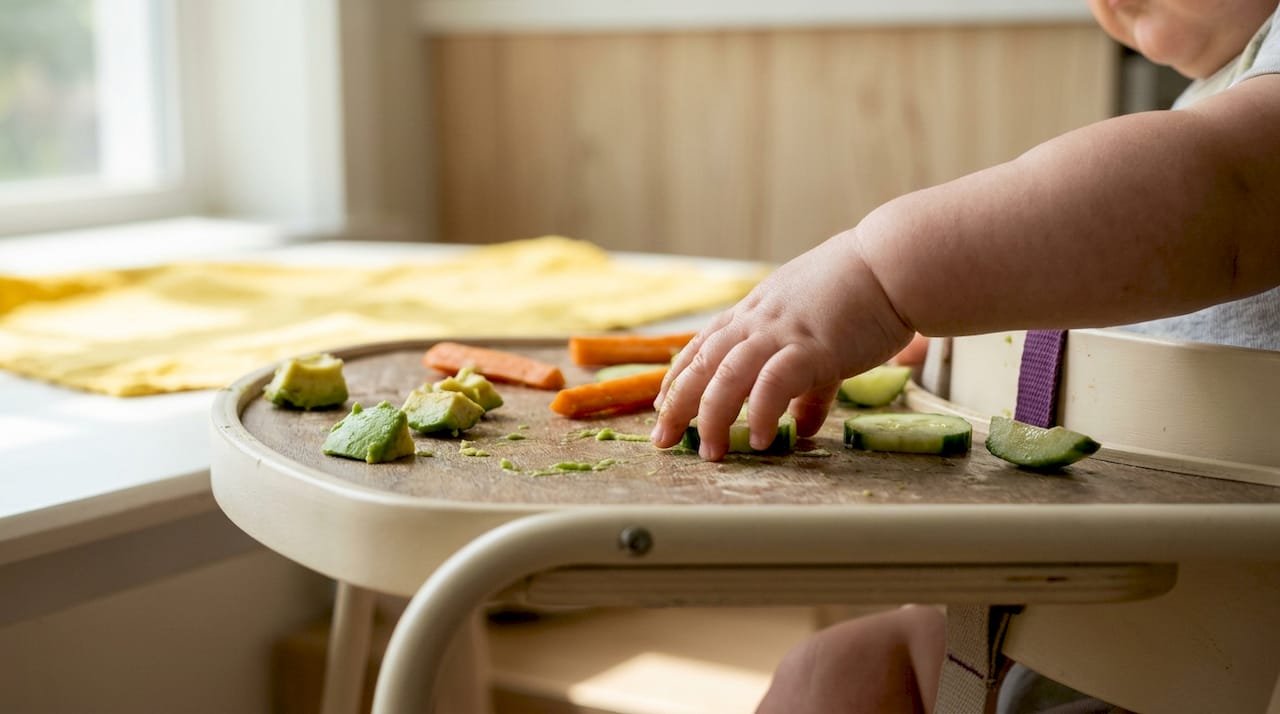
Start with soft, easy-to-grip pieces: small cubes of ripe banana, well-cooked sweet potato, or soft-cooked peas. Place two or three pieces on the high chair tray and let your baby pick them up. The process is messy and slow, and that is exactly the point. Picking up small pieces of food is one of the most natural ways to practice the emerging pincer grasp in a context that is genuinely motivating for your baby.
A few practical notes: always stay seated with your baby during self-feeding, keep pieces small enough to dissolve or mash easily, and avoid round, firm foods like whole grapes or raw carrot sticks at this age. If your baby is not yet showing interest in picking up food independently, that is fine. Offer the opportunity without pressure and follow their lead.
How do you adapt activities for babies developing at different paces?
Not every 9-month-old is in the same place, and that is completely normal. Some babies are pulling to stand; others are still working on sitting steadily. Some are babbling constantly; others are quieter. The activities in this article can flex to meet your baby where they are.
For babies who are not yet crawling: Focus on tummy time with a toy just out of reach to encourage movement. Sensory bins and board book reading work well from a seated or supported position.
For babies with limited hand strength or grip: Use larger objects — a big sponge, a soft ball, a chunky board book. Reduce the fine motor demand and focus on exploration rather than precision.
For babies who are more sensitive to sensory input: Start with one texture at a time in the sensory bin. Keep sessions short (3–5 minutes) and watch closely for signs of discomfort. Dry oats or smooth fabric scraps tend to be gentler starting points than crinkled paper or rough textures.
For babies who are ahead of the curve: Add more challenge. Use smaller stacking pieces, introduce a simple shape sorter, or extend the crawling course. Zero to Three’s responsive play framework puts it well: follow the baby’s lead and adjust the activity to match their current interest and ability, not the other way around.
If you have ongoing concerns about your baby’s development, your pediatrician or a referral to an early intervention specialist is always the right next step.
What we really think about play at this age
There is a lot of pressure on parents to do the “right” activities, buy the “right” toys, and hit every milestone on schedule. From where we sit, that pressure misses the point entirely.
The research is clear: what matters most at 9 months is not the specific activity but the quality of the interaction. A parent who narrates a simple game of peek-a-boo with genuine warmth is doing more for their baby’s brain than one who runs through a structured curriculum with half their attention elsewhere. Simple, screen-free play with a present caregiver is genuinely enough.
The Mooshiemoments app was built on exactly that principle. The activities in the app are short, low-prep, and grounded in child-development research — not because we want to make parenting feel like homework, but because we know that most parents are tired and short on time, and that the best activity is one you can actually do today.
Mooshiemoments makes ready-made activity ideas easy to find
Every day with a 9-month-old brings a new energy level, a new nap schedule, and a new window of about 20 minutes where you need something to do. Mooshiemoments gives you a library of quick, screen-free, research-backed activities matched to your child’s exact age, your available time, and your energy level — no prep, no purchases, no guessing.
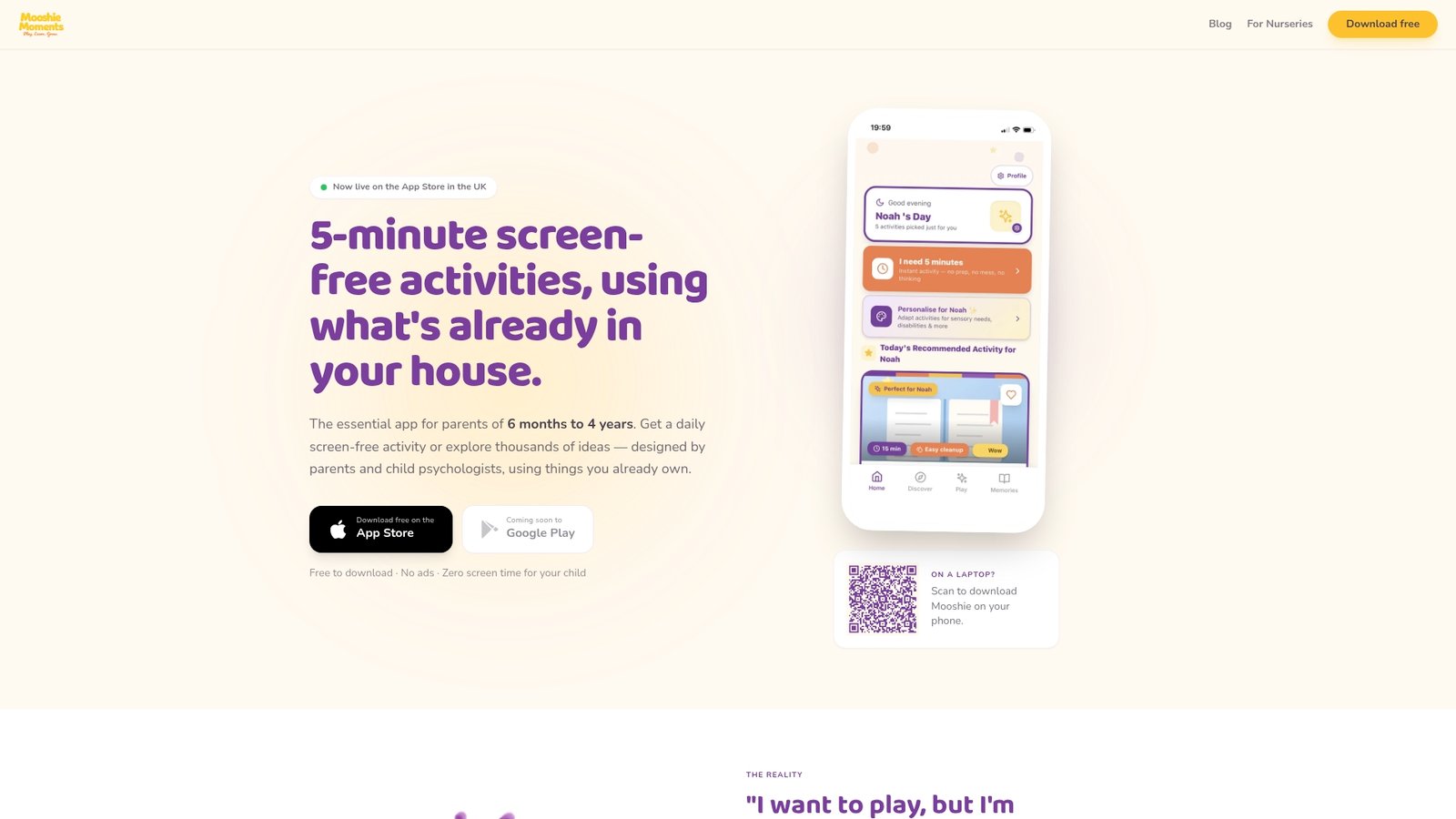
Each activity in the app comes with a short developmental explanation and coaching tips, so you always know what your baby is getting out of it. The library covers ages 6 months through 4 years, which means the ideas grow with your child.
- Screen-free: every activity is hands-on and caregiver-led
- Research-aligned: grounded in the same child-development evidence cited in this article
- Low-prep: built around household items you already own
- Nursery-ready: childcare providers can access the Home Learning Partnership for ready-made parent packs and usage tracking
Download the app and browse the 9-month activity library today at Mooshiemoments.
Sources
These are the primary sources used throughout this article. Each one is free to access and worth bookmarking.
- Bright Futures Information for Parents: 9 Month Visit
- Rady Children’s Health (health library)
- Play activities for birth to 12 months (Zero to Three)
- Toys and Play: Birth to 12 Months (Seattle Children’s)
- What to know about pincer grasp (WebMD)
- 15 best activities for 7- to 9-month-olds (BabyCenter)
Recommended
More like this
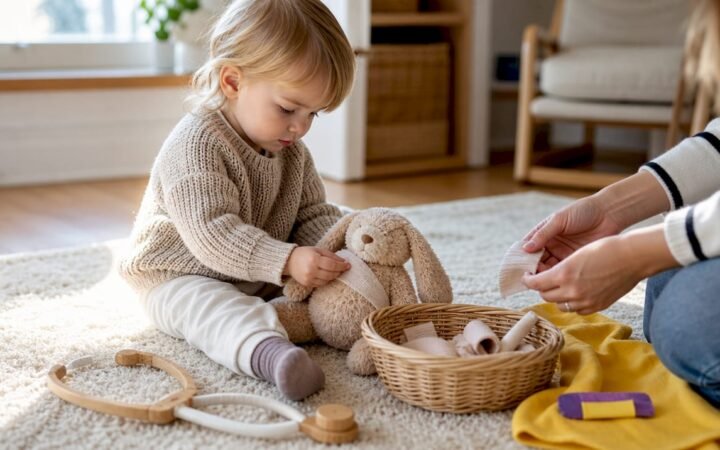
40+ Invitation to Play Ideas for Busy UK Parents and Educators
40+ low prep invitations to play using taste safe household items, age adapted setups, and a five minute staging method you can…
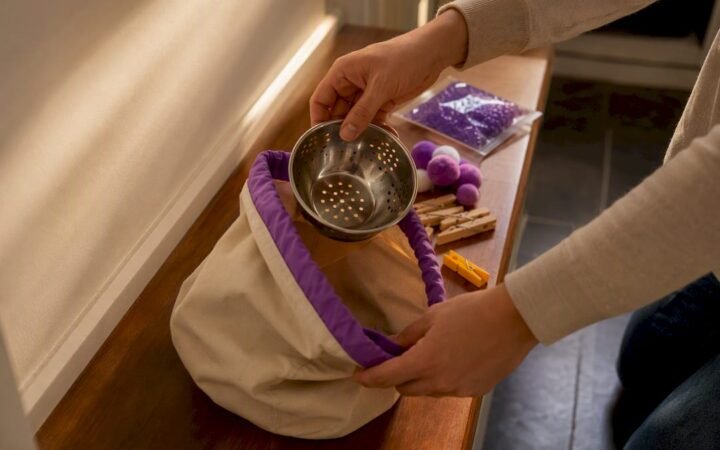
12 Budget Friendly Busy Bag Ideas for Toddlers: Pack in 15 Minutes
12 budget friendly, screen free busy bag ideas for toddlers. Pack a pouch in 15 minutes, rotate to keep interest, and build…
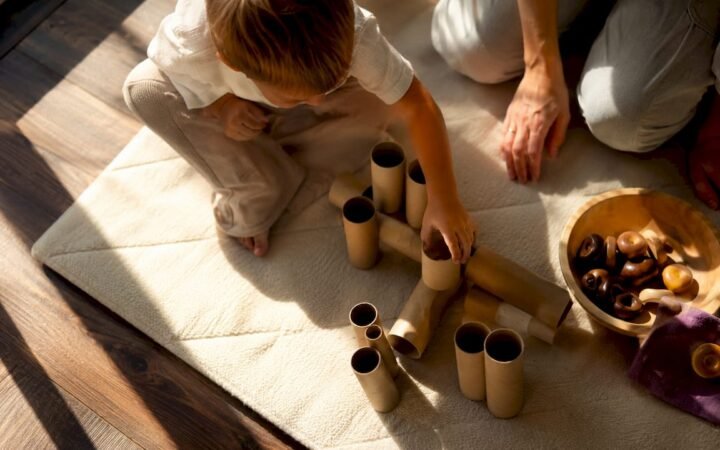
10-Minute Loose Parts Play for UK Toddlers: Toilet-Roll Safety
Start loose parts play in 10 minutes with household items. Follow the toilet-paper-roll safety check, rotate materials, and try quick, low-prep activities...