
9 Attachment Play Types and 10 Quick Games for Toddlers

Attachment play is short, attuned caregiver-child games that use touch, eye contact, mirroring, or rhythm to build emotional connection and help toddlers regulate big feelings. It comes from Dr. Aletha Solter’s Aware Parenting model, and it works because presence matters more than props. A few minutes a day, using ideas like the built-in ones some apps provide, can shift how connected and calm your toddler feels.
TL;DR:
- Attachment play relies on touch, eye contact, mirroring, rhythm, and contingency to create a sense of safety and understanding for toddlers.
- Simple household objects and quick games, such as mirror or peek-a-boo, can effectively strengthen connection without requiring extra preparation or time.
- Using controlled separation games and consistent routines helps reduce separation anxiety by gradually building object permanence and trust.
- Signs of attachment issues in toddlers include persistent, severe distress, social withdrawal, and regression that worsens over time, prompting professional support.
- Screen-free apps and activity guides can support daily attachment play by providing timely, developmentally appropriate prompts aligned with core attachment principles.
Table of Contents
- What Makes Play “Attachment Play” for a Toddler?
- What Are the Nine Types of Attachment Play?
- Low-Prep Attachment Games You Can Try Today
- Using Attachment Play to Ease Separation Anxiety
- When a Toddler Might Need More Support
- Fitting Attachment Play Into a Busy Day
- How Mooshie Moments Supports Daily Attachment Play
- A Note on Starting Small
- Try Mooshie Moments for Screen-Free Attachment Play Prompts
- Sources
- FAQ
What Makes Play “Attachment Play” for a Toddler?
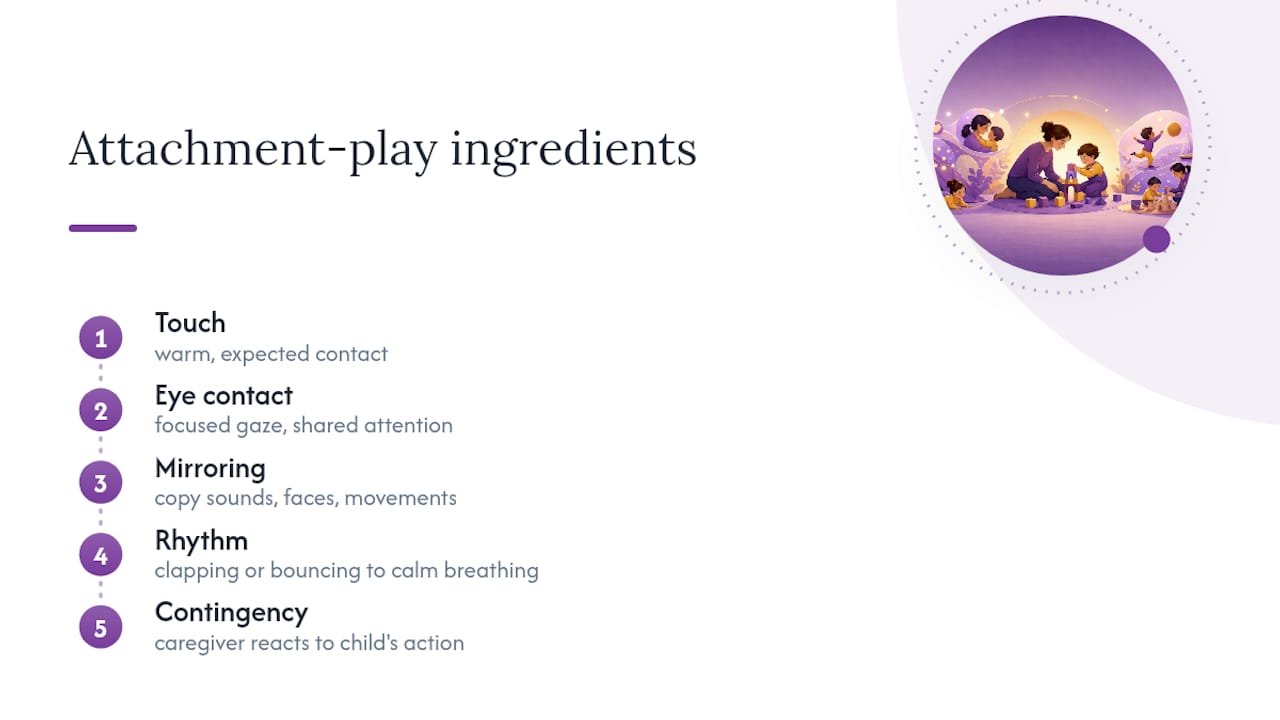
Not every game qualifies. Attachment play works because it stacks specific ingredients that tell a toddler’s nervous system “you are safe and seen.” Leave one out and you still have fun. Include them and you get something closer to therapy disguised as play.
Touch comes first. A hand on the back during a wobbly walk, a piggyback ride, a squeeze during a hug game. Toddlers often exhale audibly or go limp with relaxation when touch is warm and expected rather than sudden.
Eye contact signals focused attention. Locking eyes during a silly face game or a slow countdown before tickles (with consent) tends to produce an almost instant grin.
Mirroring means copying your toddler’s sounds, faces, or movements back at them. Copy a toddler’s stomp and pause, and you’ll often see them repeat it, checking if you noticed. This is the moment they feel understood.
Rhythm, through clapping games, songs, or bouncing knee-rides, calms breathing and helps toddlers predict what happens next, which builds a sense of safety.
Finally, contingency ties it together: your response depends directly on their action. Peek-a-boo only works because your face appears in response to their wait. That immediate cause-and-effect loop is what M‑MAT’s attachment-based play framework identifies as central to why these games regulate emotion so effectively.
What Are the Nine Types of Attachment Play?
Solter’s Aware Parenting framework organizes attachment play into nine distinct categories, and each one solves a slightly different emotional job. You don’t need to memorize the names. You do need a few examples on hand for the moments that call for them.
- Nondirective, child-centered play: Follow your toddler’s lead completely for ten minutes, no redirecting, no teaching.
- Symbolic play: Let a toddler “feed” a stuffed rabbit or pretend a spoon is a phone, working through real-life scenes at a safe distance.
- Contingency play: Peek-a-boo, where your reaction depends entirely on their action.
- Nonsense play: Say a word wrong on purpose (“Is this your nose? No, it’s your elbow!”) and let them correct you, giggling.
- Separation play: Hide behind a couch, then pop back into view, practicing goodbyes and returns.
- Power-reversal play: Let your toddler “boss” you, telling you to sit, stand, or crawl.
- Regression play: Rock or bottle-feed an older toddler like a baby for a few minutes, especially useful after a new sibling arrives.
- Body contact play: Wrestling gently, cuddling, or a slow-motion “monster hug.”
- Cooperative play: Building a block tower together toward one shared goal.
Separation play and regression play tend to do the heaviest lifting for separation anxiety and sibling jealousy. Power-reversal and nonsense play are the ones most likely to end in real, cleansing laughter, which lowers stress on its own.
Low-Prep Attachment Games You Can Try Today
Attachment play doesn’t need a shopping list. Most of these use items already sitting in your living room, and practitioner guides consistently point to household objects like blankets, scarves, and cardboard as the only real requirements.
- Floor play: Mirror game. Sit facing your toddler and copy every face and sound they make for one minute. Watch for a moment of surprised delight when they realize you’re following them.
- Floor play: Blanket peek-a-boo. Drape a light scarf over your own face, not theirs, and pull it away on their cue. Progress by letting them cover you instead.
- Mealtime: Feed-the-feeder. Offer your toddler a bite of your food, then ask for a “bite” back. This flips the usual power dynamic and often gets a laugh.
- Mealtime: Silly-name game. Point to a spoon and call it a shoe. Let your toddler correct you loudly.
- Bedtime: Baby-again cuddle. Rock your toddler like an infant for two minutes before lights out, especially helpful if a sibling arrived recently.
- Bedtime: Goodnight hide. Hide a small stuffed animal under the blanket, then “find” it together with exaggerated surprise.
- Outdoors: Chase-and-catch. Let your toddler run a short distance, then catch them in a hug. Reverse it so they chase you.
- Outdoors: Leaf-drop peek-a-boo. Hide behind a tree or bush and pop out.
- Car or waiting: Finger walk. Walk your fingers up their arm, pausing before a gentle “got you” squeeze; stop instantly if they pull away.
- Waiting rooms: Copy-my-sound. Make a quiet noise and wait for them to repeat it back.
Never tickle without a clear, ongoing “yes,” and stop the moment a toddler tenses, turns away, or says no. Once a toddler masters a game, extend the pause before the reveal. Longer anticipation, met with the same joyful payoff, deepens the regulation effect.
Using Attachment Play to Ease Separation Anxiety
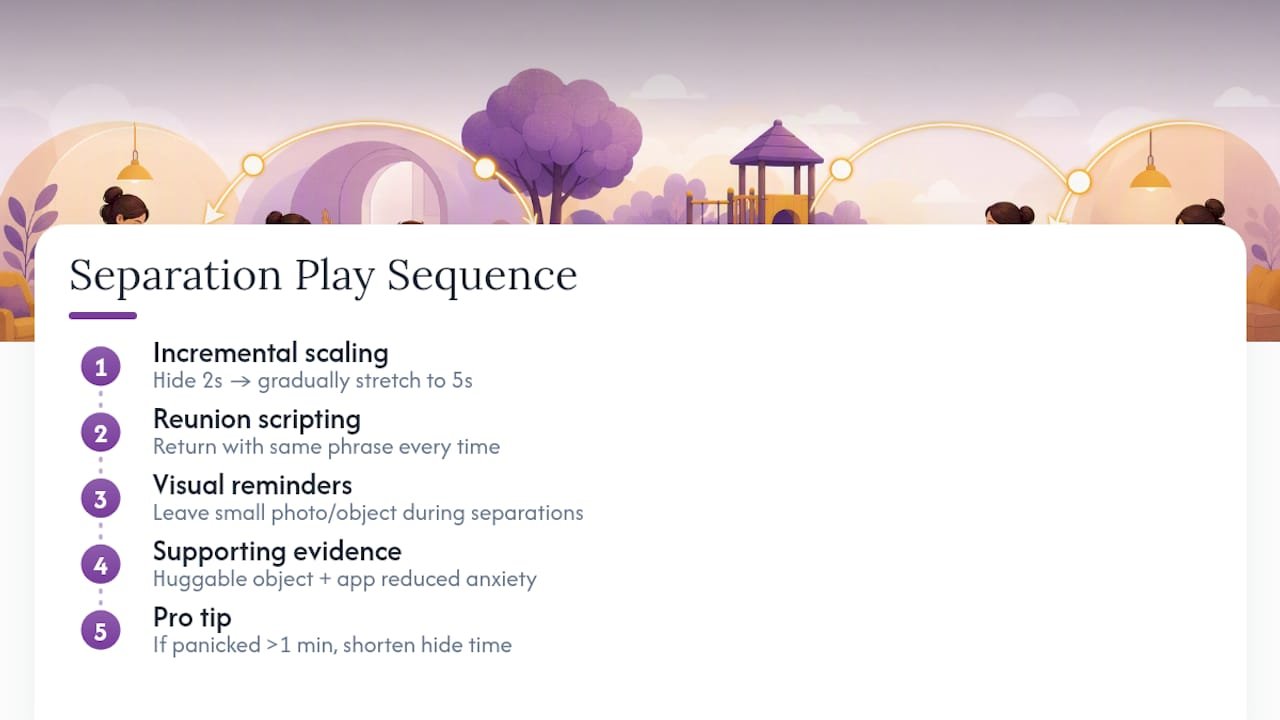
Separation anxiety often peaks because toddlers are still building object permanence, the understanding that you still exist when out of sight. Separation play gives them controlled practice at that skill, in small, safe doses, rather than forcing it during a real drop-off.
Try three exercises in sequence. First, incremental scaling: hide behind a door for two seconds, then reappear; stretch to five seconds over several sessions. Second, reunion scripting: use the exact same phrase every time you return (“I’m back, I missed you!”) so the pattern becomes predictable. Third, visual reminders: leave a small photo or object with your toddler during real separations, tying it to the game they already trust.
A small study combining a huggable object with a game-based app found reduced anxiety and improved adaptation in a preschool sample, though the group was small, which hints that touch paired with predictable play may ease separation stress generally.
Pro Tip: If your toddler cries hard and can’t be soothed within a minute, that’s panic, not manageable distress. Shorten the hide time and rebuild trust slowly rather than pushing through.
When a Toddler Might Need More Support
Most separation struggles and clinginess ease with consistent, attuned play. Watch for red flags that go beyond typical toddler behavior: extreme distress that doesn’t settle after reunion, pulling away from all social contact, or regression that keeps worsening instead of improving over a couple of weeks.
If you notice these patterns, talk to a health visitor, your GP, or an early-years specialist, who can refer you to child mental health support if needed. In the meantime, protect predictable routines, keep offering short, attuned play slots daily, and jot down what you notice so you have concrete examples ready for that conversation.
Fitting Attachment Play Into a Busy Day
You don’t need a scheduled block of time. Attachment play works in slivers, stacked onto things you’re already doing.
- 2-minute slot: Mirror game while waiting for toast to pop.
- 5-minute slot: Baby-again cuddle before a book at bedtime.
- Transition slot: Chase-and-catch on the walk from car to front door.
- Seated option: Finger walk or silly-name game, ideal for grandparents or anyone with lower energy or mobility.
- Shared caregiving: Agree on one signature game (like the same peek-a-boo phrase) so every caregiver, from parents to grandparents, delivers it the same way for consistency.
Mooshie Moments’ seated activity ideas for grandparents work well here, since they’re built for exactly this kind of low-movement, high-connection moment. Narrating what you’re doing during play also builds language alongside attachment; narrating play is worth pairing with any game on this list.
How Mooshie Moments Supports Daily Attachment Play
Finding the right game at the right moment, with the energy you actually have, is the hard part. Some apps match age, available time, and energy level to screen-free activity ideas based on child development research, without turning it into a clinical exercise.
Beyond the app itself, resources like 2-year-old activity packs and taste-safe sensory play ideas map directly onto the touch and rhythm elements covered earlier. A parent’s guide to sensory play from Baby Bare Essentials offers a complementary look at how sensory experiences support emotional regulation. Using an app can provide ready-made prompts in moments of low energy rather than leaving you to invent activities.
A Note on Starting Small
Perfect technique isn’t the goal here. Attunement is. Pick one game from this list, try it for two minutes today, and watch your toddler’s face. That’s the whole experiment.
Try Mooshie Moments for Screen-Free Attachment Play Prompts
Some apps offer an alternative to guessing what game might work, providing activities matched to age and available time and energy.
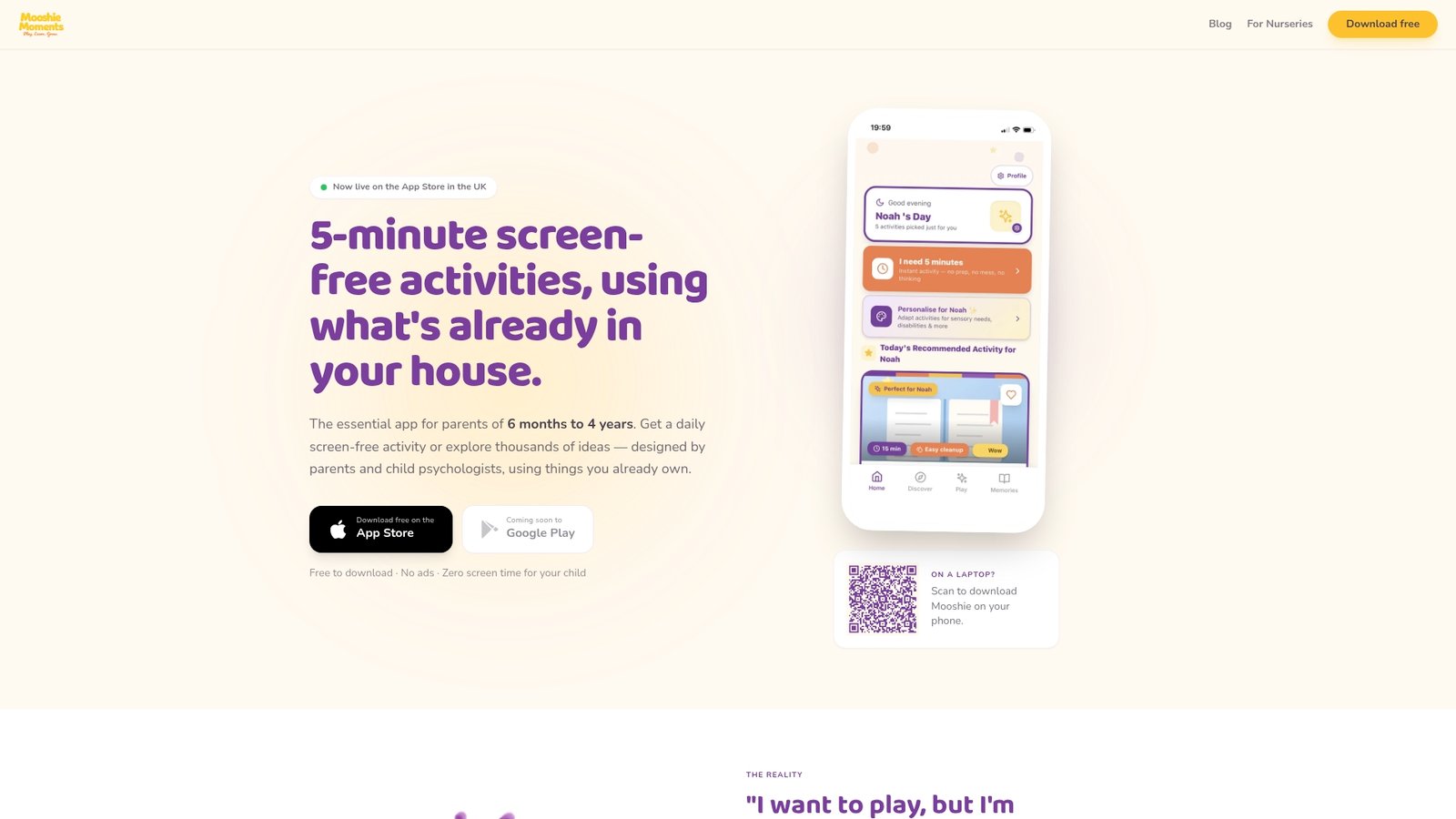
Certain apps draw on attachment-play principles (touch, rhythm, mirroring, contingency) to create quick prompts using household items. These prompts can be used by grandparents and other caregivers to help maintain consistent connective games. If sibling jealousy or bedtime resistance is the current struggle, the 2-year-old activity pack is a solid place to start. Open the app tonight and let it hand you tomorrow’s five-minute plan.
Sources
- Attachment Play — Wikipedia
- Separation anxiety — Anna Freud Centre
- Mmatti
- Using mediated social touch and game-based apps to support preschoolers — MDPI (2023)
FAQ
What are signs of attachment issues in toddlers?
Watch for persistent extreme distress that doesn’t settle after reunion, social withdrawal, or regression that keeps getting worse rather than easing over a couple of weeks. If these persist, a health visitor or GP can guide next steps.
What is the 3-3-3 rule for toddlers?
Definitions of this rule vary across parenting sources and it isn’t part of the Aware Parenting framework this article draws on, so it’s worth checking directly with the specific source you encountered it from rather than assuming one fixed meaning.
Can a 2-year-old be too attached to mom?
Strong attachment at age two is developmentally typical, not a problem to fix. Object permanence is still forming at this age, which is exactly why separation play and predictable reunions help toddlers build confidence at their own pace.
At what age does attachment peak?
Separation anxiety commonly intensifies as object permanence develops, then generally eases as toddlers gain more practice with safe separations and returns.
Can an app really support attachment play?
Yes, when it’s used as a prompt rather than a replacement for your presence. Mooshie Moments suggests screen-free, age-matched games built around the same touch, eye contact, and rhythm elements that make attachment play effective.
Recommended
- 12 Low Prep Toddler Activities for Grandparents With Seated Options
- Taste Safe Sensory Play: Top 10 Ideas for Mouthing Toddlers
- How to Narrate Play for Your Toddler’s Language Growth
Want a new idea every day, matched to your child's age?
Mooshie Moments gives you simple, guided play ideas for ages 6 months to 4 years.
Download free on the App StoreMore like this

Babysitting Toddlers: 12 Low Prep Ideas and Why They Help
Explore 12 low prep toddler activities for babysitters, with developmental benefits, age adaptations, UK safety advice, and optional activity coaching.
10 EYFS Backed Sock Games for Toddlers Under Five Minutes
Ten EYFS aligned sock games to start in under five minutes, each with a one line developmental benefit, simple adaptations, and two…

Busy Parents: 12 No Prep Shopping Activities for Toddlers
Busy parents: keep toddlers learning and calm at the store with 12 no prep, screen free activities that take under five minutes…