
4–8 Toys: Montessori, Behavior Led Toy Rotation for Toddlers
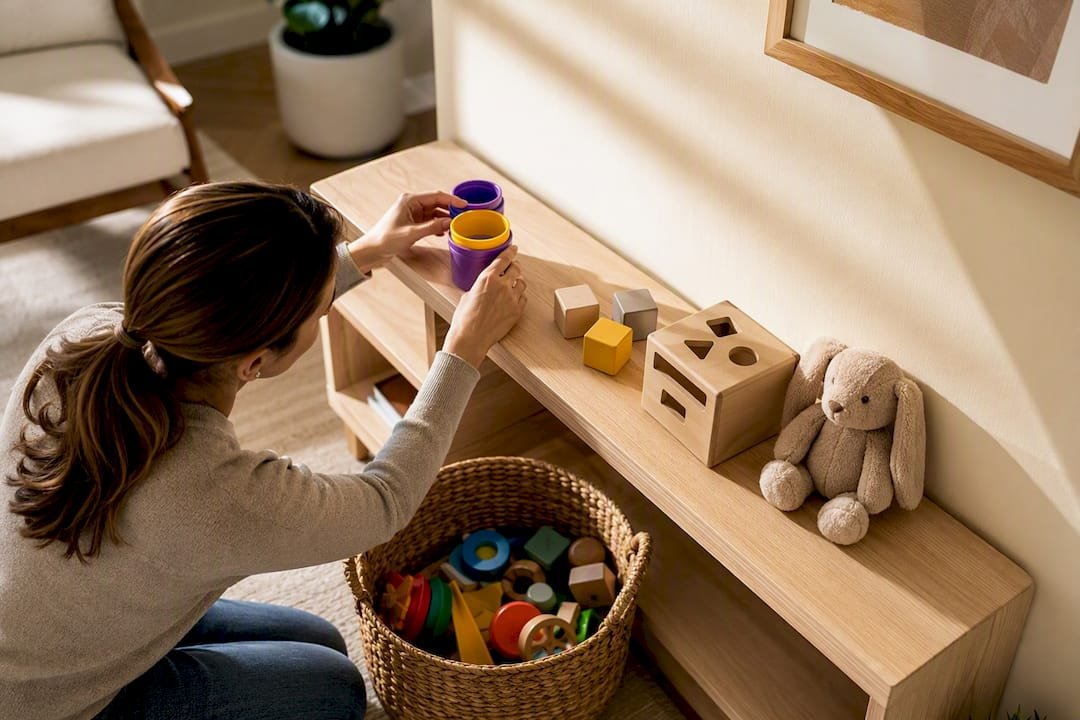
Toy rotation means keeping a small selection of toys accessible while storing the rest out of sight, then swapping items in and out over time. For most toddlers, a smaller rotating set leads to longer, more focused play and a much easier cleanup routine. Start with roughly 4 to 8 items, grouped by play type, and swap based on what your child’s behavior tells you, not a fixed calendar.
TL;DR:
- Limiting toys to four to eight per category increases focused play and reduces overstimulation, aligning with Montessori recommendations.
- Rotation based on observing your child’s engagement and developmental cues maintains interest better than fixed schedules.
- Using clear storage bins and simple labeling makes swapping toys quick, typically under 15 minutes, and preserves system consistency.
- Open-ended toys like blocks and play dough last longer in rotation because they support multiple types of play activities.
- Incorporating activity ideas from apps can extend the usefulness of toys without additional purchases, keeping play fresh.
Table of Contents
- Why Toy Rotation Toddler Systems Actually Work
- How Many Toys Should Be Out at Once?
- When Should You Actually Rotate the Toys?
- Setting Up a Toy Rotation System in Under 20 Minutes
- What Makes a Toy Worth Rotating In
- Storage Tricks That Keep Rotation From Falling Apart
- Watching Play to Understand Development
- What I’ve Learned Watching Rotation in Real Homes
- Refresh Play Without Buying a Single New Toy
- Sources
Why Toy Rotation Toddler Systems Actually Work
Fewer choices, deeper play. That is the whole mechanism behind toy rotation, and it holds up under scrutiny. Parenting coverage summarizing experimental comparisons found that toddlers given fewer toys played more creatively and for longer stretches than toddlers surrounded by many toys. Give a two-year-old sixteen options and you get a lot of scanning and dropping. Give them four good ones and you get actual play.
Rotation solves several problems at once:
- Longer attention spans during independent play
- Less visual clutter, which reduces overstimulation
- Easier, faster cleanup at the end of the day
- A built-in way to notice what your child is working on developmentally
That last point matters more than most parents realize. Rotation is not just tidiness management. It is a low-key observation tool. When you watch which toys your toddler returns to after a swap, you start seeing patterns: a sudden obsession with stacking, a phase of dumping and refilling containers, a fixation on anything with a lid. Those patterns are windows into what skill they are currently practicing.
How Many Toys Should Be Out at Once?
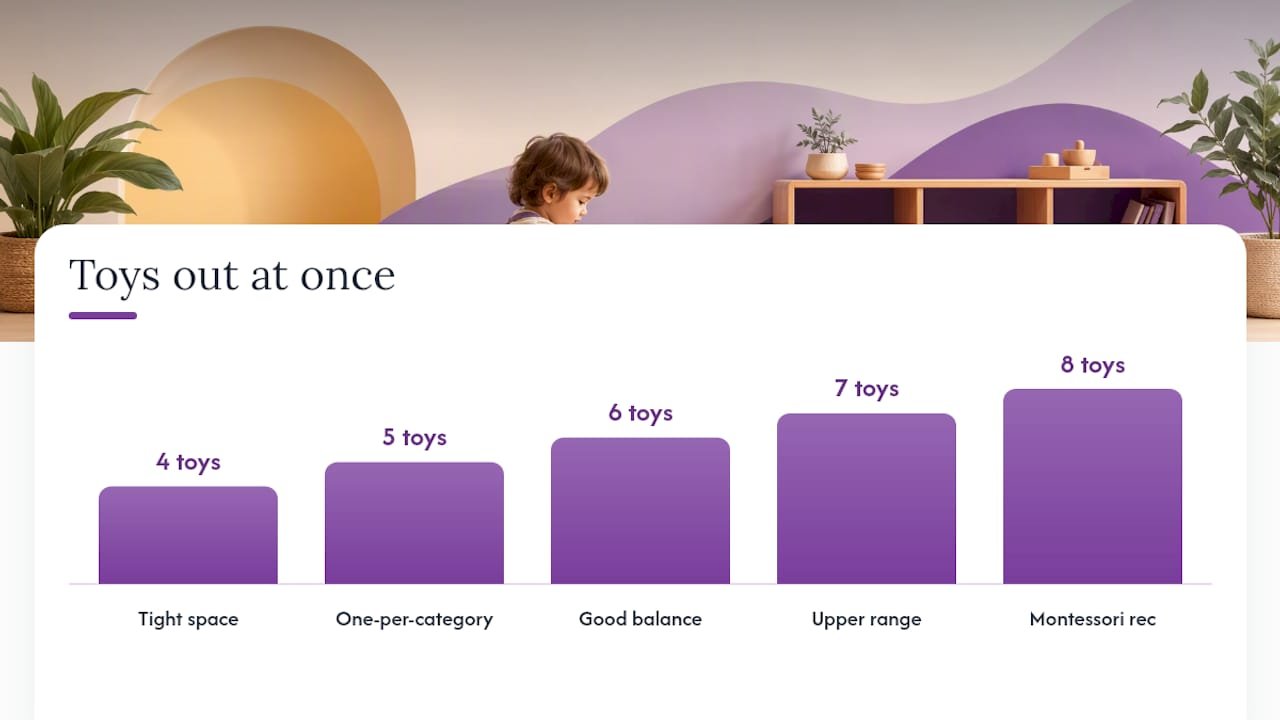
There is no single magic number, and anyone promising one is oversimplifying. Space, attention span, and your child’s personality all shift the right count. That said, Montessori practitioners commonly recommend about 6 to 8 accessible items for toddlers, which lines up with what most families find workable in a living room or playroom corner.
A simple rule beats a rigid number: one toy per category, then adjust.
- Gross motor — a ball, a push toy, a small climbing prop
- Fine motor — stacking cups, a shape sorter, threading beads
- Sensory — textured balls, a sensory bin, water beads (supervised)
- Imaginative — dolls, play food, a small figure set
- Books or puzzles — two or three board books, one simple puzzle
If your space is tight, drop to one item per category and rotate more often. If your toddler shows a strong current obsession, like trains, let that category take up two slots instead of forcing artificial balance.
When Should You Actually Rotate the Toys?
Swapping everything every Sunday sounds tidy on paper. In practice, it is one of the fastest ways to kill a rotation system, because it ignores what your child is actually doing with the toys in front of them. A category-based, cue-led system stays more manageable and keeps engagement higher than a fixed weekly overhaul ever does.
Watch for these five signals instead:
- Scanning without settling — your toddler picks up and puts down items repeatedly without engaging
- Dumping without returning — bins get emptied but nothing gets played with meaningfully
- An ignored category — one whole toy type sits untouched for several days
- Persistent frustration — a toy is too advanced or too easy, and it shows in their mood
- A new motor skill emerging — climbing, pincer grasp, throwing, which means it is time for toys that match it
When you see two or more of these, swap just one or two items. Leave everything else alone.
Pro Tip: If your toddler is deeply focused on something, even if it is just banging a spoon against a pot for the tenth day in a row, do not touch it. Practitioner guidance consistently warns against interrupting a toy a child is deeply engaged with, since that focus is often a sign of real learning in progress.

Setting Up a Toy Rotation System in Under 20 Minutes
You do not need a Pinterest-worthy playroom to make this work. You need one sorting session and a system simple enough to maintain on a tired Tuesday.
First, the one-time sort:
- Pull every toy into one pile, no exceptions
- Group by category (gross motor, fine motor, sensory, imaginative, books)
- Pick your first rotation using the one-per-category guide above
- Box the rest and label boxes by category, not by toy name
Then, the ongoing routine:
- Store extras in a closet, under a bed, or in the garage. Out of sight genuinely means out of mind for toddlers.
- Keep the swap fast: pull one box, remove one tired item, add one fresh one. Aim for under 15 minutes total.
- Skip a complicated spreadsheet. A quick note on your phone with a date and which category rotated is enough of an inventory.
Feral Toddler’s practical rotation write-ups suggest most families see improvements in play length and easier cleanup within one to two weeks of starting. It is not instant, but it is fast.
What Makes a Toy Worth Rotating In
Not every toy earns a spot in the rotation. Single-function toys, the kind that light up, play one song, and do exactly one thing, tend to lose their appeal within days regardless of how often you rotate them. Open-ended toys hold up far better because they offer more than one way to play.
- Wooden blocks, stacking rings, and nesting cups
- Play silks or scarves (imaginative play, dress-up, peekaboo)
- A basket of kitchen items: measuring cups, wooden spoons, small containers
- Play dough or similar moldable materials
Open-ended materials retain interest longer specifically because they support multiple uses instead of one scripted action. For toddlers who still mouth objects, check size and material carefully before adding anything to rotation. Our guide to taste-safe sensory play covers safer options for that stage.
Pro Tip: Let your toddler’s true favorites, the one stuffed animal or specific truck they ask for by name, stay out permanently. Rotation works best when it applies to the rest of the collection, not the emotional anchors.
Storage Tricks That Keep Rotation From Falling Apart
The system only survives if the swap itself is easy. Clear bins beat opaque ones because your toddler, and you, can see what is inside without opening every box. Low, open shelving works better than a toy chest, since toddlers can access and return items independently.
- Clear, stackable bins labeled by category, not by exact toy name
- Low shelves at toddler height for the current rotation
- A single “everything else” storage area, even a closet shelf, for items waiting their turn
- With more than one child, separate bins by age group rather than trying to blend collections
Labeling by category instead of specific toy names saves time on refill day, since you are matching a general type, not hunting for one particular item.
Watching Play to Understand Development
Rotation gives you a low-effort way to track what your toddler is actually working on. If they keep returning to anything with buttons or latches, fine motor control is likely the current focus. If stacking and knocking down dominates every session, that is often about cause and effect and early problem-solving.
- Note which category gets used first after each swap
- Watch for repeated actions, since repetition usually signals active skill-building
- Swap in household items, a muffin tin, wooden spoons, fabric scraps, when a category feels stale
The NHS recommends varied daily activity spread throughout the day to support motor, language, and cognitive growth, and rotation is one of the simplest ways to keep that variety going without constant new purchases. Pairing a rotated toy with a fresh activity idea, like the ones in our junk modelling activities, can extend a toy’s life by weeks.
What I’ve Learned Watching Rotation in Real Homes
Start smaller than feels comfortable. Most parents overcorrect on toy count and undercorrect on observation, when it should be the reverse. Grandparents who show up with a bag of new toys are not the enemy. Just fold their gifts straight into the rotation instead of adding to an already full shelf. Patience matters more than the system itself.
— samit
Refresh Play Without Buying a Single New Toy
Rotation solves clutter and boredom, but it does not solve the “I have no ideas left” moment every parent hits eventually. Instead of buying another toy to fill a rotation slot, try opening an app that provides age-tailored, screen-free activity ideas using items already in your kitchen or junk drawer, ready in the time it takes to boil the kettle.
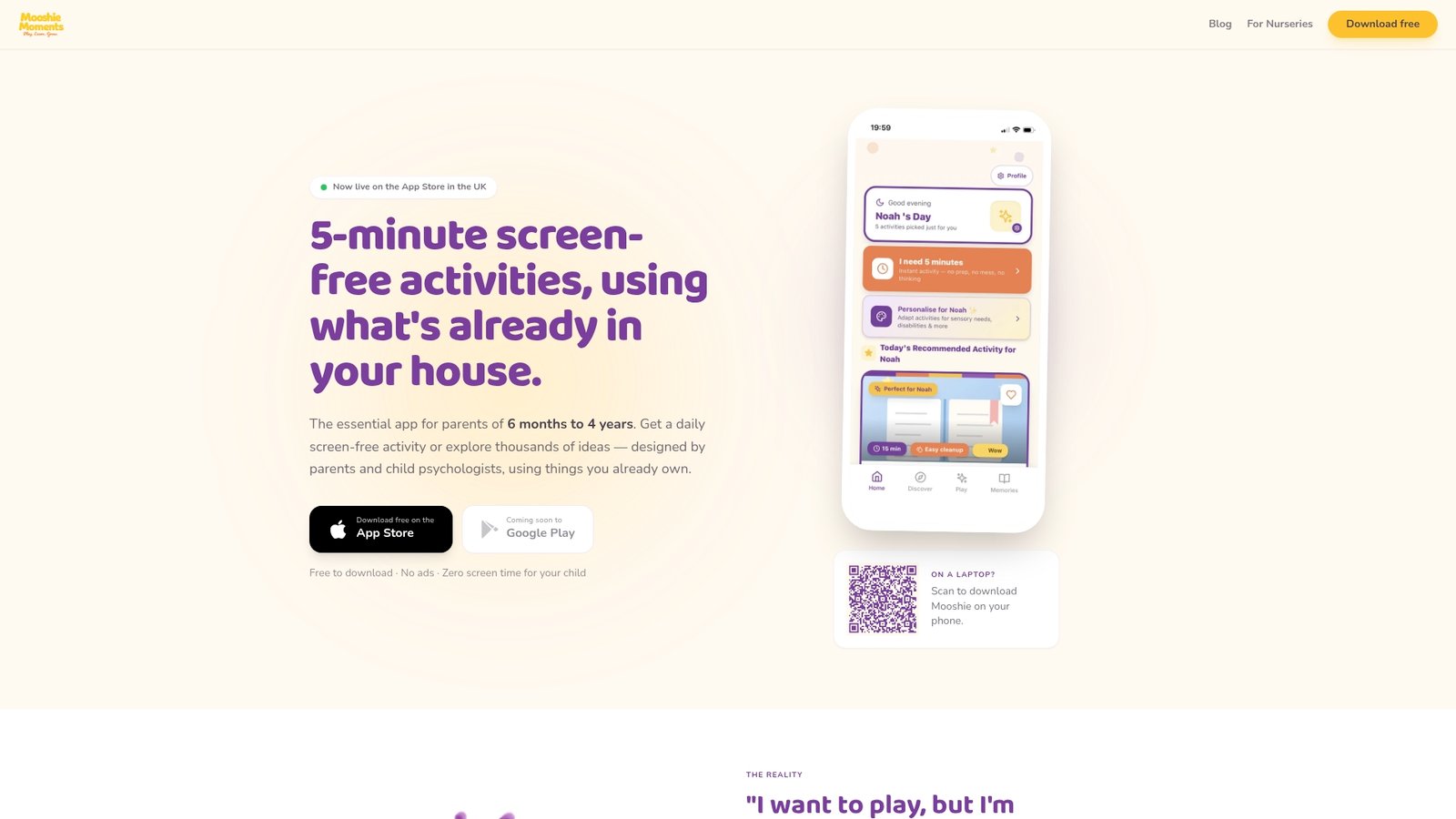
An activity app can pair naturally with a rotation system: when a category feels stale, an activity idea can breathe new life into a toy you already own instead of adding another item to the pile. Each suggestion often comes with a developmental explanation, so you know what your toddler is practicing while narrating play. If you have a two-year-old cycling through the same five toys, browse 40 activities built specifically for that age and swap one in alongside your next rotation.
Sources
- Playtime and bonding with your toddler – Best Start in Life – NHS
- Montessori toy rotation: Play more with less — Mother & Baby
- Create a Toy Rotation System That Actually Works! – Kids Who Play
- Toy Rotation: How Many Toys, When To Rotate & What To Never Touch — Montessori Theory
Recommended
More like this

Five Minute Routine Activities to Help Speech Delay in UK Toddlers
Quick, routine based activities UK parents can use in 5–15 minutes to support a toddler with speech delay. Evidence backed techniques and…

Three Minute Mess Free Sensory Play For UK Parents
Quick, reusable sensory activities UK parents can set up in minutes. Sealed bags, sticky wall art, safety checks, storage tips, and Mooshie…
10 Quiet Bin Ideas UK Parents Can Build in 5 Minutes
Practical, EYFS-aligned quiet-bin ideas UK parents can assemble in five minutes. Includes 10 ready bins, a five-bin rotation, safety checks, and quick...