
6 Nursery Home Learning Ideas You Can Start Today
Six screen-free activities you can run in the next fifteen minutes: sock puppet chats, a sofa cushion obstacle course, a kitchen colander pasta drop, a laundry basket sort, a wooden spoon drum session, and a torch shadow hunt. Each one uses items already in your home and works for nursery-aged children roughly two to four years old.
- Sock puppet chats (5 minutes): Draw a face on an old sock, then narrate a simple story together.
- Cushion obstacle course (10 minutes): Line up sofa cushions to crawl over, step between, or jump off.
- Colander pasta drop (10 minutes): Push dry pasta or pom-poms through the holes to build fine motor control.
- Laundry basket sort (5 minutes): Sort socks by color or size while naming each one out loud.
- Wooden spoon drums (10 minutes): Bang out rhythms on pots, tins, or upturned bowls.
- Torch shadow hunt (15 minutes): Dim the lights and hunt for shadows on the wall with a torch.
Pro Tip: Let your child lead. If they want to bang the spoon for twenty minutes instead of five, that’s the activity working, not going wrong. Keep small parts (pom-poms, buttons) away from children who still mouth objects.
Key Takeaways
Nursery home learning works best when it’s short, screen-free, and follows the child’s lead rather than a fixed lesson plan.
| Point | Details |
|---|---|
| Start with six quick activities | Sock puppets, cushion courses, colanders, sorting, drumming, and shadow hunts need no prep or purchases. |
| Map activities to EYFS areas | Cover communication, maths, physical, PSED, creative, and outdoor development across the week. |
| Use free UK packs | Hackney Education and Twinkl offer downloadable or video-led activity ideas. |
| Keep sessions short | Nursery-aged children typically engage for 5 to 15 minutes per activity before needing a change. |
| Widen vocabulary during play | Swap simple words for richer ones and praise effort to build language and confidence. |
| Let Mooshie Moments handle planning | The app matches screen-free, EYFS-aligned activities to your child’s age and your spare minutes. |
Table of Contents
- Nursery Home Learning Ideas Sorted by Development Area
- Where to Find Free UK-Aligned Activity Packs
- What Does a Sample Nursery Home Learning Week Look Like?
- How Do You Make Play More Learning-Rich?
- A Publisher’s View on Small Moments
- Let Mooshie Moments Take the Planning Off Your Hands
- Frequently Asked Questions
- Sources
Nursery Home Learning Ideas Sorted by Development Area
Nursery staff plan activities around specific development goals, and you can borrow that structure without any training. The EYFS framework groups early learning into distinct areas, and mapping your home activities to them means you’re not just filling time, you’re covering the same ground a nursery day covers.
Communication & language. Read the same picture book three times in a week and ask “what happens next?” before turning the page. Play “I spy” with sounds instead of letters (“something that goes brrrm”). Have a toy telephone chat where you take turns talking and listening.
Maths & number. Count stairs out loud every time you climb them. Sort buttons or pasta shapes into muffin tins by size. Set the table together, counting out one plate per person.
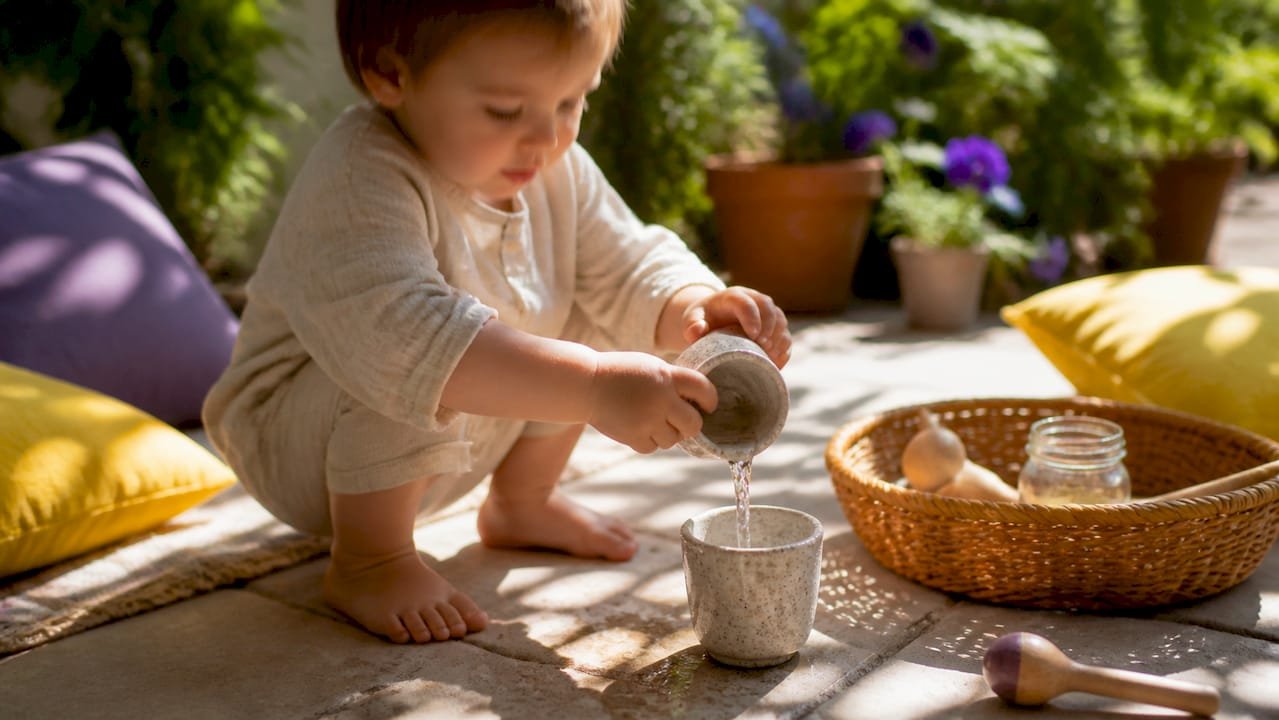
Physical development. Build a den from blankets and chairs and crawl in and out. Practice pouring water between two cups at bath time. Tape a wobbly line on the floor and walk along it like a tightrope.

Personal, social and emotional development (PSED). Take turns choosing the next game and naming whose turn it is. Practice “big feelings” faces in a mirror together. Give specific praise (“you waited so patiently”) rather than a generic “good job.”
Creative & sensory play. Fill a tray with dry rice or oats for scooping and pouring. Mix flour and water for simple dough. Finger paint with yogurt mixed with food coloring (skip this if your child has a dairy allergy).
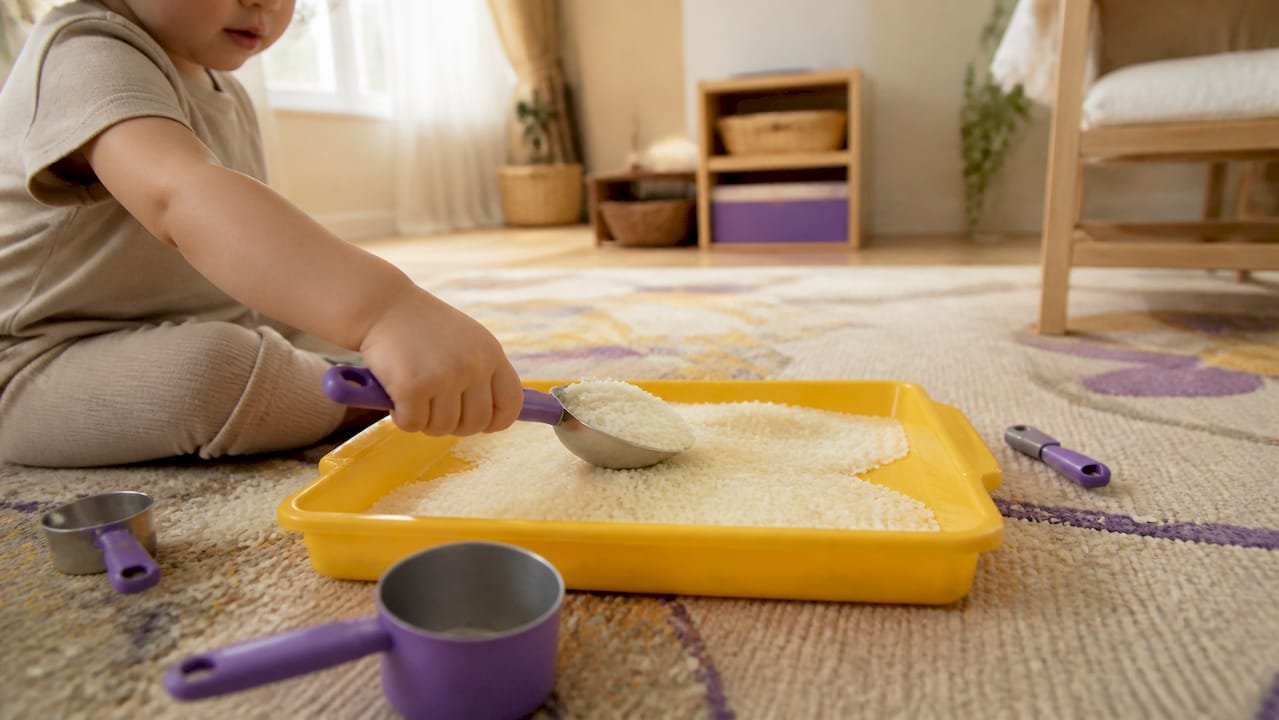
Understanding the world & outdoor play. Go on a color hunt in the garden or park. Plant cress seeds on damp cotton wool and watch them grow. Collect leaves and sort them by shape.
Music & movement. Freeze dance to any song you like. Make shakers from rice in a sealed bottle. Copy animal walks, from a wobbling duck to a stomping elephant.
Pro Tip: Widen vocabulary as you play by swapping basic words for richer ones, saying “scarlet” instead of “red,” or “enormous” instead of “big.” Small language upgrades like this build vocabulary faster than flashcards ever will.
Where to Find Free UK-Aligned Activity Packs
Several UK sources publish downloadable, teacher-created packs so you’re not building every activity from scratch.
| Resource | What it offers |
|---|---|
| Hackney Education | Free PDFs covering messy play, music, mark-making, and outdoor scavenger hunts |
| Twinkl | Themed, curriculum-linked EYFS packs for ages 3 to 5 |
| 50 Things To Do Before You’re 11¾ | A database of low-cost outdoor activity ideas for families |
| BBC CBeebies | Short, video-led songs and stories for music and movement sessions |
| Tiny Happy People | Communication and language activity ideas from the BBC |
| Oak National Academy | Free video lessons, more suited to slightly older or reception-age children |
Most council packs come as single-file PDFs under 5MB, so they open easily on a phone. BBC CBeebies and Tiny Happy People are video-led rather than downloadable, which works well if you want a five-minute prompt rather than a printed sheet.
What Does a Sample Nursery Home Learning Week Look Like?
A nursery day is built from short bursts, not long lessons, and your week at home can follow the same rhythm.
- Monday: Storytime (10 minutes) plus a color hunt outdoors (15 minutes).
- Tuesday: Messy sensory play with a rice tray (15 minutes).
- Wednesday: Number play, counting stairs and sorting buttons (10 minutes).
- Thursday: Music and movement with freeze dance and shakers (10 minutes).
- Friday: Free choice, letting your child pick a repeat favorite.
- Nursery-aged children typically hold focus for 5 to 15 minutes per activity, so stop before boredom sets in.
- Watch for engagement cues (leaning in, repeating words, asking “again”) as your signal to extend an activity.
- If your child masters something quickly, add a small challenge; if they’re frustrated, step back and simplify.
How Do You Make Play More Learning-Rich?
Expand vocabulary as you play. Instead of saying “look, a dog,” try “look, a fluffy spaniel trotting along,” a technique early years guidance links to stronger language development. Home learning guidance also stresses following your child’s interests rather than steering every activity yourself.
Praise effort over correctness: “you worked so hard stacking that” lands better than “well done.” Get outside when you can. Official guidance for parents of under-fives points toward active, screen-free play over passive screen time.
Pro Tip: Ask open questions instead of yes/no ones. “What do you think will happen if we pour it here?” invites far more talking than “is that fun?”
A Publisher’s View on Small Moments
We built Mooshie Moments because play doesn’t need to look like school to work. A few minutes of pouring rice or naming shadows on the wall does more for a two-year-old’s development than a worksheet ever will. Small, repeated moments of attention from a busy parent add up over months into real language, confidence, and coordination gains, and that’s worth trusting even on the days when fifteen minutes is all you’ve got.
Let Mooshie Moments Take the Planning Off Your Hands
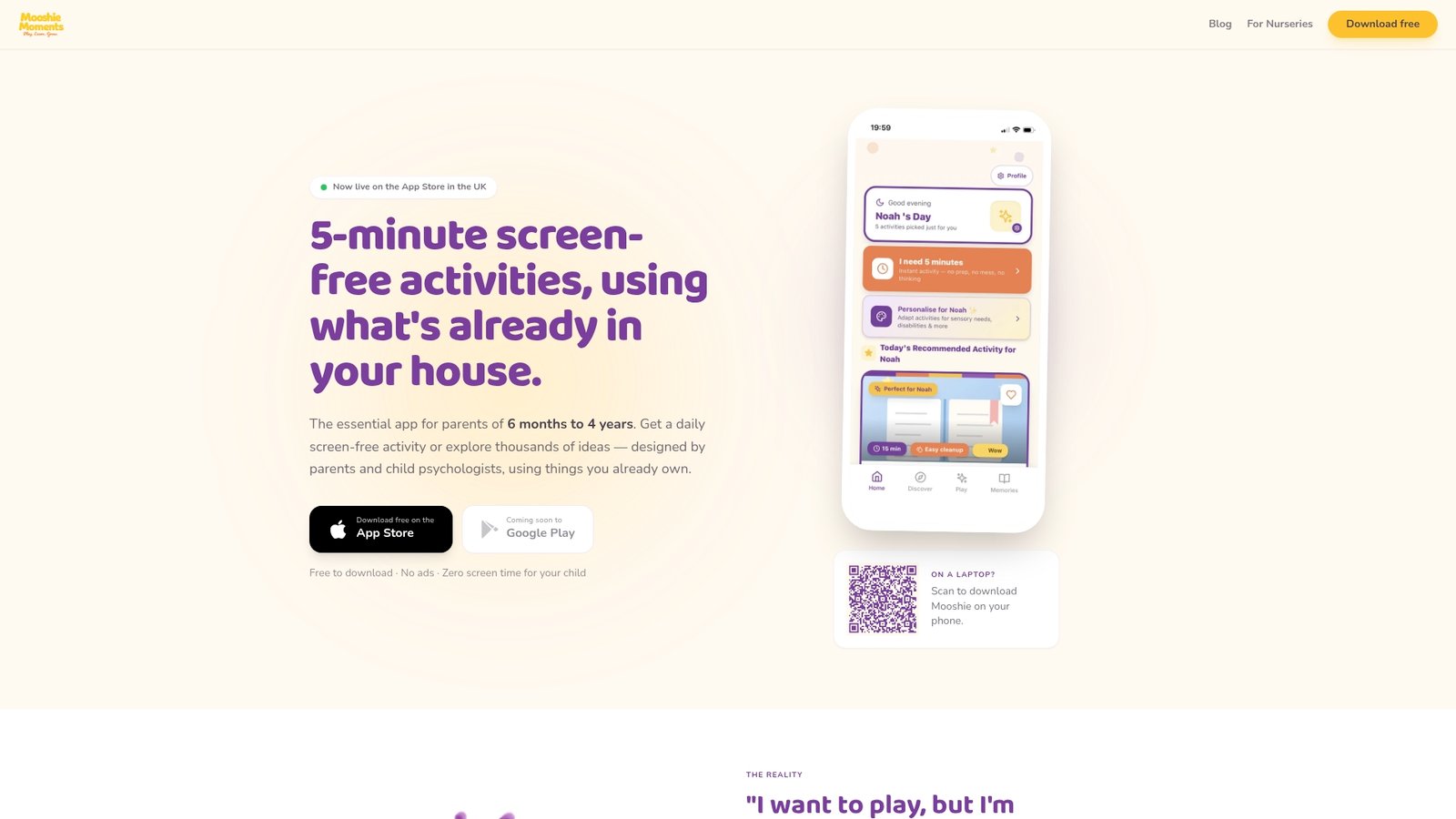
Mooshie Moments is the app version of everything in this list, minus the planning time. Instead of hunting for the right activity for a rainy Tuesday afternoon, you open the app and get a short, screen-free suggestion matched to your child’s age and how much energy you’ve got left.
- Saves planning time: activity suggestions are matched to your child’s age and your available minutes, so there’s no scrolling or guessing.
- EYFS-aligned by design: every suggestion is built around the same development areas nurseries plan around.
- Nursery partnership packs available: settings can offer families printable resources and coordinated home activities through Mooshie Moments’ nursery partnership program.
If you’re a parent wanting quick ideas tonight, try Mooshie Moments and get your first activity suggestion in under a minute. If you run a nursery and want to send families home with consistent, EYFS-aligned ideas, the nursery partnership page explains how the packs work.
Frequently Asked Questions
What are good nursery home learning ideas for a two-year-old?
Simple sensory play (rice trays, colanders with pasta), naming games during everyday routines, and short story sessions work well. Keep each activity under 15 minutes and follow your child’s lead on when to stop or repeat.
How much home learning should a nursery-aged child do each day?
There’s no fixed target. Nursery days are built from short bursts rather than long sessions, so a few 10 to 15 minute activities spread across the day matches how nursery-aged children actually learn.
Are screen-free activities really better than educational apps?
Official UK guidance points parents of under-fives toward active, play-based experiences over passive screen time. Hands-on play also gives more chances for the back-and-forth talking that builds vocabulary.
Where can I find free EYFS-aligned printable packs?
Hackney Education and Twinkl both publish free, downloadable EYFS packs, and gov.uk hosts the statutory framework these packs are built around.
Do I need to buy special toys for these activities?
No. Every activity in this guide uses household items like pasta, socks, cushions, and kitchen containers, which is the same approach Mooshie Moments takes with its activity suggestions.
Sources
- Home learning: Activities and ideas to share at home | Westmorland and Furness Council
- Gov
- Early years home learning activities – Hackney Education
Recommended
More like this

Five Minute Routine Activities to Help Speech Delay in UK Toddlers
Quick, routine based activities UK parents can use in 5–15 minutes to support a toddler with speech delay. Evidence backed techniques and…

Three Minute Mess Free Sensory Play For UK Parents
Quick, reusable sensory activities UK parents can set up in minutes. Sealed bags, sticky wall art, safety checks, storage tips, and Mooshie…
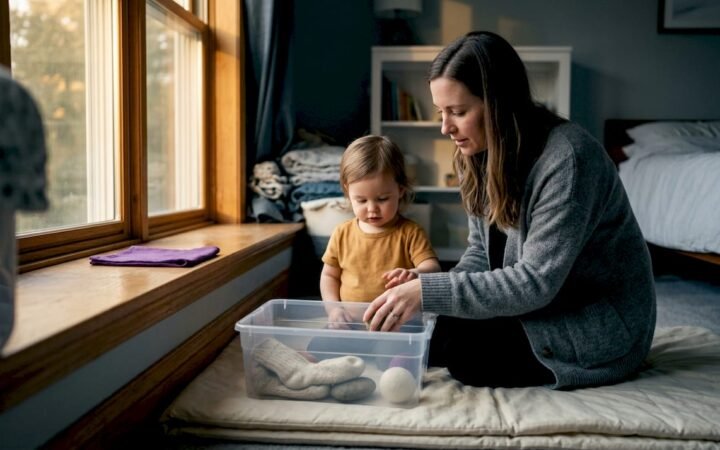
10 Quiet Bin Ideas UK Parents Can Build in 5 Minutes
Practical, EYFS-aligned quiet-bin ideas UK parents can assemble in five minutes. Includes 10 ready bins, a five-bin rotation, safety checks, and quick...