
High Chair Activities: Easy Ideas for Every Age
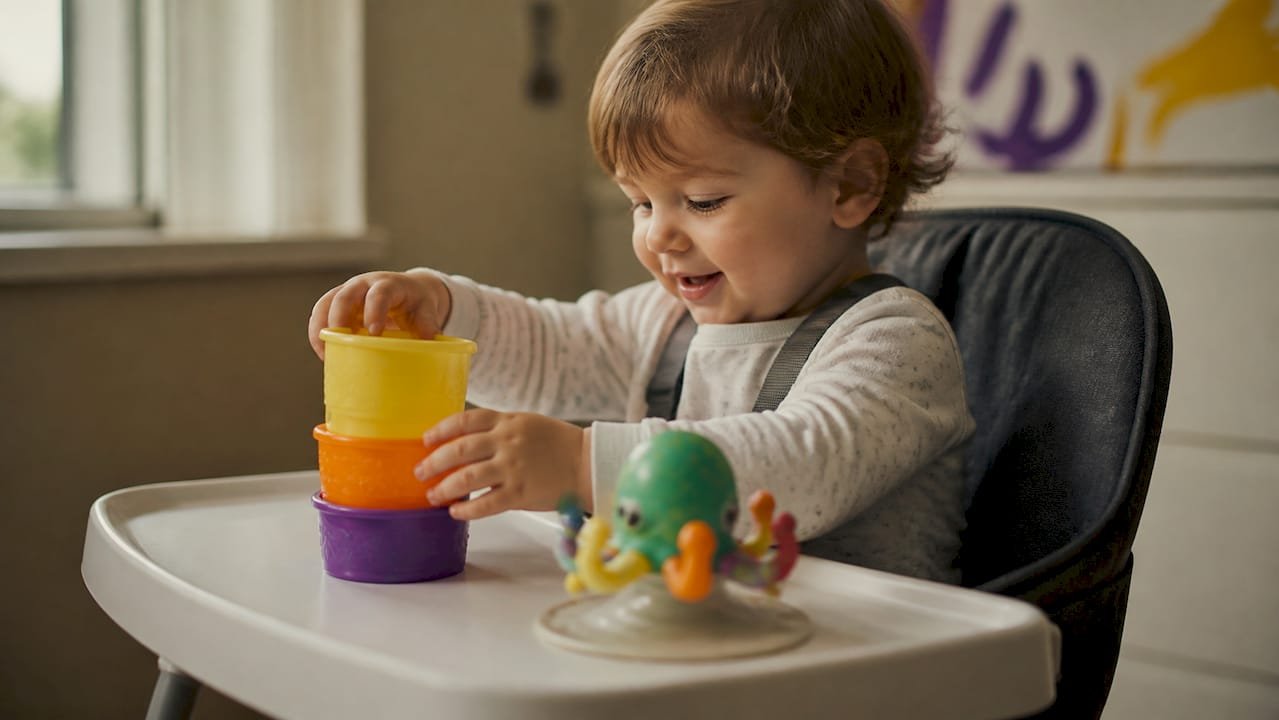
Six high-chair activities you can set up in under a minute: a sensory bag, spoon-and-bowl stirring, milk-cap drop, suction-cup toy play, no-mess water painting (paint sealed inside a resealable bag) , and sticker play. Each one works with items already in your kitchen or junk drawer.
- Sensory bag: Fill a resealable bag with hair gel and a few small beads, then seal it shut with tape. Babies squish and track the beads with their eyes. Tape the bag flat to the tray so it stays put.
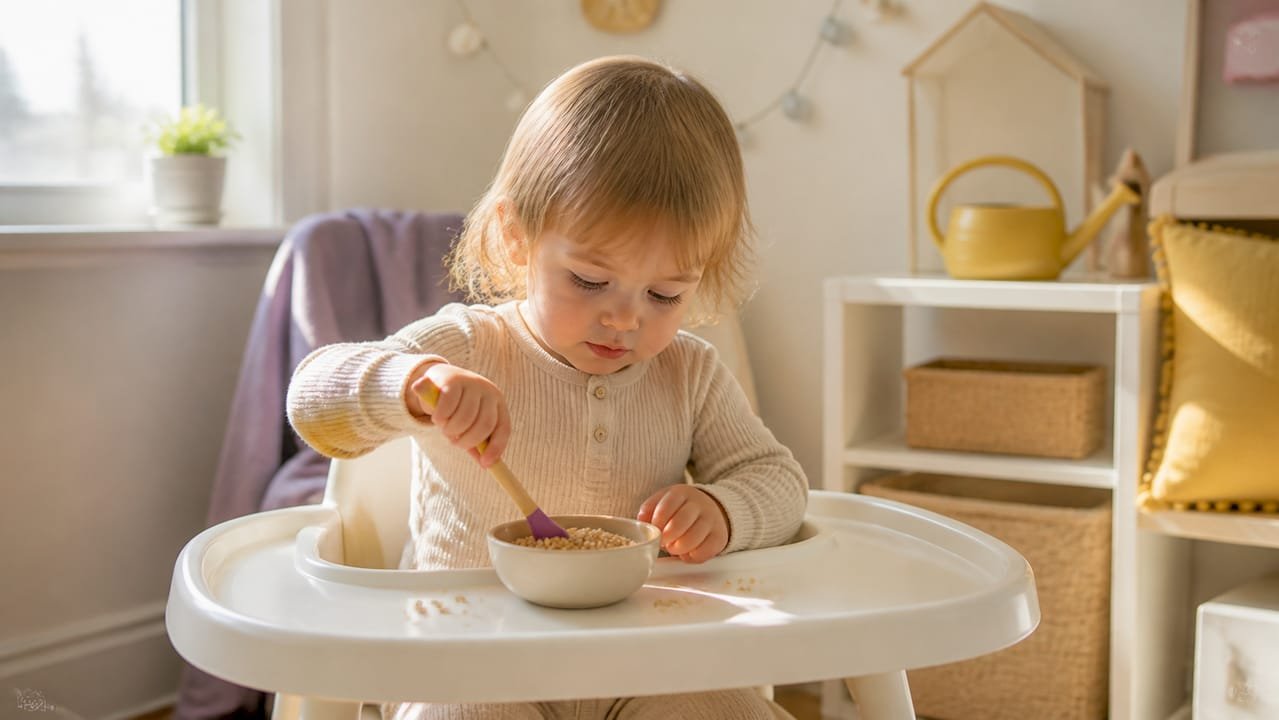
- Spoon-and-bowl stirring: Drop a large wooden spoon and a small bowl on the tray with a handful of cereal. Simple, satisfying, and great for grip. Use a bowl too big to tip easily.
- Milk-cap drop: Collect a few large bottle caps and a small container with an opening just wide enough to post them. Babies love the drop-and-clunk. Check caps are large enough to avoid a choking risk.
- Suction-cup toy play: Stick a silicone suction toy to the tray. Babies pull, twist, and bang it without it flying off. Check the suction holds before stepping away.
- No-mess water painting: Squeeze a little washable paint into a resealable bag, seal it completely, and tape it to the tray. Babies smear color without touching a drop. Double-seal the bag.
- Sticker play: Peel a few large stickers and stick them loosely to the tray edge. Toddlers peel them off and press them back. Use stickers at least 1.5 inches wide.
Key Takeaways
High-chair play supports real developmental gains when activities are matched to age, kept safe, and rotated before attention fades.
| Point | Details |
|---|---|
| Start simple | Six activities (sensory bag, stirring, cap drop, suction toy, sealed painting, stickers) need under a minute to set up. |
| Match to age | Mouthing-phase babies need large, taped-down items; toddlers over twelve months can handle loose posting and sorting activities. |
| Safety first, every time | Buckle the harness before placing items on the tray, and never leave a child unattended in the chair. |
| Rotate to extend engagement | A three-step sensory-to-manipulative-to-calm rotation can hold attention for twenty to thirty minutes total. |
| Mooshiemoments | The app delivers age-matched, screen-free activity ideas using household items, ready in under five minutes. |
Table of Contents
- High chair activities matched to your child’s age
- Choosing activities by how much mess you can handle
- What to prepare: safe household items and tray setup
- Safety checklist and answers to common parent questions
- What high-chair play actually does for your child’s development
- How long will it hold their attention, and when should you rotate?
- Mooshiemoments makes the next activity easy to find
- Sources
High chair activities matched to your child’s age
Not every activity suits every stage. A six-month-old mouthing everything needs something different from a confident eighteen-month-old with a pincer grip. The table below maps common activities to three milestone windows so you can pick something that actually fits where your child is right now.
| Age range | Recommended activities | Primary skills practiced |
|---|---|---|
| 6 months | Sensory bag (taped flat), high-contrast mirror, suction-cup toy | Sensory tracking, reaching, grasping |
| 12 months | Spoon-and-bowl stirring, milk-cap drop, crinkle paper | Cause-and-effect, early pincer grip, object permanence |
| 12–24 months | Sticker play, sealed painting bag, spice-container shake, posting corks | Problem-solving, fine motor, early pretend play |
A few notes worth keeping in mind. Babies at six to nine months are still in a heavy mouthing phase, so every item on the tray needs to pass the toilet-paper-roll test: if it fits inside the tube, it’s a choking hazard. By nine to twelve months, most babies are developing a pincer grip and love anything they can pick up and drop. From twelve months onward, simple cause-and-effect toys like a cleaned spice container with a few cereal pieces inside become genuinely absorbing. Zero to Three notes that figuring out how to shake or pour the cereal out is real problem-solving at this age.
Pro Tip: For babies under nine months, tape sensory bags and crinkle paper directly to the tray so they can’t accidentally pull items into their mouth. For toddlers over twelve months, leave items loose so they practice picking up and placing.
Choosing activities by how much mess you can handle
Some days you have a mop and ten minutes. Other days, you need everything contained. Here’s a practical breakdown by mess level, drawn from tested high-chair activity roundups.
No-mess options
These work anywhere, anytime, with zero cleanup beyond a quick tray wipe.
- Sealed sensory bag (gel and beads, fully taped down)
- Sticker play (large stickers on the tray edge)
- High-contrast mirror (propped against a cup or taped upright)
- Suction-cup toy (stuck directly to the tray)
- Board book (propped on the tray lip)
Low-mess options
A damp cloth handles all of these in thirty seconds.
- Spoon-and-bowl stirring with dry cereal or pasta
- Posting corks into a container
- Milk-cap drop into a small box
- Silicone muffin tin sorting with large pom-poms or blocks
Messy options
Worth it for the engagement, but plan for it.
- Finger painting (directly on the tray or on paper taped down)
- Water play with a shallow tray and a few cups
- Yogurt or puree smearing on the tray surface
- Ice cube exploration (cold, melty, and endlessly interesting)
Cleanup hacks that actually save time: A silicone placemat under the bowl catches most spills before they reach the tray. A full-coverage bib with a front pocket catches the rest. For messy sessions, lay a cheap shower curtain liner under the high chair and shake it out afterward. If the weather is warm and dry, move finger painting outside entirely. A quick spray of diluted dish soap on the tray and a single wipe-down takes less than a minute when you do it immediately after the activity rather than letting it dry.
What to prepare: safe household items and tray setup
The best high-chair play ideas use items you already own. Here’s what works well and how to set the tray up fast.
Safe household items to reach for:
- Large wooden or silicone spoon (too big to swallow)
- Silicone muffin tin (soft, washable, no sharp edges)
- Resealable bags (for sealed sensory and painting bags)
- Large bottle caps (check diameter against the toilet-paper-roll test)
- Large stickers (at least 1.5 inches wide)
- High-contrast mirror or small unbreakable mirror
- Cleaned spice container with a few cereal pieces inside
- Crinkle paper or tissue paper (supervised only)
Tray setup checklist:
- Secure the tray and confirm it clicks into place.
- Buckle the harness before placing any items on the tray.
- Lay a non-slip silicone mat or placemat on the tray surface.
- Tape down sensory bags or paper for babies under nine months.
- Check every item passes the toilet-paper-roll size test.
- Remove any item smaller than a golf ball for babies still mouthing everything.
Pro Tip: Suction-mounted holders and weighted silicone bowls keep items on the tray without creating a tipping hazard. They’re especially useful during stirring or sorting activities where a regular bowl would slide straight off.
Safety checklist and answers to common parent questions
High-chair play is safe when the setup is right. Run through this list before every session.
- Always buckle the harness before placing items on the tray, every single time.
- Remove small parts for any baby still mouthing objects. If it fits in a toilet-paper roll, it stays off the tray.
- Check manufacturer guidelines for your specific chair’s height, weight, and recline limits. No single rule-of-thumb (including the widely shared “90-90-90” posture cue) replaces the manual for your chair model. When in doubt, follow the manufacturer’s instructions and consult your health visitor.
- Stay within arm’s reach during any new activity, especially the first time a child encounters a new material.
- Never leave a child unattended in a high chair, even for a moment.
- Inspect toys and bags before each use. A sensory bag with a weakened seal or a suction toy with a crack should be replaced, not reused.
Hygiene checklist:
- Wipe the tray with warm soapy water between activities.
- Wash silicone toys and muffin tins after each session.
- Inspect and re-seal sensory bags before reuse; discard if the seal looks compromised.
- Discard any food-based play material (yogurt, puree, ice) after the session, not the next day.
Pro Tip: Keep a small spray bottle of diluted dish soap and a dedicated tray cloth within reach of the high chair. A ten-second spray-and-wipe after each activity means you never face a dried-on mess later.
What high-chair play actually does for your child’s development
High-chair activities aren’t just a way to buy yourself five minutes. UNICEF’s early learning guidance confirms that play is the primary way babies learn during the first two years, supporting sensory exploration, motor skill development, and caregiver bonding all at once.
The table below maps common activity types to the specific skills they build.
| Activity type | Skills supported | Evidence note |
|---|---|---|
| Sensory (bags, ice, textures) | Sensory processing, visual tracking, tactile discrimination | Consistent across early-years research |
| Manipulative (stirring, posting, sorting) | Fine motor control, hand-eye coordination, cause-and-effect | Supported by Zero to Three and Kitchen Table School |
| Language-rich (narrating, naming, singing) | Vocabulary, listening, early communication | Strongest when caregiver talks through the activity |
| Pretend/exploratory (painting, smearing) | Creativity, self-expression, sensory tolerance | Builds foundation for later pre-literacy skills |
Kitchen Table School’s highchair games guide highlights that items like stickers, tongs for transferring objects, and simple jigsaws extend these benefits into pre-literacy and early numeracy territory for toddlers approaching two years old.
Research note: UNICEF’s activity guidance links caregiver-led play directly to stronger early developmental outcomes, particularly when adults narrate what the child is doing during the activity.
How long will it hold their attention, and when should you rotate?
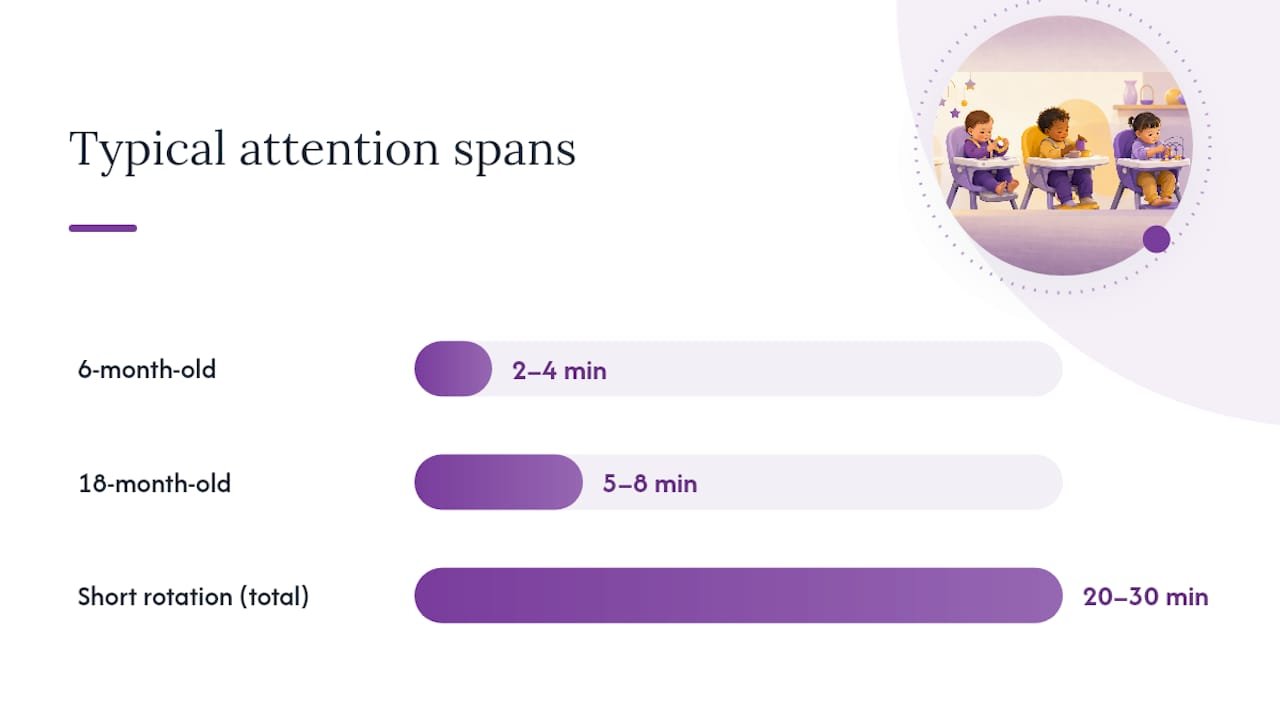
Realistic attention spans matter. A six-month-old typically stays engaged with one activity for two to four minutes. By eighteen months, that stretches to roughly five to eight minutes for a novel activity, though it drops quickly once the novelty fades. Screen-free activity research from Motherly suggests that a short rotation of practical, repeatable activities can reliably hold a toddler’s attention for twenty to thirty minutes total.
Signs it’s time to rotate: fussing, pushing items off the tray, looking away repeatedly, or reaching for you.
A simple three-step rotation:
- Start with a sensory opener (sensory bag, ice cube, crinkle paper). This settles the child and focuses attention.
- Move to a manipulative activity (posting corks, spoon-and-bowl stirring, muffin tin sorting). This builds on the focused state and adds motor challenge.
- Finish with something calm (sticker play, board book, mirror). This winds the session down naturally before mealtime or a nap.
Pro Tip: Prep three small zip-lock bags in advance, each holding the items for one activity. Label them “1,” “2,” and “3.” When you need a quick swap, you grab the next bag rather than hunting for items mid-session.
A note from one caregiver to another
Busy mornings are real. Some days the most you can manage is dropping a wooden spoon and a bowl on the tray while the coffee brews. That counts. A two-minute stirring activity while you make breakfast still gives your child something to focus on, something to practice, and a moment of connection when you narrate what they’re doing.
The activities in this article are designed for exactly those moments. You don’t need a craft kit or a Pinterest board. You need a spoon, a bowl, and thirty seconds. Start there, and build from it when you have more time and energy.
Mooshiemoments makes the next activity easy to find
When you’re standing in the kitchen at 7 AM trying to remember what worked last Tuesday, having a ready list of age-matched, screen-free activities is genuinely useful. That’s what Mooshiemoments is built for.
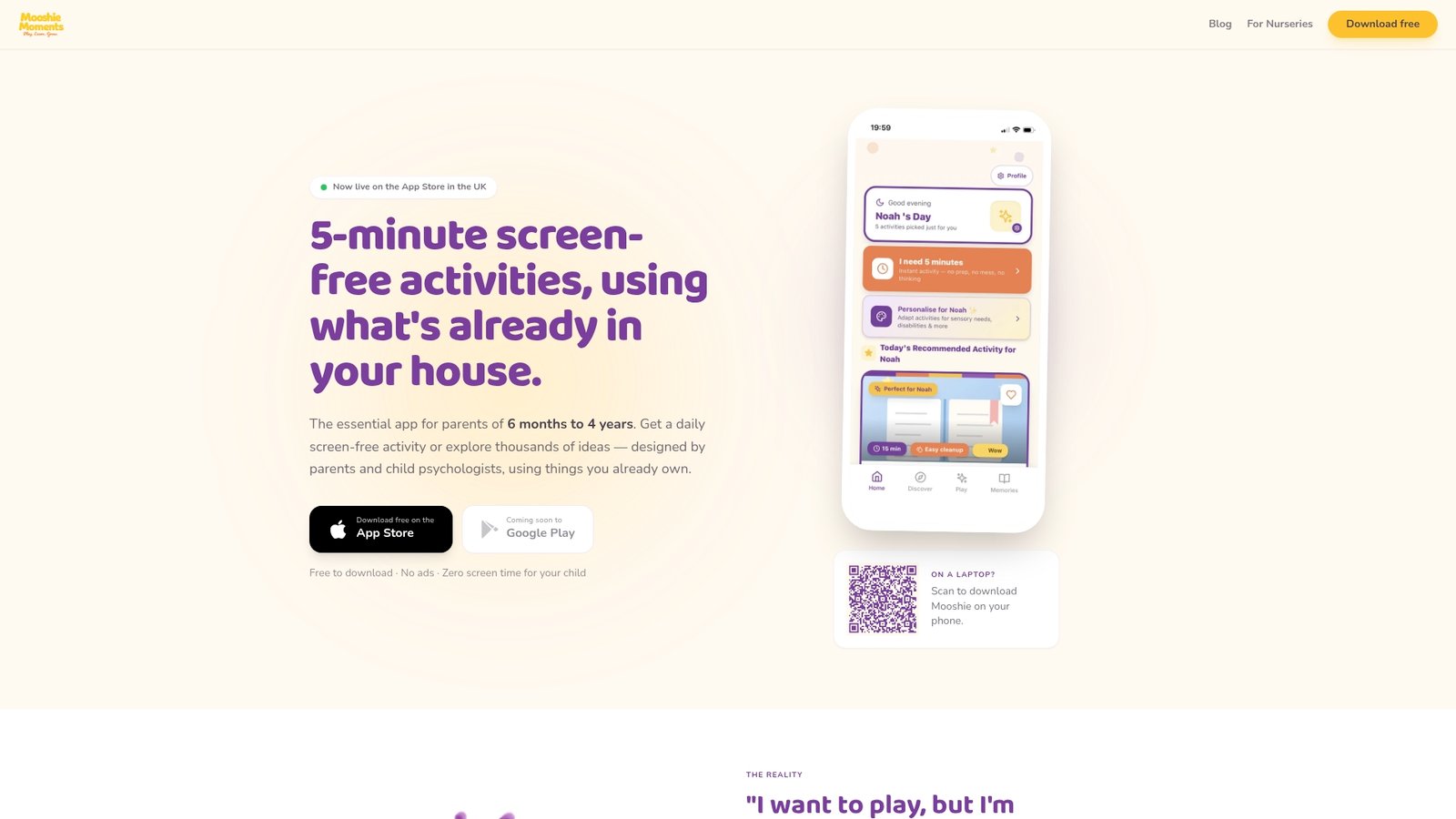
The app gives parents and caregivers of children aged six months to four years a library of quick, developmentally focused activity ideas, each matched to your child’s current age and how much time you actually have. Every activity uses household items, comes with a one-line developmental explanation, and takes under five minutes to set up. No purchases, no complicated prep. Nurseries and early years settings can also access ready-made partnership packs and printable resources through the Mooshiemoments nursery program. Download the app and browse this week’s activity ideas in under two minutes.
Sources
- 21 learning activities for babies and toddlers | UNICEF
- High Chair Games and Activities for Babies | Tinybeans
- Easy Highchair Activities for Babies – Happy Toddler Playtime
- Highchair Games – Kitchen Table School
Recommended
More like this

Five Minute Routine Activities to Help Speech Delay in UK Toddlers
Quick, routine based activities UK parents can use in 5–15 minutes to support a toddler with speech delay. Evidence backed techniques and…
Three Minute Mess Free Sensory Play For UK Parents
Quick, reusable sensory activities UK parents can set up in minutes. Sealed bags, sticky wall art, safety checks, storage tips, and Mooshie…
10 Quiet Bin Ideas UK Parents Can Build in 5 Minutes
Practical, EYFS-aligned quiet-bin ideas UK parents can assemble in five minutes. Includes 10 ready bins, a five-bin rotation, safety checks, and quick...