
Heuristic Play Ideas: Simple Home Activities That Work

Heuristic play means letting a baby or toddler explore everyday objects, like a wooden spoon or a metal tin, with zero instructions and zero “right way” to do it. Your child leads. You just gather the objects, sit close by, and watch. Start today: pull a few safe household items into a basket and give your child some time with them while you sit nearby.
Here’s what that first session can look like:
- A whisk, a pinecone, a shell, a small mirror, a scarf, and an empty tin with a lid
- No talking unless your child invites you in
- No “correct” outcome, just curiosity
Pro Tip: Rotate the basket weekly so the objects stay novel. A child who’s bored of the whisk on day one might be fascinated by it again after two weeks away.
The Mooshie Moments app can hand you a themed prompt in seconds if you’d rather skip the planning and jump straight to playing.
Key Takeaways
Heuristic play works because it hands a baby or toddler full control over exploring safe, everyday objects, building focus, coordination, and early problem-solving without any packaged toy.
| Point | Details |
|---|---|
| Start small | Assemble a few safe household items and sit nearby for a short play session. |
| Theme your basket | Grouping by material, metal, wood, fabric, sharpens comparison and sustains interest. |
| Safety first | Exclude anything smaller than a toilet paper tube, sharp, or with loose strings. |
| Watch for progression | Stacking or combining objects signals readiness for loose parts play. |
| Use Mooshie Moments for speed | The app delivers age-matched, 5-minute screen-free prompts when planning time runs short. |
A Few Words From the Editorial Team
The biggest mistake we see parents make with heuristic play isn’t safety or setup, it’s overthinking the objects themselves. A cold metal spoon and a rough pinecone do more work than a shelf of plastic toys ever will, simply because they’re real and unscripted.
Pro Tip: Don’t wait for a “perfect” basket. Three good objects today beat ten planned objects next week.
— samit
Try Mooshie Moments for Your Next Session
Mooshie Moments turns the planning above into a five-minute decision instead of a twenty-minute research project. Rather than building basket themes from scratch every week, open the app, tell it your child’s age and how much time you’ve got, and get a screen-free activity prompt built on the same developmental thinking covered here.
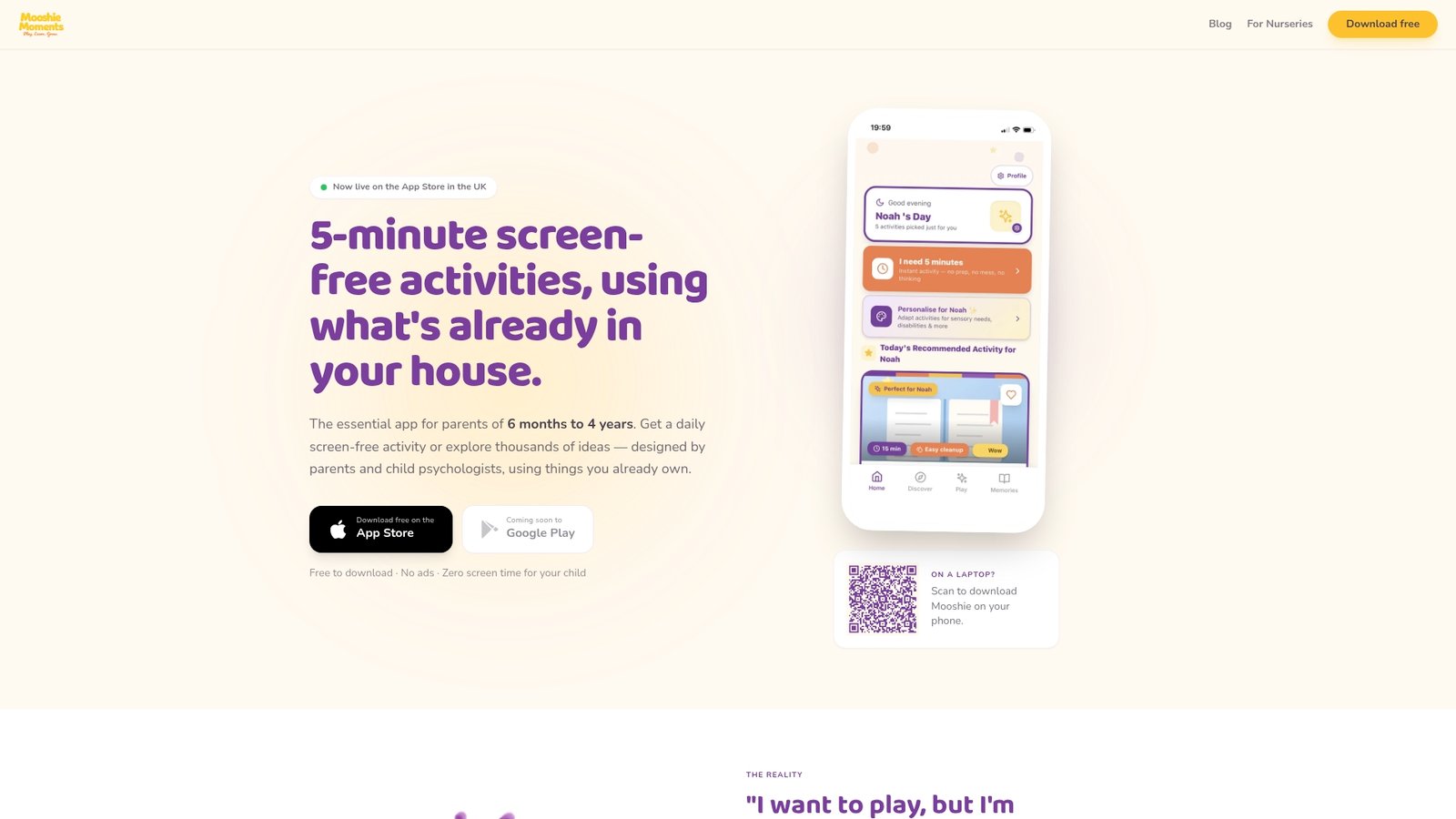
The app tailors suggestions by age and available time, so a rushed weekday morning and a relaxed Sunday afternoon get different prompts, both using items already in your home. Nurseries and childminders can access partnership packs with printable resources and usage tracking built around EYFS goals. Download Mooshie Moments and start your next screen-free session in under five minutes.
Table of Contents
- What Are Heuristic Play Ideas Based On?
- Why Heuristic Play Actually Benefits Development
- Themed Treasure Baskets You Can Build Today
- Setting Up a Safe, Focused Play Session
- Adjusting Heuristic Play as Your Child Grows
- Common Snags and What They’re Telling You
- How Mooshie Moments Makes Heuristic Play Easier
- Sources
What Are Heuristic Play Ideas Based On?
The term comes from early-years pioneer Elinor Goldschmeid, who built her approach around the Greek word “heuristic,” meaning to discover or find out. Goldschmeid’s original concept, the treasure basket, is a low basket filled with natural and household objects that a baby explores through touch, taste, sound, and sight, entirely on their own terms, as Norfolk County Council explains.
The mechanics are simple but powerful. A child picks up an object, tests it (bangs it, mouths it, drops it), and repeats the action over and over. That repetition isn’t aimless. It’s how babies build understanding of cause and effect, weight, and texture, one small experiment at a time.
Heuristic play is the toddler-specific cousin of loose parts play, a broader approach that uses open-ended materials across a wider age range, as Headstart describes. Think of heuristic play as the entry point:
- Heuristic play: focused sessions, curated objects, ages roughly 6 months to 2 years
- Loose parts play: broader material sets, more construction and combination, ages 2 and up
Why Heuristic Play Actually Benefits Development
Practitioners have found that treasure baskets can hold a child’s attention longer than many packaged toys, precisely because the child is directing the exploration rather than following a toy’s built-in function, according to Norfolk County Council’s practitioner observations.
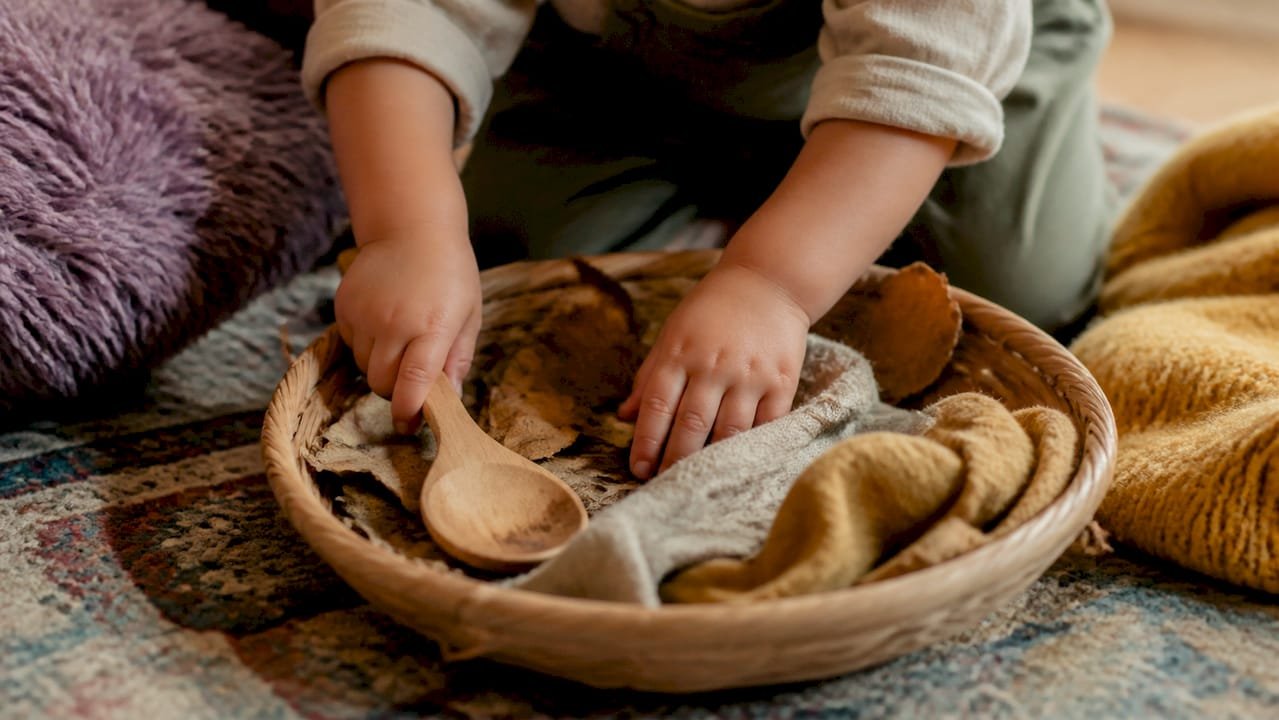
The cognitive payoff is real. Sorting, comparing, and testing objects builds early problem-solving skills and introduces math concepts like full and empty, heavy and light, before a child ever hears the words. On the physical side, grasping a rough shell versus a smooth spoon sharpens fine motor control and hand-eye coordination through pure repetition.
There’s an emotional layer too. A basket with no wrong answer gives a toddler something rare: full control over an activity. That sense of choice often has a calming effect, which is part of why some nurseries use treasure baskets to settle children during transitions.
- Cognitive: comparison, cause and effect, early vocabulary
- Physical: grip strength, coordination, sensory discrimination
- Emotional: independence, focus, calm through self-directed choice
Themed Treasure Baskets You Can Build Today
Themes make the exploration richer because they give your child a repeated feature to compare across objects, a texture, a sound, a material, according to the Norfolk County Council guidance on structuring baskets. Here are the collections worth building first.
- Metal collection. Metal spoon (cold, smooth, rings when tapped), whisk, small saucepan lid, sturdy keyring, tin cup. Wipe clean after each session.
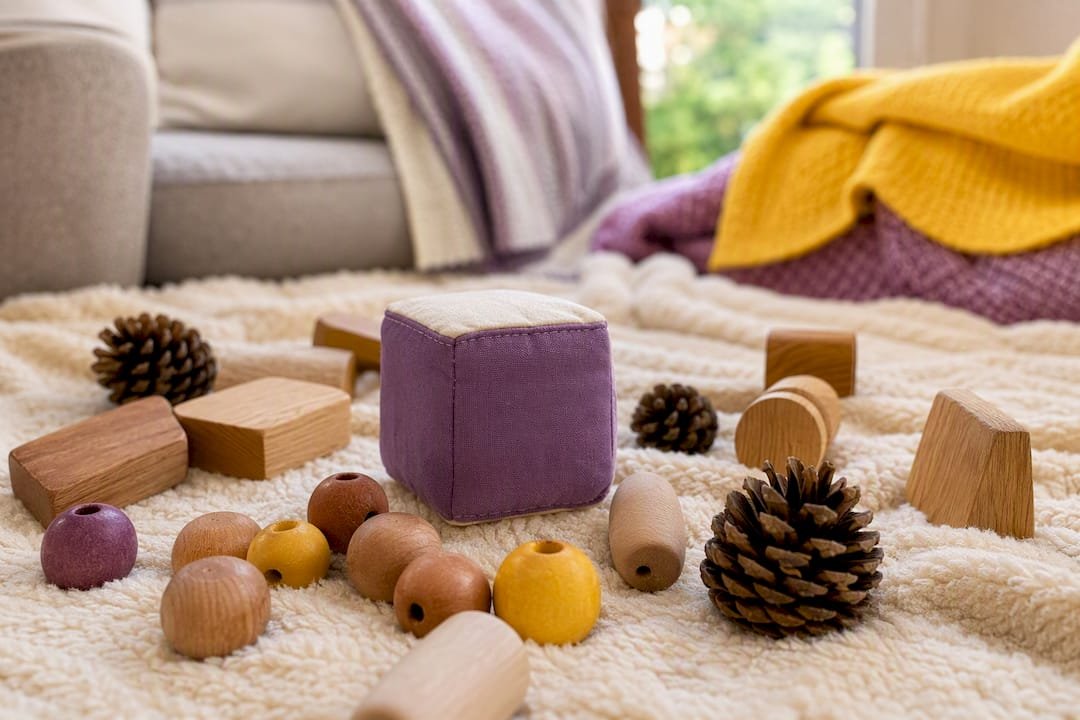
- Wooden and natural textures. Pinecone (rough, light), wooden spoon, smooth stone, seashell, small log slice. Great for outdoor rotation.
- Sound makers. Bells sewn into fabric pouches, a rattle made from a sealed tin with rice, a wooden block, a small drum. Swap items that lose their sound.
- Fabric and textures. Silk scarf, corduroy patch, bubble wrap sealed in fabric, a soft brush, a knit square.
- Black and white contrast. Best for babies under 6 months: a checkered card, a black spoon, a white shell, a striped fabric square.
- Kitchen tools (supervised only). Measuring cups, a pastry brush, a strainer, wooden tongs. Skip anything with a sharp edge.
- Filling and emptying. Small tins, a cardboard tube, an egg carton, a scoop, dried pasta shapes for over-2s only.
- Transport and movement. A small wheel, a ball with texture, a rolling pin, a toy car with no small removable parts.
Cleaning takes two minutes: a wipe with warm soapy water for metal and plastic, and an air-out for fabric items. Rotate one theme out every week or two to keep interest fresh, as Twinkl’s practitioner resource suggests. For low-cost substitutes, raid your recycling bin: yogurt pots, cardboard tubes, and jar lids all work.
Items to exclude: anything smaller than a toilet paper tube (choking risk), anything with detachable small parts, ribbons or strings longer than a few inches (strangulation risk), and any food item for children who still mouth everything, as Right From The Start’s safety notes advise.
Setting Up a Safe, Focused Play Session
A distraction-free space matters more than an elaborate one. Practitioners recommend clearing away competing toys and turning off screens for the session’s duration, since a busy room pulls attention away from the objects themselves, per Norfolk County Council. Floor time works better than a table for babies who aren’t yet sitting steadily.
- Clear the space. Pick one quiet corner, lay a mat or towel down, and remove other toys from sight.
- Set the timing. Aim for 10 to 20 minutes for toddlers, shorter for babies under a year. Let your child end the session, not a clock.
- Take your position. Sit close, at their eye level, and resist the urge to demonstrate how objects “should” be used.
- Narrate lightly. Name what you notice, “that spoon is heavy,” rather than directing the play.
- Run the safety check. Scan for small parts, sharp edges, loose strings, and anything that could trap a finger before you set the basket down.
Pro Tip: If your child hands you an object, that’s often an invitation to join in, not a request for instructions. Mirror their action rather than introducing a new one.
Adjusting Heuristic Play as Your Child Grows
Object size and complexity should track your child’s stage, not just their birthday. A 7-month-old exploring by mouth needs items too large to swallow and free of small attachments. A 2 year old ready for combining objects is signaling it’s time to add construction opportunities.
- Sitters (6 to 9 months): large, single-texture objects; no loose small parts
- Crawlers (9 to 14 months): slightly smaller items, more variety per basket
- Toddlers (14 to 30 months): themed sets, filling and emptying tasks
- Preschoolers (2.5 to 4 years): transition toward loose parts, combining and building
Watch for the shift signal: when your toddler starts stacking, nesting, or connecting objects instead of just mouthing or banging them, they’re ready for the wider material range of loose parts play, a natural progression HeadStart.gov outlines. A simple progression plan: weeks one and two, single-theme baskets; weeks three and four, mix two themes; month two onward, add connecting pieces like stacking cups or large blocks.
Common Snags and What They’re Telling You
Short attention spans usually mean too many distractions, not a flaw in the activity. Rotate the theme and clear the background noise before giving up. If your child mouths everything, swap in larger, non-swallowable items and stay within arm’s reach rather than stopping the session altogether.
Rough handling or frustration often signals the challenge level is off. Offer a different container shape or a coarser texture to work with.
- Watch for repeated actions, like banging the same object ten times; that’s a schema in action, not boredom
- Note new grips or two-handed coordination you haven’t seen before
- Time how long they stick with one object; longer stretches often mean growing focus
Pro Tip: Keep a phone note of what your child repeats most. Nurseries find these small patterns useful conversation starters at pickup.
How Mooshie Moments Makes Heuristic Play Easier
Building a themed basket from scratch takes thought, and some days you just don’t have the bandwidth to plan one. That’s the gap the Mooshie Moments app fills: age-tailored, screen-free activity prompts pulled from everyday household items, ready in the time it takes to boil a kettle.
A typical workflow looks like this: pick one of the themes above, metal, sound makers, filling and emptying, open the app, and get a 5-minute session script matched to your child’s exact age and your current energy level. Each prompt comes with a short developmental note explaining what your child is practicing and what to watch for.
- Age and time filtering so you’re never guessing what’s appropriate
- Short coaching prompts you can read in seconds, mid-session
- Printable resources and partnership packs for nurseries wanting EYFS-aligned activities at scale
Parents consistently say the hardest part of heuristic play isn’t the concept, it’s remembering to do it on a tired Tuesday afternoon. A quick prompt removes that friction.
For nurseries and childminders, the nursery partnership option bundles ready-made activity packs with usage tracking, useful for settings running heuristic play across multiple age groups at once.
Sources
- Heuristic play — Norfolk County Council
- Top ten heuristic play activities in EYFS — Twinkl blog
- Heuristic play activities for toddlers — Right From The Start
- Headstart
Recommended
Want a new idea every day, matched to your child's age?
Mooshie Moments gives you simple, guided play ideas for ages 6 months to 4 years.
Download free on the App StoreMore like this
Babysitting Toddlers: 12 Low Prep Ideas and Why They Help
Explore 12 low prep toddler activities for babysitters, with developmental benefits, age adaptations, UK safety advice, and optional activity coaching.

10 EYFS Backed Sock Games for Toddlers Under Five Minutes
Ten EYFS aligned sock games to start in under five minutes, each with a one line developmental benefit, simple adaptations, and two…
Busy Parents: 12 No Prep Shopping Activities for Toddlers
Busy parents: keep toddlers learning and calm at the store with 12 no prep, screen free activities that take under five minutes…