
The Happy Child App Review 2026: Is It Free, and What Pairs Well With It?
The Happy Child teaches you, one short lesson at a time. Mooshie hands you the play to try with your little one today. Plenty of parents will be glad to have both.
- Free to download
- No account needed
- No screen time for your child
 On a laptop?
Scan to get Mooshie on your iPhone.
The quick answer
- Is it free? Yes, completely. The UK App Store lists no in-app purchases.
- What it is: short daily lessons for parents, drawn from psychology, neuroscience and paediatrics, with short videos and quizzes.
- Is it any good? Parents rate it very highly: 4.9 on the UK App Store and 4.9 on Google Play from about 20,000 reviews.
- Where Mooshie fits: The Happy Child doesn’t give you age-based activities. Mooshie does, for 6 months to 4 years, with your child off-screen the whole time.

The Happy Child vs Mooshie at a glance
| The Happy Child | Mooshie Moments | |
|---|---|---|
| Who uses the screen | The parent only (lessons, videos and quizzes) | The parent only. Your child never uses the screen. |
| Ages | No child age range stated; lessons apply at any age | 6 months to 4 years |
| What you get | Short daily lessons on parenting, for you | Play activities to do with your child, picked for today |
| Free version | The whole app is free, with no in-app purchases | 3 coached activities a week, no account needed |
| Price (UK) | Free | Free to start; Premium £9.99 a month or £29.99 a year, with a 7-day free trial |
| Platforms | iPhone, iPad, Mac and Android | iPhone only for now (Android and iPad coming later) |
| What you need at home | Nothing | Nothing, or everyday household items |
| Privacy | Google Play listing declares no data collected or shared | Your child’s details stay on your phone and are never uploaded |
| Best for | Learning about parenting approach and emotional wellbeing | Knowing what to play today, and what to say while you do it |
Prices and features checked November 2026 from each app’s own website and the UK App Store. They can change, so check before you subscribe.
What is The Happy Child app?
The Happy Child is a free parenting education app. It’s published by HJB Ventures LLC and attributed to the Human Improvement Project. Each day you get a short lesson on raising a happy, well-adjusted child, based on research from psychology, neuroscience and paediatrics.
Lessons come with short videos and quick quizzes, plus alerts, insights and practical takeaways you can use straight away. It’s for you, the parent. Your child doesn’t use it at all.
It doesn’t set a child age range. The app says the lessons apply no matter how old your children are.
Is The Happy Child parenting app free?
Yes. At the time of writing (November 2026), the whole app is free on both the App Store and Google Play, and neither store lists any in-app purchases. There’s no trial to remember to cancel and nothing locked behind a paywall.
Its Google Play data safety section also declares that no data is collected or shared. For a free app, that’s reassuring.
So there’s really nothing to lose by trying it. If you like it, keep it. The only cost is a few minutes of your day.
What parents like about it
- It’s bite-sized. Lessons are short enough to read during a feed or while the kettle boils.
- It’s genuinely free. No subscription, no upsell.
- The ratings are excellent. 4.9 on the UK App Store from 308 ratings, and 4.9 on Google Play from about 20,000 reviews.
- No screen time for your child. It’s all aimed at you.
- It’s research-based. Lessons draw on findings from psychology, neuroscience and paediatrics.
Try Mooshie free this week.
3 coached activities every week, free. No account, no toys to buy, and your child never touches the screen.
What it isn’t trying to do
The Happy Child is about how you parent. It isn’t a play app, and it doesn’t claim to be. That means it may not be all you need if:
- You want ideas for this afternoon. There are no age-specific activities to do with a baby or toddler.
- You want content for your child’s stage. No child age range or stage-based content is stated on the store pages.
- You like to know topics up front. The store pages don’t list the specific lesson topics, so you find out as you go.
None of that is a flaw. It’s a different job. Which is where a play app can sit happily alongside it.
Lessons for you, play for them
Think of it like this. The Happy Child helps you grow as a parent. Mooshie gives you the moments to put it into practice.
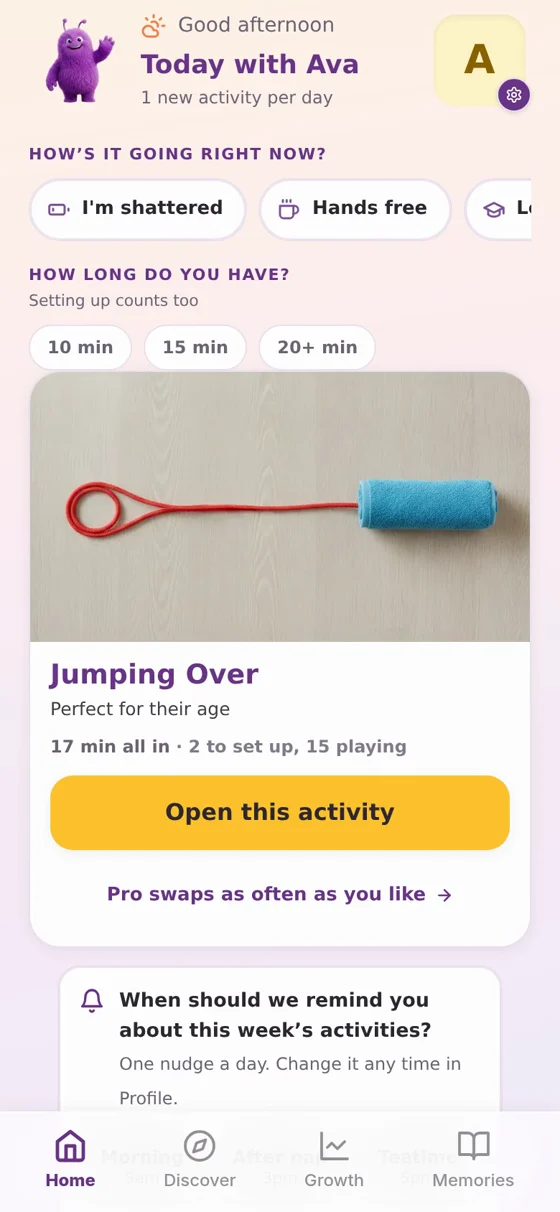
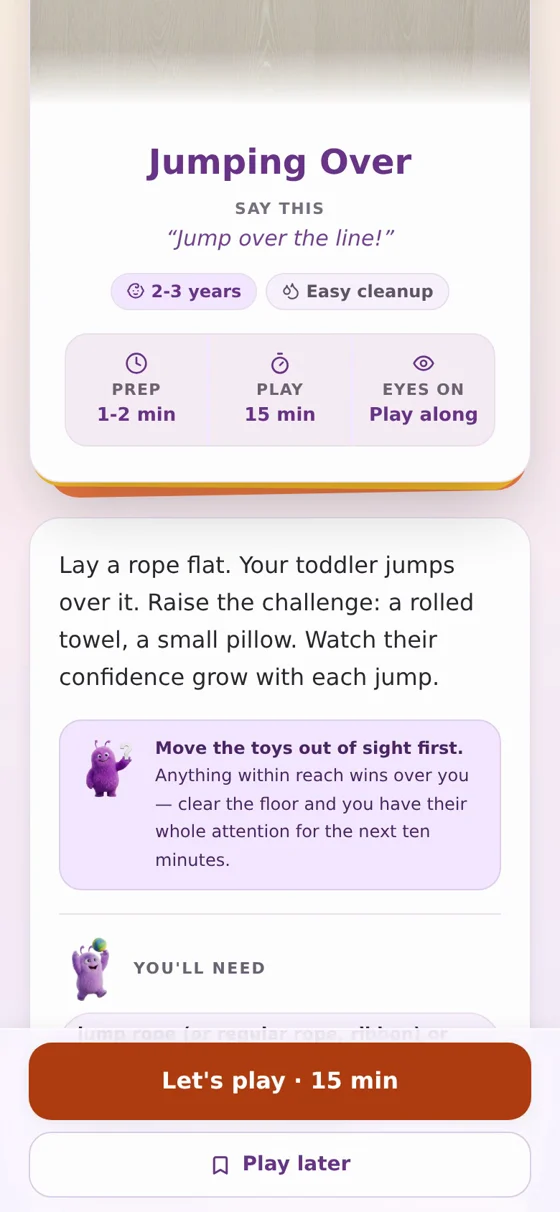
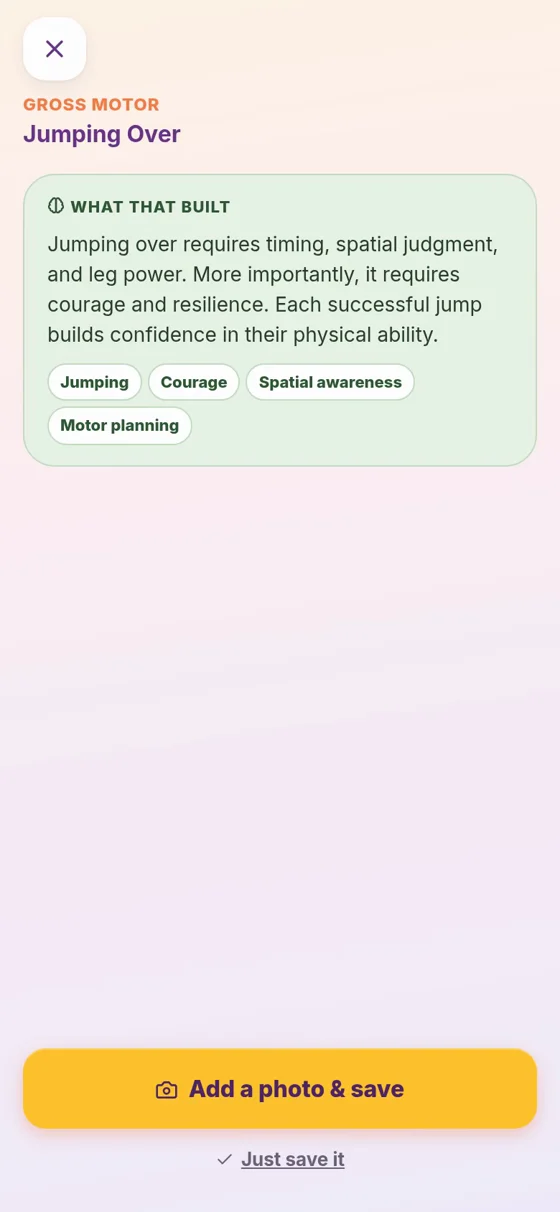
Read a lesson on the bus home. Then, when you walk in and your toddler is bouncing off the walls, open Mooshie, tap “high energy” and say how long you’ve got. It picks an activity for your child’s age and stage, with “How to play” steps and the exact words to say. A Brain Bit explains what the play does for your child’s development, so you keep learning too. Afterwards, “What that built” shows the skills you practised together.
When things get hard, Mooshie’s Lifesavers cover tantrums and meltdowns, bedtime, sleep regression, potty training, picky eating and separation anxiety. The journal saves a note and photo of what your child did, and the Growth tab shows their development over time.
Mooshie is free for 3 coached activities a week, with no account. Like The Happy Child, your child never uses the screen, and your child’s details stay on your phone. In fairness, Mooshie is iPhone only for now, has no video demos, starts at 6 months and is a newer app with fewer reviews. Have a look at our toddler tantrum help to get a feel for it.
Parents and experts on Mooshie
“I used to spend 30 minutes looking for an activity on Pinterest, get overwhelmed, and just turn on the TV. Mooshie takes 5 seconds.”
“Finally, an app that tells me to put my phone away. The activities are actually doable with stuff I have in my junk drawer.”
“As a pediatric OT, I love that these activities build core developmental skills without feeling like ‘homework’ for parents.”
Why parents choose Mooshie over The Happy Child
Something to do, not just to know
A lesson gives you the thinking. Mooshie gives you a ready-made activity with steps and words, so you can act on it in the next five minutes.
Matched to your child’s age
Activities are picked for your child’s age and stage from 6 months to 4 years, plus the time you have and how today is going.
Help in the hard moment
Lifesavers for meltdowns, bedtime and separation anxiety give you something practical to try right when you need it.
Other The Happy Child alternatives
- Pathways.org Baby Milestones: Also free, from a US non-profit, with milestone tracking and real-baby video examples.
- The Wonder Weeks: Explains fussy phases in the first 20 months through a leap chart worked out from your due date.
- Kinedu: A paid development programme with video activities, tracking and expert classes, from pregnancy to age 6.
- BabySparks: A daily plan of video-led activities and milestone tracking for 0 to 3 years.

Questions parents ask
Is The Happy Child parenting app free?
Yes. At the time of writing, it’s completely free on the App Store and Google Play, with no in-app purchases listed. There’s nothing to unlock and no trial to cancel.
Is The Happy Child app any good?
Parents rate it very highly, with 4.9 on both the UK App Store and Google Play. It’s best if you want short, research-based lessons on your parenting approach. If you want play ideas for your child’s age, pair it with a play app like Mooshie.
What age is The Happy Child app for?
It doesn’t give a child age range. The app says its lessons apply whatever the age of your children, so you can start whenever suits you.
Do I have to choose between The Happy Child and Mooshie?
Not at all. They do different jobs: The Happy Child teaches you, and Mooshie gives you screen-free play for 6 months to 4 years. Both are free to start, so you can use them side by side.
Who makes The Happy Child app?
The store developer is HJB Ventures LLC, and the app is attributed to the Human Improvement Project. Lessons draw on psychology, neuroscience and paediatrics.
Make memories. Build skills. Play together.
Your first activity is ready as soon as you tell us their age.