Big-Movement Play: Gross Motor Activities Indoors and Out

SKILLS AND LEARNING · 6 MONTHS TO 4 YEARS

Big-Movement Play: Gross Motor Activities Indoors and Out

Gross motor activities for toddlers, split by living room, stairs and hallway, and outside, from the Mooshie Moments app. Burn energy on any weather day.

  • Free to download
  • No account needed
  • No screen time for your child
QR code to download Mooshie MomentsOn a laptop?
Scan to get Mooshie on your iPhone.
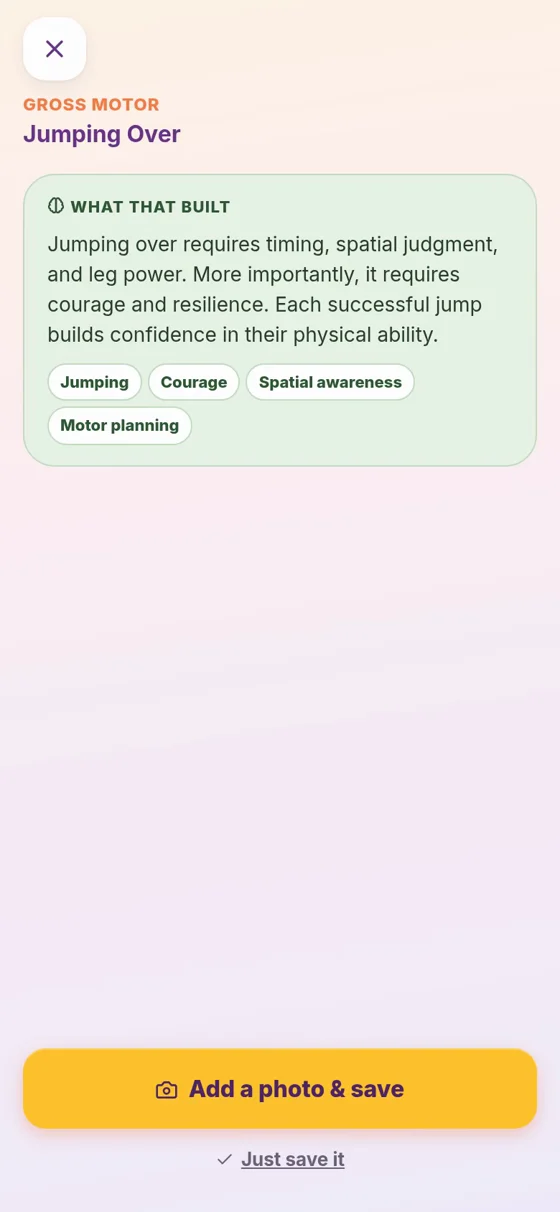
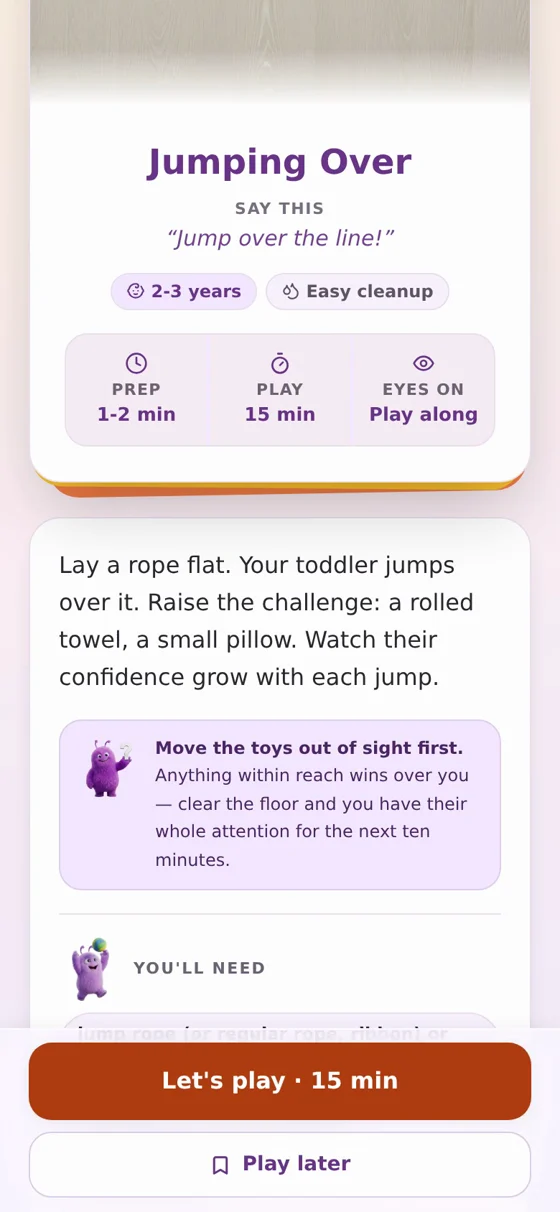
What that built screen showing the skills an activity practisedMooshie activity screen with Say this words to use
12free ideas on this page
5,918activities for 6 months to 4 years
Say thisthe exact words on every activity
0child details uploaded, ever

Gross motor activities are the big, whole-body movements, running, jumping, crawling, balancing, that burn off energy your toddler doesn’t know what to do with, and on a wet Tuesday you don’t need a garden to fit them in. The living room, the hallway and the bottom of the stairs can all double as movement space when the weather won’t cooperate.

Below are twelve ideas from the Mooshie Moments app, split by where you actually have room to do them: the living room, the stairs and hallway, and outside when the weather allows. For when hands, not the whole body, need the workout, see our fine motor activities page instead. Every one uses things already in your house, takes 5 to 25 minutes, and comes with the words to say while you play.

A loose guide to physical milestones

Every child moves at their own pace, but roughly speaking:

Walking

often begins somewhere around 12 to 18 months, sometimes earlier, sometimes later.

Running

tends to follow within a few months of confident walking, usually by 2.

Jumping with both feet off the ground

often develops around 2 to 3 years.

Balancing on one foot

, even briefly, is a genuine milestone many children work towards through ages 3 and 4.

These are general patterns, not a checklist, and plenty of healthy children sit outside them in either direction. If you have concerns about your child’s movement or development, your health visitor is the right person to ask.

In the living room

3 to 4 years10 minutes

1. Wiggle and stop dance freeze

Call out one body part to wiggle at a time, everything else stays completely still, then stop the music so the whole body freezes at once. Big movement followed by sudden stillness is a genuine workout for a young nervous system, and it’s great cardio too.

Clear the space of furniture first, and if siblings join in, set a simple rule about which way each child moves to avoid collisions.

You’ll need: phone or speaker with music

How to play
  1. Start the music: “only your hands are allowed to wiggle.”
  2. Change the part mid-song: “now only your shoulders.”
  3. Pause the music: “stop the wiggle!”
  4. Work through hips, knees and head, then finish with everything wiggling at once.
3 to 4 years10 minutes

2. Superhero training academy

Turn ordinary jumping, tiptoeing and running into “superpowers” your child is training to unlock. Casting movement as a game reduces self-consciousness and makes repetition far more appealing than plain practice ever does.

Keep the space clear of furniture, and supervise any jumping closely to avoid collisions.

You’ll need: pillows or floor markers, a couch, wall space

Say this: “Super-jump power, activate!” · “Sneaky sneaky!” · “Run like the wind!”
6 to 12 monthsA couple of minutes at a time

3. Tummy time reach

Dangle a toy just out of reach during tummy time and let your baby stretch, reach and strengthen their neck and shoulders, entirely motivated by interest rather than exercise.

You’ll need: a colourful toy, a blanket

How to play
  1. Place your baby on a mat for tummy time and sit facing them.
  2. Hold a toy about 30cm away at eye level: “look what I have!”
  3. Let them reach and bat at it, celebrating every attempt.
  4. Move the toy slightly if interest fades, then rest after a minute or two.
1 to 2 years10 minutes

4. Sock pile dig and carry

Pile clean socks in one corner and let your toddler dig through, grab one and carry it to a basket across the room, back and forth until the pile is gone. Digging, carrying and walking all in one repeated loop, with a genuinely useful result at the end.

You’ll need: 10 to 15 clean socks, a basket

Say this: “Socks are sleeping in a pile, let’s wake them up!” · “Walk it over to the basket!”

On the stairs and in the hallway

1 to 2 years10 minutes

5. Blanket tunnel crawl

Drape a blanket over two chairs to make a low tunnel and let your toddler crawl through to the other side. The enclosed space adds a small thrill of adventure while building arm, shoulder and core strength in a way open-space crawling doesn’t.

Check the chairs are stable and won’t shift, and check headroom so they don’t bump their head.

You’ll need: two chairs, a blanket or sheet

How to play
  1. Position two chairs about 4 feet apart with clearance underneath.
  2. Drape the blanket over both, leaving openings visible.
  3. Go through first slowly to demonstrate.
  4. Narrate as they crawl through: “you’re going under, you made it out!”
1 to 2 years10 minutes

6. Colour hunt around the house

Tape squares of coloured paper around the hallway and living room, then send your toddler hunting for matching coloured objects, walking room to room to compare and collect. It builds visual discrimination, but it also gets them up and moving between rooms rather than sitting still.

You’ll need: coloured paper, sticky tape

Say this: “Find something red!” · “That matches!” · “What else is blue?”
3 to 4 years15 minutes

7. Step-hop skipping practice

Hold both hands and gallop together first, then shift into a step-hop rhythm towards real skipping, a later milestone that usually lands closer to 4 or 5. Your body carries the rhythm until theirs catches up.

Practise on a flat, non-slippery surface and stay close in case of falls.

You’ll need: open space, a soft surface

How to play
  1. Gallop together first to settle into a rhythm.
  2. Shift to “step-HOP, step-HOP”, exaggerating the hop.
  3. Hold both hands and skip slowly together, saying the rhythm out loud.
  4. After 6 to 8 skips, try with one hand, then let them attempt it solo.
6 to 12 months10 minutes

8. Soft obstacle crawl course

Lay a low, winding path of rolled blankets and cushions along the hallway floor and let your baby navigate around and over it at their own pace. Assessing each obstacle and adjusting their approach is real problem-solving happening in real time.

Keep every obstacle soft and low, and stay close throughout.

You’ll need: rolled blankets, pillows, cushions

Outside

2 to 3 years25 minutes

9. Treasure dig challenge

This one works just as well tacked onto a trip covered on our best outdoor activities page. Bury a handful of small treasures just under the surface and let your child dig them all up with a spoon or small shovel, adding each find to a collection basket.

You’ll need: sand or a soil patch, small toys or stones, a spoon or small shovel

How to play
  1. Hide 5 to 8 small items just under the surface.
  2. Hand over a spoon or small shovel: “find the treasure!”
  3. Celebrate each find and add it to the basket.
  4. Wash hands thoroughly once you’ve finished digging.
2 to 3 years5 minutes

10. Pop the bubbles

Blow bubbles in the garden and let your toddler chase and pop them, changing the rules to “hands only” or “feet only” as you go. It gets them running, changing direction and reaching all at once, and there’s genuinely no way to lose.

You’ll need: a pot of bubbles

Say this: “Pop them all.” · “This time only with your hands.” · “Now stamp them with your feet.”
2 to 3 years20 minutes

11. Bubble pop counting

Blow a batch of bubbles and count out loud as your child pops each one, working up from five towards ten. Counting during a physical game embeds early numeracy without any pressure attached.

Use child-safe bubble solution and watch for slipping on wet grass.

You’ll need: bubble solution and wand

6 to 12 months10 minutes

12. Petal float watching

Float a few fallen petals in a bowl of water outside and let your baby reach for them as they swirl. A gentler outdoor moment for the youngest movers, mixing a small reach and grasp with time spent outside.

You’ll need: a few fallen petals, a bowl, water

Say this: “Watch it swirl.” · “Tiny boat.”

The rainy day energy-burn plan

On a properly wet day, along with our other indoor activities, chain three or four of the ideas above together: dance freeze to start, sock pile carrying to keep moving, a tunnel crawl through the hallway, then a calmer wind-down like petal watching if you have flowers to spare from a windowsill vase. Fifteen to twenty minutes of proper movement, indoors, usually does more for the rest of the day than an hour of sitting still ever will, and the furniture generally survives.

Hundreds more ideas like these are waiting in the app.

Plus one picked for your child every day, matched to their age and how today is going.

LOVED BY FAMILIES

Parents and experts on Mooshie

“I used to spend 30 minutes looking for an activity on Pinterest, get overwhelmed, and just turn on the TV. Mooshie takes 5 seconds.”
Sarah J.Mum of a 2-year-old
“Finally, an app that tells me to put my phone away. The activities are actually doable with stuff I have in my junk drawer.”
Mark D.Dad of two
“As a pediatric OT, I love that these activities build core developmental skills without feeling like ‘homework’ for parents.”
Dr Emily R.Paediatric occupational therapist
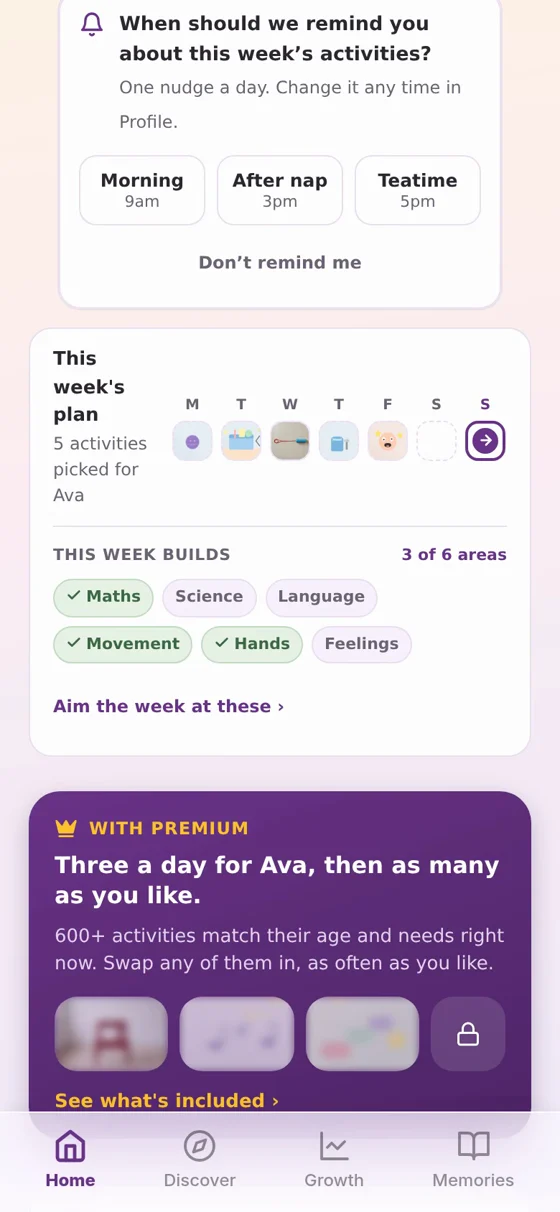
This week's plan showing five activities and the areas they build
HOW MOOSHIE HELPS

How Mooshie helps with movement and energy

Mooshie Moments has 5,918 activities for children aged 6 months to 4 years, all using things already at home, and picks one for your child’s age and stage each day. You can tell it how much time you have, from 10 minutes to 20 or more, and it suggests something that fits, indoor or out.

  • A weekly plan of five activities tracks six areas including movement, so gross motor play sits inside a wider balanced week.
  • Say this phrases and safety notes come with every activity.
  • Additional needs can be added, including wheelchair use, walking aids and motor delay, so activities your child can’t do are filtered out and adapted alternatives appear instead.
  • Free, no account: one new activity every day on iPhone.

Your little one never needs to look at it. Check the idea in 30 seconds, put the phone away and get moving.

Questions parents ask

What counts as a gross motor skill?

Any movement that uses the large muscles of the body: walking, running, jumping, climbing, crawling and balancing all count. It’s different from fine motor skills, which cover small, precise hand movements.

How much physical activity does a toddler need each day?

There’s no single fixed number, but regular movement spread across the day, rather than one long session, tends to work best for toddlers. A mix of active bursts like the ones above and quieter play usually balances out well.

My toddler seems behind on running or jumping. Should I worry?

Physical development varies a lot between children, and many catch up with practice and time. If you’re concerned, or your child has stopped progressing, it’s worth mentioning to your health visitor rather than waiting.

What are some indoor gross motor activities for a rainy day?

Dance freeze games, blanket tunnels, sock carrying and simple obstacle courses through the hallway all work well indoors, using nothing more than what you already have around the house.

Are these activities suitable for a child who uses a wheelchair or walking aid?

Several can be adapted, such as bubble popping or the colour hunt, by adjusting reach and pace to suit your child. Mooshie’s additional needs settings surface adapted alternatives where relevant.

Mooshie is a play app, not medical advice. If you’re worried about your child’s development, speak to your health visitor or GP.

Make memories. Build skills. Play together.

Your first moment is ready as soon as you tell us their age.

Mooshie MomentsFree on iPhone
Get it free