
Fun 4-Year-Old Activities That Build Real Skills
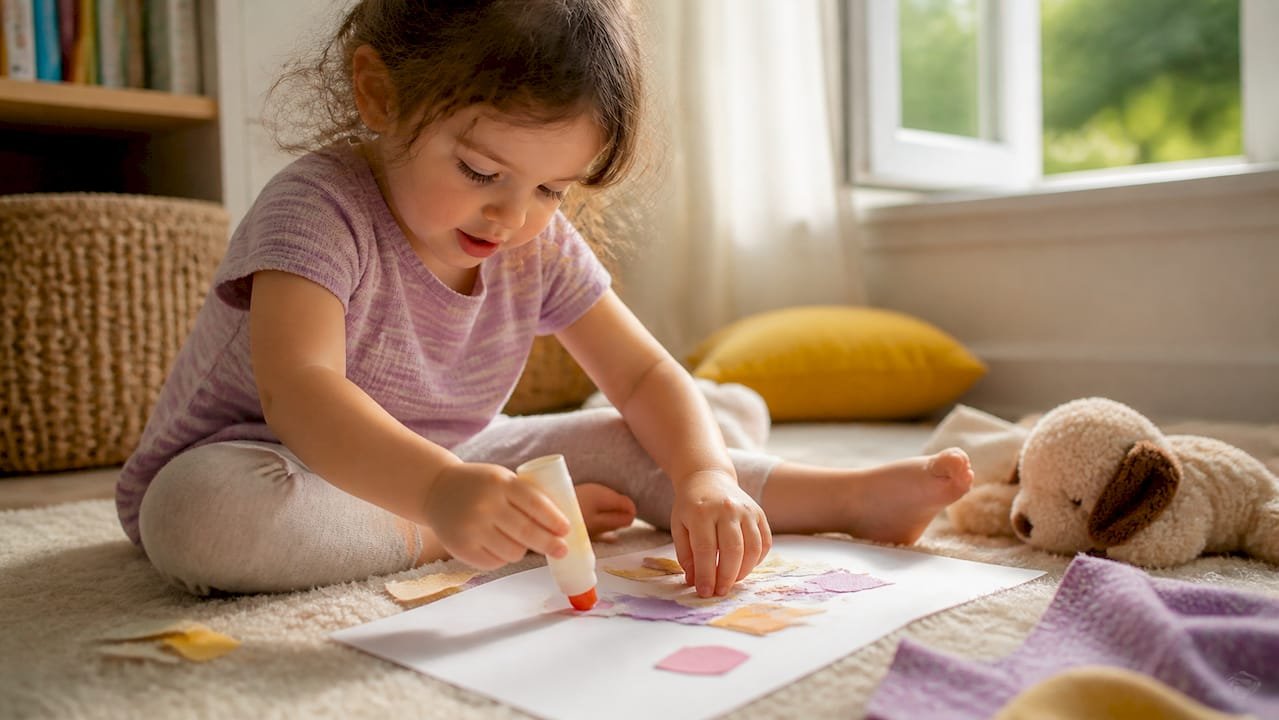
The best 4 year old activities are screen-free, take 5–30 minutes, and use things you already have at home. For a quick win right now, pick from these five:
- Obstacle course (15–20 min) — builds gross motor skills and self-regulation
- Pretend play / dramatic play (20–30 min) — grows language and social skills
- Sensory bin (10–15 min) — supports fine motor control and focus
- Simple collage or painting (10–15 min) — develops creativity and hand coordination
- Letter or number hunt (5–10 min) — introduces early literacy and math concepts
Two quick cues for choosing: if your child is bouncy and full of energy, go physical first (obstacle course, tag, hopscotch). If they’re tired or winding down, sensory or quiet art activities tend to work better. Space matters too — a rainy afternoon calls for a sensory bin on the kitchen table, not a backyard relay race.
Key Takeaways
Play-based, screen-free activities using everyday household items are the most effective way to build language, motor, and social skills in 4-year-olds.
| Point | Details |
|---|---|
| Start with 5–10 minutes | Short, focused activities work as well as long ones — pick one and run it today. |
| Use what you have | Household items like rice, boxes, and crayons support richer play than expensive toys. |
| Match activity to mood | High energy calls for physical play; tired or winding down calls for sensory or quiet activities. |
| Watch the red flags | Contact your pediatrician if concerns about development are frequent, intense, or show up across multiple settings. |
| Mooshiemoments personalizes it | The app filters screen-free activities by age, time, and energy level so you always have a ready idea. |
Table of Contents
- Why play-based activities matter for your 4-year-old
- What to expect at age 4 — milestones and red flags
- 15 activities for 4-year-olds, organized by category
- How to set up and run these activities smoothly at home
- A sample day and week to fit activities into real life
- What experts and research say about making play count
- A note from us on keeping it simple
- Mooshie Moments gives you ready-to-go activities, personalized for your child
- Sources
Why play-based activities matter for your 4-year-old
Play is how 4-year-olds build their brains. The American Academy of Pediatrics is direct about this: unstructured, child-led play develops executive function, language, collaboration, and self-regulation in the preschool years. These are not soft extras. Executive function, which includes planning, impulse control, and flexible thinking, predicts school readiness more reliably than early academic drilling.
The distinction between child-led play and didactic activities matters here. When a child decides to build a tower and then knock it down, they’re practicing hypothesis testing. When an adult directs every step, that cognitive ownership disappears. Both have a place, but the research consistently favors giving children the lead for most of the session.
Here’s a simple mapping to keep in mind:
- Pretend / dramatic play → language development and social skills
- Obstacle courses and active games → gross motor control and self-regulation
- Sensory bins and playdough → fine motor skills and focus
- Simple art and collage → creativity, hand-eye coordination
- Letter hunts and counting games → early literacy and numeracy
What to expect at age 4 — milestones and red flags
Most 4-year-olds are hitting a genuinely exciting developmental window. The CDC’s milestone checklist describes what’s typical across four domains:
Communication: Tells stories using at least two events in order; asks “why” constantly; uses sentences of four or more words; strangers can understand most of what they say.
Cognitive: Names a few colors and numbers; draws a person with three or more body parts; understands the idea of counting.
Social/emotional: Pretends to be something else during play (teacher, superhero, animal); comforts friends who are upset; likes to be with other children.
Motor: Catches a large ball most of the time; hops on one foot; uses utensils and can unbutton clothing.
Red flags to watch for. Concern rises when behaviors are frequent, prolonged, intense, or unsafe, and when they show up across multiple settings (home, daycare, playground), not just one. Specific patterns worth flagging to a pediatrician include:
- Not speaking in sentences or being very hard to understand by age 4
- Rarely making eye contact or showing little interest in other children
- Extreme tantrums that last more than 15–20 minutes and happen daily
- Significant regression in skills they previously had (toilet training, speech)
- Behaviors that feel unsafe to themselves or others on a regular basis
If you notice any of these patterns, bring a few concrete examples to your child’s next well-visit. Your pediatrician can screen further or refer to a specialist. You don’t need to wait for the next scheduled appointment if something feels urgent.
15 activities for 4-year-olds, organized by category
Activities for 4 year olds work best when they match the skill you want to build. Here are 15 ready-to-run ideas across six categories, each using common household items.
Creative and art activities
1. Collage from recycled materials
Materials: Old magazines, junk mail, glue stick, paper. Time: 10–15 min. Steps: (1) Lay out paper and torn magazine pieces. (2) Let your child choose and arrange shapes freely. (3) Glue them down. (4) Ask them to tell you about their picture. Learning goal: Fine motor control, creative decision-making. Variation: Add stickers or fabric scraps for a sensory layer; for a group, give each child a different color palette.
2. Watercolor resist painting
Materials: White crayon, watercolor paints, paper, brush. Time: 15 min. Steps: (1) Draw a simple shape or letter with the white crayon. (2) Paint over the whole page with watercolor. (3) Watch the hidden shape appear. (4) Talk about what they see. Learning goal: Color recognition, cause-and-effect thinking. Variation: Write their name in white crayon so they “discover” it.
Sensory activities
3. Sensory bin (dry)
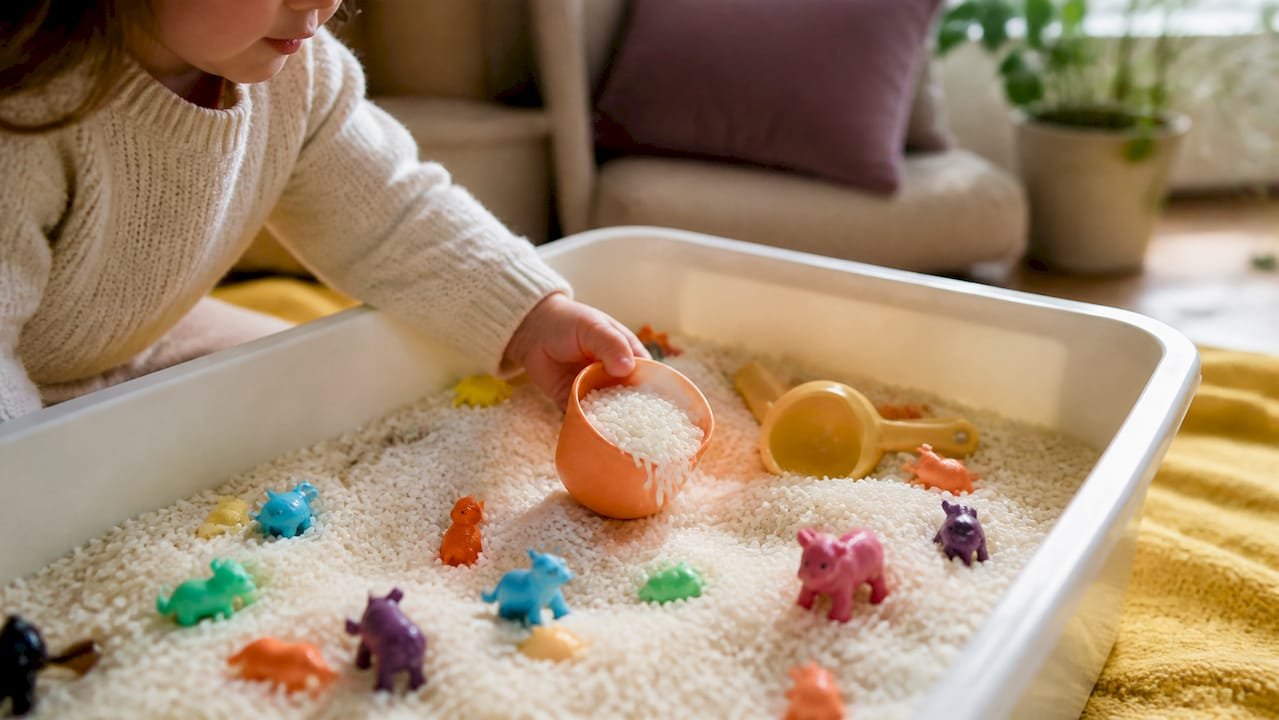
Materials: A plastic bin, dried rice or oats, small cups, spoons, toy animals. Time: 10–15 min. Steps: (1) Fill the bin with rice or oats. (2) Bury a few small toys. (3) Let your child dig, pour, and find. (4) Name what they find together. Learning goal: Fine motor skills, vocabulary, focus. Variation: Add letter tiles or number cards to turn it into a literacy hunt.
4. Playdough squeeze and build
Materials: Homemade or store-bought playdough, safe plastic tools, small objects to press in. Time: 15–20 min. Steps: (1) Roll, squeeze, and flatten together. (2) Press objects in to make prints. (3) Build a scene (farm, kitchen, space). (4) Describe what you’re making. Learning goal: Hand strength, imaginative play, vocabulary. Variation: Add counting (“make three snakes”) for a math layer.
Physical and outdoor activities
5. Backyard obstacle course
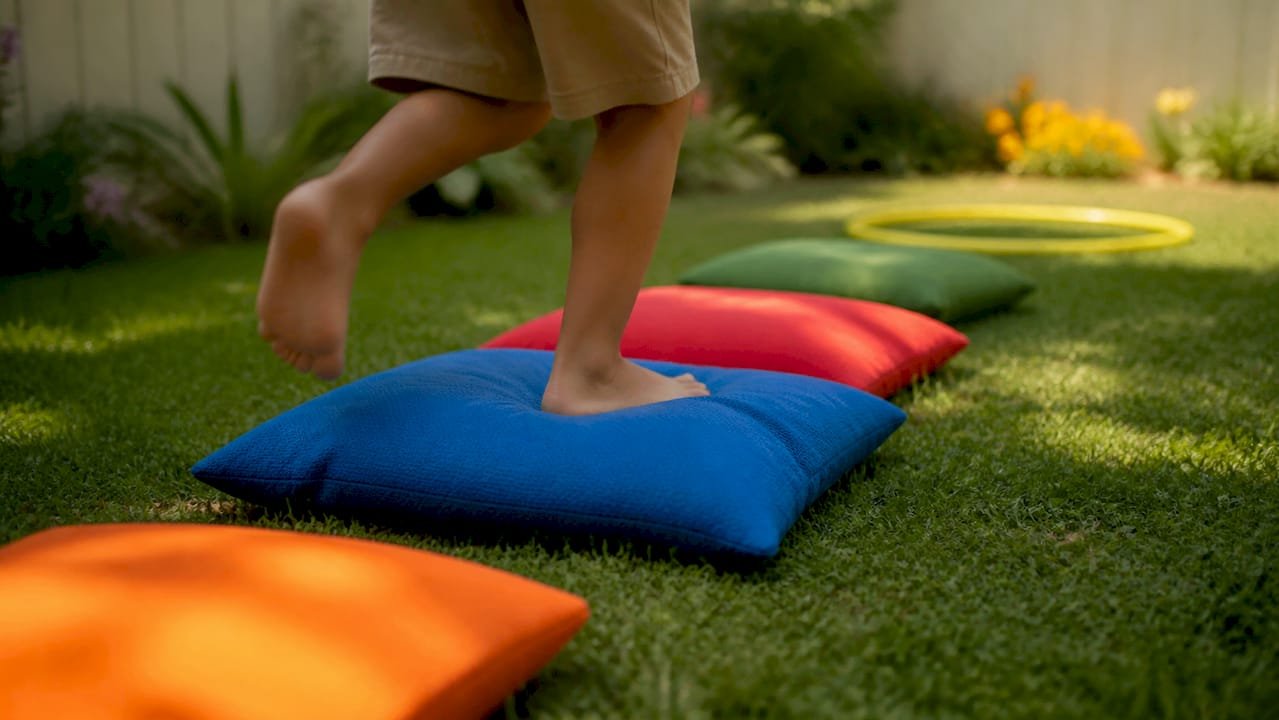
Materials: Hula hoops, cushions, chalk lines, a low step. Time: 15–20 min. Steps: (1) Set up 4–5 stations (jump over, crawl under, hop on). (2) Walk through it together once. (3) Time them with a visual countdown. (4) Let them redesign one station. Learning goal: Gross motor skills, sequencing, self-regulation. Variation: Add a sibling as a “course designer” to build leadership skills.
6. Hopscotch with a twist
Materials: Sidewalk chalk. Time: 10 min. Steps: (1) Draw a classic hopscotch grid. (2) Write numbers or letters in each square. (3) Call out a number or letter; they hop to it. (4) Swap roles. Learning goal: Balance, letter and number recognition. Variation: Use shapes instead of numbers for younger siblings.
KidsHealth notes that active games like tag, hopscotch, and obstacle courses directly build the gross motor skills — hopping, catching, and balancing — that 4-year-olds are developing right now.
7. Nature scavenger hunt
Materials: A simple checklist (drawn or printed), a small bag. Time: 20–30 min. Steps: (1) Draw 5–6 items to find (leaf, rock, something yellow, something rough). (2) Head outside. (3) Check off items together. (4) Sort the collection by color or size back home. Learning goal: Observation, early classification, vocabulary. Variation: For multiple children, give each a different list so they’re not competing for the same items.
Pretend and social play
8. Dramatic play: restaurant
Materials: Paper, crayons, play food or real snacks, a notepad. Time: 20–30 min. Steps: (1) Set up a “restaurant” at the kitchen table. (2) Make a menu together. (3) Take turns being the customer and the chef. (4) Use polite phrases (“May I take your order?”). Learning goal: Language, social skills, sequencing. Variation: Add a third child as the “delivery driver” to extend the scenario.
9. Blanket fort storytelling
Materials: Blankets, cushions, a flashlight. Time: 20–30 min. Steps: (1) Build the fort together. (2) Climb inside with the flashlight. (3) Take turns adding one sentence to a story. (4) Draw a picture of the story afterward. Learning goal: Narrative language, creativity, turn-taking. Variation: Use puppets made from socks to tell the story.
KidsHealth specifically highlights blanket forts, obstacle courses, and pretend play as activities that support executive function, social-emotional regulation, and motor control in typical 4-year-olds.
Learning, early literacy, and math
10. Letter hunt around the house
Materials: Sticky notes with letters written on them, a list of items to find. Time: 5–10 min. Steps: (1) Stick notes on objects around one room. (2) Call out a letter; they find it. (3) Name the object it’s on. (4) Collect all the notes at the end. Learning goal: Letter recognition, phonics awareness. Variation: Use numbers and ask them to find that many of something.
11. Counting with snacks
Materials: Crackers, raisins, or cereal pieces. Time: 5 min. Steps: (1) Place a small pile on the table. (2) Count together. (3) Sort by color or shape. (4) Practice simple addition (“I have 3, you have 2, how many together?”). Learning goal: Number sense, one-to-one correspondence. Variation: Use the snack as a reward for correct answers to keep motivation high.
12. Rhyming word game
Materials: None needed. Time: 5–10 min. Steps: (1) Say a simple word (“cat”). (2) Ask them to think of a rhyme. (3) Take turns adding rhymes. (4) Clap the syllables in each word. Learning goal: Phonological awareness, a key pre-reading skill. Variation: Turn it into a silly song to extend engagement.
Quiet and independent activities
13. Sorting and matching tray
Materials: A muffin tin or egg carton, small household objects (buttons, coins, pasta shapes). Time: 10–15 min. Steps: (1) Mix objects in a bowl. (2) Ask them to sort by color, shape, or size. (3) Count each group. (4) Ask them to make a new sorting rule. Learning goal: Classification, early math, independent focus. Variation: Add a timer to make it a self-challenge.
14. Simple puzzle or pattern blocks
Materials: A floor puzzle (24–48 pieces) or pattern blocks. Time: 15–20 min. Steps: (1) Tip out the pieces. (2) Find the corner and edge pieces first. (3) Work section by section. (4) Celebrate the finish. Learning goal: Spatial reasoning, persistence, problem-solving. Variation: For a group, assign each child a section of the puzzle.
15. Drawing journal
Materials: A blank notebook, crayons or markers. Time: 10–15 min. Steps: (1) Ask one open question (“What made you happy today?”). (2) Let them draw their answer. (3) Write their words underneath as they dictate. (4) Date the page. Learning goal: Emotional vocabulary, early writing concepts, self-expression. Variation: Review old pages together monthly — children love seeing their own progress.
Pro Tip: For mixed-age groups, assign roles rather than identical tasks. Let the 4-year-old be the “director” or “narrator” while a younger child handles simpler steps. This reduces conflict, keeps everyone engaged, and quietly builds leadership skills in your older child.
How to set up and run these activities smoothly at home
Good preparation takes two minutes and prevents most meltdowns. Before you start, gather everything into a tray or bin so there’s no mid-activity scrambling. A visual timer (a sand timer or a simple phone countdown your child can see) helps them understand when the activity will end without a power struggle.
A few setup habits that consistently help:
- Offer two choices, not open-ended questions. “Do you want to do the sensory bin or the obstacle course?” works far better than “What do you want to do?”
- Set one clear expectation before you begin. “We’re going to paint for 10 minutes, then we clean up together.”
- Use a transition object. A specific song, a clap pattern, or a cleanup bell signals the end without it feeling abrupt.
Safety notes worth keeping in mind: Always supervise water play and sensory bins with small objects around children under 5. Outdoor obstacle courses need a quick scan for hazards (sharp edges, uneven ground) before your child runs them. AAP screen-time guidance recommends no screens 1–2 hours before bed, which makes the quiet activities in this list a natural fit for the wind-down window.
Pro Tip: Daily routines are free learning moments. Letting your child pick their own shirt builds decision-making. Having them count out five crackers at snack time is a math lesson. Asking them to put their shoes by the door practices sequencing. You don’t need a dedicated “activity time” for every skill.
A sample day and week to fit activities into real life
You don’t need a rigid schedule. What helps is a loose rhythm so activities happen consistently without requiring daily planning from scratch.
One sample day
- 7:30 AM — Morning routine as learning: Let your child choose between two breakfast options and count out their own cereal. (5 min, no prep)
- 9:00 AM — Active play: Backyard obstacle course or a walk with a nature scavenger hunt. (20 min)
- 10:30 AM — Creative activity: Collage or watercolor resist painting at the kitchen table. (15 min)
- 12:00 PM — Snack math: Count and sort snack pieces together. (5 min)
- 1:00 PM — Quiet/independent: Sorting tray or drawing journal during rest time. (15 min)
- 3:30 PM — Pretend play: Restaurant or blanket fort storytelling. (20–30 min)
- 5:30 PM — Wind-down: Rhyming word game or a simple puzzle before dinner. (10 min)
One-week rotation
| Day | Morning activity | Afternoon activity |
|---|---|---|
| Monday | Obstacle course (physical) | Letter hunt (literacy) |
| Tuesday | Playdough build (sensory) | Blanket fort storytelling (pretend) |
| Wednesday | Nature scavenger hunt (outdoor) | Drawing journal (quiet) |
| Thursday | Watercolor painting (art) | Counting with snacks (math) |
| Friday | Rhyming game (literacy) | Dramatic play: restaurant (social) |
| Weekend | Free outdoor play | Family puzzle or collage |
Short on time? Two 5-minute screen-free activities that always work: the rhyming word game (zero materials, works anywhere) and counting snacks at the table (built into a meal you’re already making).
What experts and research say about making play count
The core message from the AAP is simple: child-led, unstructured play builds executive function and is not optional at this age. Pediatricians are now encouraged to give a “prescription for play” at well-child visits, treating play as a health recommendation alongside nutrition and sleep.
Research-backed practices that make a real difference:
- Prioritize child-led play. Let your child direct the scenario. Your role is to follow, ask open questions, and respond — not to correct or redirect.
- Use everyday items. Simple household objects (boxes, spoons, fabric) often spark more creative thinking than purpose-built toys. The AAP notes that adult presence and responsive interaction matter more than the specific toy.
- Keep sessions short and frequent. Short supervised play periods of 10–20 minutes can reduce preschool-related stress and help anxious children transition into group settings more easily.
- Limit screens before bed. The AAP recommends no entertainment screens 1–2 hours before sleep, making the quiet activities in this list a practical evening choice.
- Ask, wait, listen. The AAP’s practice note on “prescribing play” emphasizes that simple prompts — ask a question, wait for the answer, listen fully — improve language outcomes more than any specific activity.
A note from us on keeping it simple
There’s a version of parenting advice that makes you feel like every moment needs to be optimized. It doesn’t. A 10-minute sensory bin while you make dinner is genuinely good enough. A blanket fort that falls apart in five minutes still counts. The research is clear that connection and responsiveness during play matter far more than the activity itself.
If you’re reading this list and feeling like you can’t do all of it, pick one activity this week. Just one. Run it for 10 minutes. See what your child does with it. That’s the whole idea.
Pro Tip: Accept “good enough” play. A short, joyful 10-minute activity where you’re present and responsive does more for your child’s development than a 45-minute structured session where you’re distracted or stressed. Small windows of time, used well, add up.
Mooshie Moments gives you ready-to-go activities, personalized for your child
Every activity in this article works. The harder part is remembering them when you’re tired at 4 PM and your child is asking “what can we do?” That’s exactly the gap Mooshiemoments fills.
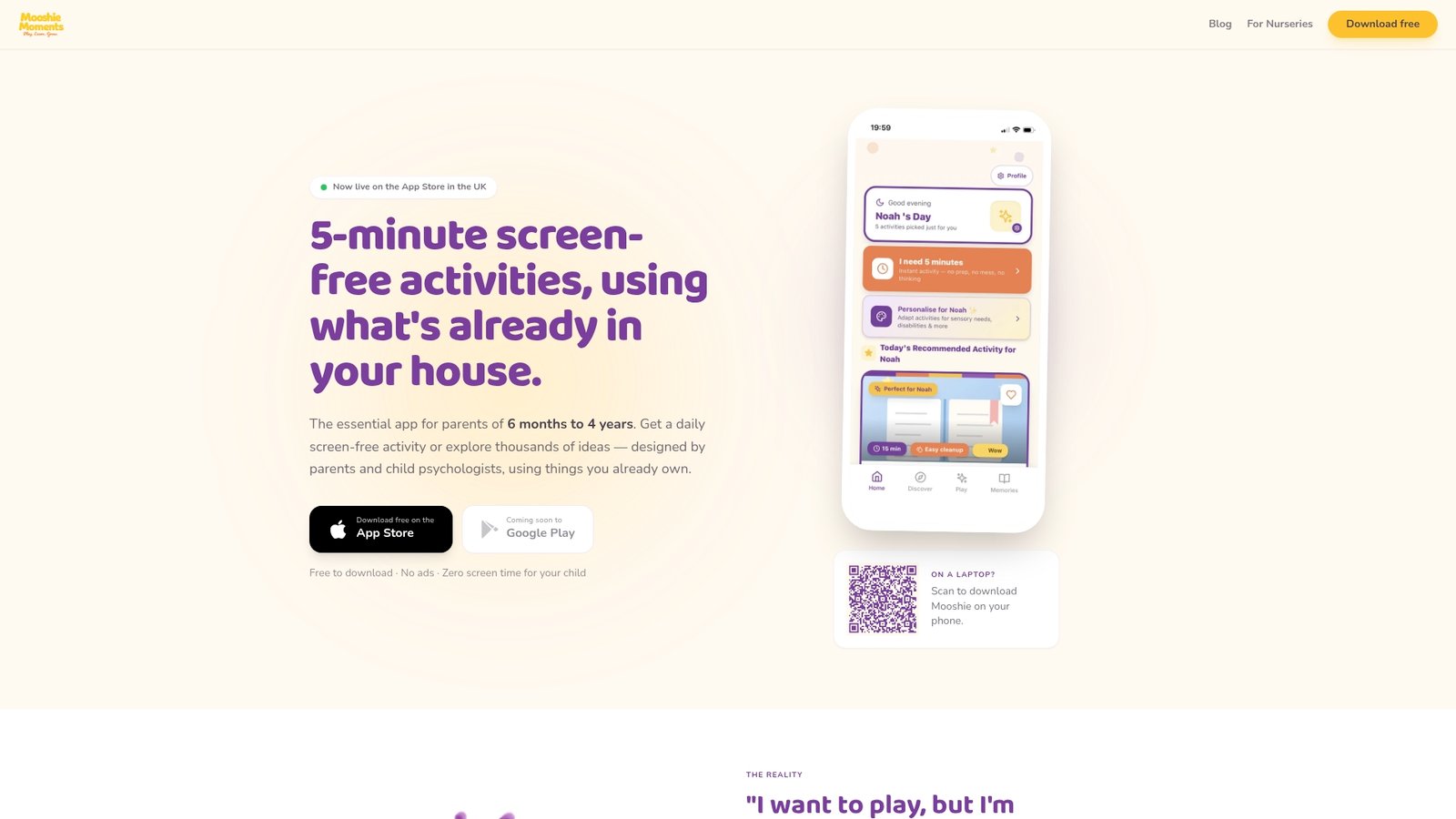
The app gives you a library of screen-free, developmentally focused activities filtered by your child’s age, your available time, and your energy level. Every activity uses household items and comes with a clear learning goal and expert-backed coaching notes, so you’re not just keeping them busy — you’re building something. For parents connected to nurseries or early years settings, Mooshiemoments also offers nursery partnership packs with printable resources and usage tracking to keep home and school aligned.
No planning. No extra purchases. Just open the app, pick an activity, and go. Try Mooshiemoments free and have something ready for this afternoon.
Sources
These are the primary sources behind the guidance in this article. Each one is free to access and worth bookmarking.
- Want creative, curious, healthier children with 21st century skills? Let them play, according to the American Academy of Pediatrics
- Milestones: 4 years | CDC
- A pediatric role in enhancing development in young children (AAP report reproduction) | DocsLib
- Fitness: 4–5 years | KidsHealth
Recommended
More like this

Five Minute Routine Activities to Help Speech Delay in UK Toddlers
Quick, routine based activities UK parents can use in 5–15 minutes to support a toddler with speech delay. Evidence backed techniques and…
Three Minute Mess Free Sensory Play For UK Parents
Quick, reusable sensory activities UK parents can set up in minutes. Sealed bags, sticky wall art, safety checks, storage tips, and Mooshie…
10 Quiet Bin Ideas UK Parents Can Build in 5 Minutes
Practical, EYFS-aligned quiet-bin ideas UK parents can assemble in five minutes. Includes 10 ready bins, a five-bin rotation, safety checks, and quick...