
Fun 3 Year Old Activities That Build Real Skills
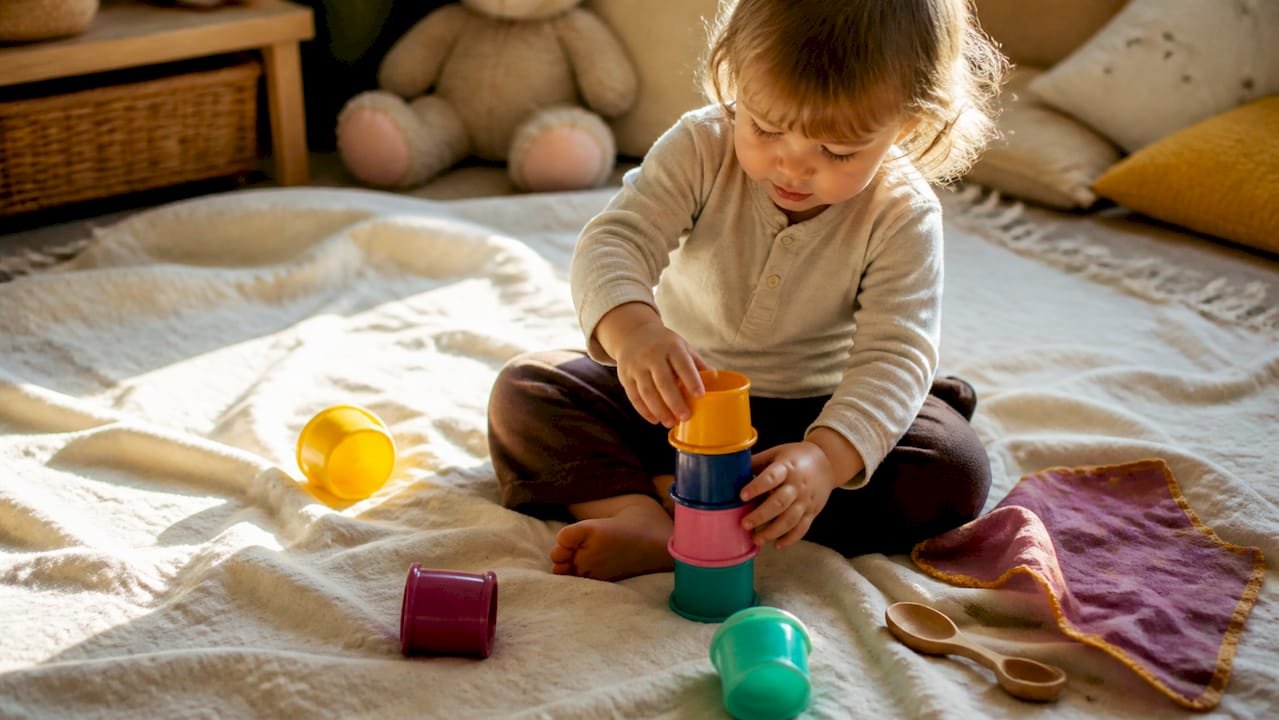
Here are 10 easy, developmentally appropriate activities you can start with your 3-year-old right now, no special supplies needed.
- Pretend play kitchen — social-emotional, language | pots, spoons
- Block building — spatial reasoning, fine motor | blocks
- Sensory rice bin — sensory regulation, fine motor | rice, cups
- Leaf rubbings — fine motor, nature observation | paper, crayons
- Bubble station — gross motor, cause-and-effect | dish soap, water
- Sorting socks — early math, self-help | laundry socks
- Story-building with puppets — language, narrative | socks or stuffed animals
- Sink or float experiment — early STEM, reasoning | bowl, 5 household items
- Sticker lines on paper — fine motor, pre-writing | stickers, paper
- Sidewalk chalk shapes — gross motor, early literacy | chalk
Each of these takes under three minutes to set up. The sections below break them into categories with more ideas, skill tags, setup times, and safety notes so you can plan a full day.
Pro Tip: Pick one activity from this list right now and try it before reading further. You’ll feel more confident about the rest once you’ve seen your child’s reaction.
Key Takeaways
The most effective approach to 3 year old activities is to keep them short, varied, and grounded in what your child is naturally curious about right now.
| Point | Details |
|---|---|
| Start with one activity | Pick one idea from this article and try it today; short wins build momentum for both of you. |
| Match activity to skill | Each activity type targets a different area: sensory for regulation, pretend play for language, outdoor play for gross motor. |
| Follow the child’s lead | If your child redirects an activity, go with it; child-directed play builds creativity and self-regulation. |
| Balance structured and free play | Aim for roughly equal time between adult-led activities and open-ended free play across the day. |
| Mooshiemoments for daily ideas | The app filters screen-free activities by age, available time, and skill so you always have something ready. |
Table of Contents
- 1. Indoor activities that work with what you already have
- 2. Outdoor and active play ideas for big movement and exploration
- 3. Sensory play activities that calm and engage
- 4. Art and craft projects scaled for a 3-year-old
- 5. Fine motor and preschool skill-building through play
- 6. Imaginative play and language-building prompts
- 7. Simple STEM and counting activities for early reasoning
- 8. Cooking and practical-life activities that teach real skills
- 9. How much playtime does a 3-year-old need each day?
- 10. Materials, storage, and cleanup hacks that make activities repeatable
- 11. Safety, supervision, and adapting activities for different abilities
- 12. What a 3-year-old is learning right now
- 13. How to build language into every activity you do
- 14. How to balance structured activities with free play
- 15. Inclusive activities that work for children with varying abilities
- What I’ve learned about choosing activities for a 3-year-old
- Mooshiemoments gives you a fresh activity idea in under 5 minutes
- Sources
1. Indoor activities that work with what you already have
Ten hands-on ideas for home, each with a quick setup and a clear skill goal.
Pretend play kitchen
Set out a few pots, wooden spoons, and plastic containers. Tell your child they’re the chef and you’re the hungry customer. Setup: 2 minutes. Skill: language, social-emotional. Three-year-olds thrive in role play because it lets them rehearse real-world conversations in a safe space.
Block building challenges
Ask your child to build “a tower taller than your hand” or “a house for this toy animal.” Setup: 1 minute. Skill: spatial reasoning, fine motor. Giving a specific goal stretches engagement well past the usual few minutes.
Simple puzzles
Keep a small rotation of 12–24 piece puzzles within reach. Setup: 30 seconds. Skill: problem-solving, hand-eye coordination. Swap puzzles every few days to keep them feeling new.
Reading with questions
Read a picture book, but pause on every third page and ask, “What do you think happens next?” Setup: 0 minutes. Skill: language, narrative thinking. This one small shift turns passive listening into active story-building.
Tray painting
Spread a thin layer of shaving cream or finger paint on a baking tray. Your child draws, erases, and draws again. Setup: 2 minutes. Skill: fine motor, sensory. The erasable surface removes the pressure of “ruining” the page.
Indoor obstacle course
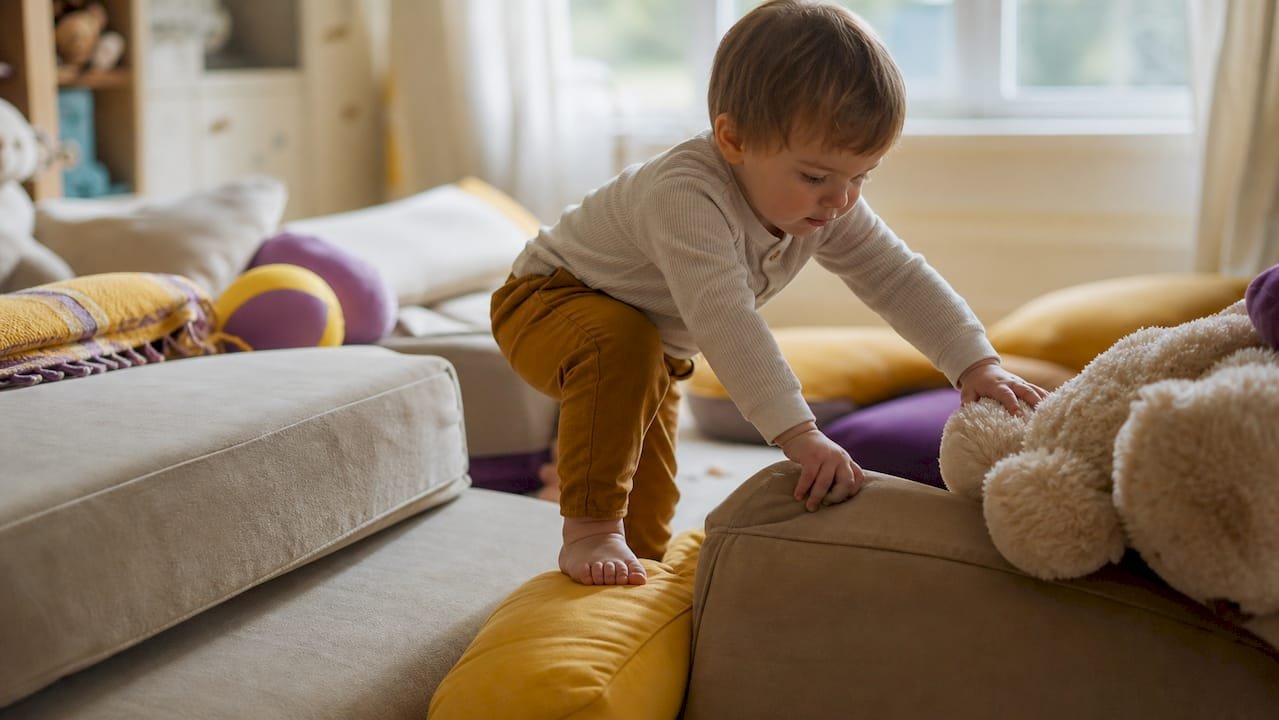
Line up couch cushions, a low step, and a hula hoop on the floor. Setup: 3 minutes. Skill: gross motor, sequencing. Call out the steps in order to sneak in some early instruction-following practice.
Matching and sorting games
Pull out a muffin tin and a handful of colored pom-poms or buttons (supervised). Ask your child to sort by color. Setup: 1 minute. Skill: early math, categorization.
Playdough at the table
Roll, press, and cut. No instructions needed. Setup: 1 minute. Skill: fine motor, creativity. Playdough is one of the most versatile materials you can keep on hand.
Dance freeze
Play music and freeze when it stops. Setup: 0 minutes. Skill: gross motor, listening, self-regulation. Short bursts of movement between quieter activities help 3-year-olds reset.
Simple board games
Games like Candy Land or a basic memory card game work well at this age. Setup: 2 minutes. Skill: turn-taking, counting, social skills. Losing gracefully is a real skill, and low-stakes games are the best place to practice it.
Pro Tip: Resist the urge to set up everything perfectly before your child arrives at the table. A partially set-up activity invites them to help finish it, which adds five extra minutes of engagement and a sense of ownership.
2. Outdoor and active play ideas for big movement and exploration
Eight activities that burn energy while building gross motor skills and curiosity about the world.
Backyard obstacle course
Use a garden hose to mark a path, set up a low step to jump off, and place a hula hoop to hop through. Change the order each time to keep it fresh. Safety note: keep jumps low (under 12 inches) and surfaces soft. Seasonal variation: in winter, use snow mounds as obstacles.
Nature scavenger hunt
Write or draw five items to find: a smooth rock, a yellow leaf, something soft, something that flies, a stick. Hand your child the list and a small bag. This builds observation skills and early literacy when you read the list together. Safety note: remind children not to put found items in their mouths.
Bubble station
Mix dish soap with water in a shallow tray. Use a variety of wands, including homemade ones made from pipe cleaners. Chasing and popping bubbles builds tracking skills and coordination. Seasonal variation: bubbles freeze beautifully in cold weather, which is a mini science moment on its own.
Water play
A plastic bin, a few cups, funnels, and spoons turn any warm afternoon into a fine motor and science session. Safety note: never leave a child unattended near water, even shallow amounts.
Sidewalk chalk target games
Draw circles of different sizes and toss beanbags or rolled-up socks into them. Add numbers to the circles for early counting practice. Skill: gross motor, early numeracy.
Ball games
Rolling, kicking, and throwing a large soft ball covers a surprising range of gross motor skills. Start with rolling back and forth, then progress to kicking a stationary ball, then a moving one. Safety note: use soft foam balls near windows.
Blanket play
Spread a large blanket on the grass. Two adults (or one adult and an older sibling) hold the edges and wave it up and down while your child runs underneath or sits in the middle for a gentle “ride.” Skill: vestibular processing, social play.
Scooter or ride-on zone
Set up a simple path with chalk arrows or cones. Ride-on toys build leg strength and spatial awareness. Safety note: helmets on, even for low-speed rides on flat surfaces. For local family-friendly outdoor events and parks to extend these activities beyond the backyard, DayHop is a useful resource for finding options near you.
3. Sensory play activities that calm and engage
Six sensory ideas with materials, cleanup notes, and safety reminders.
-
Sensory rice bin: Fill a shallow bin with dry rice. Add small cups, spoons, and a few hidden toys. Cleanup: lay a sheet underneath to catch spills. Safety: supervise closely; rice is a choking hazard for children under 3, but fine for most 3-year-olds with supervision. Skill: fine motor, sensory regulation.
-
Playdough (homemade): Mix 1 cup flour, ½ cup salt, 2 teaspoons cream of tartar, 1 cup water, and 1 tablespoon oil. Cook over medium heat, stirring until it forms a ball. Cool before use. Add food coloring for extra sensory input. Cleanup: air-dries quickly on surfaces; peel off tables easily. Skill: fine motor, creativity.
-
Pasta scooping: Cooked or dry pasta in a bin with tongs and cups. Dry pasta is lower mess; cooked pasta adds a tactile dimension. Cleanup: sweep dry pasta; wipe cooked pasta with a damp cloth. Safety: watch for small pasta shapes with children who still mouth objects.
-
Scented sensory bottles: Fill a small clear bottle with water, a drop of food coloring, and a few drops of lavender or peppermint extract. Seal tightly with glue. Your child shakes and watches. Cleanup: none. Skill: visual tracking, calming regulation.
-
Sensory bags: Place hair gel and a few small plastic toys inside a zip-lock bag. Seal with strong tape along the zipper. Your child squishes and moves the items without getting messy. Cleanup: none. Safety: check the seal before each use.
-
Cloud dough: Mix 8 parts flour with 1 part baby oil. It holds its shape when squeezed but crumbles when released. Cleanup: vacuum or sweep; the oil can stain fabric, so use a mat. Skill: sensory exploration, fine motor.
4. Art and craft projects scaled for a 3-year-old
Six projects that balance process and product, because at this age, your child genuinely wants to show you what they made.
Sticker collages
Steps: (1) Set out a sheet of paper and a variety of stickers. (2) Your child places stickers freely. (3) Add crayons to draw around the stickers if they want. Materials: paper, sticker sheets. Variation: use dot stickers and ask your child to make a face or an animal. Skill: fine motor, creativity.
Washable easel painting
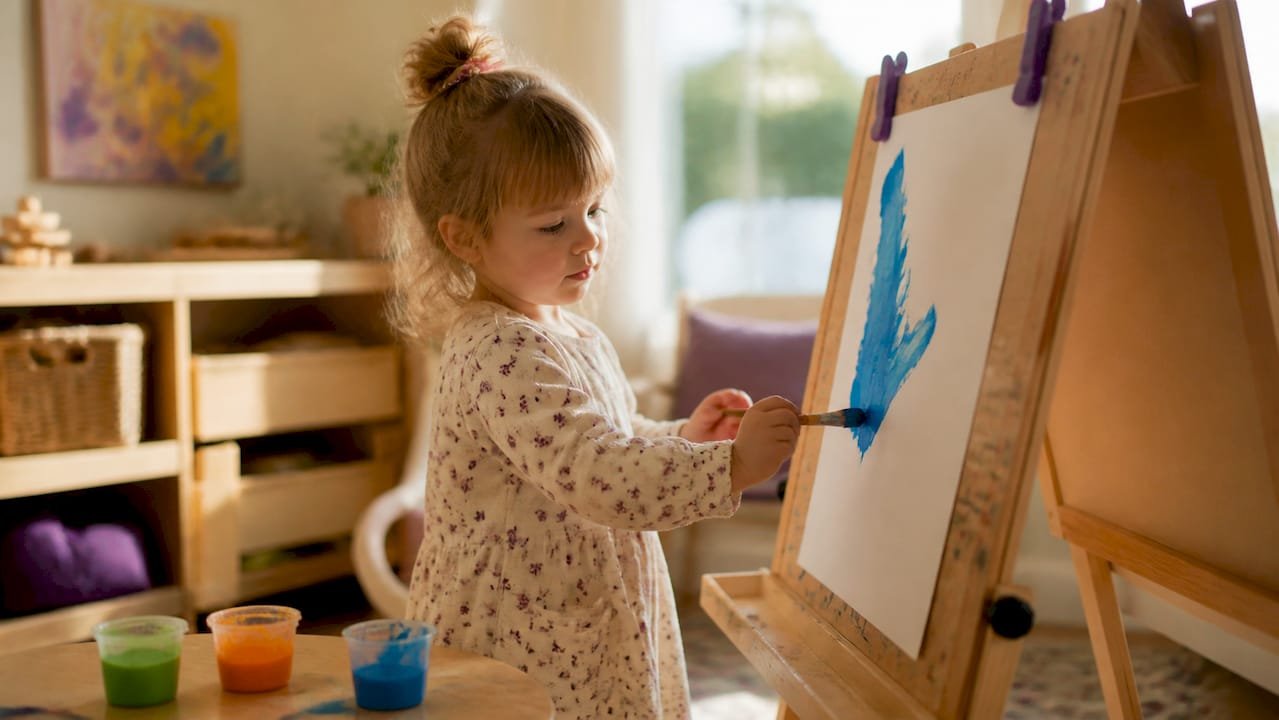
Steps: (1) Clip paper to an easel or tape it to a wall. (2) Set out two or three colors of washable paint in small cups. (3) Step back. Materials: washable paint, paper, brushes. Variation: use sponges, cotton balls, or toy cars as stamps. Skill: fine motor, color recognition, self-expression.
Simple glue-dot collage
Steps: (1) Pre-cut magazine pictures, tissue paper squares, or fabric scraps. (2) Give your child a glue stick and a piece of cardstock. (3) They arrange and stick. Materials: cardstock, glue stick, scraps. Variation: give a theme (“make a garden” or “make a city”). Skill: fine motor, creative decision-making.
Salt dough ornaments
Steps: (1) Mix 1 cup flour, ½ cup salt, ½ cup water. (2) Roll and cut shapes with cookie cutters. (3) Bake at 200°F for 2–3 hours. Materials: flour, salt, water, cookie cutters. Variation: press leaves or buttons into the dough before baking for texture. Skill: fine motor, following steps, sensory.
Leaf rubbings
Steps: (1) Collect a few leaves with visible veins. (2) Place a leaf under paper. (3) Rub the side of a crayon over the paper. Materials: leaves, paper, crayons. Variation: try bark rubbings on a tree trunk for a different texture. Skill: fine motor, nature observation.
Sticker name craft
Steps: (1) Write your child’s name in large block letters on paper. (2) Your child fills each letter with stickers. (3) Display it. Materials: paper, marker, sticker sheets. Variation: use dot stickers in two colors and ask them to alternate. Skill: name recognition, fine motor, early literacy.
5. Fine motor and preschool skill-building through play
Small-muscle control is the foundation for writing, dressing, and self-care. These activities build it progressively.
Sticker lines: Draw a wavy or zigzag line on paper and ask your child to place stickers along it. This targets pincer grasp and directional tracking. Progress by making the line thinner each week.
Pom-pom transfer with tongs: Set two bowls side by side. Your child uses kitchen tongs or child-safe tweezers to move pom-poms from one bowl to the other. This builds bilateral coordination and hand strength. Progress by switching to smaller pom-poms or using a spoon instead of tongs.
Large-bead threading: Start with large wooden beads and thick shoelace. Once your child threads ten beads confidently, reduce bead size or switch to a thinner cord. This targets hand-eye coordination and pincer grasp.
Simple cutting practice: Give your child child-safe scissors and strips of paper to snip. Draw short lines across the strip so they know where to cut. Progress to cutting along a curved line, then a simple shape outline. This builds hand strength and bilateral coordination.
Tray tracing: Pour a thin layer of sand or salt into a baking tray. Your child traces letters, shapes, or their name with one finger. This is a low-pressure way to practice pre-writing strokes. Progress by asking them to copy a shape you draw first.
Shape puzzles: Wooden shape puzzles with knob handles build pincer grasp and spatial reasoning simultaneously. Start with four-piece puzzles and work up to twelve pieces.
Short, game-like activities around 10–15 minutes using tools like scoops, cups, and tongs are particularly effective for fine motor development at this age.
6. Imaginative play and language-building prompts
Pretend play is one of the most powerful language tools available to a 3-year-old. Practicing past and future talk, memory games, and building sentences through imaginative play are all recommended strategies for boosting language development at this age.
Here are prompts and props that work well:
- Puppet show: Use two socks as puppets. Give each puppet a name and a problem to solve (“My puppet is hungry but doesn’t know what to eat. What should she do?”). Ask “what happens next?” to keep the story going.
- Store or shop role play: Set up a few items on a low shelf with price tags made from sticky notes. Give your child “coins” (buttons or poker chips). Practice asking for items, counting, and saying “thank you.”
- Doctor role play: A toy stethoscope or a ruler as a “thermometer” is enough. Ask your child to check your temperature and tell you what’s wrong. This builds empathy vocabulary and narrative sequencing.
- “What happens next?” story-building: Start a story: “One day a little bear found a door in the forest…” and stop. Your child continues. Take turns adding one sentence each.
Language scaffolding tips to use during any of these:
- When your child says “bear go,” expand it: “Yes, the bear is going into the forest.”
- Add one new word per session. If they say “big,” introduce “enormous” in your next sentence.
- Ask open-ended questions: “Why do you think she did that?” rather than “Did she do that because she was scared?”
Small props make a big difference. A cardboard box becomes a car, a cash register, or a spaceship. You don’t need a full play kitchen to run a restaurant.
7. Simple STEM and counting activities for early reasoning
These mini-experiments take under fifteen minutes and need nothing beyond what’s already in your kitchen.
Sink or float
Fill a bowl with water. Gather five household items: a coin, a cork, a grape, a small plastic toy, and a wooden spoon. Before each item goes in, ask your child: “What do you think will happen?” Then test it. Afterward, ask: “Why do you think the coin went down?” You’re not looking for the right answer. You’re building the habit of predicting and observing.
Color mixing in clear cups
Fill three clear cups with water. Add red food coloring to one, blue to another, yellow to the third. Let your child pour small amounts between cups using a spoon or dropper. Watch the colors change. Ask: “What color do you think we’ll get if we mix these two?”
Measuring with cups
During bath time or water play, set out cups of different sizes. Ask: “How many small cups do you think will fill the big one?” Count together as you pour. This introduces volume and early measurement vocabulary without any formal instruction.
Nature sorting
After a walk, spread the collected items on a tray. Ask your child to sort them: smooth vs. rough, big vs. small, or by color. Sorting is a foundational math skill, and it works with whatever you found outside.
Caregiver questions that prompt reasoning:
- “What do you think will happen if we add more water?”
- “Why did that one sink?”
- “Can you find something else that might float?”
Everyday routines like counting during chores and short interactive read-alouds are practical ways to layer numeracy and literacy into a 3-year-old’s day without adding a separate “lesson.”
8. Cooking and practical-life activities that teach real skills
Three-year-olds often love real tasks more than toy versions of them. Giving your child a genuine role in the kitchen or household builds fine motor control, vocabulary, and a sense of competence.
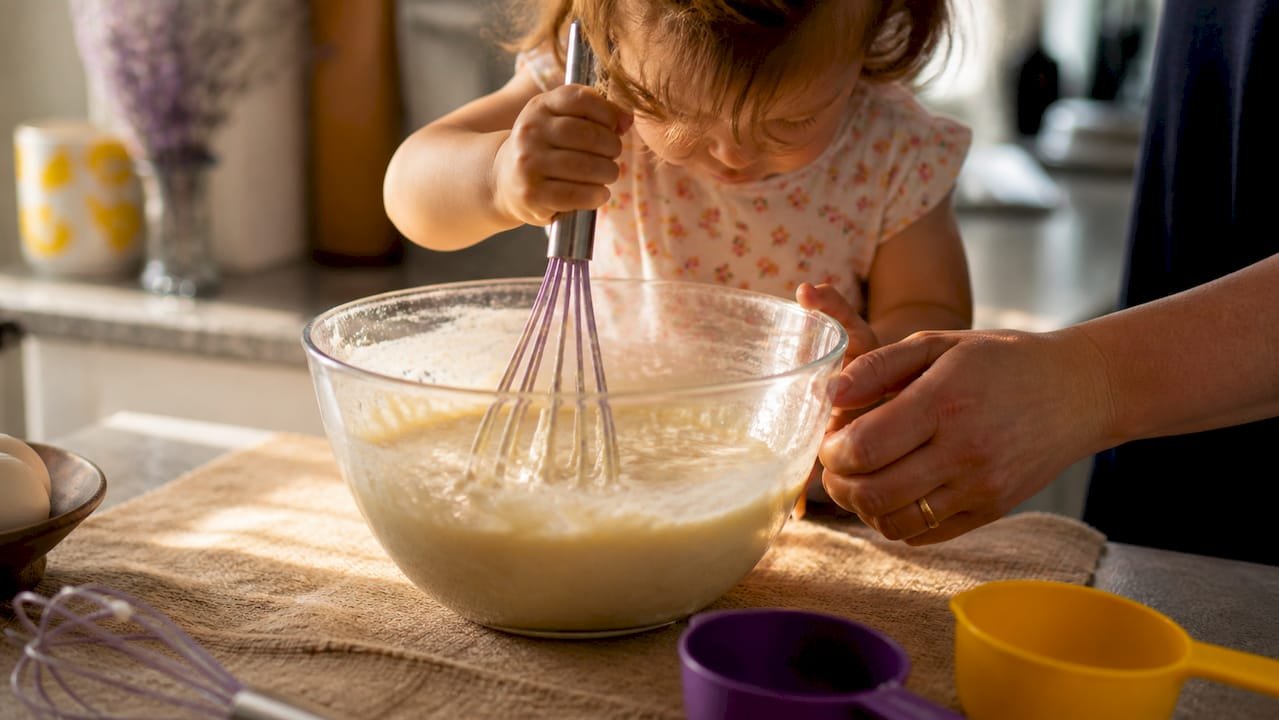
Stirring: Let your child stir pancake batter, oatmeal, or a salad dressing. Keep the bowl on a non-slip mat. Skill: bilateral coordination, following instructions. What to expect: spills. That’s fine.
Sprinkling cheese or toppings: Your child sprinkles shredded cheese on pizza or crackers. This builds pincer grasp and portion awareness. Safety note: keep them away from the oven; their job ends before anything goes in.
Washing produce: Set your child up at the sink with a colander of strawberries or cherry tomatoes. They rinse, you dry. Skill: fine motor, responsibility. What to expect: they’ll eat half of it. Also fine.
Setting napkins: Ask your child to place one napkin at each seat before dinner. This builds one-to-one correspondence, a foundational math concept. Skill: early numeracy, responsibility.
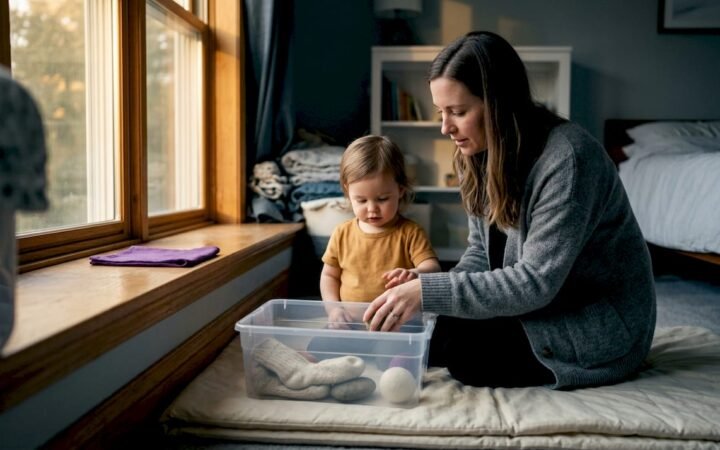
Sorting socks: Dump a pile of clean socks on the floor and ask your child to find the matching pairs. Skill: categorization, visual discrimination. Most 3-year-olds find this genuinely satisfying.
Safety notes for all kitchen tasks: use child-safe utensils, keep hot surfaces and sharp tools out of reach, and stay within arm’s reach throughout. Teach the difference between “warm” and “hot” by letting your child touch the outside of a warm (not hot) mug.
9. How much playtime does a 3-year-old need each day?
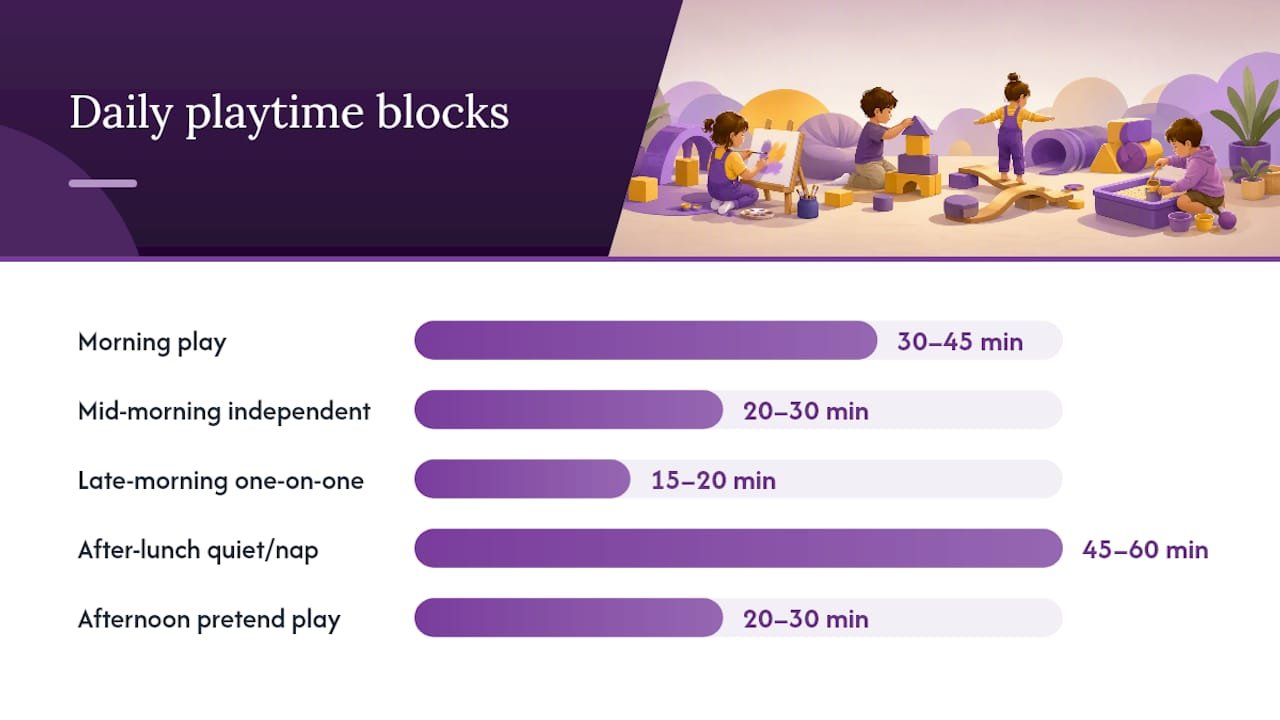
Three-year-olds can focus for 30–45 minutes on something genuinely engaging, and daily activity targets suggest roughly 60–90 minutes of outdoor time and 45–60 minutes of independent play. These are guidance ranges, not strict rules. A flexible daily rhythm matters more than hitting exact numbers.
Here’s a sample schedule you can adapt to your household:
| Time block | Activity type | Duration |
|---|---|---|
| Morning (after breakfast) | Outdoor play or active indoor movement | 30–45 min |
| Mid-morning | Independent play (puzzles, blocks, drawing) | 20–30 min |
| Late morning | One-on-one activity (art, STEM, cooking) | 15–20 min |
| After lunch | Quiet time or nap | 45–60 min |
| Afternoon | Pretend play or sensory activity | 20–30 min |
| Before dinner | Short read-aloud with questions | 10–15 min |
Transitions are activity opportunities too. Counting steps on the stairs, naming colors while getting dressed, or doing a quick letter hunt on the cereal box all add learning without adding time. The goal is connection and curiosity, not a packed curriculum.
10. Materials, storage, and cleanup hacks that make activities repeatable
The biggest barrier to running activities daily isn’t creativity. It’s friction. Keep these on hand and you’ll always have something ready.
Low-cost materials to stock:
- Dry rice, pasta, or oats (sensory bins)
- Washable paint and large brushes
- Playdough (store-bought or homemade)
- Sticker sheets in various sizes
- Large wooden beads and shoelace
- Child-safe scissors
- Pom-poms in multiple sizes
- Cardstock and construction paper
- Crayons, markers, and chalk
Storage ideas that work:
- Muffin tins for sorting small items by color or size
- Clear plastic bins labeled with a picture (not just words) so your child can help tidy
- Shoebox caddies for art supplies
- Zip-lock bags for pre-prepped activity kits (“ready to go” bags with one activity’s materials inside)
Cleanup strategies:
- Teach a cleanup song. Even a simple “clean up, clean up, everybody clean up” sung together makes the transition easier and builds responsibility.
- Use a sheet or shower curtain liner under messy activities. Shake it outside when done.
- Keep a damp cloth within reach during art and sensory play.
Mixing active and quiet play, rotating materials, and keeping a small “go bag” with crayons, small toys, and playdough for transitions and outings keeps the day varied without extra planning.
11. Safety, supervision, and adapting activities for different abilities
Quick safety checklist
- Choking hazards: any item smaller than a toilet paper roll tube is a risk for children who still mouth objects. Supervise closely with beads, small pom-poms, and dry pasta.
- Water supervision: stay within arm’s reach during all water play, including sensory bins with more than an inch of water.
- Hot surfaces: keep children away from stovetops, ovens, and hot drinks during cooking activities.
- Allergies: check for wheat, gluten, or nut allergies before using flour-based playdough or cloud dough recipes.
Supervision ratios
For sensory bins and water play, one adult per child is the safest setup. For dry activities like puzzles, drawing, or block play, one adult can supervise two or three children comfortably while staying engaged.
Adapting for varying abilities
Not every 3-year-old is at the same developmental point, and that’s completely normal. Here’s how to adjust:
- Make materials larger: use jumbo beads instead of standard ones, wider crayons, and larger puzzle pieces.
- Reduce choices: instead of offering ten sticker shapes, offer two. Fewer options lower decision fatigue and help children who feel easily overwhelmed.
- Provide step prompts: break each activity into one step at a time. “First, pick up the bead. Now push it onto the string.”
- Offer more adult modeling: do the first step yourself while narrating it, then hand it over. Some children need to see before they try.
- Sensory sensitivities: for children who dislike wet textures, offer tools (spoons, tongs) instead of hands-on contact. Sensory bags (gel inside a sealed zip-lock) give visual sensory input without touch.
12. What a 3-year-old is learning right now
By age 3, children consolidate language, fine and gross motor skills, and emotional regulation. These gains make them capable of narrative pretend play, multi-step projects, and real household tasks. Understanding this helps you choose activities that feel just right: challenging enough to hold attention, simple enough to succeed.
| Developmental area | What’s happening at age 3 | Activities that support it |
|---|---|---|
| Language | Vocabulary expanding rapidly; beginning to use sentences of 4–5 words | Pretend play, read-alouds, story-building |
| Fine motor | Improved pincer grasp; beginning scissor use | Threading, cutting practice, tray tracing |
| Gross motor | Running, jumping, climbing with more control | Obstacle courses, ball games, dance freeze |
| Emotional regulation | Learning to name feelings; beginning to manage frustration | Sensory play, pretend play, quiet time |
| Early numeracy | Counting 1–5 reliably; beginning to sort and categorize | Sorting games, measuring, counting during chores |
| Narrative thinking | Pretend play gains story structure | Puppet shows, role play, “what happens next” games |
Three-year-olds can focus for 30–45 minutes on something genuinely engaging, with daily targets of roughly 60–90 minutes of outdoor time and 45–60 minutes of independent play.
The activities in this article map directly to these milestones. Sensory bins support regulation and fine motor. Pretend play builds language and narrative. Outdoor movement covers gross motor and observation. You don’t need a formal curriculum. You need a variety of play types spread across the day.
13. How to build language into every activity you do
Language development doesn’t need a separate slot in the day. It happens inside every activity when you know what to listen for and how to respond.
Expand what your child says. When they say “dog run,” you say “Yes, the dog is running fast!” You’re not correcting them. You’re modeling the fuller sentence naturally. This technique, called expansion, is one of the most effective ways to grow sentence length and grammar.
Talk about the past and the future. After an activity, ask: “What did we do first?” Before one, ask: “What do you think we’re going to make?” Practicing past and future talk is a recommended strategy for boosting language in 3–4 year olds. It builds memory, sequencing, and narrative skills simultaneously.
Name everything during play. During a sensory bin, say “rough,” “smooth,” “heavy,” “light.” During cooking, say “pour,” “stir,” “measure.” Vocabulary grows fastest when words are tied to real, hands-on experiences.
Pause and wait. After asking a question, give your child 5–10 seconds to respond before jumping in. That pause feels long to adults but is often exactly the processing time a 3-year-old needs.
Read aloud with interaction. Point to pictures, ask “what’s that?” and “what do you think she’s feeling?” Short, interactive read-alouds build vocabulary and comprehension faster than passive listening.
14. How to balance structured activities with free play
Structured activities and free play both matter. The key is knowing when to lead and when to step back.
Free play is child-directed. Your child decides what to do, how to do it, and when to stop. It builds creativity, problem-solving, and self-regulation. A block corner, a dress-up box, or a pile of cardboard tubes counts. Your role is to be nearby but not directing.
Structured activities are adult-initiated. You set up the materials, introduce the idea, and guide the process. These are the activities in this article: the sensory bins, the STEM experiments, the art projects. They’re valuable because they introduce new skills and vocabulary your child might not encounter in free play alone.
A good daily rhythm includes both. A rough guide: for every structured activity (15–20 minutes), allow at least an equal amount of free play. If your child is deeply engaged in free play, let it run. Interrupting a child in flow to do a “better” activity is rarely worth it.
Signs your child needs more free play: they seem restless during structured activities, they keep redirecting to their own ideas, or they seem tired of adult input. Follow those signals.
Signs a structured activity helps: your child is bored, asking “what do we do now?”, or cycling through the same toys without engagement. That’s a good moment to introduce something new.
15. Inclusive activities that work for children with varying abilities
Most of the activities in this article are already adaptable. A few specific principles make them genuinely accessible.
Sensory-friendly versions: for children who are sensitive to textures, offer tools instead of direct contact. A spoon in a rice bin, a brush instead of finger painting, or a sensory bag instead of a playdough session all deliver the same developmental benefit with less sensory demand.
Motor adaptations: for children with limited hand strength or coordination, use larger materials (jumbo crayons, wide-handled brushes, large puzzle knobs), reduce the number of steps, and offer physical guidance through the first attempt.
Language and communication support: for children who are still developing verbal communication, pair every activity with clear visual cues. Hold up the bead before threading, show the cup before pouring. Use simple, consistent language: “your turn,” “my turn,” “all done.”
Attention and engagement: shorter sessions work better for children who have difficulty sustaining focus. A 5-minute version of any activity here is completely valid. End on a success, not a struggle.
Emotional regulation support: sensory play (playdough, rice bins, scented bottles) tends to be calming for children who dysregulate easily. Keep these available as a go-to during transitions or high-energy moments.
The goal of inclusive play isn’t to make every child do the same thing the same way. It’s to make sure every child has a way in.
What I’ve learned about choosing activities for a 3-year-old
The most common mistake caregivers make isn’t choosing the wrong activity. It’s over-preparing. You spend twenty minutes setting up a beautiful invitation to play, and your child spends forty-five seconds at it before wandering off to stack the Tupperware. That’s not failure. That’s a 3-year-old doing exactly what they’re supposed to do.
The activities that hold attention longest are usually the simplest ones: a bowl of water and a few cups, a pile of socks to sort, a cardboard box with a door cut in it. The developmental value isn’t in the complexity of the setup. It’s in the conversation you have while you’re doing it together.
What actually matters is showing up curious alongside your child. Ask questions you don’t know the answer to. Let them lead when they have an idea. Celebrate the process, not the product. A painting that looks like a muddy blur to you is a masterpiece to them, and the fine motor practice it took to make it is real regardless of what it looks like.
Small moments add up. Ten minutes of pretend play, five minutes of sorting, a walk where you name everything you see: that’s a rich developmental day. You don’t need to do it all. You just need to do something.
Mooshiemoments gives you a fresh activity idea in under 5 minutes
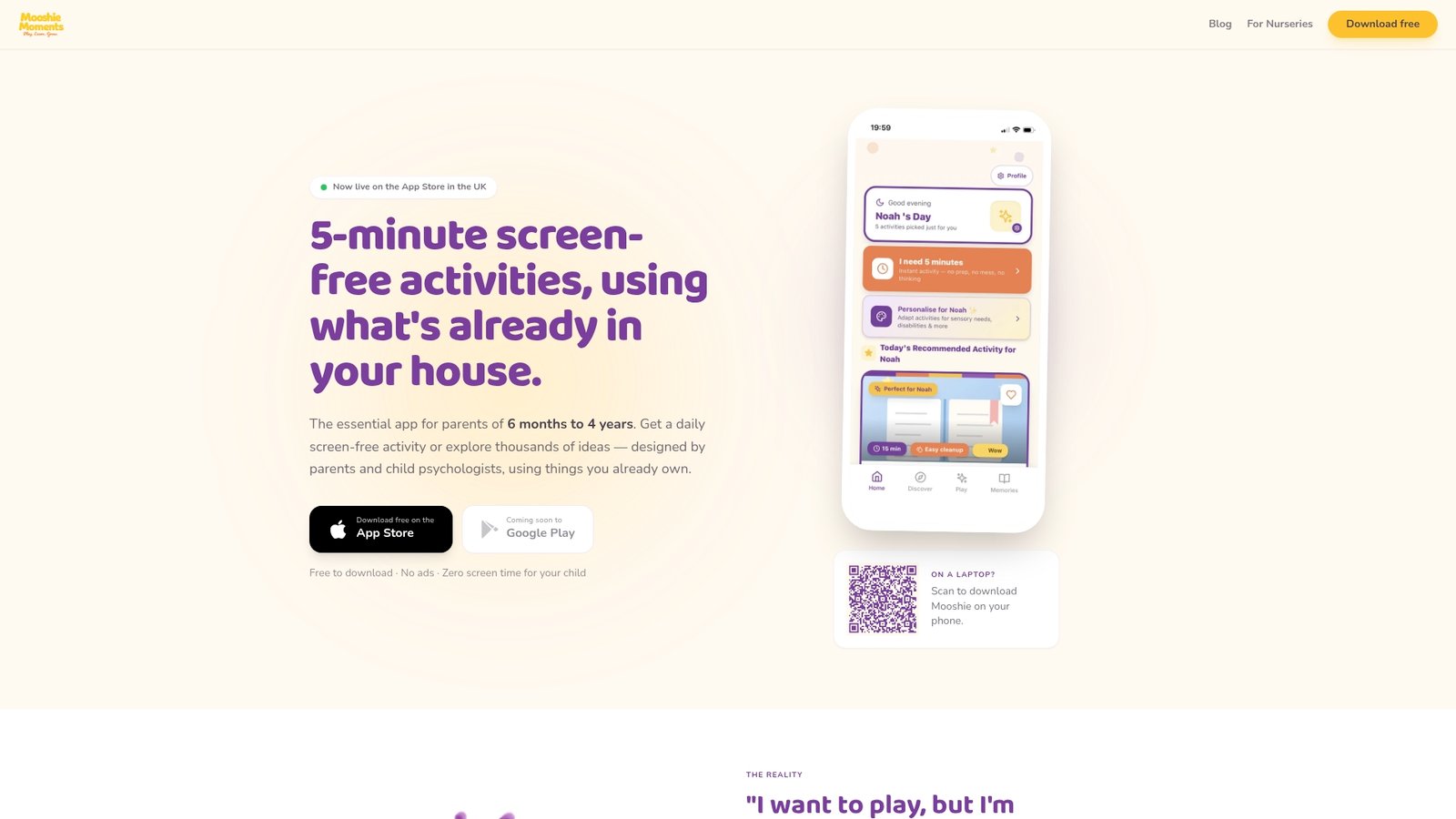
When you’re low on energy and your child is asking “what do we do now?”, having a ready list of age-matched, screen-free ideas makes a real difference. Mooshiemoments is built for exactly that moment.
The app filters activities by your child’s age (6 months to 4 years), your available time, and the skill you want to work on, whether that’s language, fine motor, calm-down play, or gross motor. Every activity uses items you already have at home. No kits, no purchases, no complicated prep.
Three reasons parents come back to it daily:
- Developmentally aligned: every activity is grounded in child-development research, with a short explanation of what your child is practicing and why it matters.
- Screen-free: the whole point is real play and real connection, not more time in front of a device.
- Fast to use: open the app, set your filters, and you have an activity ready before your child loses patience.
Nurseries and early years settings can also access partnership packs and printable resources through Mooshiemoments, making it easy to send home activity ideas that align with what children are working on in the setting.
Download the Mooshiemoments app and try your first activity today.
Sources
These resources are worth bookmarking for deeper reading on child development and activity ideas.
- 15 best activities for 3-year-olds whether you’re stuck inside or need some fresh air | BabyCenter
- Activities for 3-4 year olds – Tiny Happy People
- 50 Activities for 3-Year-Olds: Longer Attention, Bigger Projects | MiniMinors
- Preschool Learning activities for 3 year olds at home
- Preschool at Home Activities 🕺: Fun & Easy Ideas to Boost Learning
Recommended
More like this
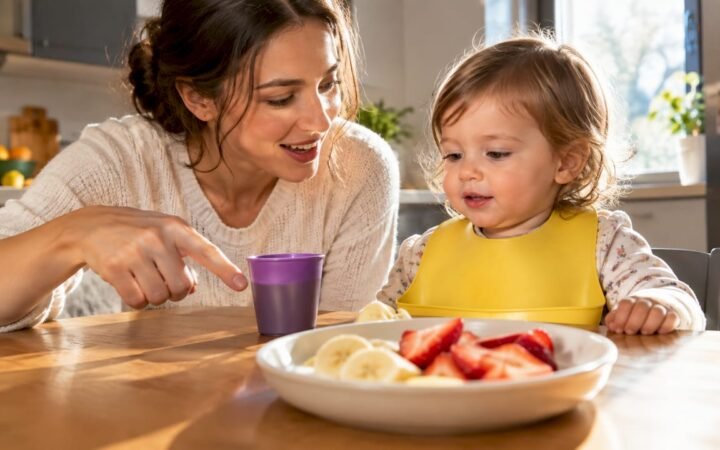
Five Minute Routine Activities to Help Speech Delay in UK Toddlers
Quick, routine based activities UK parents can use in 5–15 minutes to support a toddler with speech delay. Evidence backed techniques and…
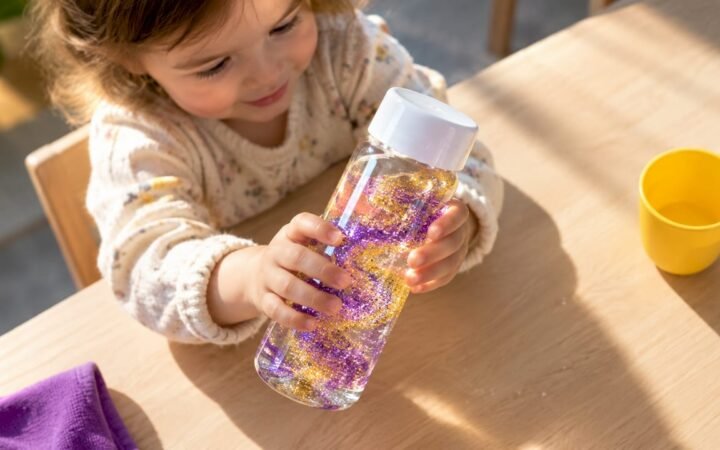
Three Minute Mess Free Sensory Play For UK Parents
Quick, reusable sensory activities UK parents can set up in minutes. Sealed bags, sticky wall art, safety checks, storage tips, and Mooshie…
10 Quiet Bin Ideas UK Parents Can Build in 5 Minutes
Practical, EYFS-aligned quiet-bin ideas UK parents can assemble in five minutes. Includes 10 ready bins, a five-bin rotation, safety checks, and quick...