
Fun and Safe 12 Month Old Activities for Parents
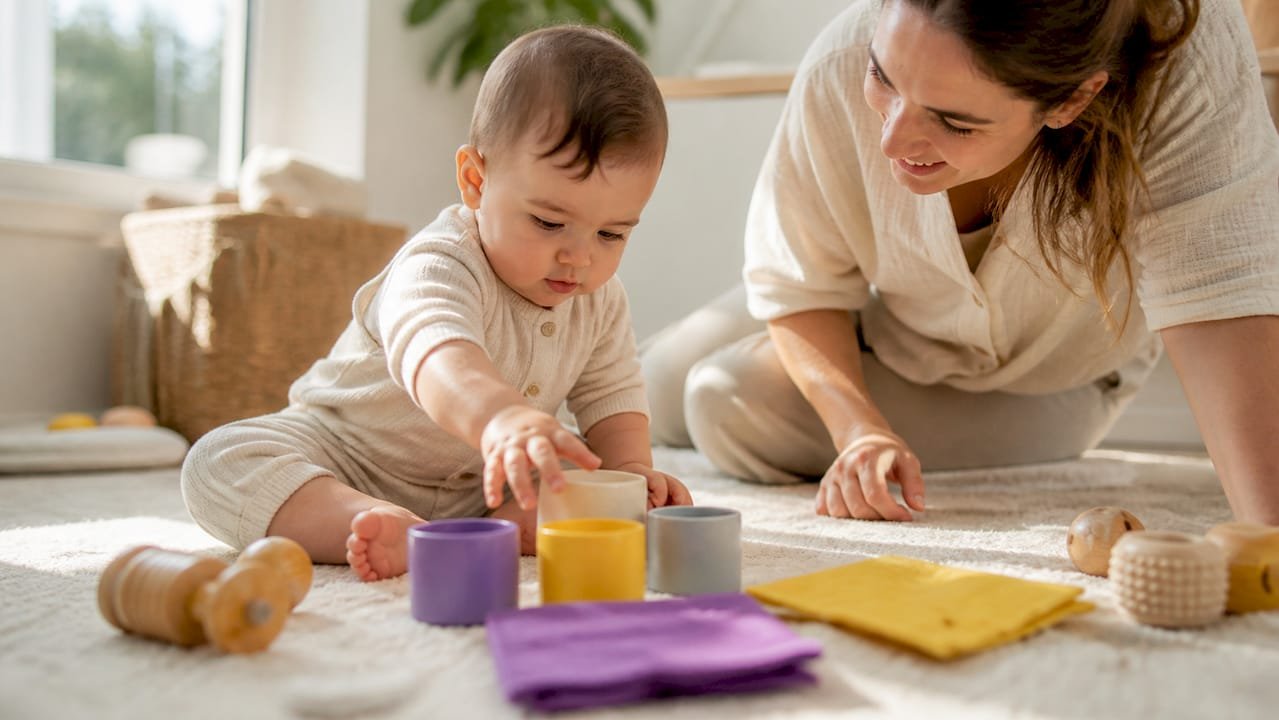
The best activities for a 12-month-old are sensory play, music and singing, movement games, and simple book-sharing — all doable right now with things you already have at home. Here are three you can start in the next five minutes:
- Discovery basket: Fill a small basket with safe household objects (a wooden spoon, a fabric square, a sealed plastic container). Let your child pull items out, mouth-safe ones only, and explore textures freely.
- Roll a soft ball: Sit facing your child on the floor and roll a soft ball back and forth. This builds eye contact, turn-taking, and early gross motor skills.
- Lap rhymes with a board book: Hold your child on your lap, open a simple board book, and read or sing the words with exaggerated expression. Point to pictures and name them as you go.
Safety note: Stay within arm’s reach at all times. Before any activity, check for small loose parts (anything smaller than a toilet roll tube is a choking hazard). BBC Tiny Happy People confirms that sensory materials require constant, direct adult supervision at this age.
Pro Tip: Keep a small “ready basket” on a low shelf with three or four safe objects swapped out weekly. When you need an activity fast, it’s already there.
Key Takeaways
The single most effective approach to play at 12 months is short, repeated, interaction-rich sessions using whatever you already have at home.
| Point | Details |
|---|---|
| Follow your child’s lead | Watch what they reach for or vocalize about and build the activity from there. |
| Keep sessions short | Five to fifteen minutes is the sweet spot; watch for tiredness cues and stop before fussing starts. |
| Narrate everything | Naming objects, actions, and feelings during routines builds vocabulary more than any dedicated language session. |
| Supervise sensory play constantly | Remove all objects smaller than a toilet roll tube and stay within arm’s reach throughout. |
| Mooshiemoments filters by age and time | The app provides household-item activities with developmental notes, ready when you need an idea fast. |
Table of Contents
- Where should you start with 12 month old activities?
- Safe sensory play ideas using household items
- How music and singing support your child’s development
- Everyday language games that encourage first words
- Fine motor activities that build small-hand skills
- Gross motor ideas for walking practice and outdoor play
- How to turn everyday routines into learning moments
- Safety checklist and key developmental red flags at 12 months
- Why play matters so much at this age
- What actually matters more than the “right” activity
- Mooshiemoments makes finding the right activity genuinely easy
- Sources
Where should you start with 12 month old activities?
Child development experts recommend following your child’s lead rather than planning a structured session. Watch what your child already reaches for, vocalizes about, or brings to you. That object or action is your starting point.
Three quick signs your child is ready for an activity:
- Reaching or pointing toward an object or area of the room
- Vocalizing or babbling while looking at you, signaling they want to share something
- Bringing an object to you and holding it out, which is an invitation to play together
For materials, start with what you have. A wooden spoon, a clean plastic cup, a folded tea towel. Remove anything smaller than a toilet roll tube before play begins. Avoid items with sharp edges, loose buttons, or long strings.
Session length matters too. Five to fifteen minutes is the sweet spot for most one-year-olds. Watch for yawning, turning away, or fussing. Those are clear signals to wrap up, offer a cuddle, and let your child rest before the next activity.
Pro Tip: Set a gentle timer for 10 minutes. When it goes off, check in with your child’s mood before deciding whether to continue or move on. This habit prevents both under- and over-stimulation.
Safe sensory play ideas using household items
Sensory play builds exploration and early problem-solving. A simple discovery basket or shallow sensory tray is all you need to get started.
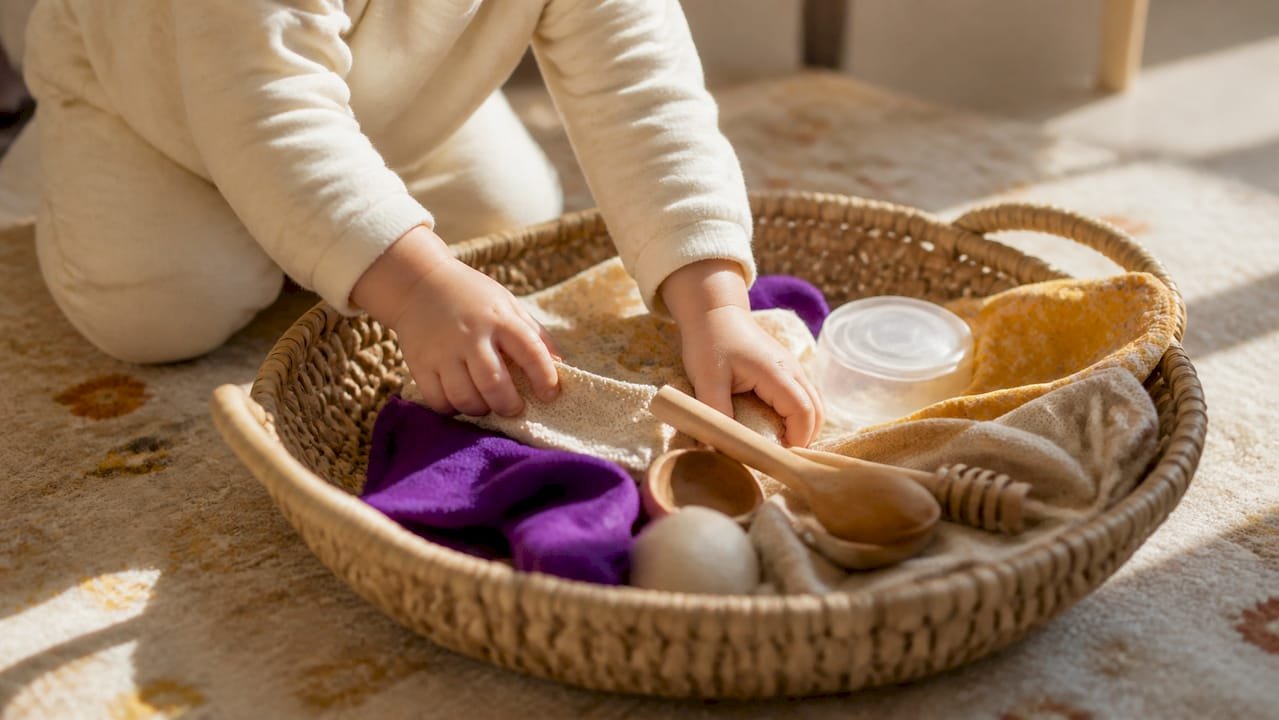
How to set it up: Choose a shallow tray or baking dish. Add one dominant material (oats, fabric scraps, or crinkled paper). Sit your child in front of it and stay right beside them throughout. When the session ends, put everything away immediately.
Safe household items to use:
- Fabric scraps in different textures (smooth, fluffy, ribbed)
- Wooden spoons and silicone spatulas
- Sealed plastic containers (lids taped shut)
- Large dried pasta shapes (under constant supervision only)
- Oats or dry rice in a shallow tray (supervised, never left unattended)
- Sponges and cups for water play in a shallow bowl
Items to avoid completely: small buttons, beads, coins, anything that fits through a toilet roll tube, and loose dried beans.
Other sensory ideas that work well at this age:
- Sound bottles: Fill small sealed bottles with rice, bells, or water. Shake together and listen.
- Texture walk: Lay out fabric squares, a rubber mat, and a soft towel on the floor. Let your child crawl or walk across each one in socks.
- Water play: A shallow bowl with two cups and a sponge. Simple, absorbing, and easy to clean up.
Pro Tip: Rotate one dominant material per session rather than mixing several at once. This keeps the activity focused, reduces overwhelm, and gives you a natural moment to introduce one new word (“rough,” “cold,” “heavy”).
Safety reminder: never leave sensory materials with a 12-month-old unattended, even briefly. Constant, direct supervision is non-negotiable.
How music and singing support your child’s development
Short songs and rhythm games boost language and turn-taking more than most parents expect. You do not need instruments or a playlist, and your voice alone is effective. Your voice is enough.
Good activities to try:
- Lap songs: “Row, Row, Row Your Boat” or “Humpty Dumpty” with your child on your lap and gentle rocking movements. The rhythm and repetition build memory and anticipation.
- Call-and-response rhymes: Sing a line, pause, and wait. Your child will often fill the gap with a sound or gesture. That back-and-forth is early conversation.
- Homemade shakers: Seal a small amount of rice inside a plastic bottle with the lid taped firmly. Shake together to a beat.
- Clapping and marching: Clap a simple pattern and encourage your child to copy. March around the room together. Both build coordination and body awareness.
For songs and rhymes that work well at this age, keep refrains short (15–30 seconds), use lots of onomatopoeia (“splash,” “bang,” “moo”), and repeat the same songs across several days. Repetition is how children learn, not a sign they are bored.
Music supports memory, attention, and early speech imitation. When your child hears the same song repeatedly and starts to anticipate the next line, that is early language processing in action.
Everyday language games that encourage first words
The most effective language technique at 12 months is simple: narrate, label, and respond. Continuous conversational interaction, even one-sided at first, stimulates language development throughout the day.
Here is how to build it into moments you are already having:
- Model single words clearly. Hold up a cup and say “cup” before handing it over. Pause. Repeat. You are building a word-to-object connection.
- Expand babbled attempts. If your child says “ba,” respond with “ball! Yes, that’s your ball.” You are not correcting; you are extending.
- Pause and wait. After asking a question or naming something, wait five seconds. Give your child space to respond with a sound, gesture, or look.
- Use pointing and naming together. Point to something, name it, then look at your child. This joint attention is a foundation for vocabulary growth.
Short scripts for common moments:
- Mealtime: “Here’s your spoon. Spoon. Can you hold the spoon?” Then wait.
- Bath time: “Water! It’s warm. Splash! You’re splashing.”
- Book time: Point to a picture. “Dog. The dog is sleeping. Can you see the dog?”
BBC Tiny Happy People notes that responding to gestures by naming objects and using simple reciprocal games are among the most effective ways to build early communication at this age. Face-to-face interaction matters far more than any screen-based content at 12 months.
For books that support emotional vocabulary alongside language, a curated toddler book list can help you choose titles that work well for this age.
Fine motor activities that build small-hand skills
Simple posting, stacking, and transferring games build the pincer grasp and early problem-solving. You do not need specialist toys.
Activities to try at home:
- Stacking cups: Stack two or three plastic cups and let your child knock them down. Then rebuild together. The knocking-down part is just as developmental as the stacking.
- Shape sorters: Start with one shape only. Trying to post a circle through a circle hole is enough of a challenge at this age.
- Posting games: Cut a slot in the lid of a clean takeaway container. Give your child large pom-poms or folded fabric squares to post through the slot.
- Hide-and-find with cups: Hide a small toy under one of three cups and encourage your child to find it. This builds object permanence and focused attention.
- Safe mark-making: Finger painting with yogurt on a tray, or washable paint on large paper. The NHS recommends showing children how to hold a crayon and offering cereal boxes as paper to keep it low-cost and low-pressure.
Materials to avoid: small beads, buttons, loose googly eyes, or anything with a diameter smaller than a toilet roll tube. Keep the activity area clear of clutter so your child can focus on one task at a time.
Cleanup tip: lay a wipe-clean mat under any mark-making activity. It takes 30 seconds to set up and saves significant time afterward.
Gross motor ideas for walking practice and outdoor play
Movement practice builds balance, strength, and confidence. Short, frequent sessions work better than one long outing, especially for children who are still building stamina.
Indoor and outdoor ideas:
- Push toys and wagons: A sturdy push-along toy gives early walkers something to hold while they build confidence. A laundry basket pushed across a smooth floor works just as well.
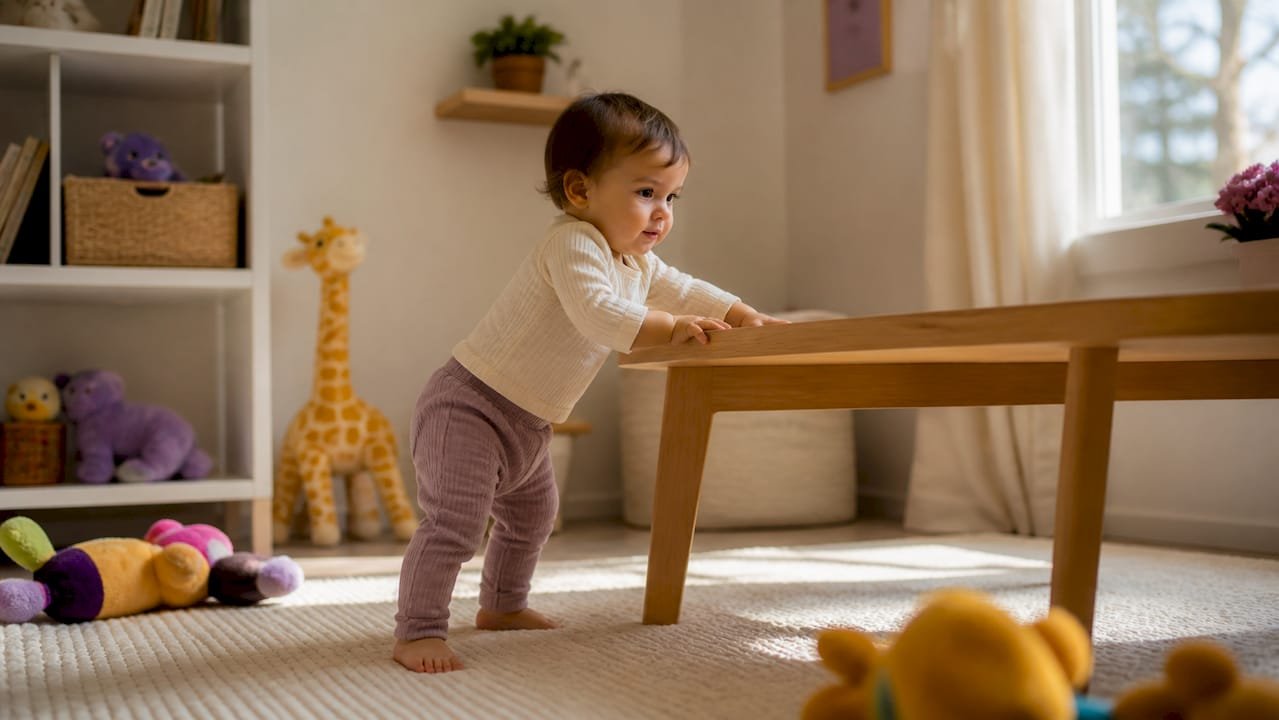
- Cushion obstacle paths: Line up sofa cushions on the floor. Encourage your child to crawl over, walk around, or climb across them with your hands ready nearby.
- Supervised low climbing: A single step or a low foam block is enough. Hold your child’s hands and let them practice stepping up and down repeatedly.
- Rolling and chasing a soft ball: Roll a soft ball across the room and encourage your child to chase it. Outdoors, this works on grass with a slightly larger ball.
- Nature walks with a small basket: A short walk where your child can pick up leaves, small stones, or sticks (checked for safety) builds curiosity and language at the same time.
For UK weather: dress in layers, use a waterproof layer over the top, and keep outdoor sessions shorter in cold or wet conditions. A 10-minute garden session in light rain is still worthwhile. Mud play in wellies is a classic for a reason.
Safety: remove trip hazards before indoor movement play, supervise near any slope or water, and secure furniture against the wall if your child is cruising along it. UNICEF emphasizes that movement activities for one-year-olds work best when interaction and repetition are built in alongside the physical challenge.
How to turn everyday routines into learning moments
Routines are continuous learning opportunities. Narrate what you are doing and add one small challenge to each routine, and you have built a learning activity without any extra setup.
Routine-by-routine ideas:
- Mealtime: Name each food before offering it. Let your child try to use a spoon, even messily. “Banana. Yellow banana. Can you pick it up?”
- Bath time: Offer two cups and a sponge. Let your child pour water from one cup to another. Name the actions: “pour,” “splash,” “squeeze.”
- Dressing: Slow down and narrate. “Now the sock. Can you pull it up? Pull, pull, pull.” Let your child try to pull a sock over their heel independently.
- ‘Find the sock’ game: Hide a sock under a small towel while your child watches. Ask “where’s the sock?” and wait. This builds object permanence in 30 seconds.
One-minute activities for tight moments:
- Point-and-name anything in the room while waiting for food to cool
- Peek-a-boo with a muslin cloth during a nappy change
- Quick stacking with two cups while the bath fills
Balancing stimulation with rest is just as important as the activities themselves. If your child has had an active morning, a quiet afternoon with a book and a cuddle is the right call. Watch for glazed eyes, clinginess, or increased fussiness. Those are signs to slow down, not push through.
Safety checklist and key developmental red flags at 12 months
Supervision and removing small parts are the two most important safety actions before any play session. Run through this checklist quickly before you start:
- Stay within arm’s reach at all times
- Remove all objects smaller than a toilet roll tube from the play area
- Check toys for cracks, loose parts, or peeling paint before use
- Use shallow trays for sensory play (no deeper than 2–3 cm)
- Keep mealtimes seated and supervised; never leave a child alone while eating
- Secure furniture against walls if your child is cruising
Developmental red flags at 12 months — speak to your health visitor or GP if you notice any of the following:
If your child is not reaching these milestones, contact your NHS health visitor or GP. Early support makes a real difference, and the right person to speak to is always your child’s own health professional. For urgent concerns, NHS 111 is available around the clock.
Why play matters so much at this age
Play during the first year directly supports language, motor skills, and early problem-solving. This is not a nice idea. It is how the brain builds connections.
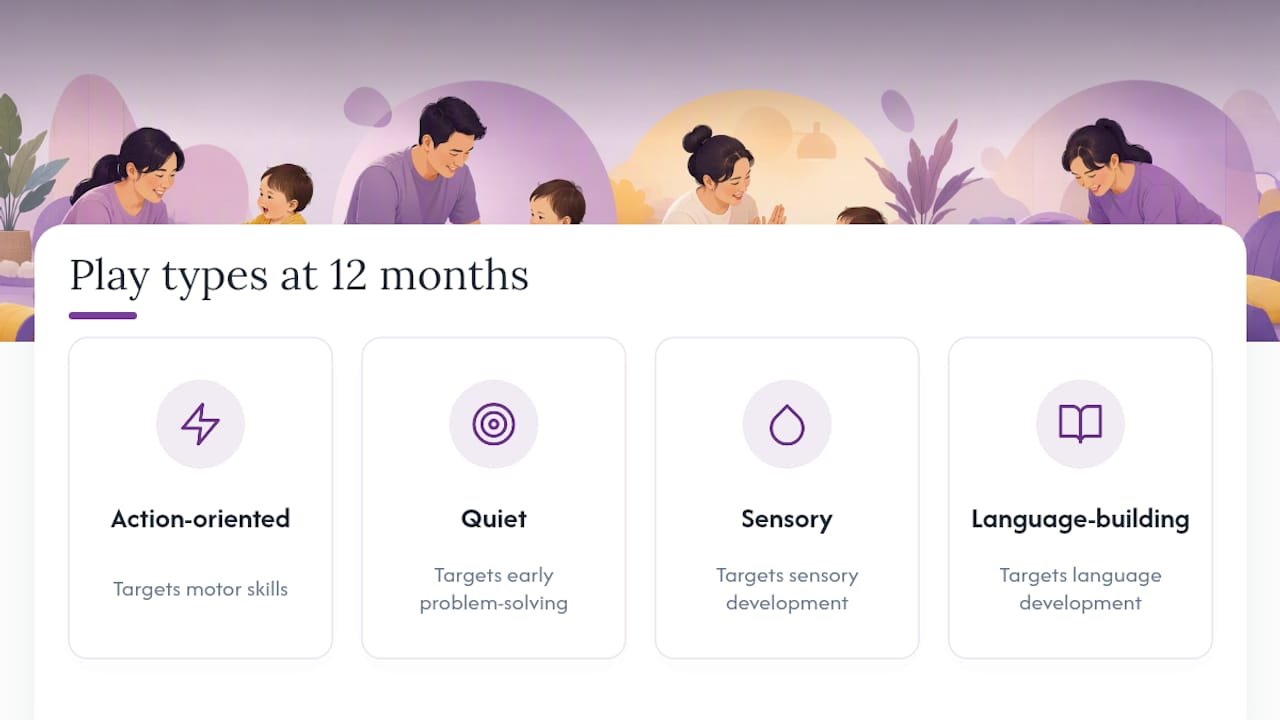
Zero to Three groups play for 12–24 months into four types: action-oriented, quiet, sensory, and language-building. Each type targets a different developmental area, which is why variety across the day matters more than doing any single activity for a long time.
The practical takeaway: a five-minute fill-and-dump game, a short song, and a narrated bath time together cover more developmental ground than one long structured session. Spread short, varied interactions across the day and you are already doing the most important thing.
What actually matters more than the “right” activity
Most articles about one-year-old play focus on which activities to choose. The more useful question is how you show up during them.
A child who spends 10 minutes with a wooden spoon and a pot while a caregiver narrates, responds, and makes eye contact gets more developmental benefit than a child with an expensive toy played with alone. The research on this is consistent. BBC Tiny Happy People and the NHS both point to low-prep, interaction-rich play as the most effective approach, not elaborate setups.
The pressure parents feel to provide the “right” activities is real, and it is mostly unnecessary. Your child does not need a sensory bin with six materials and a Pinterest aesthetic. They need you, present and responsive, for a few minutes at a time.
One habit that helps on low-energy days: keep one go-to activity stashed and ready (a small basket, a sealed shaker bottle, a board book). Rotate it weekly so it stays fresh. On the days when you have nothing left, that basket is enough.
Mooshiemoments makes finding the right activity genuinely easy
Knowing what to do and actually having the energy to think of it in the moment are two different things. Mooshiemoments is built for the second problem.
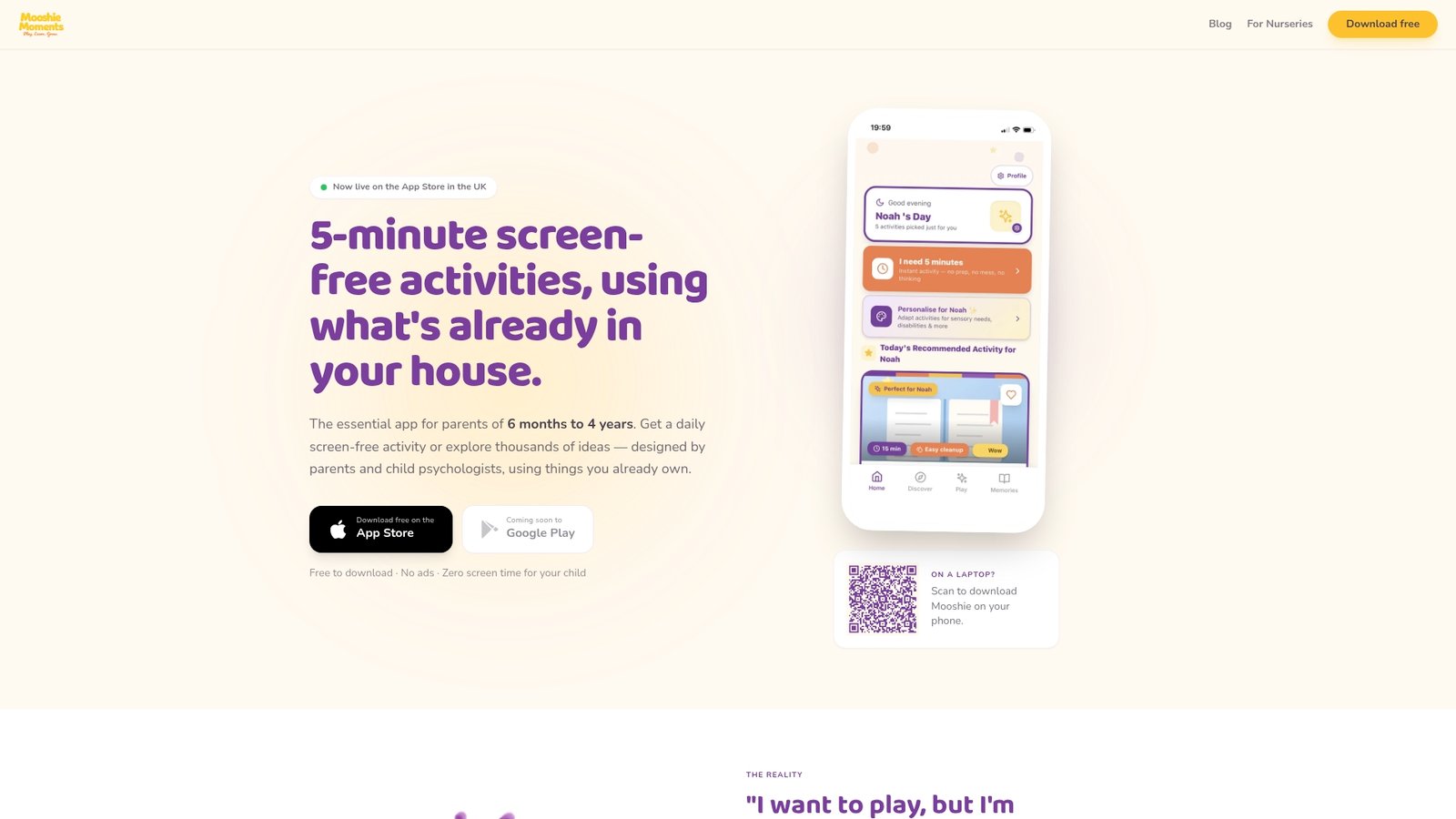
The app gives parents of children aged 6 months to 4 years a library of quick, screen-free activities filtered by your child’s age and how much time you have right now. Every activity uses household items, so there is nothing to buy. Each one includes expert-reviewed developmental notes so you know exactly what skill you are supporting and why. For nurseries and early years settings, Mooshiemoments also offers a Home Learning Partnership with EYFS-aligned resources, printable packs, and usage tracking built in.
Try the free activities at Mooshiemoments and see how quickly a five-minute idea can turn into a genuinely good moment.
Sources
These are the sources used throughout this article. Each one is worth bookmarking for ongoing reference:
- Tiny Happy People – Activities 12-18 month olds
- Play and learning for babies and toddlers – NHS
- 21 learning activities for babies and toddlers – UNICEF
- Play Activities for 12 to 24 Months | ZERO TO THREE
For personalized guidance on your child’s development, contact your NHS health visitor or GP. They are the right first point of contact for any developmental questions or concerns specific to your child.
This article is general information, not a substitute for advice from a qualified doctor. Consult a qualified healthcare professional about your own circumstances before acting on anything here.
Recommended
More like this

Five Minute Routine Activities to Help Speech Delay in UK Toddlers
Quick, routine based activities UK parents can use in 5–15 minutes to support a toddler with speech delay. Evidence backed techniques and…
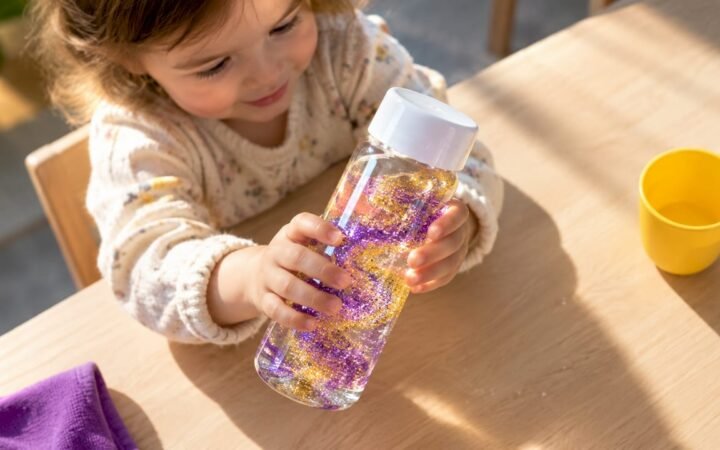
Three Minute Mess Free Sensory Play For UK Parents
Quick, reusable sensory activities UK parents can set up in minutes. Sealed bags, sticky wall art, safety checks, storage tips, and Mooshie…
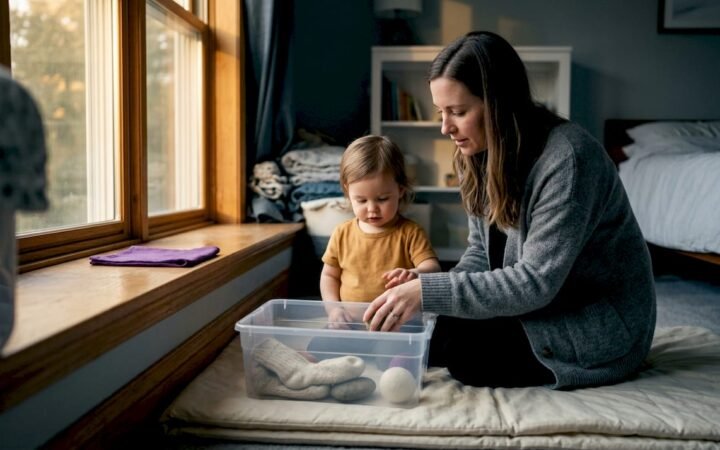
10 Quiet Bin Ideas UK Parents Can Build in 5 Minutes
Practical, EYFS-aligned quiet-bin ideas UK parents can assemble in five minutes. Includes 10 ready bins, a five-bin rotation, safety checks, and quick...