12 Bubble Play Ideas for Busy Parents That Build Toddler Language

Bubbles are one of the easiest wins in toddler play: grab a wand, blow, and watch a room full of chasing, popping, and giggling start instantly. Start with adult-blown or simple wand bubbles outdoors, or over a washable mat indoors, and keep your toddler within arm’s reach the whole time. That’s it. No elaborate setup, no special toys required, and the developmental payoff is real.
TL;DR:
- Bubble play boosts toddler language development by encouraging narration, repetition, and introducing size, action, and direction words during simple activities.
- Activities like chasing, popping, and bubble painting promote hand-eye coordination, turn-taking, and sensory input, with minimal setup and cleanup required.
- Using household items or basic solutions, parents can create safe, low-cost bubble experiences indoors or outdoors, always under close supervision.
- Incorporating short, repetitive phrases and counting during bubble time enhances vocabulary and early number sense, with no need for advanced blowing skills.
- Structured bubble games such as races, freeze-and-pop, and shape bubble art foster social skills and impulse control while keeping activities engaging and manageable.
Table of Contents
- Why Bubble Play Ideas for Toddlers Actually Work
- 12 Easy Bubble Activities for Toddlers
- Bubble Solution and Supplies That Won’t Cause a Mess Disaster
- Safety Rules Every Bubble Play Session Needs
- Turning Bubble Play Into Language-Building Moments
- Why We Keep Coming Back to Bubbles
- Get Bubble Play Ideas Matched to Your Toddler’s Age
- Sources
- FAQ
Why Bubble Play Ideas for Toddlers Actually Work
Bubbles aren’t just a distraction. Watching, chasing, and popping bubbles gives toddlers a burst of language prompts, turn-taking practice, and physical coordination work, all wrapped inside something they already find fascinating. BBC Tiny Happy People points to bubble play as a strong tool for building vocabulary around actions, sizes, and directions, simply because the child’s attention is already locked onto the bubble.
That focused attention is what makes bubble play punch above its weight developmentally.
- Language building: narrate what’s happening (“big bubble,” “pop,” “up high”) and pause so your toddler can fill the gap
- Turn-taking: passing the wand back and forth teaches waiting and listening in a way that feels like fun, not a lesson
- Hand-eye coordination: tracking a floating bubble and timing a pop is genuine motor skill practice
- Sensory input: the visual movement, the light pop on skin, and the soap smell all add texture to the moment
12 Easy Bubble Activities for Toddlers
These bubble activities for kids range from zero-prep wand play to slightly messier indoor sensory bubble experiences. Pick based on your space, your toddler’s age, and how much cleanup you’re up for today.
- Classic wand chase. Blow bubbles outdoors and let your toddler chase and pop them. Say “pop!” every time one bursts. Best outdoors; indoors, use a washable mat underneath.
- Giant bubble wand. Use a large mesh or pipe-cleaner wand dipped in solution for slow, huge bubbles toddlers can watch (and swat) more easily than fast little ones. Keep this one outdoors since giant bubbles drip.
- Bubble races. Blow two bubbles at once and ask your toddler which one “wins” by popping first or floating farthest. Great for early comparison words like “faster” and “higher.”
- Counting pops. Blow a cluster of bubbles and count each pop out loud together. Works for toddlers who are just starting number words.
- Color and size bubbles. Narrate “big bubble” versus “little bubble” as you vary your breath. This is a simple way to build descriptive vocabulary without flashcards.
- Bubble painting. Mix a few drops of food coloring into bubble solution in a shallow tray, then have your toddler blow through a straw (with supervision) or press a bubble onto paper to leave a print. Requires close water supervision; skip food coloring near light-colored clothing.
- Freeze and pop. Call “freeze!” mid-chase, then “pop!” to release. This adds an impulse-control game on top of the sensory fun.
- Bubble tray sensory play. Fill a shallow tray with diluted solution and let your toddler dip hands or a small brush to make foam patterns. Use a dry foam version (whipped soap flakes with no standing water) if you can’t watch continuously.
- Bath bubble time. Add bubble solution to a few inches of bath water and narrate textures: “soft,” “fluffy,” “splash.” Always stay within arm’s reach; never rely on a bath seat as a substitute for supervision.
- Straw blowing (light touch). Offer a straw and a shallow dish of solution and see if your toddler wants to blow bubbles themselves. Never force blowing. Watching and popping still deliver benefits.
- Pass-the-wand turn-taking. Take turns blowing and popping with a sibling or parent, narrating whose turn it is each time. This is one of the simplest bubble games for toddlers to teach patience.
- Bubble art with cookie cutters. Dip cookie cutters in bubble solution and blow through them for shaped bubble bursts, or just let your toddler examine the shapes before they pop. A fun twist on bubble art ideas that needs almost no cleanup.
Pro Tip: Keep a damp towel within reach before you start any tray or bath-based bubble activity. Wiping a spill in ten seconds beats mopping up a slip risk later.
Bubble Solution and Supplies That Won’t Cause a Mess Disaster
You don’t need to fancy toys for creative bubble play. A basic wand, a few household items, and a homemade solution cover almost everything on the list above.
- Store-bought solution: pick one labeled for your toddler’s age range and avoid anything marked for children over 3 if your toddler is younger
- Homemade recipe: mix roughly 1 cup water, 2 tablespoons dish soap, and a teaspoon of sugar or glycerin if you have it, for sturdier bubbles
- Wand alternatives: cookie cutters, plastic rings, or a straw with a small cut cross at the tip all work as bubble wands
- Giant bubble tools: two sticks and a loop of yarn or a mesh kitchen strainer create bigger, slower bubbles kids can actually catch
- Indoor setup: work over a washable mat or tray, keep a towel nearby, and wipe floors immediately since soap solution turns tile and wood slippery fast
Safety Rules Every Bubble Play Session Needs
Bubble play is low-risk compared to most sensory activities, but a few rules matter every time.
- Stay within arm’s reach whenever water is involved, especially bath-time bubble play; a few centimeters of water is enough to be dangerous for a toddler left unattended, per Healthier Together’s water safety guidance
- Check the box. Follow packaging age warnings on any bubble toy or solution, and skip products marked for children over 3 if your toddler is younger, per NHS-linked toy safety guidance
- Never use water beads in bubble sensory bins or trays with toddlers under 5. Gov flags a real asphyxiation and choking risk once beads are hydrated
- Prevent slips. Soap on hard flooring gets dangerously slick fast, so wipe spills the moment they happen and keep towels under bare feet during tray play
If you can’t watch a water-based tray without interruption, switch to outdoor wand bubbles or a dry foam version instead. It removes the risk entirely without cutting the fun.
Turning Bubble Play Into Language-Building Moments
The real value in bubble play comes from what you say while it’s happening, not just the bubbles themselves. BBC Tiny Happy People recommends short, repeatable phrases with a pause built in, so your toddler has room to respond instead of just watching you talk.
- Say “Ready, steady… blow!” and pause before the bubble appears; toddlers quickly learn to anticipate and often join in with sound or gesture
- Model size and direction words: “big bubble,” “up high,” “pop,” then expand whatever your toddler offers (“big pop” becomes “Yes, big pop! Two pops!”)
- Count together as bubbles burst; simple number words stick faster during a game than during flashcard drills
- Skip the pressure to get your toddler blowing bubbles themselves. A Lancaster University study found an association between complex mouth movements like blowing and later language skill, but that’s an association, not a rule. Watching and popping still count as full participation
Pro Tip: Keep your scripts short and reuse the same three or four phrases across sessions. Repetition, not novelty, is what actually builds vocabulary at this age.
Why We Keep Coming Back to Bubbles
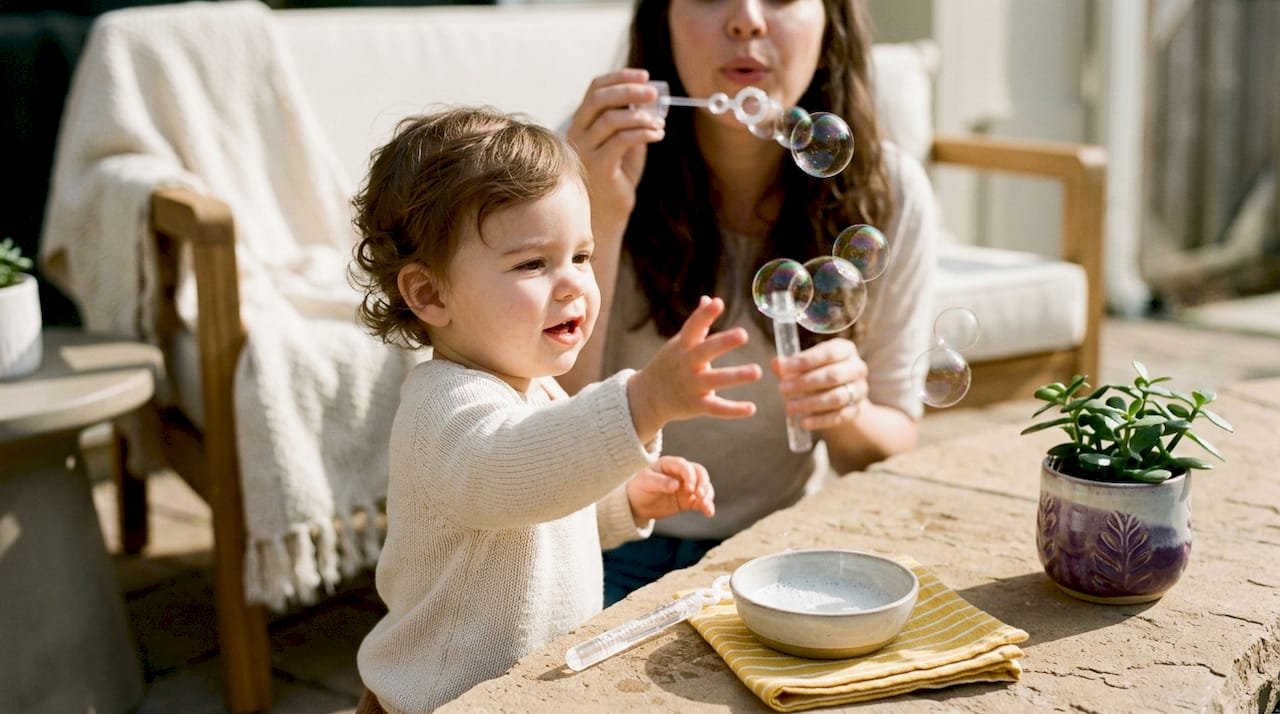
Elaborate sensory setups look impressive on social media, but most of them get used once and abandoned in a cupboard. Bubbles survive because they ask for almost nothing and deliver almost every time, which is exactly the kind of play that fits into a real toddler’s real week. That’s the same principle behind how some apps build activity libraries: short, repeatable ideas that use what’s already in the house, matched to how much time and energy a parent actually has that day.
The research on bubble play backs this up too. The benefits don’t come from complexity. They come from a caregiver narrating, pausing, and responding, over and over, in small five-minute windows.
— samit
Get Bubble Play Ideas Matched to Your Toddler’s Age
Some apps offer an alternative to scrolling through activity blogs early in the morning trying to guess what your toddler is ready for today. These apps provide activity suggestions tailored to a child’s approximate age and the time available, often including plain-language explanations of developmental benefits and quick narration scripts to use during play.
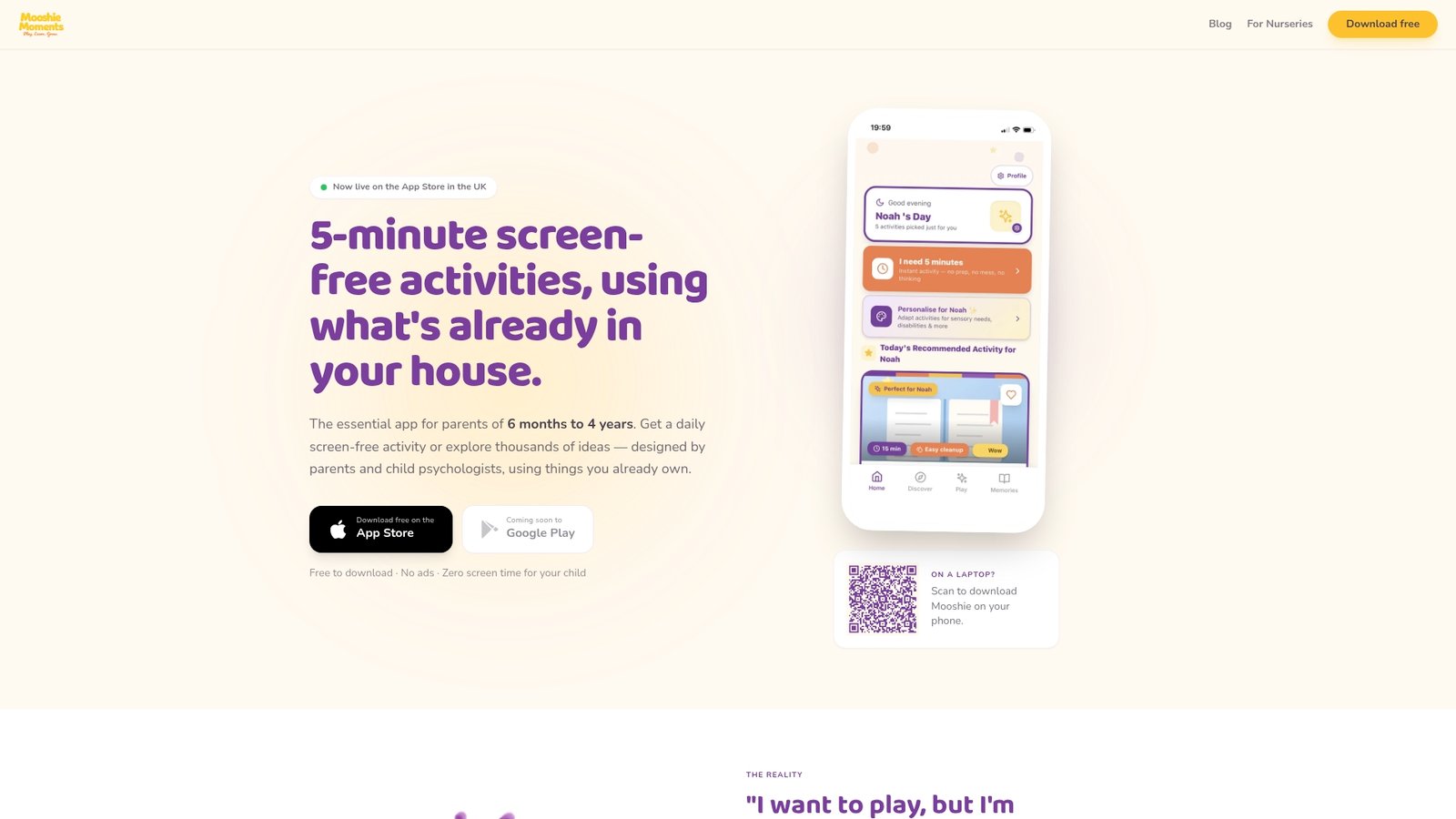
For a toddler at the counting-pops stage, you’d get a different prompt than for one just starting to chase and swat. That’s the point: no screen time for your child, no supplies to buy, and no guessing whether an activity is actually worth the five minutes. If you run a nursery or early years setting, the Partnership Pack offers ready-made printable resources and home-learning materials your families can use, too. Open the Mooshie app and get a tailored activity suggestion for your child right now, bubbles included.
Sources
- Toy safety guidance — Healthier Together / NHS-linked
- The development of oral motor control and language — Lancaster University
- Gov
FAQ
Can a 2-year-old play with bubbles?
Yes. Two-year-olds can safely chase, pop, and watch bubbles, and many enjoy attempting to blow through a wand or straw themselves under supervision. Keep the focus on fun rather than getting them to blow correctly, since watching and popping deliver plenty of developmental benefit.
What are some fun ways to play with bubbles?
Outdoor wand chases, giant bubble wands, counting pops, and bubble painting on trays all work well for toddlers. Indoor options like a dry foam tray or bath-time bubbles are good low-water alternatives when you can’t be outside.
Why is bubble play important for toddlers?
Bubble play combines language prompts, turn-taking, and hand-eye coordination practice into one activity toddlers naturally enjoy, according to BBC Tiny Happy People. It also offers light oral-motor practice, which Lancaster University research links to later language development, though only as an association.
What are some fun bubble games for kids?
Bubble races, freeze-and-pop, and pass-the-wand turn-taking are simple games that add structure to regular bubble play. Each one builds in a language or social skill, like comparison words or waiting for a turn, without feeling like a lesson.
Does Mooshiemoments include bubble play activities?
Yes. Mooshiemoments suggests screen-free activities, including bubble play, tailored to your toddler’s age and how much time you have, with plain-language explanations of the developmental benefit behind each one. Current pricing and features are available directly on the Mooshiemoments site.
Recommended
- 40 Fun 2 Year Old Activities to Start Right Now
- How to Narrate Play for Your Toddler’s Language Growth
- Taste Safe Sensory Play: Top 10 Ideas for Mouthing Toddlers
- Junk Modelling for Toddlers: Easy EYFS-Aligned Activities
Want a new idea every day, matched to your child's age?
Mooshie Moments gives you simple, guided play ideas for ages 6 months to 4 years.
Download free on the App StoreMore like this
Babysitting Toddlers: 12 Low Prep Ideas and Why They Help
Explore 12 low prep toddler activities for babysitters, with developmental benefits, age adaptations, UK safety advice, and optional activity coaching.
10 EYFS Backed Sock Games for Toddlers Under Five Minutes
Ten EYFS aligned sock games to start in under five minutes, each with a one line developmental benefit, simple adaptations, and two…
Busy Parents: 12 No Prep Shopping Activities for Toddlers
Busy parents: keep toddlers learning and calm at the store with 12 no prep, screen free activities that take under five minutes…