
Best apps for toddler speech delay (free and paid)
If your toddler isn’t talking as much as you hoped, an app can give you ideas for home. Here is how six options compare, and where professional help comes in.
- Free to download
- No account needed
- No screen time for your child
 On a laptop?
Scan to get Mooshie on your iPhone.
The quick answer
- Apps don’t replace a speech and language therapist. If you’re worried, speak to your health visitor or GP. In many areas you can also refer your child to NHS speech and language therapy yourself.
- For talking-focused play together: Mooshie Moments. Add speech and language delay to your child’s profile and you get activities with specific words to say, plus adaptation tips.
- For a speech app your child uses: Speech Blubs, where children copy videos of other children saying words.
- Best free option: CBeebies Parenting, the BBC’s free home for its former Tiny Happy People talking tips.

The apps at a glance
Swipe the table to see every column →
| App | Who uses the screen | Ages | Free version | Paid (UK) |
|---|---|---|---|---|
| Mooshie Moments | Parent only | 6 months to 4 years | 3 coached activities a week, no account | £9.99 a month or £29.99 a year, 7-day free trial |
| Speech Blubs | Child, ideally with a parent alongside | 1 to 8 years | 7-day trial; free speech screener on its website | Monthly £14.99 to £19.99; annual £28.99 or £48.99 (App Store) |
| CBeebies Parenting | Parent (website) | Pregnancy to 5 years | Everything is free | Free |
| Kinedu | Parent only | Pregnancy to 6 years | Limited activities, articles, milestones | Several App Store prices, £3.99 to £59.99; 7-day free trial |
| BabySparks | Parent only | 0 to 3 years | Sample activities and milestones | App Store lists £3.99 to £29.99, plans not named |
| Khan Academy Kids | Child | 2 to 8 years | Whole app is free, no ads | Free |
Prices and features checked November 2026 from each app’s own website and the UK App Store. They can change, so check before you subscribe.
Start here: apps help, therapists treat
No app can diagnose or treat a speech delay. If you’re concerned about how your toddler is talking or understanding, speak to your health visitor or GP. They can look at how your child is getting on and refer you on, for example for a hearing check, if needed. In many areas, parents can also self-refer to NHS speech and language therapy without going through a GP, so it is worth looking at your local NHS children’s services website.
While you wait for an appointment, home play still matters. The apps below can give you ideas and keep you going on tired days. We compared them using each app’s own website and UK App Store page at the time of writing (November 2026). Mooshie is ours and is listed first, but each other app has an honest “best for”.

Our picks, one by one
1. Mooshie Moments
Best for: Parents who want everyday talking play, guided word by word
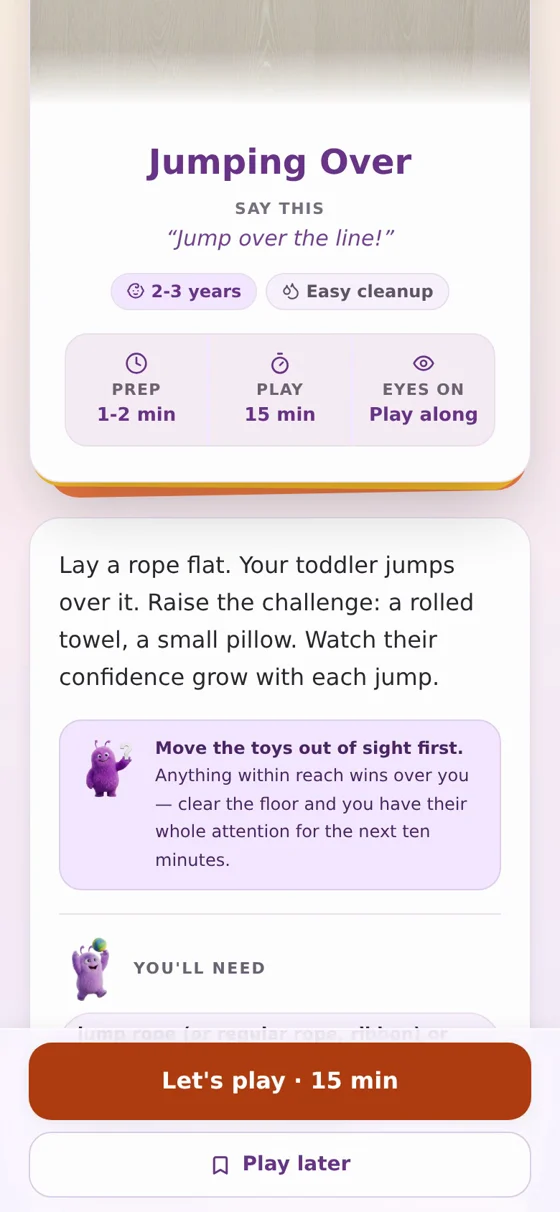
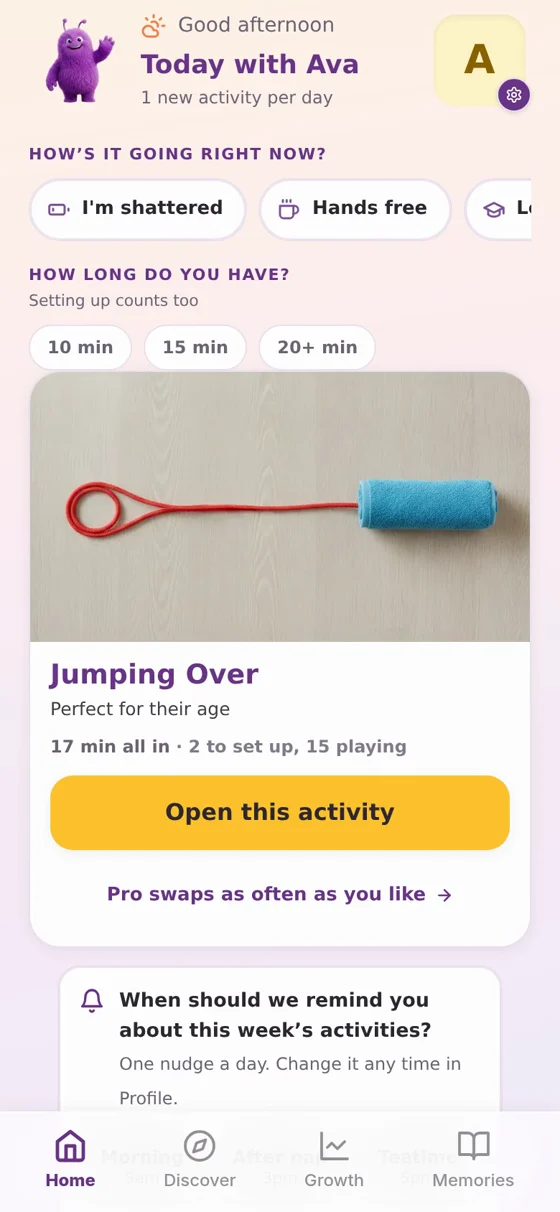
Mooshie keeps the phone in your hand, so your child can watch your face while you talk and play together. You can add speech and language delay (and other needs such as autism or hearing impairment) to your child’s profile, which filters out activities that won’t suit and adds adaptation tips. Every activity tells you specific words to say, so you always have something to model, and “What that built” shows which skills you practised. It is not therapy, it has no video demos and it is iPhone only for now.
2. Speech Blubs
Best for: A dedicated first-words practice app for your child to use
Speech Blubs is built entirely around speech. Children watch short videos of other children saying sounds and words, then copy them, with voice recognition, face filters and stickers as rewards. It has 1,500+ activities, a Parents’ Academy and a free speech screener on its website, and the company describes it as a home supplement to therapy. Your child uses the screen directly (it suggests 10 to 15 minutes a day), and it is one of the pricier options, so use the 7-day trial and the 3-day automatic refund window to judge it.
3. CBeebies Parenting (formerly BBC Tiny Happy People)
Best for: Free, expert-backed talking tips from a UK source
Speech, language and communication sit at the heart of this free BBC website. Each age band from birth to 5 opens with a short Tools for Talking film, and there are key talking tips, nursery rhymes and downloadable activity sheets. Its partners include the Royal College of Speech and Language Therapists and the Institute of Health Visiting. As a website, it won’t plan your day or track progress, and it takes some browsing to find the right age page.
4. Kinedu
Best for: Tracking language alongside all-round development
Kinedu isn’t a speech app, but its starting assessment looks at linguistic skills alongside physical, cognitive and socio-emotional ones, and its progress reports cover all four. You get a daily plan of video activities, plus expert classes on development and behaviour. It suits parents who want to see language in the wider picture, though most activities need a subscription.
5. BabySparks
Best for: Video-led play ideas and milestone tracking for under-3s
BabySparks gives 0 to 3-year-olds a daily programme of play activities, with a short video showing you how to do each activity and milestone tracking with weekly reports. Being able to watch first can help if you’re not sure how to pitch an activity to a quiet toddler. It is not speech-specific, and the programme ends at 3.
6. Khan Academy Kids
Best for: Free early reading and phonics for children aged 2 and up
Khan Academy Kids is a free, ad-free app with games, books and videos on reading, phonics and more. It is aimed at early literacy and maths rather than talking. It isn’t designed for speech delay, and your child uses the screen rather than chatting with you. We include it because many parents search for it, and it is a good free choice for older toddlers.
Talking with you vs talking to a screen
Speech apps for toddlers come in two styles:
- Parent-guided: Mooshie, CBeebies Parenting, Kinedu and BabySparks give the grown-up ideas and words, and the play happens face to face.
- Child-facing: Speech Blubs and Khan Academy Kids put the screen in front of your child, with videos and games doing the prompting.
Child-facing apps can be motivating, especially for a child who loves copying other children. Face-to-face play gives your toddler your expressions, turn-taking and the chance to answer in their own way, whether that is a sound, a sign or a point. Many families use a little of both and keep the conversation going off the screen.
Simple ways to build words at home
Whatever app you choose, here are a few everyday habits that are easy to try:
- Say less, more often. Use one or two words more than your child does: if they say “car”, you say “red car”.
- Wait. Pause after a question and give them time to reply in any way they can.
- Talk about what they’re looking at. Follow their gaze and name it.
- Sing and repeat. Songs with actions and pauses invite them to fill in the gap.
For more ideas, see our speech and language activities and our guide to activities for toddlers with speech delay.
Try Mooshie free this week.
3 coached activities every week, free. No account, no toys to buy, and your child never touches the screen.
Free or paid: what’s worth it?
If money is tight, you can do a lot for free. CBeebies Parenting costs nothing, Khan Academy Kids is fully free, and Mooshie gives you 3 coached activities a week without an account. Speech Blubs has no ongoing free tier, but its website offers a free speech screener.
Paid apps make most sense when they save you thinking time or keep you consistent. Try a free trial for a full week, notice whether you actually use it, and cancel before it renews if it doesn’t fit. If your child needs more help, your money and energy may be best spent on getting that NHS referral moving.
Parents and experts on Mooshie
“I used to spend 30 minutes looking for an activity on Pinterest, get overwhelmed, and just turn on the TV. Mooshie takes 5 seconds.”
“Finally, an app that tells me to put my phone away. The activities are actually doable with stuff I have in my junk drawer.”
“As a pediatric OT, I love that these activities build core developmental skills without feeling like ‘homework’ for parents.”

Questions parents ask
What is the best app for toddler speech delay?
For a child-facing speech app, Speech Blubs is the most focused option. For play you do together, Mooshie Moments lets you add speech and language delay to your child’s profile and gives you words to say in every activity. Neither replaces a speech and language therapist.
Are there free apps for toddler speech delay?
CBeebies Parenting is a free BBC website full of talking tips and activities, and Khan Academy Kids is a free app for early reading. Mooshie Moments has a free tier with 3 coached activities a week. Speech Blubs offers a free speech screener on its website, but the app needs a subscription after the trial.
Can an app replace speech therapy?
No. Apps can support practice at home, but they can’t assess or treat your child. Speak to your health visitor or GP, and check whether your area lets parents self-refer to NHS speech and language therapy, which many areas do.
How much is Speech Blubs in the UK?
The UK App Store lists monthly plans at £14.99 to £19.99 and annual plans at £28.99 or £48.99, without saying which a new user will see. There is a 7-day trial, and its FAQ describes an automatic refund within the first 3 days.
How much screen time is OK in a speech app?
Speech Blubs suggests 10 to 15 minutes a day. If you’d rather avoid screen time for your toddler, a parent-led app such as Mooshie or the free CBeebies Parenting website gives you ideas to use face to face.
Make memories. Build skills. Play together.
Your first activity is ready as soon as you tell us their age.