
10-Minute Activities for an 18-Month-Old You Can Start Now
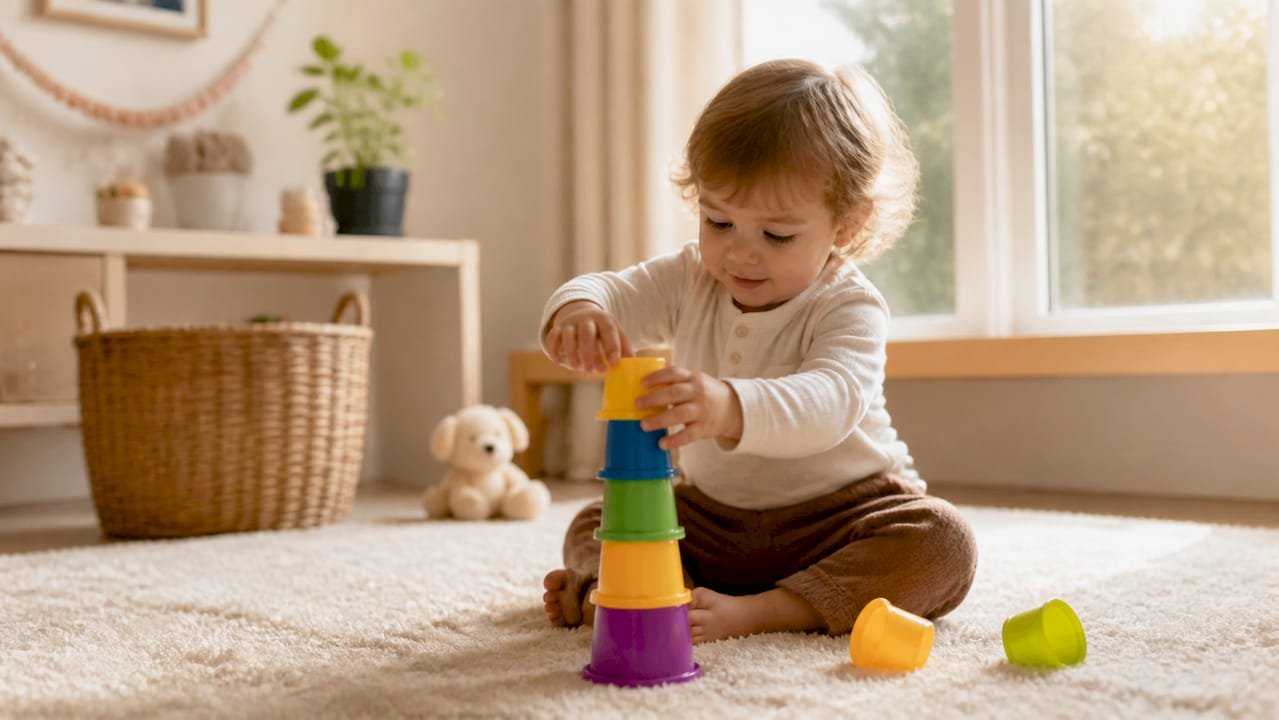
Ten simple activities you can start in the next five minutes: stacking cups, a fill-and-dump bin, bubble popping, a mini obstacle course, pretend feeding with a doll, sensory scooping, storytime with pointing, action songs with gestures, a cardboard box wagon pull, and a simple shape sorter. Each one targets a specific skill your toddler is actively wiring right now.
You don’t need a Pinterest board or a trip to the store. You need about three household items and ten free minutes. Here’s the quick list, with the one skill each activity builds:
- Stacking plastic cups — fine motor and hand-eye coordination
- Fill-and-dump bin (a box, some scarves or pom-poms) — sensory processing and cause-and-effect
- Bubble popping — gross motor and visual tracking
- Cushion obstacle course — balance and spatial awareness
- Feeding a doll or stuffed animal — pretend play and early empathy
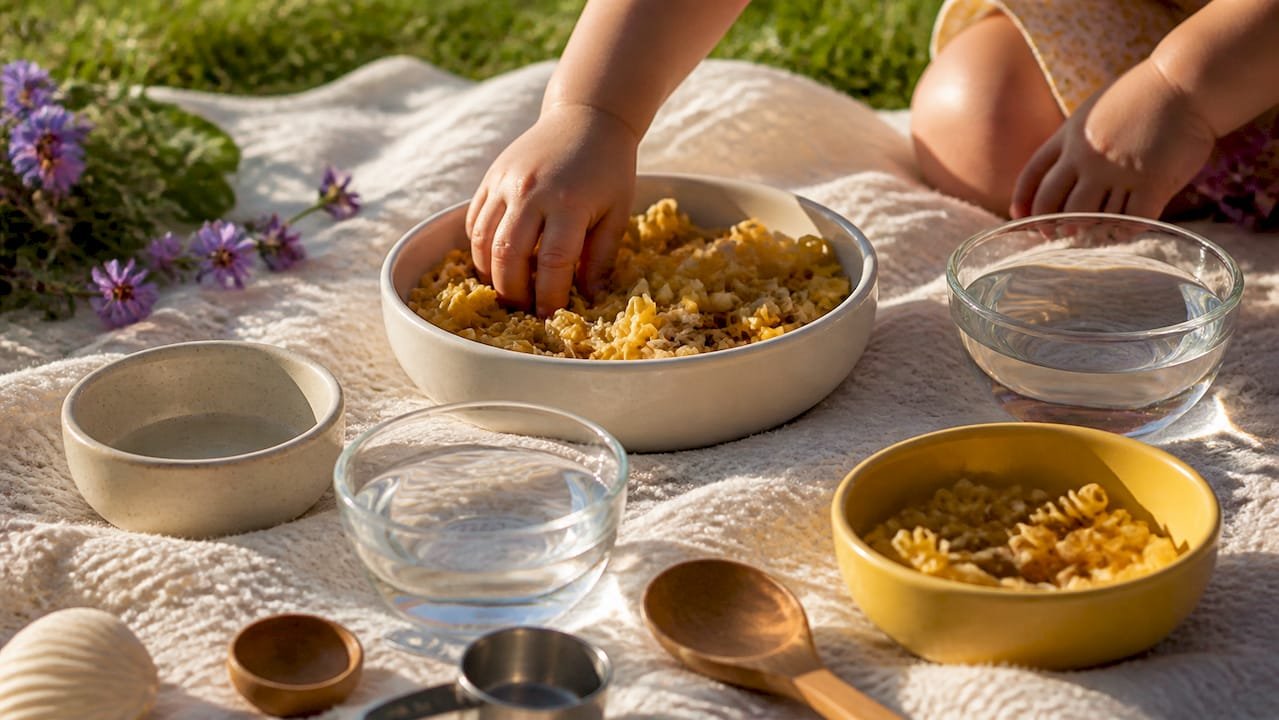
- Sensory scooping (dry rice or oats, a cup and bowl) — fine motor and focus
- Storytime with pointing — vocabulary and joint attention
- Action songs with gestures (“Row Row Row Your Boat”) — imitation and listening
- Pulling a laundry basket “wagon” — leg strength and problem-solving
- Simple shape sorter or muffin tin sort — fine motor and early categorization
Every one of these can happen on your kitchen floor while dinner cooks. That’s the whole point of activities for an 18-month-old: low prep, high payoff, and nothing that needs charging.
Key Takeaways
Short, repeated, low-prep activities that pair play with narration build language, motor skills, and executive function faster than elaborate one-off setups.
| Point | Details |
|---|---|
| Start with what you own | Cups, towels, boxes, and spoons cover most fine motor, sensory, and pretend play needs. |
| Narrate everything | Name objects and actions out loud during play to build vocabulary faster than toys alone. |
| Expect 5 minutes or more | Shorten, split, or add yourself to the activity when attention fades instead of pushing through. |
| Watch the milestone list | Flag missing single words, no walking, or no name response with your GP or health visitor. |
| Get more ideas fast | Mooshie Moments filters screen-free activities by age and available time when you need a new idea now. |
Where these guidelines come from
- CDC — Milestones: 18 Months
- ZERO TO THREE — Play Activities for 12 to 24 Months
- NHS — First Words and Little Sentences (1 to 2 Years)
- UNICEF — 21 Learning Activities for Babies and Toddlers
- Harvard Center on the Developing Child — Play and Executive Function
- NAEYC — Ten Things Children Learn From Block Play
Table of Contents
- Gross Motor Activities That Burn Energy and Build Balance
- Fine Motor and Problem-Solving Play
- Sensory Play That’s Messy Without Being a Nightmare
- Pretend Play That Doubles as a Language Lesson
- Music, Movement, and Storytime in Short Bursts
- Setting Up Fast and Playing Safe
- How Long a Session Really Lasts (and What to Do When Interest Fades)
- What This Play Is Actually Building
- 18-Month Milestones and When to Ask for Help
- How an App Like Mooshie Moments Fits Into All of This
- Want Thousands More Quick, Screen-Free Activity Ideas?
- Sources
Gross Motor Activities That Burn Energy and Build Balance
Eighteen-month-olds are wobbly experts. They’ve usually mastered walking but they’re still working out stairs, uneven ground, and stopping without faceplanting. Gross motor play at this stage isn’t about exercise. It’s about wiring the balance and coordination systems they’ll rely on for the next several years.
Try these:
- Cushion or pillow obstacle course — line up couch cushions to crawl over and around; builds balance and motor planning.
- Soft ball roll-and-throw — sit a few feet apart and roll a soft ball back and forth; builds coordination and turn-taking.
- Bubble chase — blow bubbles and let your toddler stomp or grab them; builds visual tracking and leg strength.
- Push-pull wagon or laundry basket — fill a basket with soft toys to pull across the room; builds leg strength and a sense of accomplishment. ZERO TO THREE specifically calls out homemade “important jobs” like this for building competence at this age.
- Stair step practice (with hands held or a low step) — builds coordination and confidence on uneven surfaces.
- Freeze dance — play music, dance, then pause it and freeze; builds impulse control alongside gross motor skill.
Pro Tip: For a newer walker, keep the obstacle course flat and slow the music down for freeze dance. For a confident runner, add a low step or a “tunnel” made from an open cardboard box to raise the challenge without raising the risk.
Fine Motor and Problem-Solving Play
This is where the pincer grasp gets its daily workout. Fine motor activities at 18 months look deceptively simple, but scooping, stacking, and sorting are laying down the hand control your toddler will eventually use to hold a crayon and, years later, a pencil.
- Stacking cups — nest and stack, then knock them down.
- Shape or peg insertion — a simple shape sorter, or poke craft sticks into a colander.
- Scooping and pouring — dry rice, oats, or water between two containers.
- Simple puzzles — chunky 2 to 4 piece wooden puzzles with knobs.
- Object transfer — move pom-poms or small blocks from one bowl to another with tongs or a spoon.
Block play deserves a special mention here. NAEYC notes that even basic stacking and knocking down teaches spatial reasoning, planning, and cooperation when a sibling or parent joins in, which makes it one of the highest-value, lowest-cost toys you’ll ever own.
| Activity | Materials Needed | Cheap Substitute |
|---|---|---|
| Stacking cups | Plastic stacking cup set | Yogurt containers or measuring cups |
| Shape insertion | Shape sorter toy | Colander and craft sticks |
| Scooping and pouring | Two small bowls, scoop | Kitchen measuring cups and dry pasta |
| Simple puzzles | Chunky knob puzzle | Cut a cereal box into 3 large pieces |
| Object transfer | Tongs, small bowls | Ice cube tray and cotton balls |
To make any of these easier, use bigger objects and one container instead of two. To make them harder, add a second bowl, smaller objects, or a timer for a silly race against yourself.
Sensory Play That’s Messy Without Being a Nightmare
Sensory play gets a bad reputation for the cleanup, but it doesn’t have to mean glitter in the carpet for a month. A towel on the floor and a shallow bin solves most of the mess problem before it starts.
- Water play on a towel — a shallow tub, a few cups, and some floating toys build cause-and-effect understanding and calm, focused play.
- Sensory scooping bins — dry rice, oats, or dry pasta with cups and spoons; builds fine motor control and sustained attention.
- Ice play — a few ice cubes in a bowl (supervised, never unattended) build sensory tolerance and vocabulary around “cold” and “melting.”
- Scented treasure walks — a basket of safe household items (a lemon half, a cinnamon stick, a soft scarf) to smell and touch on a walk around the house.
- Edible sensory bins — cooked and cooled pasta or oats for toddlers who mouth everything; lower mess anxiety because eating it isn’t a hazard.
| Setup | Benefit | Watch For |
|---|---|---|
| Water play | Cause-and-effect, calm focus | Never leave unattended near standing water |
| Dry scooping bin | Fine motor, attention span | Choking risk if items are small; supervise closely |
| Ice play | Sensory tolerance, new vocabulary | Melting water can be slippery; towel underneath |
| Scented walk | Smell discrimination, descriptive words | Check for allergies before introducing new scents |
Pro Tip: Keep a laundry basket of “sensory towels” by the back door so setup takes ten seconds, not ten minutes. The lower the friction, the more often you’ll actually do it.
Safety checklist before any sensory session: check for choking-sized pieces, never leave your toddler alone near water even shallow water, confirm no food allergies if using edible materials, and inspect any secondhand toys for loose parts or peeling paint. To scale the mess down, use a single bowl instead of a bin. To scale it up, add a second texture, like both rice and water cups on the same towel.
Pretend Play That Doubles as a Language Lesson
Pretend play at 18 months is really language practice wearing a costume. A pediatric speech therapist notes that play is the primary vehicle for language acquisition at this stage, and that caregivers build vocabulary fastest by narrating actions and objects out loud during play, not by drilling flashcards.
- Feeding a doll or stuffed animal — say “Baby is hungry. Here’s a spoon. Open wide!” while pretending to feed it.
- Toy animal barn — name each animal and its sound as your toddler moves them around: “Cow says moo. Cow is sleepy.”
- Tea party — narrate pouring and sipping: “More tea? Pour, pour, pour. All done.”
- Dress-up with simple props — a hat, a scarf, an old pair of oversized shoes; describe each item as they put it on.
- Toy phone conversations — model a simple back-and-forth: “Hello? Yes! Bye bye!” then hand the phone over and wait for their turn.
Pro Tip: Use names, verbs, and repeat the same short phrases across several days. Toddlers this age learn new words faster from repetition than from variety, so “all done,” “more please,” and “uh oh” said the same way every time will stick sooner than a new phrase every session.
Music, Movement, and Storytime in Short Bursts
Combine rhythm with repetition and you get one of the highest-return activity categories at this age. Songs with gestures, in particular, build imitation skills and memory because your toddler has to watch, wait, and copy, all at once.
- Action songs with gestures — “Wheels on the Bus,” “Row Row Row Your Boat,” or “Itsy Bitsy Spider.” Keep each song under two minutes.
- Drum time with household items — wooden spoons on pots and upside-down bowls build rhythm and motor coordination.
- Short dance-and-freeze — 30 to 60 seconds of dancing, then a sudden pause; builds listening and impulse control.
- Interactive storytime — a simple board book, pointing to pictures and repeating key words on each page.
For storytime, aim for two to three short books read at a slow pace rather than one long book rushed through. UNICEF’s activity guide recommends flip-and-point books specifically because the repetition and pointing build vocabulary faster than passive listening does. If you want ready-made playlists to rotate through, this collection of songs for young kids is a solid starting point for building a rotation without reinventing your song list every week.
Pro Tip: Once your toddler knows a song, leave out the last word of a line and wait. “Twinkle twinkle little…” then pause. That tiny pause turns a familiar song into active language practice instead of passive listening.
Setting Up Fast and Playing Safe
You don’t need a dedicated playroom. You need a clear patch of floor and a small rotation of household items you already own.
| Item You Have | What It Becomes |
|---|---|
| Plastic cups or bowls | Stacking towers, scoops, sorting containers |
| Old towels | Sensory play mat, water play barrier |
| Cardboard boxes | Tunnels, wagons, fill-and-dump bins |
| Wooden spoons | Drumsticks, stirring tools, pretend cooking |
| Laundry basket | Pull wagon, ball pit, obstacle course piece |
Safety checklist for any home play session:
- Clear the floor of small objects that fit through a toilet paper tube (a rough choking-hazard test).
- Never leave water play, even a shallow tub, unattended.
- Inspect secondhand or hand-me-down toys for cracks, loose parts, or peeling paint before handing them over.
- Check ingredient labels if using food items for sensory play, especially with known allergies.
- Keep play spaces away from stairs, cords, and unlocked cabinets.
For quick cleanup, keep a designated bin or basket for each activity type so putting toys away takes thirty seconds instead of ten minutes. A basket by the door for outdoor and messy-play items, and a low shelf for the daily rotation, cuts down on the friction that usually kills a good habit before it starts.
How Long a Session Really Lasts (and What to Do When Interest Fades)
Most 18-month-olds hold focus on a single activity for somewhere between five and fifteen minutes, and that’s on a good day. A tired, hungry, or overstimulated toddler might give you ninety seconds. That’s normal, not a sign you did something wrong.
When interest fades, try one of these pivots instead of pushing through:
- Shorten it. Do two minutes instead of ten, and call it a win.
- Split it into two parts. Scoop now, pour later after a snack.
- Add yourself. Sitting down and joining in often resets attention faster than any new toy.
- Change location. Move the same activity from the kitchen floor to the porch.
- Repeat just one element. Drop the full obstacle course and just do the tunnel crawl three times.
- Offer a choice. “Cups or bubbles?” gives back a sense of control.
- Watch for overstimulation, not just boredom. Sometimes fading interest means too much noise or too many toys out at once, not too little fun.
- End before the meltdown. Stopping on a high note makes the next session easier to start.
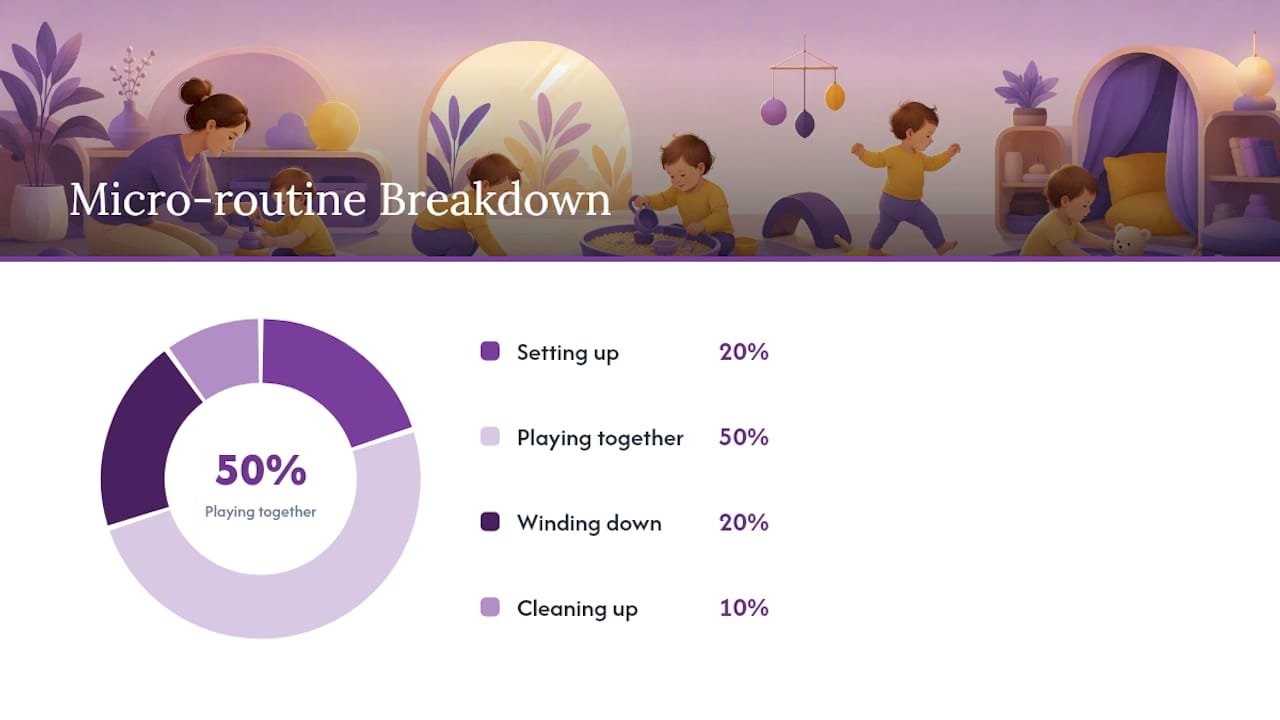
A simple ten-minute micro-routine: spend two minutes setting up in front of your toddler (they love watching you prepare), five minutes playing together with heavy narration, two minutes winding down with a transition cue like “one more scoop, then all done,” and one minute cleaning up together, even if they only manage to drop one item in the bin.
Pro Tip: Narrate the ending the same way every time, like “all done, time to clean up.” Predictable transitions reduce meltdowns because your toddler knows what’s coming instead of being surprised by it.
What This Play Is Actually Building
Every category above maps to a specific developmental skill, and knowing the map helps you choose with intention instead of guessing.
- Sensory play builds sensory integration, sustained attention, and tolerance for new textures.
- Pretend play builds symbolic thinking, early empathy, and social-emotional understanding.
- Gross motor play builds balance, coordination, and body awareness.
- Fine motor play builds hand control, problem-solving, and pre-writing strength.
- Music and storytime build memory, imitation, and receptive vocabulary.
- Turn-taking games like rolling a ball back and forth or playing peekaboo build early executive function. The Harvard Center on the Developing Child notes that games requiring a child to wait, hide, or hold a rule in mind actively strengthen attention and working memory, the same systems that later support focus in a classroom.
You don’t need a separate “lesson” for any of this. Mealtime narration (“You’re eating carrots. Crunchy carrots!”) and walk-and-name games (“There’s a dog. Dog says woof.”) fold these same skills into routines you’re already doing every day.
18-Month Milestones and When to Ask for Help
By 18 months, many children walk without holding on, use three or more words, point to show interest in something, and imitate simple household tasks like wiping a table or “talking” on a toy phone. The CDC’s 18-month milestone checklist also includes practical tips for parents alongside the checklist itself.
Watch for these signs and don’t wait to ask for guidance if you notice them:
- No single words by 18 months.
- Not walking independently.
- Not responding to their own name.
- No pointing to show interest in objects or people.
- Loss of a skill they previously had.
If any of these apply, talk to your GP, health visitor, or pediatrician. In the US, the CDC’s Learn the Signs, Act Early program is a solid starting point for what to ask about. Bring a short list to the appointment: a couple of specific examples of what you’ve noticed, approximate dates when you first noticed it, and any developmental screening results you already have on hand. This is general guidance, not a diagnosis. If you have any concern about your toddler’s development, a qualified health professional is the right person to talk to.
How an App Like Mooshie Moments Fits Into All of This
Every activity in this article works with things you already own. That’s deliberate. But on the days when you’ve got five minutes, no ideas, and a toddler standing at your feet, having a ready-made suggestion beats scrolling for one.
Mooshie Moments filters its activity library by your child’s age and by how much time and energy you actually have that moment, then hands you a screen-free idea using items already in your house. A few ways that plays out in practice:
- Five minutes before dinner: pull up a quick sensory or fine motor activity while something’s on the stove.
- Ten minutes of low-energy calm: a sensory scooping or ice-play idea sized for a tired afternoon.
- A multi-day pretend-play theme: extend a barnyard or tea party idea across a few days instead of starting fresh each time.
Each activity comes with a short developmental note explaining what it builds, similar to the skill labels used throughout this article, so you’re not guessing whether an idea is worth the setup. Nurseries and early years settings can also access EYFS-aligned partnership resources to send consistent, screen-free ideas home with families. For more sensory and language-focused ideas beyond this list, the Mooshie blog covers additional setups worth trying.
Pro Tip: Keep a rotating shortlist of five activities you know work for your toddler’s mood on a hard day. Novelty is nice, but reliability is what actually gets you through a rough afternoon.
A parent’s perspective on playing with a toddler who won’t sit still
Anyone who tells you they’ve nailed toddler play every single day is either exaggerating or has a toddler who naps four hours straight. Most days, you’ll get through half of an activity before your child wanders off to open the pantry for the fortieth time, and that’s fine. The research on play and executive function doesn’t ask for perfection. It asks for repetition, narration, and a little bit of your attention, offered often enough that it becomes a pattern rather than an event. The activities that actually stick in our house aren’t the elaborate ones. They’re the boring, repeated ones: the same three songs, the same scooping bin, the same “all done” phrase at cleanup time. If you want a bigger rotation without the mental load of inventing new ideas every week, that’s exactly the gap something like Mooshie Moments is built to fill.
Want Thousands More Quick, Screen-Free Activity Ideas?
Mooshie Moments gives you a personalized activity library instead of a single list to burn through in a week. It filters ideas by your toddler’s age, how much time you have, and your energy level, then hands you a screen-free suggestion built from things already in your kitchen or toy basket.
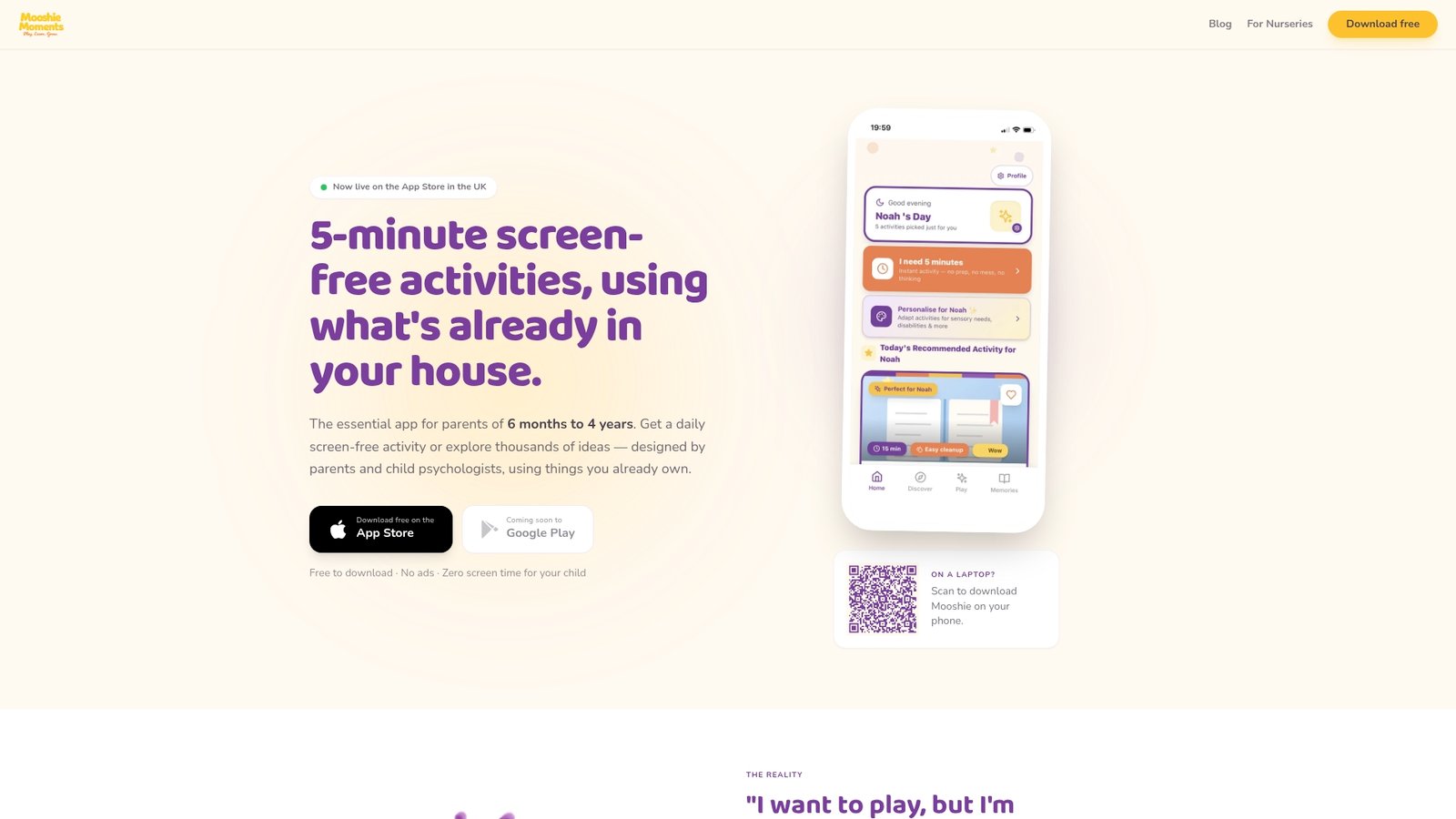
Instead of rebuilding your own activity list every few weeks, open the app and get a fresh, age-matched idea in seconds, complete with the developmental note behind it. If you run a nursery or early years setting, the nursery partnership program offers ready-made, EYFS-aligned resources you can send home with families instead of building your own. Ready to stop reinventing playtime from scratch? Try Mooshie Moments and get your next activity idea in under a minute.
Sources
- CDC — Milestones: 18 months
- ZERO TO THREE — Play activities for 12 to 24 months
- Harvard Center on the Developing Child — Play and executive function (handout)
- NHS — First words and little sentences (1 to 2 years)
- UNICEF — 21 learning activities for babies and toddlers
Recommended
More like this

Five Minute Routine Activities to Help Speech Delay in UK Toddlers
Quick, routine based activities UK parents can use in 5–15 minutes to support a toddler with speech delay. Evidence backed techniques and…
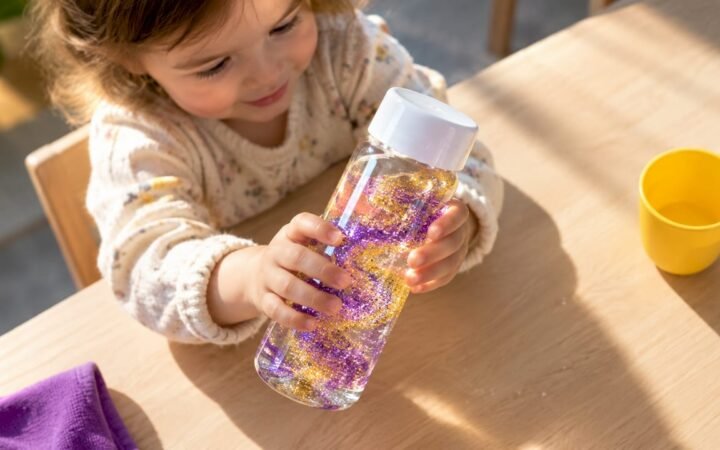
Three Minute Mess Free Sensory Play For UK Parents
Quick, reusable sensory activities UK parents can set up in minutes. Sealed bags, sticky wall art, safety checks, storage tips, and Mooshie…
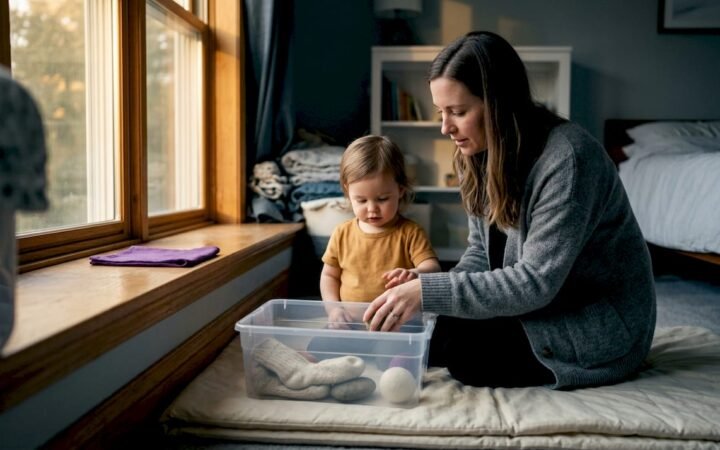
10 Quiet Bin Ideas UK Parents Can Build in 5 Minutes
Practical, EYFS-aligned quiet-bin ideas UK parents can assemble in five minutes. Includes 10 ready bins, a five-bin rotation, safety checks, and quick...