Open-Ended Play for Toddlers: What It Is and Why It Works
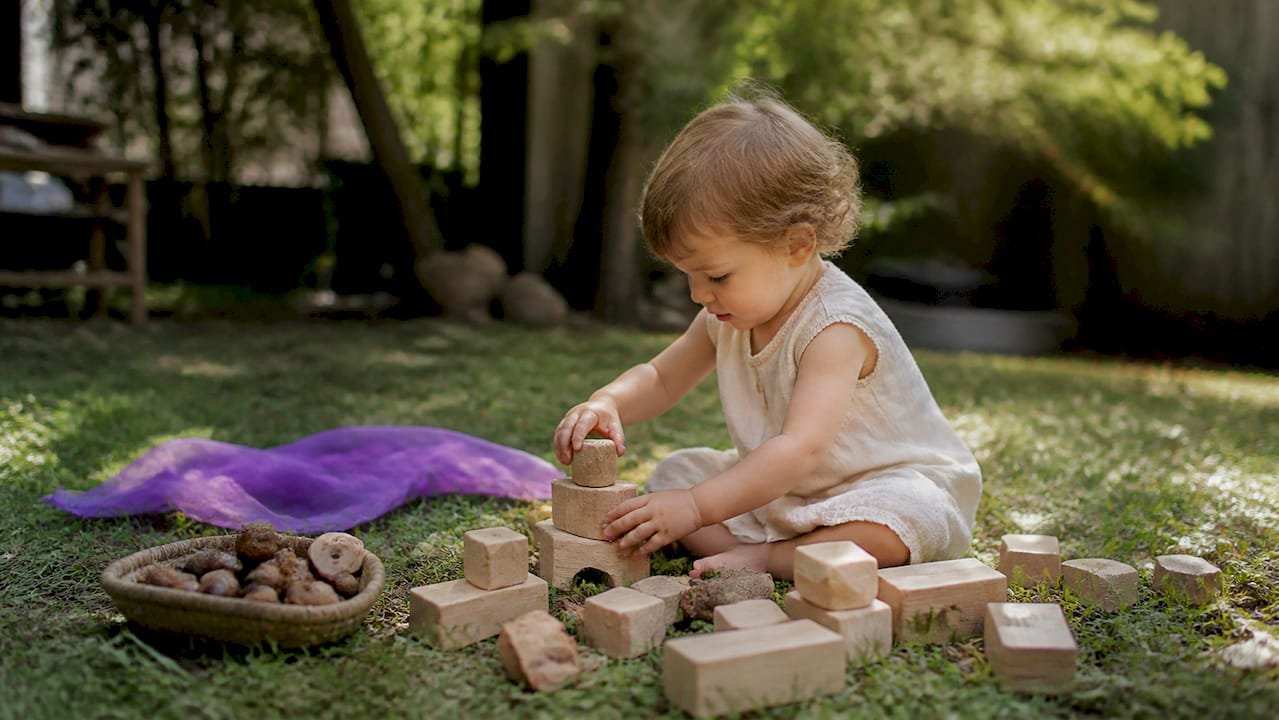
Open-ended play means letting your toddler use a material however they want, with no single “right” outcome, no instructions, and no finish line. A pile of wooden blocks can be a tower, a phone, or dinner for a stuffed bear. This kind of play builds creativity, problem-solving, and language skills faster than toys with only one use.
You don’t need a shopping trip to start. Grab two or three versatile items you already own tonight and set them in front of your toddler. Then watch.
Good starting picks:
- A few empty containers with lids (nesting and filling)
- A handful of large wooden spoons or blocks
- A basket of fabric scraps or a play silk
Key Takeaways
Open-ended play with versatile, low-cost materials builds cognitive, language, and motor skills faster than single-purpose toys, and a rotation of 8 to 12 items sustains that benefit longer than a full toy box.
| Point | Details |
|---|---|
| Start small | Offer 2 to 3 versatile items, like blocks or containers, before buying anything new. |
| Let repetition happen | Filling, dumping, and stacking repeatedly is real cognitive work for toddlers under 2. |
| Rotate instead of accumulate | Keep 8 to 12 toys out at a time and swap them every one to two weeks. |
| Narrate, don’t direct | Describe what your toddler is doing and ask open questions instead of correcting their play. |
| Use Mooshie Moments for quick wins | The app suggests screen-free, five-minute activities matched to your toddler’s age and your available time. |
Table of Contents
- What Open-Ended Play Looks Like Between 1 and 3 Years
- The Research Behind Open-Ended Play’s Benefits
- Top Open-Ended Toy Categories Every Toddler Needs
- Fewer, Better Toys: A Minimalist Approach to Toddler Play
- Setting Up a Safe Open-Play Space at Home
- Five 5-Minute Open-Ended Activities You Can Try Today
- Common Misconceptions About Open-Ended Play
- Bringing Open-Ended Play Into Everyday Life
- Why I Think We Undersell How Much Toddlers Are Already Doing
- How Mooshie Moments Fits Into Your Toddler’s Play Routine
- Frequently Asked Questions
- Sources
What Open-Ended Play Looks Like Between 1 and 3 Years
At 12 to 18 months, open-ended play often looks repetitive: filling a cup and dumping it out, stacking two blocks and knocking them down, over and over. That repetition is the work. It’s how toddlers test cause and effect and build the motor control they’ll need later.
By 2, you’ll start seeing symbolic play creep in. A block becomes a phone. A scarf becomes a blanket for a doll. This shift from purely sensory exploration to pretend scenarios is one of the clearest markers of cognitive growth in the second and third year, and it happens on its own timeline for every child.
Your job during this stretch is mostly to stay out of the way. Sit nearby, resist the urge to show them the “correct” way to stack the cups, and let the play wander. If your toddler decides the blocks are soup ingredients, that’s not a wrong answer. That’s imaginative play doing exactly what it’s supposed to do.
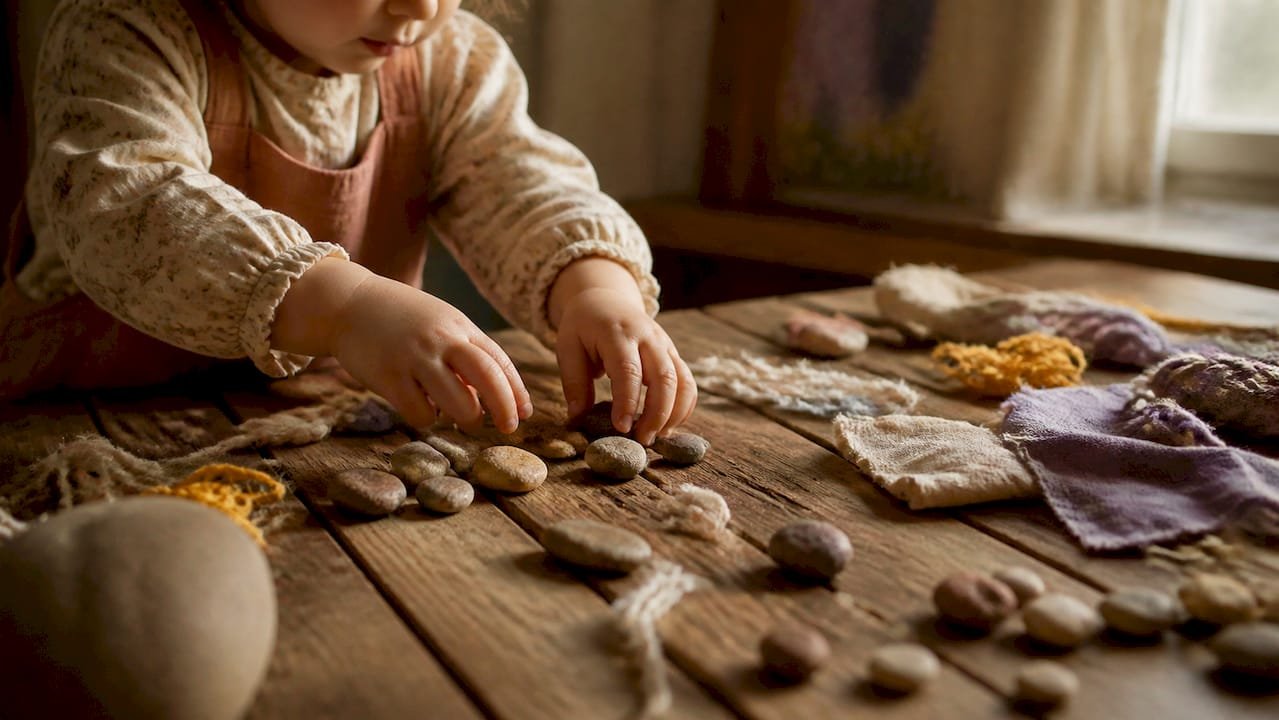
This is also where loose parts come in: an approach built around materials without a fixed purpose, like buttons, stones, fabric, or bottle caps, that toddlers can combine, sort, and reinvent endlessly. Loose parts adapt as your child’s skills grow, which makes them one of the most efficient toy investments a caregiver can make.
The Research Behind Open-Ended Play’s Benefits
Open-ended play is not just a pleasant way to pass an afternoon. A review of loose parts play research found it consistently supports executive function, cognitive self-regulation, and problem-solving in early childhood, partly because loose parts allow for divergent thinking. There is no single correct move, so a toddler has to generate their own approach every time.
Loose parts and open-ended materials show up across multiple domains of development at once, rather than isolating one skill. That review found the same play session can build reasoning skills, spatial awareness, and language, depending on how the child directs it.
Language grows through this too. When a toddler narrates their own pretend play, “Baby sleeping, shh,” they’re practicing sentence structure and vocabulary in a low-pressure setting. Today’s Parent notes that open-ended play, defined as play without predetermined rules, supports language growth alongside problem-solving and motor skills in children under five.
The physical side matters just as much. Pouring water between containers, stacking uneven blocks, and squeezing playdough all refine fine motor control and hand-eye coordination.
There’s an emotional payoff too. Scientific American reports that unstructured play helps calm anxious children more effectively than passive activities like being read a story. For toddlers navigating big feelings with a small vocabulary, that’s a meaningful outlet.
Top Open-Ended Toy Categories Every Toddler Needs
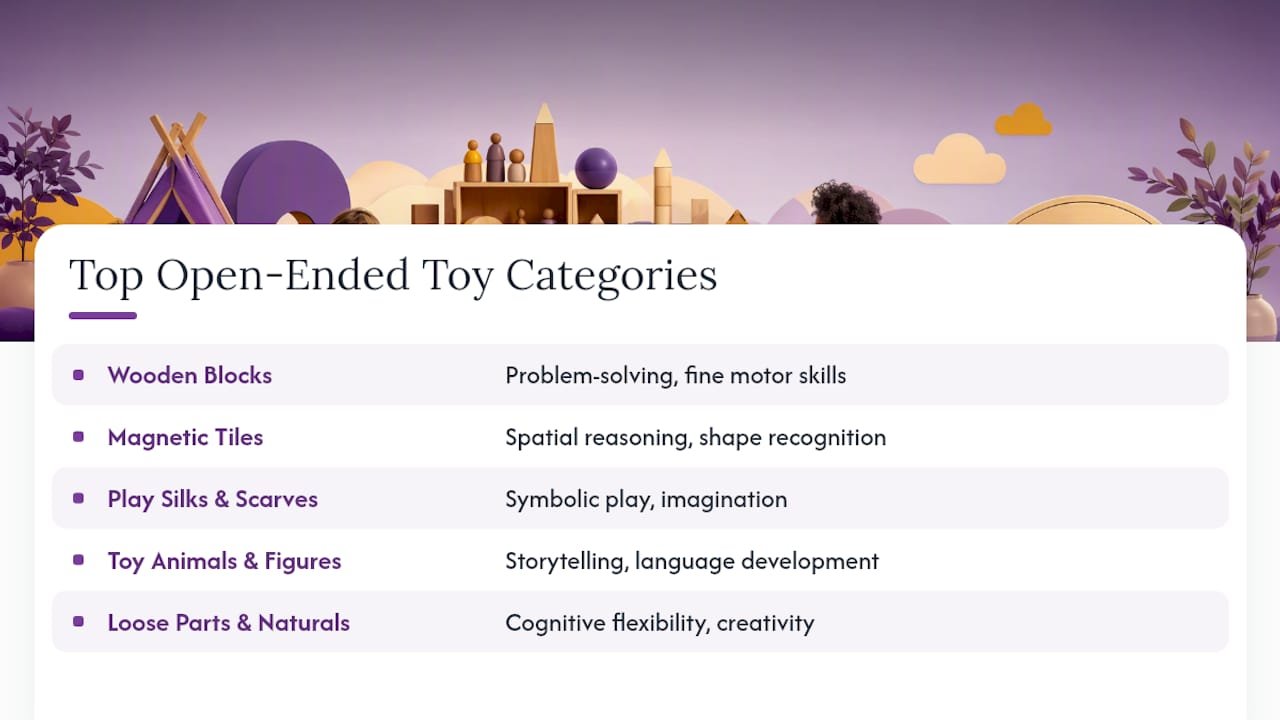
You don’t need a playroom full of gear. A handful of well-chosen categories covers nearly every developmental angle. Here’s what actually earns shelf space.
1. Wooden Blocks
Blocks are the anchor of any open-ended toy collection. Toddlers stack them, knock them down, sort by size, and eventually use them symbolically, as a car, a phone, a piece of cake. Look for smooth edges and a washable finish since they’ll spend time on the floor and in mouths during the younger toddler years.
2. Magnetic Tiles
These snap together to build flat shapes or 3D structures, which introduces spatial reasoning earlier than most toys manage. For toddlers under 2, choose larger tile sets and stay close during play, since smaller magnetic pieces are a genuine swallowing risk.
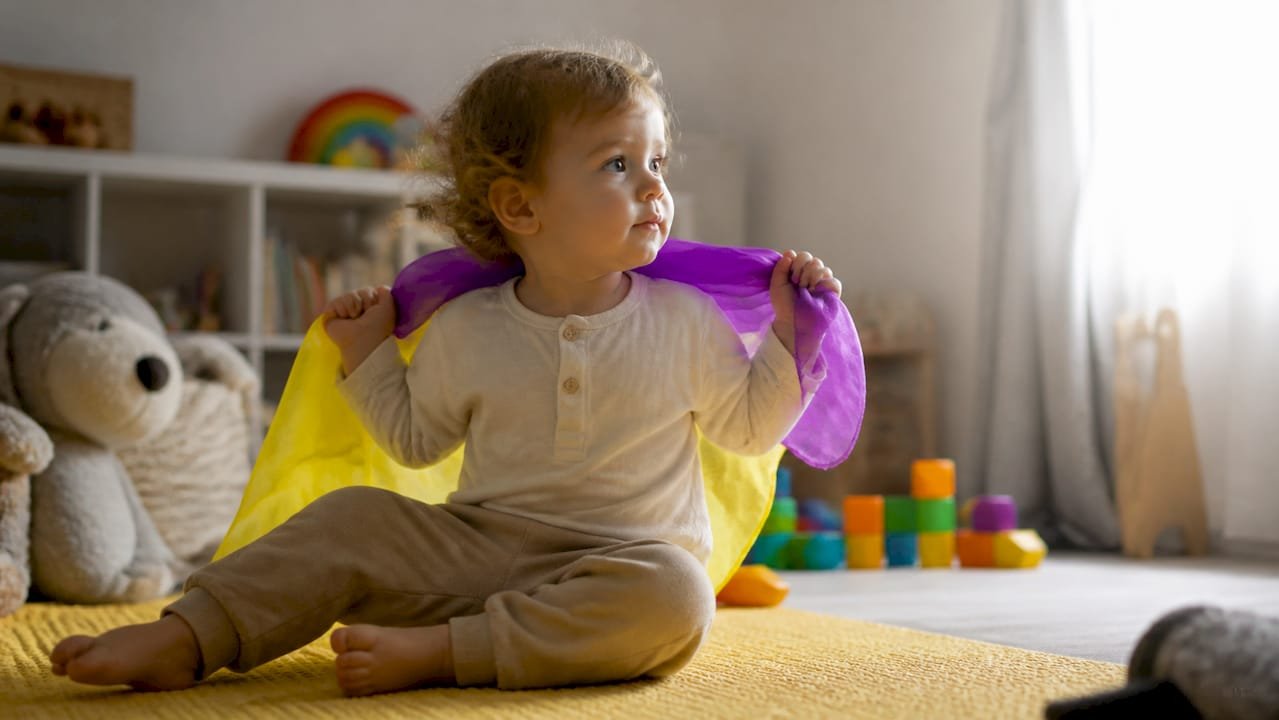
3. Play Silks and Scarves
A square of lightweight fabric becomes a cape, a picnic blanket, a puppet, or a tent wall in the same afternoon. Play silks are some of the most versatile items in an open-ended collection precisely because they have no fixed shape or use.
4. Toy Animals and Figures
Simple, chunky animal or people figures give toddlers a vehicle for storytelling long before they have the vocabulary to explain a plot out loud. Choose pieces sized well beyond a choking hazard for children under 3, and skip anything with small removable parts.
5. Loose Parts and Natural Materials
Pinecones, smooth stones, bottle caps, shells, and fabric scraps cost little to nothing and grow with your child for years. A Head Start guide to loose parts recommends pairing these found materials with toys your toddler already owns, which extends the play value of both.
A few more categories round out a well-stocked but restrained collection:
- Stackers and rainbow arches for sorting, balancing, and early counting
- Play food and simple kitchen items for pretend cooking and turn-taking
- Basic art supplies like chunky crayons and washable paint for toddlers old enough to avoid mouthing
- Sand, water, and a set of containers for pouring, measuring, and sensory exploration
- Simple wheeled vehicles without batteries or sound buttons, so imagination fills in the noise
Every item on this list shares one trait: no single correct way to use it. That’s the test worth applying before any toy purchase.
Fewer, Better Toys: A Minimalist Approach to Toddler Play
Depth of play matters more than volume of toys. A NAEYC resource on open-ended materials points out that caregivers and educators tend to see stronger developmental outcomes from a smaller set of versatile items rotated regularly than from a permanent mountain of toys. Too many options at once actually shortens attention span rather than lengthening it.
A simple rotation system fixes this without any real cost:
- Keep a modest number of toys accessible at any one time, organized by category rather than piled together
- Swap in a rotated batch regularly, storing the rest in a bin out of sight
- Notice which toys get ignored for a week straight. Those are your first candidates to rotate out
Gift-giving relatives don’t have to wreck this system. Ask for consumable or shared-use gifts instead: art supplies, a membership, or a single well-made open-ended piece rather than a set of six single-purpose toys. Cardboard boxes, muffin tins, and wooden spoons from your own kitchen often outperform anything store-bought.
Pro Tip: Before buying anything new, check if a household item already does the job. A muffin tin with pom-poms teaches sorting just as well as a specialty toy, at zero extra cost.
Setting Up a Safe Open-Play Space at Home
You don’t need a dedicated playroom. A single low shelf, a floor mat, and a few labeled bins are enough to turn any corner into an open-play zone.
- Pick a spot with easy sightlines so you can supervise from the kitchen or couch without hovering directly over your toddler.
- Use open bins instead of a toy chest. Toddlers can’t choose from a pile they can’t see, and open bins encourage independent selection.
- Run a quick safety check on every material. Anything smaller than a toilet paper tube is a choking risk for children under 3. Check for splinters, peeling paint, and washability before adding an item to rotation.
- Stay nearby without directing. Narrate what you see (“You’re stacking those so high!”) instead of correcting how they play. Ask open questions like “What happens if you add one more?” rather than giving instructions.
- Step in only for safety, not for “wrong” play. If the tower falls, let your toddler decide whether to rebuild it or turn the blocks into something else.
Pro Tip: Label bins with a picture, not just a word, since most toddlers are reading images long before text. It builds independence into cleanup time too.
Five 5-Minute Open-Ended Activities You Can Try Today
Short, targeted play sessions cut down on the mental load of constantly inventing new activities, and they fit into the gaps of a real day, before dinner, during a sibling’s nap, waiting for the kettle to boil.
- Sock Match Sort. Materials: a basket of clean socks. Setup: dump them in a pile and ask your toddler to find pairs. Skill: sorting and matching. Extension: sort by color instead of pattern for older toddlers.
- Spoon Excavation. Materials: a bin of dry rice or pasta and a few spoons. Setup: bury small toys and let your toddler dig them out. Skill: fine motor control. Extension: add small cups for pouring and measuring.
- Box Fort Basics. Materials: one large cardboard box. Setup: leave it open ended, literally, and ask what it could become. Skill: imaginative play. Extension: add a play silk as a “door.”
- Nature Basket Sort. Materials: pinecones, leaves, and stones from a walk. Setup: offer a muffin tin for sorting. Skill: categorization and language. Extension: name each item together to build vocabulary.
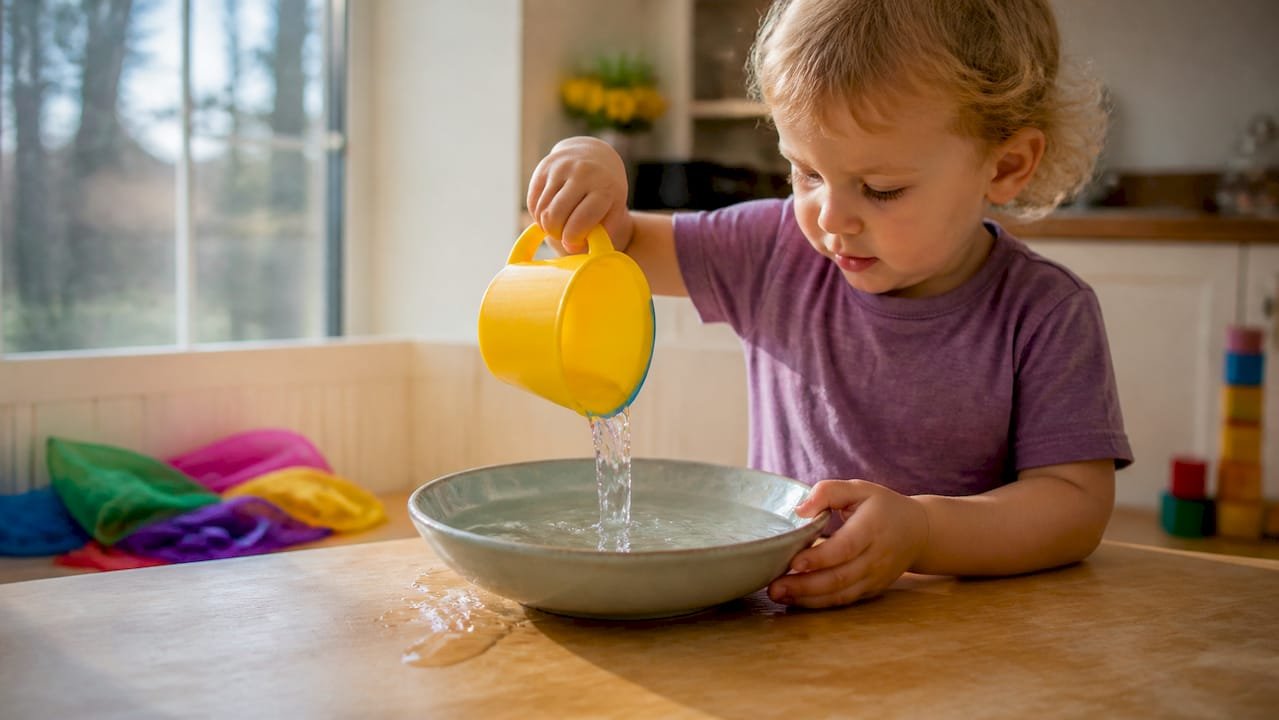
- Water Pour Station. Materials: two cups and a small bowl of water. Setup: let your toddler pour between containers. Skill: hand-eye coordination and cause and effect. Extension: add food coloring for a sensory boost.
For toddlers under 18 months, simplify each activity to one repeated motion, filling and dumping is enough. For toddlers closer to 3, add a storytelling layer by asking what the socks, animals, or water represent in their pretend world. According to the Head Start loose parts guide, brief adult narration and open questions extend the complexity of play without pulling control away from the child.
| Activity | Target Skill |
|---|---|
| Sock Match Sort | Sorting and matching |
| Spoon Excavation | Fine motor control |
| Box Fort Basics | Imaginative play |
| Nature Basket Sort | Categorization and language |
| Water Pour Station | Hand-eye coordination |
Common Misconceptions About Open-Ended Play
The biggest misconception is that open-ended play means no involvement from you. It doesn’t. Toddlers still benefit from a caregiver nearby who narrates, asks questions, and occasionally models a new use for a material, like showing how blocks can balance on their edge, without taking over the activity.
Another common worry: “My toddler just dumps things out and doesn’t build anything. Is that actually play?” Yes. Filling and dumping is real cognitive work for a 1 or 2 year old, testing volume, gravity, and cause and effect. Progression to symbolic pretend play comes later, and pushing it early doesn’t speed anything up.
Some parents also assume open-ended toys are messier or harder to manage than single-purpose ones. In practice, a rotation system with a handful of categories is usually less cluttered than a room full of battery toys with dozens of small parts. And a few worry that without a screen or a specific outcome, their toddler will get bored fast. Toddlers get bored of toys that only do one thing. A basket of loose parts rarely runs out of possibilities, because the child keeps inventing new ones.
Bringing Open-Ended Play Into Everyday Life
Open-ended play doesn’t need a scheduled block of time. It fits into laundry folding (a basket of socks to sort), bath time (cups and containers for pouring), and grocery unpacking (empty boxes and containers become instant building material).
Outdoors, the options multiply. Sticks, stones, mud, and puddles are loose parts in their most natural form, and they cost nothing. A walk to the park becomes a scavenger hunt for “sorting treasures” you bring home for later play.
If your toddler is in daycare or a nursery setting, ask how open-ended materials are worked into the day. Many early years settings already lean on this approach because it scales easily across mixed-age groups and requires less constant restocking than single-use toys. If you want to reinforce the same approach at home, consistency between environments helps toddlers transfer skills, like problem-solving with blocks at nursery and applying the same patience with stacking cups at home.
The goal isn’t to add another task to your day. It’s to notice the open-ended opportunities already built into routines you’re doing anyway.
Why I Think We Undersell How Much Toddlers Are Already Doing
The thing that surprised me most while looking into this topic wasn’t the research on executive function, it was how often caregivers assume their toddler is “just playing” when dumping a bin of blocks for the tenth time in a row. That repetition is the actual curriculum. A toddler stacking and knocking down the same three blocks isn’t stuck. They’re running a physics experiment.
Trust the boring-looking play. It’s doing more than it looks like.
How Mooshie Moments Fits Into Your Toddler’s Play Routine
Building an open-ended play habit is simple in theory and hard on a Tuesday evening when you’re out of ideas and your toddler is out of patience. Mooshie Moments solves that specific problem: it’s a screen-free app that gives you a fresh, age-matched activity idea in under five minutes, built from things already in your kitchen or junk drawer.
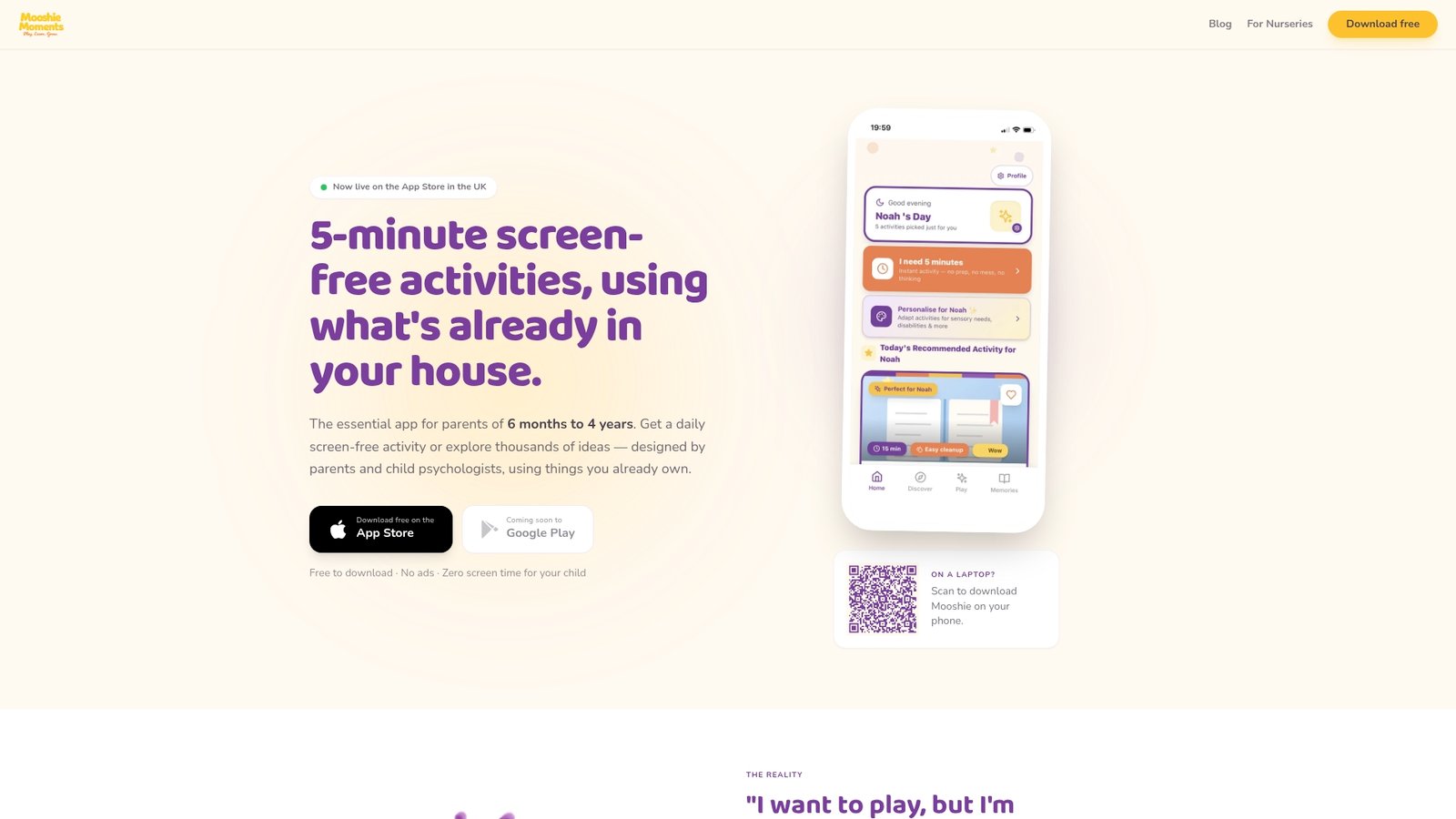
Instead of scrolling for inspiration or defaulting to a screen, you open the app, tell it how much time and energy you’ve got, and get a suggestion that’s been shaped around real child-development research, the same kind behind loose parts play and open-ended materials covered above. If you run an early years setting, the nursery partnership program extends that same library into EYFS-aligned home learning packs for the families you support. Download Mooshie Moments free and try tonight’s activity before bedtime.
Frequently Asked Questions
What is open-ended play for toddlers?
Open-ended play is child-led play using materials with no fixed rules or single correct outcome, like blocks, fabric, or loose parts, that toddlers can shape however they choose.
What age should open-ended play start?
It can start as soon as a toddler can grasp and manipulate objects, typically around 9 to 12 months, and the complexity naturally grows through age 3 and beyond.
Are open-ended toys better than educational toys with lights and sounds?
Toys without a single fixed function generally support longer attention spans and more creative use than battery-operated toys, since there’s no “correct” way to play that limits imagination.
How many toys does a toddler actually need?
Somewhere between 8 and 12 accessible toys at a time, rotated every one to two weeks, tends to sustain deeper engagement better than a large permanent collection.
Is unstructured play safe to leave completely unsupervised?
No. Toddlers under 3 still need supervision for choking hazards and safety, even during open-ended play. Supervision doesn’t mean directing the play itself.
Sources
- Preschool Children’s Loose Parts Play and the Relationship to Cognitive Development: A Review of the Literature – PMC
- Why open-ended play is an essential part of learning — Today’s Parent
- Harnessing the Joy of Open-Ended — NAEYC (PDF)
- Headstart
Recommended
- Screen-Free Toddler Activities in 5 Minutes | Mooshie Moments
- Blog – Mooshie
- Home Learning Partnership for Nurseries | EYFS Parent Partnership | Mooshie Moments
- Become a Mooshie Affiliate | Creator Partnerships
Want a new idea every day, matched to your child's age?
Mooshie Moments gives you simple, guided play ideas for ages 6 months to 4 years.
Download free on the App StoreMore like this
Babysitting Toddlers: 12 Low Prep Ideas and Why They Help
Explore 12 low prep toddler activities for babysitters, with developmental benefits, age adaptations, UK safety advice, and optional activity coaching.
10 EYFS Backed Sock Games for Toddlers Under Five Minutes
Ten EYFS aligned sock games to start in under five minutes, each with a one line developmental benefit, simple adaptations, and two…
Busy Parents: 12 No Prep Shopping Activities for Toddlers
Busy parents: keep toddlers learning and calm at the store with 12 no prep, screen free activities that take under five minutes…