
25 Activities for 2 Year Olds at Home (No Special Toys)
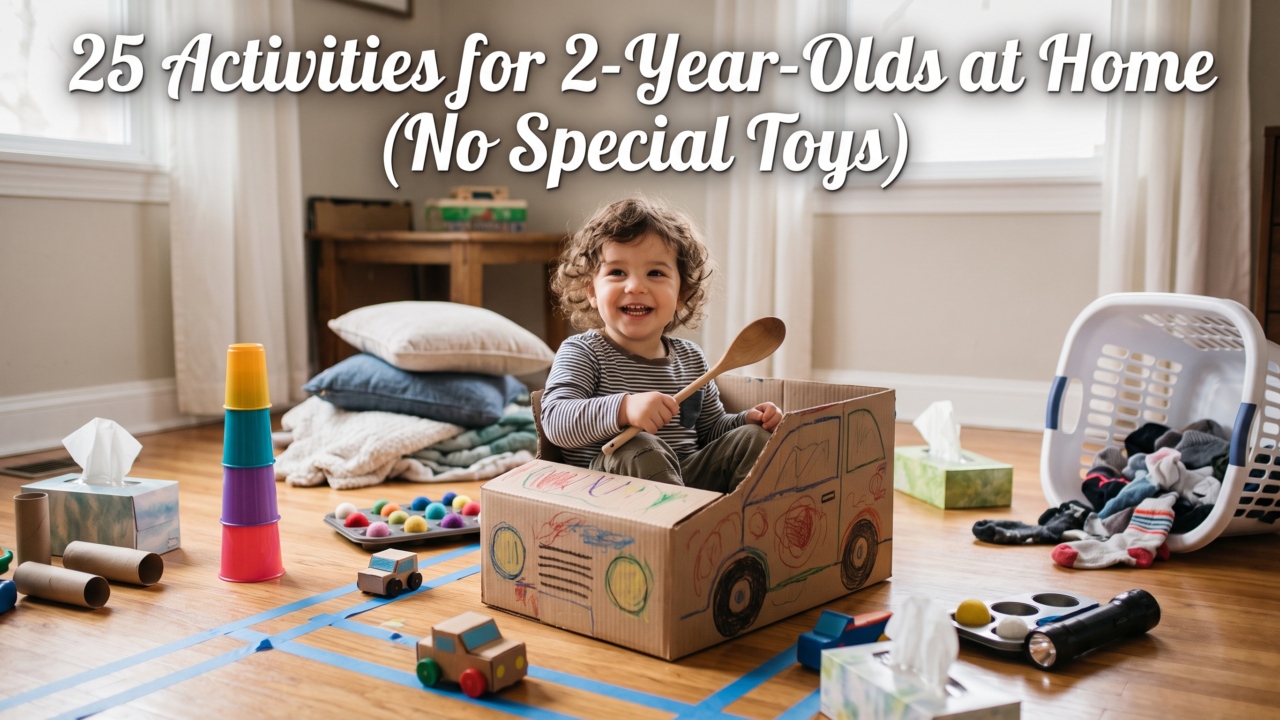
Twenty-five low-prep activities for 2 year olds at home using junk-drawer materials you already own. Each idea includes steps, time, and the developmental skill it builds so play stays simple and screen-free.
25 Activities for 2 Year Olds at Home (No Special Toys)
TLDR
You do not need a craft haul or a Pinterest setup. Most 2 year olds thrive on short, repeatable play with cups, boxes, pillows, spoons, and water. Below are 25 activities for 2 year olds at home, grouped by energy level, each with materials, steps, time, and a plain-English brain note on select ideas. Active supervision is always required.
You love your toddler. You are also tired. By the time you have a free pocket of the day, scrolling for “toddler activities” often leads to glitter, glue, and a setup that takes longer than the play itself.
This guide is the opposite. Every idea uses things you already have. No toy shopping. No idea paralysis. Just 5 to 20 minutes of real play you can start tonight.
By age 2, most children kick a ball, run, say two words together, and start simple pretend play. The CDC 2-year milestones also note skills like holding something in one hand while using the other, and trying switches, knobs, or buttons. The activities below lean into those strengths: big movement, cause and effect, language, and hands-on problem solving.
Safety note: Stay within arm’s reach. Skip small parts that fit in a choke tube. For water play, never leave your child alone.
Quick jump list
- Hallway bowling
- Sticky foam window shapes
- Pillow mountain climb
- Laundry basket push taxi
- Sock match dump
- Wooden spoon band
- Cardboard box car
- Cup stack crash
- Ice cube rescue
- Painter’s tape roads
- Pom-pom blow race
- Water transfer station
- Shadow flashlight hunt
- Sticky contact-paper wall
- Muffin tin color sort
- Tissue box pull
- Blanket fort picnic
- Sponge squeeze bath
- Cotton ball tweezers
- Sticker peel path
- Book point-and-name
- Ready set go dash
- Dress-up shoe walk
- Napkin table helper
- Tower build and crash
High-energy activities (burn the wiggles)
1. Hallway bowling
Materials: 6 empty plastic bottles, soft ball, hallway
Time: 10 minutes
Steps: Line bottles at one end. Hand over the ball. Cheer every roll. Reset. Repeat.
Super Brain Fact: Each roll practices hand-eye coordination, force control, and cause and effect. The CDC lists kicking and ball play among movement skills many 2 year olds build around this age (CDC).
Say this: “Ready… set… crash! Can you knock the last one?”
2. Sticky foam window shapes
Materials: Foam sheets cut into simple shapes, spray bottle with water, window or glass door
Time: 10 to 15 minutes
Steps: Mist a shape so it gets damp. Press it flat onto the glass. Let your toddler spray and stick more.
Super Brain Fact: Squeezing a spray trigger works the same small hand muscles your child will later use to hold a crayon or pencil.
Say this: “Squish the water. Stick the star. Look, it stays!”
3. Pillow mountain climb
Materials: Couch cushions and pillows on the floor
Time: 10 minutes
Steps: Pile a low “mountain.” Invite climbs, crawls, and gentle jumps onto a soft landing zone.
Say this: “Up the mountain… over the top… soft landing!”
4. Laundry basket push taxi
Materials: Laundry basket, hallway or open floor
Time: 10 minutes
Steps: Load a teddy or blocks. Toddler pushes the “taxi” to a stop (kitchen, sofa, door).
Super Brain Fact: Pushing a load builds core strength and spatial planning as they steer around furniture.
5. Ready set go dash
Materials: Open space, optional soft start line (tape or scarf)
Time: 5 minutes
Steps: Crouch together. Say “Ready, set…” pause… “Go!” Race to a safe spot and back.
The CDC suggests “ready, set, go” style outdoor play to support movement and listening (CDC tips for 2-year-olds).
Say this: “Ready… set… (wait) … go!”
Medium-energy activities (hands busy, mess low)
6. Sock match dump
Materials: Basket of clean socks
Time: 10 minutes
Steps: Dump socks on the floor. Find pairs by color or size. Stuff pairs into the basket “mailbox.”
Say this: “Where is the other blue one? You found a match!”
7. Wooden spoon band
Materials: Wooden spoons, pots, plastic containers
Time: 5 to 10 minutes
Steps: Set pots upside down. Tap soft, loud, fast, slow. Copy each other’s rhythm.
Say this: “Soft taps… now loud taps. Your turn to lead.”
8. Cardboard box car
Materials: Large delivery box, crayons or stickers optional
Time: 15 minutes
Steps: Open the top. Toddler sits inside. Push gently or let them “drive” with sound effects.
Super Brain Fact: Pretend play (cars, roles, stories) is a big cognitive leap around age 2. Dress-up and pretend are on the CDC activity list for this age (CDC).
9. Cup stack crash
Materials: Plastic cups or yogurt pots
Time: 5 to 10 minutes
Steps: Stack a tower together. Count as you go. Knock it down on purpose. Rebuild.
Say this: “One… two… three… crash! Want to build taller?”
10. Painter’s tape roads
Materials: Painter’s tape, toy cars or a block as a “bus”
Time: 15 minutes
Steps: Tape simple roads on the floor. Drive along the lines. Add a “bridge” with a book.
Say this: “Follow the road. Stop at the red block. Go!”
11. Pom-pom blow race (or cotton ball)
Materials: Cotton balls or pom-poms, straw (adult models first), table
Time: 5 minutes
Steps: Race cotton balls across the table with gentle blows. Toddler can use lips or a short straw with close supervision.
Say this: “Blow soft… blow strong. Which one wins?”
12. Water transfer station
Materials: Two shallow tubs or bowls, cup, sponge, towel on the floor
Time: 10 to 15 minutes
Steps: Fill one tub with a little water. Scoop, pour, squeeze sponge into the empty tub.
The CDC suggests tub or sandbox play with cups, spoons, and funnels for exploration (CDC).
Super Brain Fact: Pouring and squeezing build bilateral coordination (two hands doing different jobs), a skill the CDC flags when kids hold a container and take a lid off (CDC cognitive milestones).
13. Shadow flashlight hunt
Materials: Flashlight, dim room
Time: 5 to 10 minutes
Steps: Make hand shadows on the wall. “Catch” the light spot with feet or hands.
Say this: “Where did the light go? You caught it!”
14. Sticky contact-paper wall
Materials: Contact paper (sticky side out) taped to wall, light collage bits (feathers, paper scraps, leaves)
Time: 10 minutes
Steps: Stick items on. Peel off. Stick again.
Say this: “Press. Stick. Peel. Do it again.”
15. Muffin tin color sort
Materials: Muffin tin, colored pom-poms, socks, or snack pieces
Time: 10 minutes
Steps: Sort by color into cups. Mix and sort again.
Say this: “Red goes here. You found another red!”
Calm / low-energy activities (reset mode)
16. Tissue box pull
Materials: Empty tissue box, fabric scraps or scarves
Time: 5 to 10 minutes
Steps: Stuff scarves in. Toddler pulls them out one by one. Stuff again together.
Super Brain Fact: Pulling against light resistance builds pincer and grip strength without a worksheet.
17. Blanket fort picnic
Materials: Blanket over two chairs, books or snack
Time: 15 to 20 minutes
Steps: Build a simple fort. Read or snack inside. Whisper voices optional.
Say this: “This is our cozy cave. What book should we open?”
18. Sponge squeeze bath (or sink)
Materials: Sponges, cup, shallow water, towel
Time: 10 minutes
Steps: Dip, squeeze, fill the cup. Name wet and dry.
Say this: “Squeeze hard. Hear the drip?”
19. Cotton ball tweezers
Materials: Cotton balls, child-safe tongs or large clip, bowl
Time: 5 to 10 minutes
Steps: Move cotton balls bowl to bowl with tongs. Fingers work too.
Say this: “Open… grab… drop. You did it!”
20. Sticker peel path
Materials: Large stickers, paper or highchair tray
Time: 10 minutes
Steps: Start stickers peeled halfway. Toddler finishes peel and sticks on paper.
Super Brain Fact: Peeling stickers is fine-motor gold: fingertip control plus patience.
21. Book point-and-name
Materials: Favorite picture book
Time: 5 to 10 minutes
Steps: Ask “Where is the bear?” Pause. Point together. Expand their words.
The CDC encourages pointing in books and expanding unclear words (“or nana” → “You want more banana”) (CDC).
Say this: “Where is the dog? Yes! Soft dog. What does the dog say?”
22. Dress-up shoe walk
Materials: Adult shoes, hat, or bag
Time: 10 minutes
Steps: Toddler clomps in big shoes. Add a hat. Take a “commute” to the kitchen.
CDC tips include dress-up with grown-up clothes to spark pretend play (CDC).
Say this: “Where are you going, worker? Off to the shop?”
23. Napkin table helper
Materials: Napkins or plastic cups
Time: 5 minutes
Steps: Let them carry napkins to the table before a meal. Thank them.
Helping with meal setup is a CDC-suggested routine that builds confidence and cooperation (CDC).
Say this: “Thank you for helping. You put the napkin right there.”
24. Tower build and crash
Materials: Blocks, plastic containers, or food boxes
Time: 10 minutes
Steps: Take turns adding one piece. Count. Knock down. Cheer.
CDC encourages block play with turn-taking towers (CDC).
Say this: “My turn… your turn… so tall… crash!”
25. Ice cube rescue
Materials: Ice cubes in a shallow tray, spoon or dropper, warm water in a cup
Time: 10 minutes
Steps: “Rescue” toys frozen in ice or plain cubes with spoon and drips of warm water.
Say this: “The ice is cold. Drip drip… it is melting!”
How to pick an activity when you are exhausted
Use this 10-second filter:
| You have… | Pick… |
|---|---|
| 5 minutes + zero energy | #16 Tissue box pull, #21 Book point-and-name, #23 Napkin helper |
| 10 minutes + wiggles | #1 Hallway bowling, #5 Ready set go, #3 Pillow mountain |
| 15 minutes + one bowl of water | #12 Water transfer, #18 Sponge squeeze, #2 Sticky foam shapes |
| Need quiet before bed | #17 Blanket fort, #21 Books, #20 Stickers |
Rotate three “always ready” kits in a low drawer: bottles + ball, spoons + pots, scarves + tissue box. When the afternoon melts down, open the drawer instead of the app scroll spiral.
What 2 year olds are practicing (without a lesson plan)
When play stays simple, your toddler still works on real skills:
- Movement: run, kick, climb, push (CDC movement milestones)
- Hands: stack, pour, peel, squeeze, two-handed tasks
- Language: two-word phrases, pointing, gestures
- Thinking: pretend, buttons and cause-effect, more than one toy at once
- Connection: turn-taking, helping, checking your face in new situations
You do not need to announce the skill. A short line of coaching (“Squeeze hard,” “Your turn”) is enough.
The CDC also recommends limiting screen time for this age to no more than about 1 hour a day of children’s programming with an adult present, because toddlers learn best through talking, playing, and interacting with people (CDC). That is why these ideas keep the phone in your hand for the setup, then away for the play.
Never run out of “what now?” ideas
If you want a fresh activity matched to your child’s age, your energy, and what is already in the room, that is exactly what Mooshie Moments is built for.
Mooshie is the screen-free activity app for ages 6 months to 4 years. You open it for 30 seconds, grab an idea that uses junk-drawer stuff, then put the phone down and play. Every card includes the developmental “why” in plain English and simple parent coaching lines, the same style as the Super Brain Facts above.
Get early access at mooshiemoments.com and join the first families. Early members also get the free Junk Drawer Genius guide: 15 science-backed games you can play tonight.
FAQ
What are the best activities for a 2 year old at home?
Short, repeatable play with household items: bowling with bottles, stacking cups, water pouring, pillow climbs, picture books, and simple pretend. Match the activity to their energy, not your Pinterest board.
How do I keep a 2 year old busy without toys?
Use recycling and kitchen gear: boxes, tape, spoons, cups, baskets, scarves, water, and cushions. Novelty comes from a new job for an old object, not a new purchase.
How long should an activity last at age 2?
Often 5 to 15 minutes. Ending while they still enjoy it beats forcing a 45-minute craft. You can always reset the same game later.
Are messy sensory bins required?
No. Many 2 year olds get rich sensory input from water, ice, sticky foam, tape, and outdoor dirt with far less setup.
Conclusion
Great activities for 2 year olds at home are boring on paper and magic in practice: a ball, a box, a spoon, a little water, and you. Start with one idea from the high-energy list and one from the calm list. Save this page for the next long afternoon.
When you want endless age-right ideas without the scroll, join Mooshie early access. Your junk drawer is already a discovery lab.
Want a new idea every day, matched to your child's age?
Mooshie Moments gives you simple, guided play ideas for ages 6 months to 4 years.
Download free on the App StoreMore like this
Babysitting Toddlers: 12 Low Prep Ideas and Why They Help
Explore 12 low prep toddler activities for babysitters, with developmental benefits, age adaptations, UK safety advice, and optional activity coaching.
10 EYFS Backed Sock Games for Toddlers Under Five Minutes
Ten EYFS aligned sock games to start in under five minutes, each with a one line developmental benefit, simple adaptations, and two…
Busy Parents: 12 No Prep Shopping Activities for Toddlers
Busy parents: keep toddlers learning and calm at the store with 12 no prep, screen free activities that take under five minutes…